


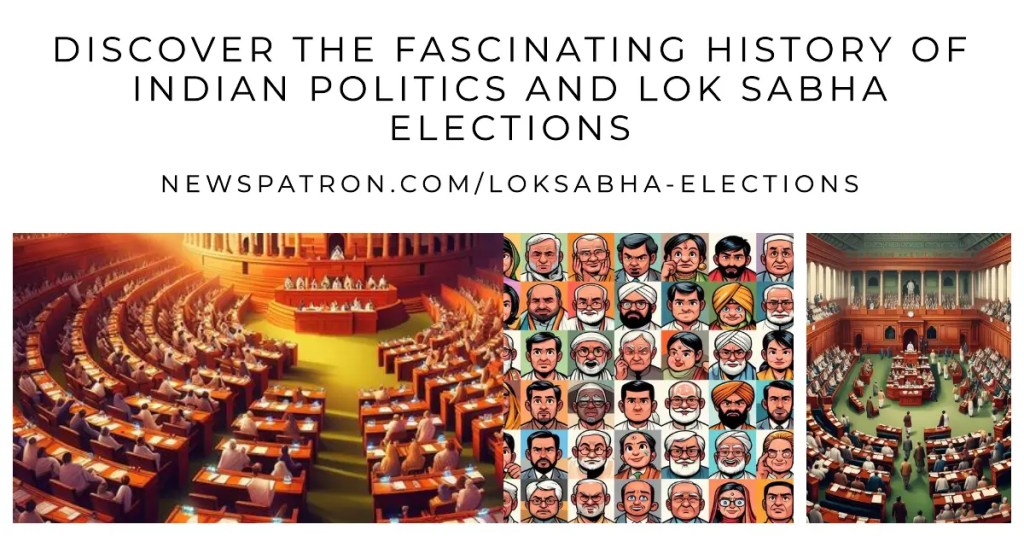

Understand LokSabha Elections: Your Essential Guide
editor@newspatron.com
India’s LokSabha elections are more than just political events; they embody the spirit of the world’s largest democracy. As India prepares for another electoral journey, delve into the rich history of the Lok Sabha elections, a tapestry woven with struggles, triumphs, and the evolution of a nation.
Democracy is a dance of ideals and realities, a symphony of voices rising in unison. India, a land of vibrant tapestry and unwavering spirit, embodies this democratic rhythm. The Lok Sabha, the “house of the people,” stands as a testament to the undying belief in the power of representation. As India embarks on yet another electoral journey, we delve into the annals of time, tracing the footsteps of a nation determined to shape its own destiny. This is not merely a story of dates and events, but a narrative of dreams, struggles, and the unwavering spirit of a people determined to be heard.[ Read more about Lok Sabha Elections: India’s Democratic Pulse]
LokSabha Elections
Tracing the Arc of Indian Democracy
India’s Democratic Journey: A Historical Tapestry
India’s path toward democracy stretches back centuries, a winding road paved with ambition and perseverance. Let’s unravel this historical tapestry, witnessing pivotal moments that shaped the nation’s democratic heart. [Read about Threads of Unity: 26/1 Nation Building, Beyond the Parade]
The Seeds of Change: 1600-1857
The year 1600 marked a turning point in India’s history. The arrival of the British East India Company, a seemingly simple trading venture, sowed the seeds of change. Slowly, steadily, the Company’s influence expanded from trade posts to political control. In 1757, the Battle of Plassey solidified their dominance, marking a shift in the power dynamics of India. While attempts were made, such as the Regulating Act of 1773, to manage the Company’s growing authority, true change was yet to come.
The Winds of Revolution: 1858-1947
The flames of discontent, fueled by a desire for self-rule, ignited a new era in 1858. The Sepoy Mutiny, a powerful uprising against British control, left an indelible mark. It was a turning point, leading to the British government directly taking over India, establishing the British Raj. Under Queen Victoria, who was proclaimed Empress of India in 1876, the quest for self-determination intensified.
The year 1885 saw the birth of the Indian National Congress (INC), a beacon of hope in the fight for India’s voice. The early 20th century brought reforms like the Morley-Minto Reforms (1909), paving the way for greater Indian participation in governance. But it was the spirit of Mahatma Gandhi and the nonviolent Non-Cooperation Movement in 1920 that shook the foundations of British rule. India was awakening, and its yearning for freedom could no longer be suppressed.

Triumph and the Birth of a Nation: 1947-1950 to 1952
The culmination of decades of struggle arrived in 1947 – India earned its hard-fought independence. Jawaharlal Nehru, a visionary leader, became India’s first Prime Minister. It was a moment of triumph, but also a time of tremendous challenges. The nation embarked on a remarkable journey, drafting a Constitution that enshrined democratic ideals. On January 26th, 1950, India shed its colonial past and declared itself a sovereign, democratic republic.
The year 1951 witnessed a watershed moment – India’s first-ever general elections. Millions of people, many of whom had never cast a vote before, lined up to exercise their newfound right. It was a celebration of democracy, a testament to the spirit of a young nation ready to chart its own course. [Read about BR Ambedkar: The Architect of Indian Constitution and a Champion of Social Justice]
Recommended Product
Magnesium Body Spray – Muscle Recovery & Lavender Scent
🛒 View on Amazon →As an Amazon Associate, we earn from qualifying purchases. Price and availability may vary.
Crossroads of Democracy: Challenges and Opportunities
The dawn of Indian independence in 1947 marked a triumphant milestone, yet the path towards solidifying democratic ideals has not been without its complexities. While a multi-party system offers the promise of diverse representation, it also carries inherent risks. The influence of well-funded political machinery, often intertwined with opaque corporate interests, can undermine the principle of unbiased public service. India, as it strives for a position of world leadership, must confront these challenges head-on to create a true democracy of the people.
The Evolution of Indian Political Parties
The formation and evolution of Indian political parties mirror the hopes, dreams, and aspirations of the nation itself. Think of them as the teams competing for a chance to shape the country’s future.
- The Founding Fathers: The Indian National Congress (INC) Established in 1885, the INC became the torchbearer of the freedom struggle. From its early days advocating for reforms to its pivotal role in the nonviolent movement for independence, the INC left an enduring legacy. Leaders like Mahatma Gandhi, Jawaharlal Nehru, and countless others gave voice to a nation determined to break free from colonial rule. [Read about Sardar Patel: Unifier of India, Visionary of Progress]
- Diversity of Voices: The Rise of New Parties India’s political landscape has never been static. The early 20th century saw the formation of the All India Muslim League (1906), advocating for the interests of the Muslim community. The need for social and economic reforms led to the birth of the Communist Party of India in 1925. These new voices added depth and dimension to the political discourse of a nation on the move.
- Post-Independence Era: New Alignments The years following independence brought significant changes. The Bharatiya Jana Sangh (1951), the precursor to today’s Bharatiya Janata Party (BJP), emerged as a major political force. The split within the Communist Party in 1964 led to the Communist Party of India (Marxist).
- The Era of Coalitions: 1980s and Beyond The 1980s marked a shift in Indian politics. The dominance of a single party waned, leading to the rise of coalition governments. Regional parties, rooted in specific states and representing local interests, began to wield significant influence. This trend continues today, making India’s political landscape diverse and dynamic.
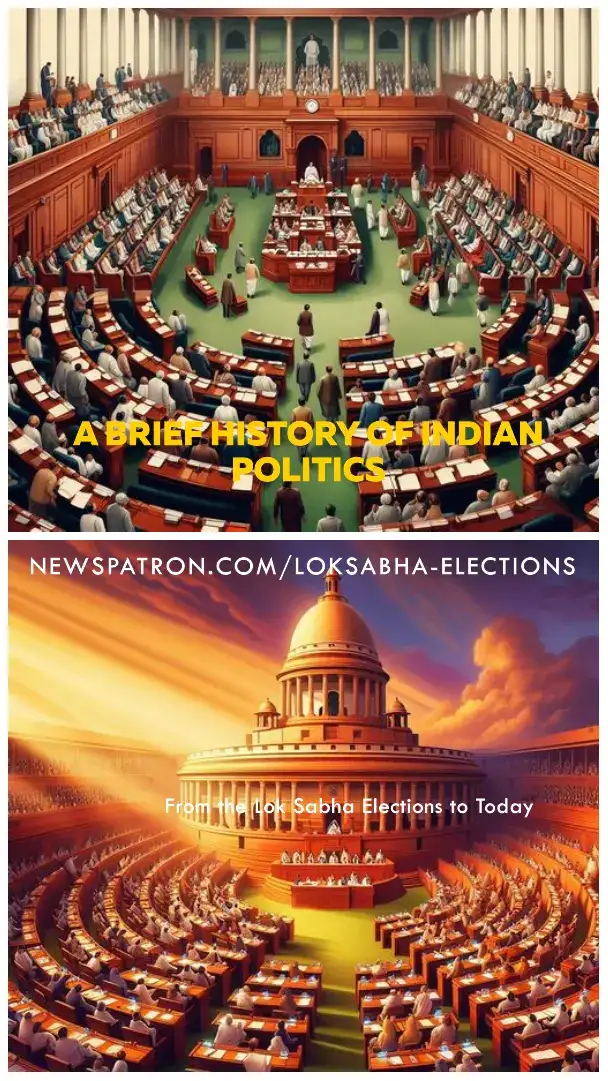
The Need for Transformation: Mitigating Corporate Influence
The nexus of political parties and powerful business interests calls for urgent reforms. India must strive for a system where elected officials are aligned on fundamental goals, working together cohesively regardless of party lines. This could involve a model where the majority elects a leader either before or after the elections.
Alternatives like regulated crowdfunding must be explored. Most importantly, parties need to resolutely reject funds tied to hidden agreements. Electoral bonds are a positive step, but a cap on political party funding would further reduce the risk of undue influence and power concentration.
Conclusion
India’s journey is a testament to its indomitable spirit and the promise of democracy. While the multi-party system is rooted in the desire for diverse representation, the nation must mature its political landscape. By reducing the undue influence of vested interests, foreign funding, and opaque power structures, India will forge a truly representative system that places the needs and aspirations of its people at the forefront.
[Read How to Get Your Voter Card Online or Offline : A Simple Guide]
Landmark Lok Sabha Elections
[Read about Election Commission of India the Mega Event Managers since inception.]
Download Article PDF
The Lok Sabha elections are more than just a political process; they are a reflection of the nation’s pulse. Let’s revisit some of the most pivotal elections in India’s history:
1st Lok Sabha (1952-1957)
This wasn’t just India’s first general election; it was history in the making. After centuries of struggle, Indians finally had the power to elect their own leaders. The Indian National Congress, led by the iconic Jawaharlal Nehru, won a resounding victory. This election laid the foundation for India’s vibrant democracy.
2nd Lok Sabha (1957-1962): Consolidating Democracy
Following the success of the inaugural elections, the 2nd Lok Sabha elections solidified India’s democratic journey. These elections were a testament to the nation’s unwavering commitment to the power of the ballot box. The Indian National Congress (INC), again led by Jawaharlal Nehru, won a comfortable victory, cementing its position as the dominant force in Indian politics.
3rd Lok Sabha (1962-1967): Transition and Turmoil
The 3rd Lok Sabha elections were a period marked by significant changes. Jawaharlal Nehru, India’s beloved first Prime Minister, passed away in 1964. His successors, Lal Bahadur Shastri and later Indira Gandhi, faced the challenges of guiding a young nation through times of both progress and hardship. This era set the stage for the political shifts that would shape the 4th Lok Sabha elections.
4th Lok Sabha (1967-1971): A Watershed Moment
The 4th Lok Sabha elections marked a significant turning point in Indian politics. For the first time since independence, the Indian National Congress (INC) faced a serious challenge from a united opposition. The results were a fractured mandate, with the INC losing its comfortable majority. Indira Gandhi emerged as Prime Minister, but the political landscape had shifted dramatically.
- Rise of Regional Parties: The dominance of the INC was challenged by the emergence of strong regional parties like the DMK in Tamil Nadu and the Akali Dal in Punjab.
- Political Fragmentation: The opposition parties, although ideologically diverse, united against the INC. This led to the formation of coalition governments in several states.
- Economic Challenges and Social Unrest: The period preceding the election was marked by economic difficulties and growing social unrest, contributing to anti-INC sentiments.
5th Lok Sabha (1971-1977): Indira Gandhi’s Resurgence
Indira Gandhi called for snap elections in 1971, seeking a fresh mandate. Her campaign focused on populist themes, national strength, and the ‘Garibi Hatao’ (Eradicate Poverty) call. The result was a resounding victory for the INC, establishing Indira Gandhi as a formidable political leader.
- Indo-Pakistan War of 1971: This decisive war and India’s role in the creation of Bangladesh played a major role in Indira Gandhi’s electoral success.
- Declining Economy and Internal Emergency: Rising inflation, unemployment, and political unrest led Indira Gandhi to impose the controversial “Emergency” in 1975, suspending civil liberties and curbing dissent.
6th Lok Sabha (1977-1980): The Janata Experiment
A wave of widespread anger against the Emergency resulted in a stunning defeat for the INC in the 1977 elections. A coalition of opposition parties formed the Janata Party government, led by Morarji Desai.
- Anti-Emergency Wave: The 6th Lok Sabha election was driven by people’s desires for a return to democratic freedoms after the Emergency period.
- Fragile Coalition: The Janata Party government was hobbled by internal divisions and infighting, resulting in a short and unstable tenure.
7th Lok Sabha (1980-1984): Return of Indira and Tragedy
Indira Gandhi and the INC stormed back to power in 1980, riding on a wave of public sympathy after the collapse of the Janata government. However, her tenure was cut short by a tragic turn of events.
- Political Instability: The preceding years of the Janata Party government had left the country yearning for a strong central government.
- Punjab Crisis: The rise of militancy in Punjab posed a serious challenge to national unity and security, and Indira Gandhi’s handling of the situation proved controversial.
- Assassination: Indira Gandhi was assassinated by her own bodyguards in 1984, leading to widespread unrest and a sympathy wave that would propel her son, Rajiv Gandhi, to power.
8th Lok Sabha (1984-1989): The Rajiv Gandhi Era
Rajiv Gandhi, young and charismatic, became Prime Minister following his mother’s assassination. The INC won a landslide victory in the subsequent election, the largest majority in India’s history.
- Age of Technology and Modernization: Rajiv Gandhi sought to usher in an era of technological advancement and modernization, earning him the moniker of ‘Mr. Computer’.
- Foreign Policy Shifts: Some notable shifts in international relations occurred, such as improved ties with the USA.
- Controversies and Decline: The Bofors Scandal, allegations of corruption, and growing unrest in several regions of the country tarnished his image and eroded the INC’s dominance.
9th Lok Sabha (1989-1991) and Beyond: Coalition Politics Takes Center Stage
The 1989 elections marked the end of the single-party dominance era in Indian politics. No party secured a clear majority, leading to a period of coalition governments.
- Rise of the BJP: The Bharatiya Janata Party (BJP) emerged as a major force with its Hindu nationalist ideology.
- Mandal Commission and Social Upheaval: The implementation of the Mandal Commission recommendations for reservations ignited nationwide protests and intensified caste-based politics.
- Governments of Short Duration: The 9th and 10th Lok Sabhas saw short-lived coalition governments as regional parties gained prominence.
Key Takeaways:
The period from the 7th Lok Sabha onwards was a transformative time in Indian politics. It witnessed the rise of regional power centres, challenges to national integrity, economic liberalization, and the increasing importance of complex coalition building.
[Read an article about The Untold Story of Kashmiri Pandits]
10th Lok Sabha (1991-1996): Economic Reforms and Political Flux
The 10th Lok Sabha came into existence against a backdrop of profound political and economic change in India.
- Assassination of Rajiv Gandhi: The assassination of Rajiv Gandhi during the election campaign created a wave of uncertainty and instability.
- Economic liberalization: Under Prime Minister P.V. Narasimha Rao, India embarked on a path of significant economic reforms, opening up the economy and initiating a move away from socialist-leaning policies.
- Rise of Hindutva and Communal Tensions: The demolition of the Babri Masjid in 1992 sparked widespread communal riots, highlighting the growing influence of Hindutva ideology and the BJP’s ascent.
11th and 12th Lok Sabha (1996-1999): Era of Short-lived Coalitions
The period of the 11th and 12th Lok Sabha elections was marked by a remarkable degree of political instability, a clear departure from the decades of Congress dominance.
- United Front Government: A coalition of regional and left-leaning parties formed the government, but faced difficulties in coordinating policy and decision making.
- Rise of the BJP: The BJP continued to gain strength, briefly forming a government in 1996 under Atal Bihari Vajpayee. However, this government lasted only 13 days.
- Instability and Re-elections: The era witnessed multiple instances of short-lived governments and repeated elections, reflecting India’s adjustment to coalition politics.
13th Lok Sabha (1999-2004): NDA & Vajpayee Era
The 13th Lok Sabha elections brought a semblance of stability with the formation of the National Democratic Alliance (NDA), a BJP-led coalition under Atal Bihari Vajpayee as Prime Minister. [Read Beyond Vajpayee: Main Atal Hoon Explores Legacy & Future]
- Kargil Conflict: India’s victory in the brief Kargil conflict with Pakistan in 1999 boosted the NDA’s popularity.
- Economic Progress and ‘India Shining’: The NDA government focused on infrastructure development and economic reforms, leading to a period of sustained growth. However, critics argued that the benefits of this growth did not reach the masses.
- 2002 Gujarat Riots: The communal riots in Gujarat in 2002 tarnished Vajpayee’s secular image and remain a point of controversy.
14th Lok Sabha (2004-2009): UPA and a Resurgent Congress
The 2004 elections saw a surprise victory for the United Progressive Alliance (UPA), a Congress-led coalition, marking a return to power for the Congress party. Manmohan Singh became Prime Minister.
- Focus on Inclusive Growth: The UPA government prioritized social welfare programs such as the Mahatma Gandhi National Rural Employment Guarantee Act (MGNREGA) and the Right to Information (RTI) Act.
- Indo-US Nuclear Deal: A controversial but significant foreign policy move was the Indo-US nuclear deal.
15th Lok Sabha (2009-2014): UPA Strengthens its Position
The UPA convincingly won a second term, with the Congress Party securing its largest tally since the 1980s. Manmohan Singh continued as Prime Minister.
- Continuation of Social Programs: Existing programs like MGNREGA expanded, and new initiatives like the Right to Education were introduced.
- Economic Challenges: The global financial crisis of 2008 impacted India, demanding economic policy measures to counter the downturn.
- Corruption Scandals: Major corruption allegations rocked the government, leading to popular protests and a decline in trust.
16th Lok Sabha (2014-2019): BJP Ascends to Power
The elections of 2014 marked a major shift. The Bharatiya Janata Party (BJP), led by Narendra Modi, won by a landslide, securing the first outright majority by a single party since 1984.
- Focus on Economic Development: The Modi government emphasized ‘Make in India’, aimed at boosting manufacturing, and introduced the Goods and Services Tax (GST), a major tax reform.
- Demonetization: In a controversial move in 2016, high-value currency notes were suddenly withdrawn from circulation in an effort to tackle black money and corruption.
- Social and Religious Tensions: Incidents of religious intolerance and cow-related violence rose, causing social divisions.
17th Lok Sabha (2019-Present): BJP Consolidation
The BJP returned to power in 2019 with an even larger majority.
- Controversial Legislation Citizenship Amendment Act (CAA) led to widespread protests. Abrogation of Article 370 removed the special status of Jammu and Kashmir. [Read about Article 370 Movie: Drama Sparks Debate]
[Read How Jammu and Kashmir Bills Passed by Modi-Shah Government Will Transform the Region]
- Focus on Hindutva: Construction of the Ram Mandir temple in Ayodhya, a long-standing BJP promise, commenced.
- Pandemic Response: The COVID-19 pandemic caused massive disruption and led to a severe economic crisis in the country.
[Read an article on India-EFTA Pact: A New Era in Economic Partnership]
Conclusion: India’s Democratic Crossroads – Challenges and Opportunities Ahead
India’s democratic journey, as illustrated by its vibrant Lok Sabha history, is a remarkable testament to both the power of the people and the complexities of a diverse nation. As the world’s largest democracy marches towards its future, several key themes emerge that will undoubtedly shape the landscape of the coming elections and the next decade of Indian politics:
- The Evolving Political Spectrum: While national parties like the INC and BJP will remain major players, the rise of regional parties and coalitions is undeniable. Future governments are likely to be based on alliances, demanding both deft negotiation skills and a willingness to compromise.
- Economic Growth and Inequality: India’s economic trajectory is promising but needs to be inclusive. Tackling the widening gap between rich and poor, ensuring benefits of growth reach all segments of society, and creating sustainable employment will be central to any party’s success.
- Religious Identity and Social Harmony: The increasing politicization of religious identity poses a significant challenge. It will be crucial that parties create a vision focused on unity and promote an inclusive idea of “Indianness” that celebrates diversity while protecting minority rights.
- The Unpredictable Electorate: Indian voters have proven their ability to make waves, with the power to propel new parties, punish incumbents, and demand accountability. Any party needs to understand that old political formulas no longer guarantee success.
- Technology and Governance: Technology will continue to reshape how parties communicate with citizens and mobilize support. The need for robust electoral reforms to maintain transparency and address concerns around electoral integrity in the digital age is undeniable. [Read How former bureaucrats in Modi government are transforming India]
Looking Forward
It’s not impossible to definitively predict the winners and losers of Indian politics in the next ten years. However, several key factors will likely determine a party’s success in the eyes of the voters:
- Vision for a United India: A compelling and inclusive narrative of what India should be as a nation – one that goes beyond narrow interests and appeals to the aspirations of all its citizens.
- Focus on Livelihood and Development: Concrete solutions to issues like unemployment, education, healthcare, and environmental protection will hold more weight than ideological promises. [Read about Muft Bijli: Powering India’s Future]
- Building Trust: In an era where political disillusionment seems to be rising, parties and leaders that rebuild trust through transparency, accountability, and a commitment to democratic values will stand out.
India’s democratic future is in the hands of its citizens. While the challenges are immense, so are the opportunities for a more inclusive, prosperous, and just India. The coming elections hold the key to determining which path that future will take.
Read About WTO & India: Navigating Global Trade Challenges

[…] Lok Sabha Elections: A History of Indian Politics […]