


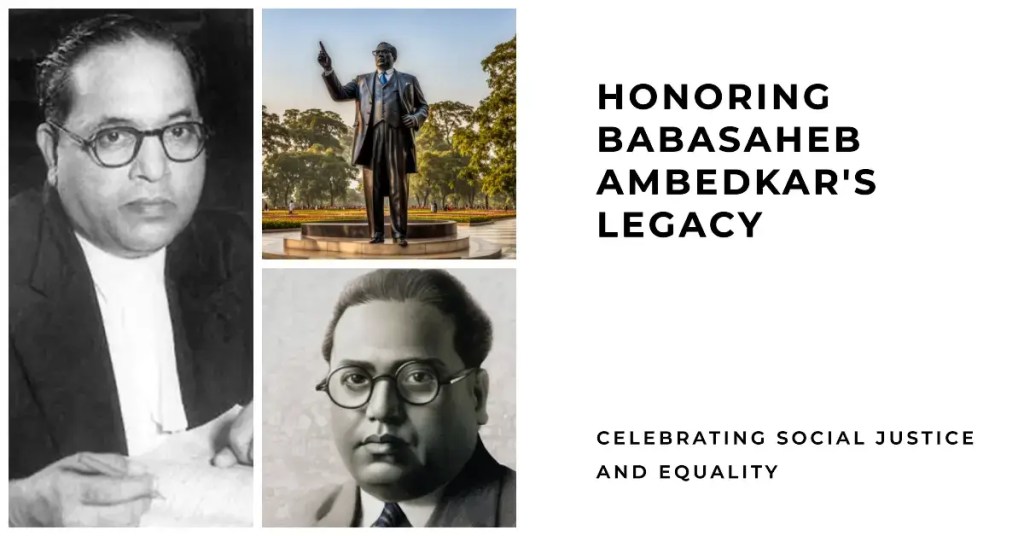

AI-Generated Image for representative purpose [Read About Us to know more]
Today, December 6th, is Mahaparinirvan Diwas, a day of remembrance and tribute to Dr. Bhimrao Ramji Ambedkar, popularly known as Babasaheb Ambedkar. He was a prominent Indian jurist, political leader, philosopher, social reformer, and Buddhist revivalist. He is widely regarded as the architect of the Indian Constitution and a champion of social justice and equality. He dedicated his life to fighting for the rights of Dalits and other marginalized communities in India. His legacy continues to inspire people around the world.
In this blog post, we will explore the remarkable achievements and the lasting impact of BR Ambedkar on Indian society. We will also discuss the significance of Mahaparinirvan Diwas and how it is commemorated across India.
editor@newspatron.com
YouTube Short Link Dr. BR Ambedkar
Early Life and Education
Babasaheb Ambedkar was born on April 14, 1891, in Mhow, a town in present-day Madhya Pradesh. He belonged to the Mahar caste, which was considered untouchable in the Hindu social hierarchy. He faced discrimination and humiliation from an early age, both in school and outside. He was not allowed to sit with other students, drink water from the same source, or touch books that belonged to upper-caste students. He had to endure insults, abuse, and violence from the dominant castes.
Despite these hardships, Ambedkar was determined to pursue education and overcome the barriers imposed by his caste. He was a brilliant student who excelled in academics. He obtained his Bachelor of Arts from Elphinstone College in Bombay in 1912. He then went on to study economics and law at Columbia University in New York, where he earned his Master of Arts degree in 1915 and his PhD in 1927. He also studied at the London School of Economics and obtained another PhD in economics in 1923. He also became a barrister at Gray’s Inn in London in 1923.
Ambedkar was one of the first Dalits to receive such high education and recognition in India and abroad. He used his knowledge and skills to challenge the oppressive caste system and advocate for social reform.

Fight against Caste Discrimination
BR Ambedkar
Was a staunch critic of the caste system and its inherent injustice and inequality. He argued that caste was not a natural or divine order, but a human-made construct that divided people into hierarchies based on birth.
BR Ambedkar Real Image from PIB GOV IN
AI-Generated Image for representative purpose [Read About Us to know more]
Was a staunch critic of the caste system and its inherent injustice and inequality. He argued that caste was not a natural or divine order, but a human-made construct that divided people into hierarchies based on birth. He rejected the notion of caste-based karma and dharma, which justified the subjugation and exploitation of the lower castes by the upper castes. He also denounced the practice of untouchability, which deprived the Dalits of basic human dignity and rights.
Recommended Product
Waterproof Car Body Cover for Maruti Dzire 2017-2023
🛒 View on Amazon →As an Amazon Associate, we earn from qualifying purchases. Price and availability may vary.
Ambedkar was a leader of the Dalit movement, which aimed to eradicate the caste system and uplift the Dalits. He organized several protests and campaigns to assert the rights and dignity of the Dalits. One of the most famous examples was the Mahad Satyagraha in 1927, where he led thousands of Dalits to drink water from a public tank that was prohibited for them. He also burned the Manusmriti, a Hindu scripture that codified the caste rules and regulations. He declared that he would not die a Hindu and urged his followers to renounce Hinduism and embrace a more egalitarian religion.
Ambedkar also entered politics to represent the interests of the Dalits and other oppressed groups. He formed the Independent Labour Party in 1936, which won 15 seats in the Bombay Legislative Assembly. He also participated in the Round Table Conferences in London, where he demanded separate electorates and reservations for the Dalits. He clashed with Mahatma Gandhi, who opposed the idea of separate electorates, fearing that it would divide the Hindu society. After a fast by Gandhi, Ambedkar agreed to give up the demand for separate electorates but secured a larger share of reserved seats for the Dalits in the Poona Pact of 1932.
Contribution to the Indian Constitution
Ambedkar played a pivotal role in drafting the Indian Constitution, which came into effect on January 26, 1950. He was appointed as the Chairman of the Drafting Committee of the Constituent Assembly, which was responsible for preparing the draft of the Constitution. He was also a member of several other committees, such as the Fundamental Rights Committee, the Union Constitution Committee, and the Advisory Committee on Minorities.
Ambedkar envisioned a just and equitable society, where all citizens would enjoy equal rights and opportunities, regardless of their caste, religion, gender, or class. He infused this vision into the Constitution, which abolished caste-based discrimination and untouchability, and guaranteed fundamental rights such as the right to equality, the right to freedom, the right to life,
He infused this vision into the Constitution, which abolished caste-based discrimination and untouchability, and guaranteed fundamental rights such as the right to equality, the right to freedom, the right to life, and the right to constitutional remedies. He also ensured that the Constitution provided for affirmative action and reservations for the Dalits and other backward classes, to enable them to overcome the historical disadvantages and achieve social and economic empowerment.
Ambedkar is widely regarded as the chief architect of the Indian Constitution, which is considered one of the most progressive and democratic constitutions in the world. He is also known as the chief lawgiver of India, as he shaped the legal and judicial system of the country.

DR.BR Ambedkar Image PIB GOV IN
AI-Generated Image for representative purpose [Read About Us to know more]
Social Reforms and Economic Empowerment
Ambedkar was not only a constitutionalist, but also a social reformer and an economist. He advocated for various social reforms, such as the abolition of child marriage, the empowerment of women, the eradication of untouchability, and the modernization of Hindu personal laws. He drafted the Hindu Code Bill, which aimed to codify and reform the Hindu laws relating to marriage, divorce, inheritance, adoption, and succession. The bill was opposed by the conservative sections of the Hindu society and was not passed by the Parliament. However, it influenced the enactment of several laws, such as the Hindu Marriage Act, the Hindu Succession Act, and the Hindu Adoption and Maintenance Act, which granted equal rights to women and children.
Ambedkar was also an expert in economics and finance. He wrote several books and articles on topics such as public finance, currency, taxation, agriculture, industry, and labour. He advocated for economic empowerment of the Dalits and other marginalized communities, emphasizing education and employment opportunities. He also supported the development of small-scale and cottage industries, cooperatives, and state socialism. He was the first Finance Minister of India and the Chairman of the First Planning Commission of India. He also established the Reserve Bank of India, the central bank of the country.

Mahaparinirvan Diwas
Mahaparinirvan Diwas is the day of Ambedkar’s death, observed on December 6th every year. It is also known as Dr. Ambedkar Mahaparinirvan Diwas, Dr. BR Ambedkar Mahaparinirvan Diwas, Baba Saheb Mahaparinirvan Diwas, or Babasaheb Mahaparinirvan Diwas.
Dr.BR Ambedkar Image PIB GOV IN
AI-Generated Image for representative purpose [Read About Us to know more]
The term Mahaparinirvan means “great departure” or “great nirvana” in Sanskrit. It signifies the end of Ambedkar’s earthly life and his attainment of liberation.
Mahaparinirvan Diwas is a day of remembrance and tribute to Ambedkar’s extraordinary life and achievements. It is also a day of reaffirmation and renewal of Ambedkar’s ideals and values. Millions of people across India and the world commemorate Mahaparinirvan Diwas by paying homage to Ambedkar’s statue or portrait, participating in processions and rallies, organizing seminars and lectures, and performing cultural and religious activities.
One of the most important places of Mahaparinirvan Diwas is Chaitya Bhoomi, the cremation site of Ambedkar in Mumbai. It is considered a sacred place by the Dalits and the Buddhists, who flock to Chaitya Bhoomi in large numbers to offer their respects and prayers. Chaitya Bhoomi is also the place where Ambedkar converted to Buddhism, along with millions of his followers, on October 14, 1956. He embraced Buddhism as a religion of equality, fraternity, and rationality, and rejected Hinduism as a religion of inequality, oppression, and superstition.
Ambedkar died on December 6, 1956, at his home in Delhi, after suffering from diabetes and heart ailments. He was 65 years old. He was given a state funeral, and his body was cremated according to Buddhist rites at Chaitya Bhoomi. His ashes were later distributed to several places in India and abroad, where they are enshrined in stupas and memorials.
Conclusion
Babasaheb Ambedkar was a man of great intellect, courage, and compassion. He dedicated his life to fighting for social justice and equality for all Indians. He was a visionary leader, a brilliant scholar, a prolific writer, a skilful lawyer, a dynamic politician, a radical reformer, and a devout Buddhist. He is widely regarded as the father of the Indian Constitution, the chief lawgiver of India, and the messiah of the Dalits. His legacy continues to inspire people around the world.
On Mahaparinirvan Diwas, let us remember and celebrate the life of Babasaheb Ambedkar. Let us also reflect on his teachings and strive for a more inclusive and equitable society.
External Sources
Here are the sources that you can use for further reading and research on Babasaheb Ambedkar and his Mahaparinirvan Diwas.
- Dr B.R. Ambedkar: The Maker of Modern India, by K.N. Kadam, is a biography of Ambedkar’s life and achievements.
- The Essential Writings of B.R. Ambedkar, edited by Valerian Rodrigues, a collection of Ambedkar’s writings on various topics, such as caste, religion, politics, economics, and law.
- Ambedkar’s World: The Making of Babasaheb and the Dalit Movement, by Eleanor Zelliot, is a historical and sociological analysis of Ambedkar’s role in the Dalit movement and his impact on Indian society.
- Ambedkar: Towards an Enlightened India, by Gail Omvedt, is a political and philosophical exploration of Ambedkar’s vision of a democratic and egalitarian India.
- Ambedkar and Buddhism, by Sangharakshita, is a Buddhist perspective on Ambedkar’s conversion to Buddhism and his contribution to the revival of Buddhism in India.
- Ambedkar: The Attendant Details, edited by Salim Yusufji, is a compilation of personal accounts and anecdotes of Ambedkar’s life by his associates, friends, and family members.
- Ambedkar.org, is a website dedicated to Ambedkar’s life and work, featuring his speeches, writings, photos, videos, and other resources.
- Chaitya Bhoomi, a website that provides information about Chaitya Bhoomi, the cremation site of Ambedkar in Mumbai, and the events and activities that take place there on Mahaparinirvan Diwas.

[…] BR Ambedkar: The Architect of Indian Constitution and a Champion of Social Justice ABOUT THE FOUNDER? I'm the one behind Newspatron… […]