


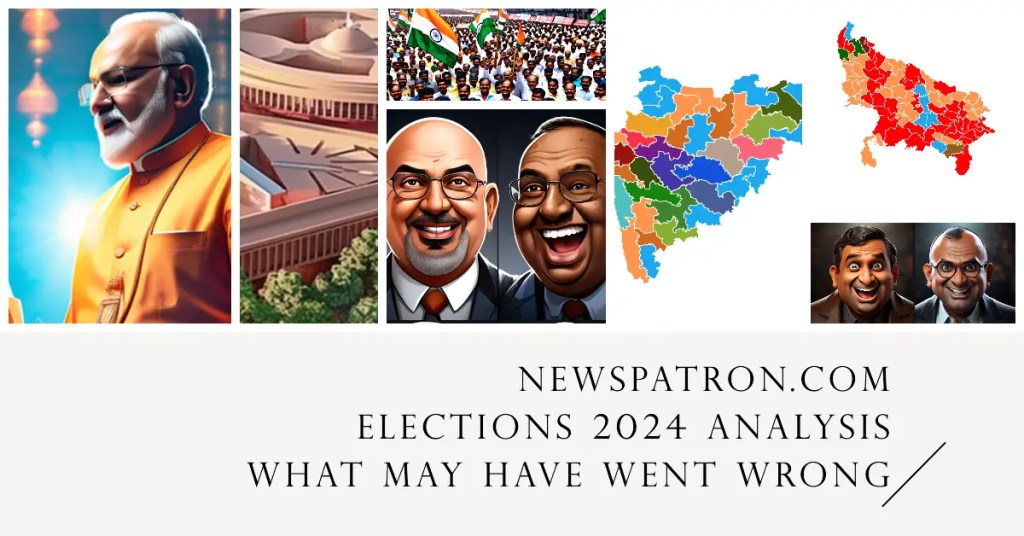

Unravelling the Election Saga
Welcome to the concluding chapter of our insightful journey through the Lok Sabha Election Results Analysis of 2024. As we’ve navigated through the intricate narratives of political strategies and voter tides in our previous four parts, we now stitch together the final threads of this election’s story.
Lok Sabha Elections: The Verdict
Read previous posts.
Lok Sabha Election 2024 Result Analysis
Part 1– [Lok Sabha Elections Result Analysis – 1: A New Political Era]
Part 2 – [Analysing the 2024 Lok Sabha Election Results]
Part 3 [Unravelling Lok Sabha Election Dynamics 2024]
Part 4 [Elections 2024 Insight]
Read About Lok Sabha – The Lower House of Indian Parliament
[Read about Lok Sabha Elections: India’s Democratic Pulse]
[Read about Lok Sabha Elections: A History of Indian Politics]
Recommended Product
Jockey Women's Hipster Brief – Comfort Fit, Assorted Colors
🛒 View on Amazon →As an Amazon Associate, we earn from qualifying purchases. Price and availability may vary.
Read articles about Politics
Read the BJP Manifesto of 2024: A Vision for India’s Progress [Download]
Download the Congress Manifesto of 2024 [Download]
The Coalition Canvas: Painting a New Political Landscape
The Congress’s Calculated Gambit:
In a strategic pivot, the Congress party chose to contest fewer seats, a move akin to a chess grandmaster sacrificing a piece for positional advantage. This calculated gambit was not merely about winning more seats but about nurturing trust within their alliances. The result? A significant boost in vote share and a notable increase in seat count, particularly in Maharashtra, where the Congress’s tally reached double digits, leaving the BJP trailing behind. Check facts at the Election Commission Website. [ECI]
The Social Media Surge:
In the digital arena, Congress’s campaign strategy was a game-changer. Their focused efforts on social media platforms led to a noticeable dip in the Prime Minister’s digital popularity. Rahul Gandhi’s relatable campaigns resonated with the younger demographic, marking a shift in the party’s digital footprint and enhancing its appeal among the tech-savvy electorate.
The United Front: A Coalition’s Strength Against the Tide
A Symphony of Strategies:
The Congress-led alliance orchestrated a symphony of strategies, combining their strengths to mount a united defence against the BJP’s advances. This coalition was not just a political arrangement but a strategic symphony that leveraged social engineering to challenge BJP candidates across the nation, particularly in the pivotal states of Uttar Pradesh and Maharashtra.
Perception and Reality:
While the electorate expressed no significant discontent with PM Modi’s governance, there was a palpable sense of disillusionment with what was perceived as the party’s arrogance. Instances such as the Enforcement Directorate’s untimely interventions and the Election Commission’s reluctance to share data without the Supreme Court’s intervention contributed to a narrative of hubris that the BJP could ill afford.
Join Forums
[bbp-single-topic id=5914]
[Read about How Narendra Modi is a Great Leader Who Fulfils the Dreams of India’s Great Leaders]
The Quest for Leadership: Filling the Void
The Absence of a Statesman:
The BJP faced a leadership conundrum with the absence of Arun Jaitley’s sage-like presence. His diplomatic prowess and narrative-shaping abilities left a void that the party found challenging to fill. The search for a successor who could match Jaitley’s finesse became a quest for the BJP, with eyes turning towards figures like Shivraj Singh Chauhan, whose electoral magnetism and governance track record presented a beacon of hope. [Watch a short video on Newspatron and Subscribe to our old and new YouTube Channels where we occasionally share content].
Navigating the Coalition Waters:
As PM Modi steers the ship of his third term, the waters are choppy with the complexities of coalition politics. The BJP’s internal dynamics are at a crossroads, requiring a delicate balance between empowering emerging leaders and managing the aspirations of established ones. The party’s ability to harness the strengths of leaders like Nitin Gadkari and Shivraj Singh Chauhan will be pivotal in navigating the coalition landscape and addressing the electorate’s diverse aspirations.
The Epilogue: Democracy’s Resilient March
The 2024 Lok Sabha Election is a chapter in the ongoing saga of Indian democracy. It reflects the intricate dance of political strategies, leadership quests, and the electorate’s evolving preferences. As we close this series, we extend an invitation to our readers to join the conversation in our forums, engage with our content across platforms, and contribute to the rich mosaic of democratic discourse.
Introduction to Indian Political Terminology
Navigating the world of Indian politics can be akin to learning a new language. The political arena is rife with jargon that can seem impenetrable to the uninitiated. This section aims to demystify these terms, providing a clear and concise explanation of the key terminologies used in the context of Indian elections and governance.
Understanding the Basics
Manifesto: A document released by political parties before elections, outlining their vision, intentions, and policy proposals for the country if they come to power.
Agenda: The set of goals or policy objectives that a political party aims to achieve. It’s the to-do list of the party.
Common Minimum Program (CMP): An agreement among coalition partners to form a government based on a shared set of minimum policy objectives.
Vote of Confidence: A parliamentary vote to determine if the current government still enjoys the support of the majority of legislators.
No Confidence Motion: A motion moved by the opposition to oust the current government, requiring a majority vote in the Parliament to pass.
Legislative Terms
Bill: A draft of a proposed law presented to Parliament for discussion.
Amendment: A change proposed to an existing bill or law.
Constitution: The supreme law of India, which lays down the framework defining political principles, establishes the structure, procedures, powers, and duties of government institutions, and sets out fundamental rights, directive principles, and the duties of citizens.
Money Bill: A special type of bill that deals with taxes, borrowing of money by the government, expenditure from the state treasury, etc., and can only be introduced in the Lok Sabha.
Parliamentary Positions and Procedures
Speaker: The chief of the Lok Sabha, responsible for the conduct of its business.
Leader of Opposition: The leader of the largest party not in government in both the Lok Sabha and the Rajya Sabha.
Zero Hour: The time immediately following the Question Hour in the Indian Parliament when Members of Parliament can raise issues without prior notice.
Order of the House: The agenda of the day’s proceedings in the Parliament.
Campaign: The process of gathering public support for a political party or candidate.
Code of Conduct: A set of guidelines for the behaviour of political parties and candidates during an election.
Election Commission: An autonomous constitutional authority responsible for administering election processes in India.
Financial and Governmental Structure
Budget: The annual financial statement of the country’s estimated revenue and expenditure presented by the government.
Coalition Government: A government formed by multiple political parties who must compromise on policies.
Simple Majority (272): More than half of the minimum number of votes required to win certain types of votes in the Parliament, specifically 272 out of 543 in the Lok Sabha.
Absolute Majority: A majority over all rivals combined; more than 50% of the total membership of the House.
Minority Government: A government formed by a ruling party that does not have an absolute majority in the Parliament.
Parliamentary Members and Bodies
Member of Parliament (MP): An elected representative of the people to the Parliament.
Lok Sabha: The lower house of India’s bicameral Parliament, also known as the House of the People.
Rajya Sabha: The upper house of India’s bicameral Parliament, also known as the Council of States.
Cabinet: A group of high-ranking government officials, typically representing the executive branch.
Cabinet Minister: A member of the Cabinet and head of a ministry.
Union Minister: A minister in the central government who is not a Cabinet Minister.
Minister of State: A junior minister in the central government who assists a Cabinet Minister.
Parliament: The supreme legislative body of India, composed of the President, the Lok Sabha, and the Rajya Sabha.
Parliamentary Practices
Quorum: The minimum number of members required to be present for the Parliament to conduct its business.
Voice Vote: A voting method in which a vote is taken on a topic or motion by responding verbally.
Majority: The greater number in a vote, more than half of the total cast.
Walk Out: When members leave the parliamentary proceedings as a form of protest.
Dismissal: The removal of a member from a session due to misconduct.
Suspension: Temporarily preventing a member from attending parliamentary sessions as a disciplinary measure.
This glossary is not exhaustive but covers many of the key terms you’ll encounter when engaging with Indian politics. Understanding these terms will help you better grasp the nuances of political discussions and news in India.
