



By the NewsPatron Lifestyle Desk
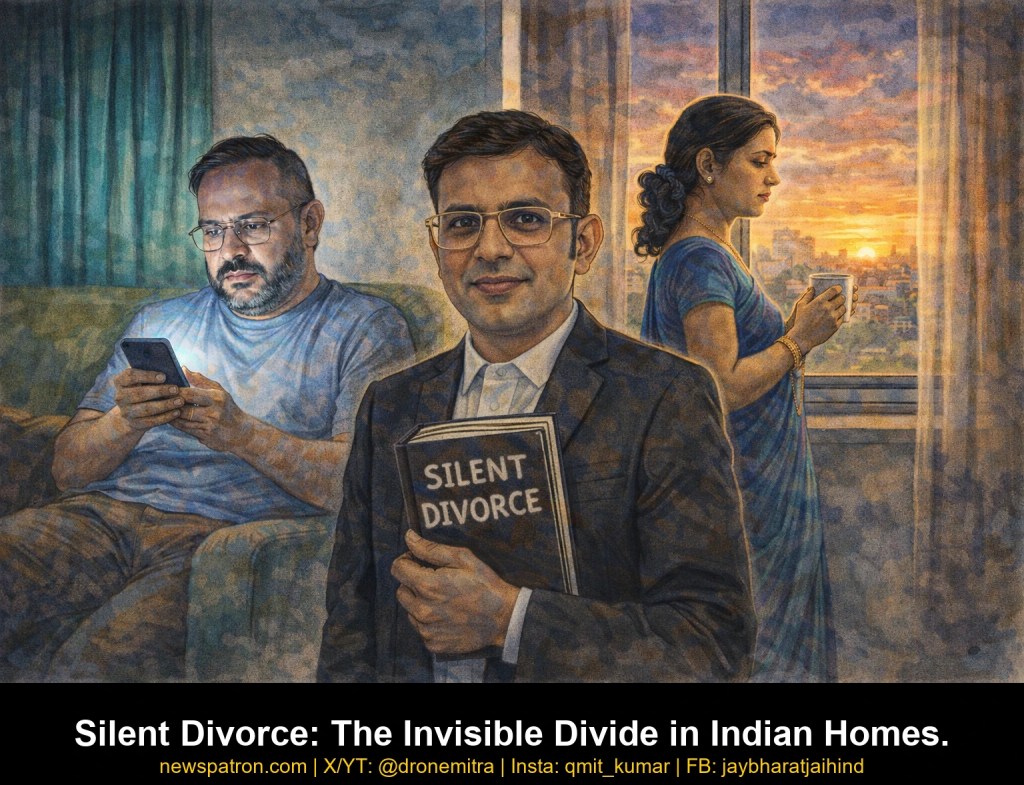
Hey there, wrapping up your evening on this January 18, 2026? Picture this: It’s a typical Sunday dinner at home. The table’s set, the kids are chattering, and from the outside, everything looks just fine. But you and your partner? You’re sitting across from each other like polite strangers at a cafe—nodding about the weather, scrolling through phones, no real laughs or lingering glances.
No arguments, either, because who has the energy anymore? If this hits a nerve, or if you’ve overheard whispers about it in family chats, you’re not imagining things. This is silent divorce, that sneaky emotional drift where the marriage stays on paper, but the connection? Long gone.
We’re chatting about this rising issue in the Indian and South Asian scene, pulling from buzzing online forums and casual talks with counsellors who’ve seen it all. Think of folks like those offline relationship experts who, in informal chit-chats, share stories from their clients: “One couple I know stayed glued for decades, but now at 55, they’re finally calling it quits—it’s more common than you think.” No names, just real vibes. If you’re here feeling that unnamed ache, know we’re in this together. Let’s unpack it step by step, without the judgment. Sound good? Let’s roll. ?
Related Reading: Growing Screen Time: A Threat to Relationships?
The Indian Silent Divorce: When “Log Kya Kahenge” Keeps You Stuck
Let’s be real—India’s divorce rate sits at about 1%, which sounds like a win for “happily ever after,” right? But online sources paint a different picture: That low number often masks a ton of hidden misery, where couples endure emotional separation just to avoid the gossip mill. Counsellors in recent interviews have noted how many clients admit, “We’re only together for the kids or because what will people say?”—that classic “log kya kahenge” trap.
Take those raw shares from online discussions: Folks confess to living like shadows in their own homes, no deep talks, no shared dreams, just co-existing for societal brownie points. One counsellor mentioned in a casual chat, “A lot of my clients in their 30s and 40s are going through this—they fake smiles on social media but feel utterly alone.”
And it’s not just one-sided; both husbands and wives “check out” emotionally. For wives, it’s often that “walk-away” vibe, where after begging for change, they just stop caring. Husbands? They might bury themselves in work, turning the home into a pit stop.
Read More: Smart Devices & Society: A Love-Hate Story? ?
Recommended Product
Casio Enticer Men's Analog Green Dial Watch MTP-VD01D
🛒 View on Amazon →As an Amazon Associate, we earn from qualifying purchases. Price and availability may vary.
Silent vs. Quiet Divorce: Clearing Up the Mix-Ups
Ever heard someone toss around “silent” and “quiet” divorce like they’re the same? You’re not alone in the confusion—it’s a common slip-up in online chats. Let’s sort it out, shall we?
- Silent Divorce: That’s the one where you’re still legally hitched, often sharing the same roof, but emotionally? Total radio silence. No drama, just a slow fade into unhappiness—think parallel routines with zero spark.
- Quiet Divorce: On the flip side, this is the legal split done low-key: No big fights, no public spectacle, just a calm parting ways.
From what counsellors have shared in recent interviews, the overlap happens when silent turns quiet—folks endure the emotional void for years, then quietly file when they can’t anymore. Online sources highlight real examples: One story floating around describes a couple who were “silently divorced” for a decade (separate lives, no intimacy), until one quietly walked out without a fuss.
Expert Insights: Fix 18 Husband Mistakes in Marriage Now
The Parallel Lives Trap: When Your Marriage Feels Like a Shared Flat
Oof, this one’s tough—the “roommate phase.” You know, where everything’s functional but nothing’s fun? Separate bedrooms (or that invisible wall in the same one), split finances, and intimacy? What’s that? Yet on Instagram, it’s all hearts and hashtags.
Online sources echo the sentiments: People share how they appear perfect online but live in emotional isolation, tied by kids or EMIs. One expert in a recent chat mentioned, “In South Asian homes, this parallel life hits hard—arranged setups sometimes start distant, and ‘log kya kahenge’ keeps the show going.” Signs? Zero fights (because apathy wins), solo hobbies, and that nagging loneliness.
Deep Dive: Smartphone Addiction & Sex: 7 Ways to Reclaim Intimacy
Gray Divorce: When Silent Suffering Boils Over in Your 50s
Now, let’s zoom out to a related twist: Gray divorce, where couples over 50 finally pull the plug after years of quiet endurance. It’s like silent divorce’s older sibling—built on decades of emotional gaps, but hitting when kids are independent and life’s too short for regrets. Online sources from 2024-2026 show it’s on the rise in India, mirroring global trends.
Stats-wise, online data indicates about 1.36 million Indians are divorced overall, with women leading urban filings. Globally, gray divorce has doubled since 2000 in many places, and in India, rates among 50+ are climbing steadily while younger ones dip. By 2025 reports, roughly 36% of divorces involve folks 50+, up from under 9% in 1990.
Related: Understanding Physical Intimacy: Insights from Dr. Neelima Deshpande
Recent Buzz and Trends: Why This “Hidden Epidemic” Is Spiking
Diving deeper, is silent divorce really an epidemic? Counsellors and online sources say yes—it’s hidden because we don’t talk about it, but it’s everywhere. In casual interviews, therapists have called it a “quiet crisis,” with spikes post-2024 from pandemic stress and economic shifts.
Data from recent chats points to urban vs. rural divides: Tier 1 (Delhi, Bangalore) sees more due to independence, while Tier 2 holds on tighter to family norms—but even there, it’s creeping in. Online trends show 80% of marriages might fit this mold, per some discussions.
Cautionary Tale: People to Avoid: 7 Toxic Types
Helpful Tools to Break the Silence: Affiliate Picks
If all this has you thinking about small steps toward change, you’re in the right spot. We’ve rounded up some practical tools that can help spark conversations, ease stress, or guide reflection—without needing to dive straight into therapy.
- Book: The Silence Divorce: A Therapy for Relationships – This gem dives into emotional disconnection with practical tips tailored for real-life scenarios. Check it out on Amazon
- Workbook: The Couples Therapy Toolbox – Hands-on exercises to tackle communication blocks and intimacy dips. Grab it here on Amazon
- Card Game: Life Sutra Couple Reconnect – Fun prompts to turn silent dinners into meaningful chats. Pick up the deck on Amazon
- Guided Relationship Journal – Daily questions to reflect on feelings and goals together. Get journaling on Amazon
- Essential Oil Diffuser Set – Create a relaxing vibe at home to unwind and open up. Set the mood with this on Amazon
Tying It All Together: You’re Stronger Than the Silence
Alright, we’ve covered a lot ground—from the Indian silent divorce traps like “log kya kahenge,” to mix-ups with quiet splits, the roommate rut, and gray divorce stats. Key nuggets? Spot the emotional drift early, talk it out, and know silent doesn’t mean stuck forever.
You deserve more than a facade—real connection, joy, even if it means tough choices. Whether it’s therapy, a heart-to-heart, or exploring options, start small today. You’ve got the power to rewrite your chapter.
Final Thought: The ‘Toh Kya Fayda’ Trap: Are You Rich in Money but Poor in Memories?
