


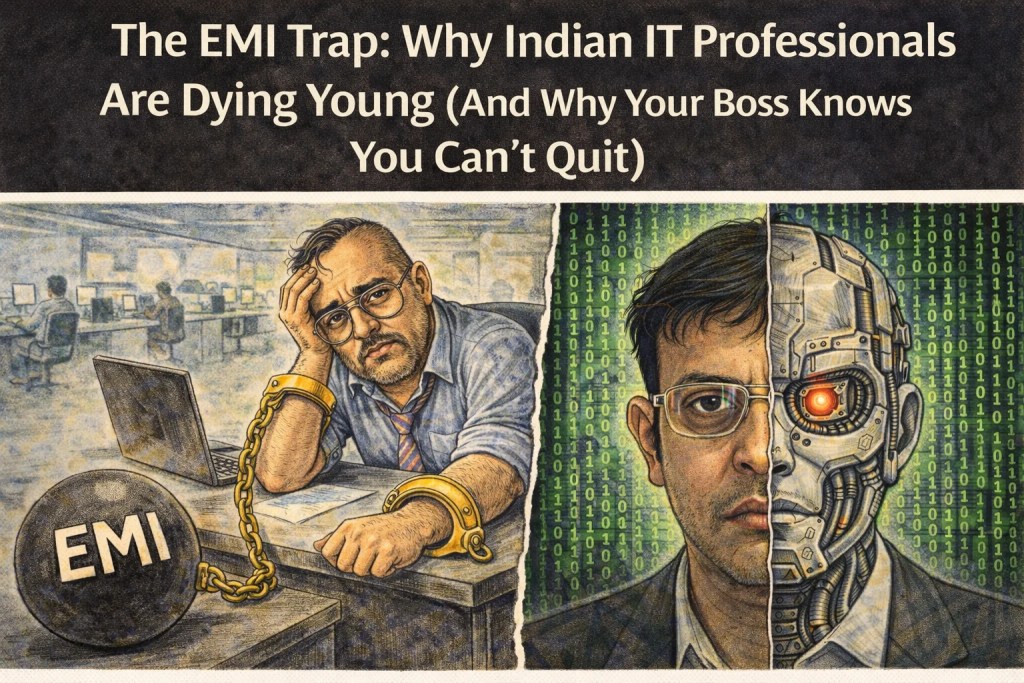

Let’s be real for a second. We need to talk about the elephant in the AC-cooled, glass-walled room.
You know the dream, right? You crack the code (literally), land that fat package at an MNC in Pune or Bengaluru, buy the 3BHK in the gated community, and get the sedan. You’ve “made it.”
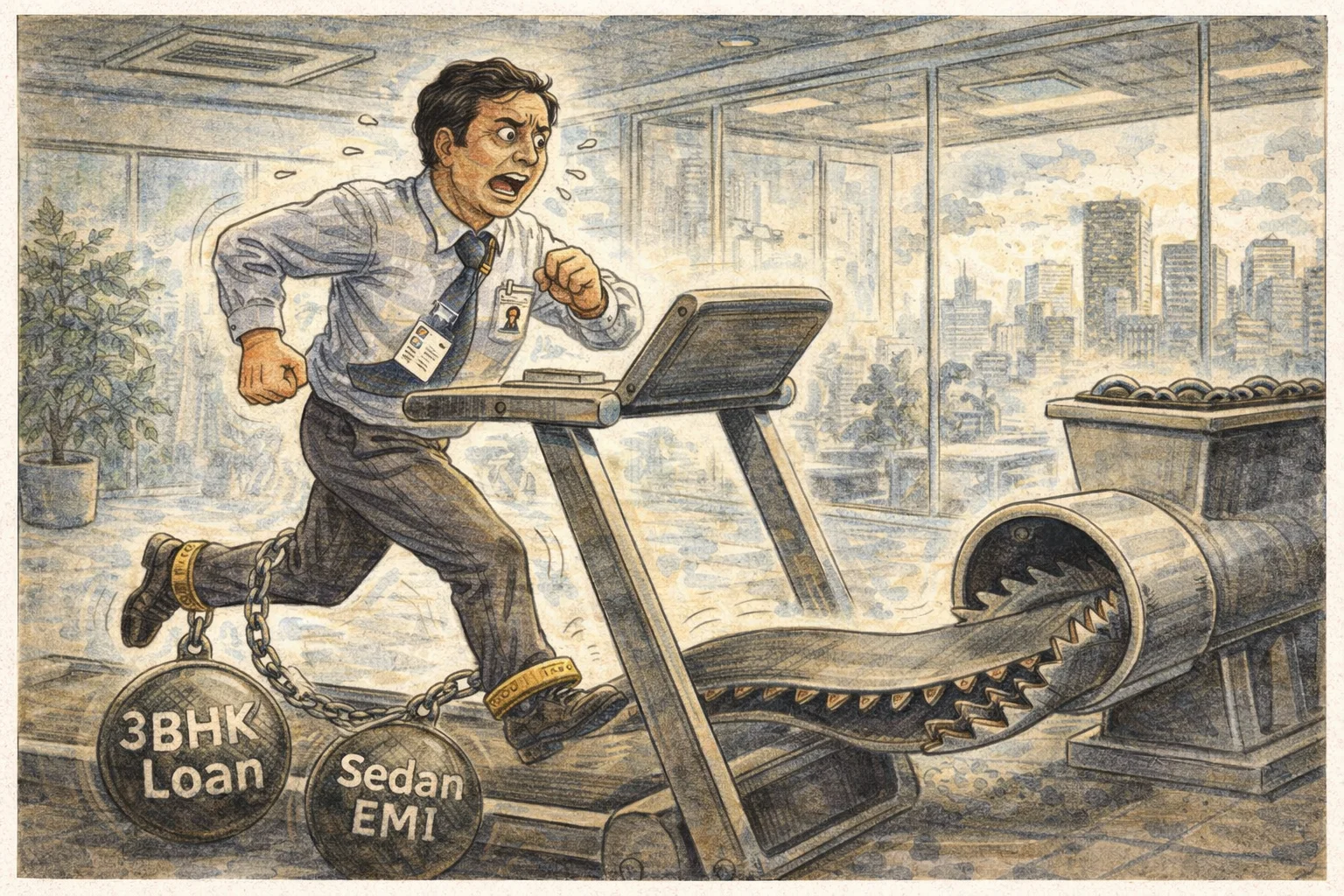
But if you’ve made it, why does your chest feel heavy on Sunday nights? Why are your colleagues dropping from heart attacks in their 30s? And why does it feel like you’re running on a treadmill that’s slowly turning into a meat grinder?
A recent psychological autopsy by Dr. Vrushali Raut, an organizational psychologist with a PhD specifically in IT Mental Health, sheds light on this. She didn’t just study the industry; she lived it. And what she has to say isn’t just a “wake-up call”—it’s a fire alarm.
Combined with some terrifying real-time data, we’re going to dissect the “Silent Crisis” eating the Indian IT workforce alive. Spoiler alert: It’s not just “burnout.” It’s systemic captivity.
1. The “Golden Handcuffs” (Or: Why You Can’t Quit)
Here is the darkest secret of the Indian IT industry, straight from Dr. Raut: Your boss knows you are trapped.
In the early days, IT brought glamour and high salaries. But it also brought a dangerous trap. We built expensive lifestyles—the EMIs, the international schools, the luxury cars—based on the assumption that the money would never stop.
Dr. Raut puts it bluntly: “Employers developed a mindset: these people are not going anywhere… They are trapped in EMIs.”
Because you have that massive home loan hanging over your head, you become risk-averse. You can’t protest. You can’t quit. You can’t say “no” to a 14-hour shift. Employers know this dependency exists, and they exploit it to extract work however they please.
SURVIVAL GEAR: PROTECT YOUR BACK & WALLET
Related: Work Life Balance Crisis Exposing Harsh Reality of Indian IT Sector
2. The Soldier vs. The Coder: The Myth of “Rest”
Here is a chilling comparison Dr. Raut makes: Even soldiers in a war get rest. After a battle, they retreat. Farmers work hard during the harvest, but then they have a downtime.
You don’t.
In the IT sector, the brain is treated like a server—expected to have 99.9% uptime. But biological brains aren’t silicon chips. They overheat.
Because we are connected 24/7 via smartphones and emails, we never truly “switch off”. And when we do try to relax? We don’t sleep. We “binge.” We drink, we shop, we doom-scroll. We treat stress with over-stimulation, which just exhausts the brain further.
HEALTH ALERT: MONITOR YOUR VITALS
❤️ Heart Check
👓 Eye Protection
😴 Deep Sleep
The “Heart-Stopping” Reality:
This isn’t a metaphor. It’s a medical emergency.
- Heart Attacks in the 30s: The average age for a first heart attack in India has plummeted from 52 to 39.
- The “Bengaluru Burn Ward”: In tech hubs, cardiologists report that two-thirds of their cardiac consultations are now from people aged 25-40.
- The Cause: It’s not just bad food. It’s the “always-on” culture spiking cortisol until your arteries just give up.
Read More: Achieving Work-Life Balance: Can You Have It All?
3. The “Machine” Syndrome: Why You Feel Hollow
Have you noticed that you—or your spouse—seem a little… colder lately? Less patient? Less empathetic?
That’s not just “stress.” It’s what Dr. Raut calls “Emotional Hollowing”.
When you spend 12 hours a day interacting with logic, code, and machines, your brain starts to mimic them. You lose “human sensitivity”. You start expecting relationships to be as logical as a Python script. But humans are messy. Wives, husbands, and kids are emotional.
The result?
- Relationship Breakdown: Delayed marriages, loneliness within marriage, and a spike in divorces.
- The “Hollow” Job: Unlike a carpenter who can point to a chair and say, “I made that,” IT workers often do maintenance work. You can’t “see” your output. This lack of tangible creation erodes your self-worth over decades.
Related: Beat Toxic Micromanagement: Reclaim Work!
4. The Rebellion: Moonlighting & The Future
So, where is this heading? If we look at the sentiment on social media, the workforce is polarized. On one side, you have the “70-Hour Week” dictating slavery. On the other, you have the “Moonlighting” rebellion.
Employees are realizing that loyalty is a one-way street. If the company treats you like a resource to be mined, you might as well act like a mercenary. Moonlighting is the “guerrilla resistance” to the EMI trap.
Deep Dive: The Great Indian Burnout: Why ’70-Hour Weeks’ Are Driving Talent to the Auto Stand
The Verdict: Reclaim Your Humanity
Dr. Raut’s diagnosis is clear: We are turning into machines, and we don’t even realize it. This isn’t just about “work-life balance.” It’s about survival. The system—the EMIs, the 24/7 pings, the toxic bosses—is designed to keep you running until you crash.
Your Action Plan:
- Acknowledge the Cage: Admit that your high salary comes with “Golden Handcuffs.”
- Stop “Bingeing” Relaxation: Your brain needs silence, not Netflix.
- Draw the Line: The “Right to Disconnect” starts with you. If you don’t respect your downtime, your boss definitely won’t.
Treating humans better costs nothing. But ignoring it? That costs lives.
Did this hit a nerve? Share this with a colleague who needs to read it. And if you’re feeling the burn, drop a comment below—let’s talk about it.

[…] Read More: The EMI Trap: Why Indian IT Professionals Are Dying Young […]
[…] The EMI Trap: Why Indian IT Professionals Are Dying Young (And Why Your Boss Knows You Can’t Q… […]
[…] The EMI Trap: Why Indian IT Professionals Are Dying Young (And Why Your Boss Knows You Can’t Q… […]
[…] READ THE FULL REPORT 📑 […]