




A Milestone Nobody Celebrated
A data point that changes everything — and what it actually means
This post relies on government-verified data — the Sample Registration System (SRS) Statistical Report 2023, UNFPA State of World Population 2025, NFHS-5, and UN Population Division projections. No ideology. No alarm for its own sake. Just what the numbers say — and what they mean for a country that is still telling itself the old story about population.
India Just Crossed a Line. Did Anyone Notice?
In September 2025, the Registrar General of India released a number that should have been front-page news in every newspaper in the country. It was not.
India’s Total Fertility Rate fell to 1.9 in 2023. Below replacement level. For the first time in recorded modern history, Indian women on average are having fewer children than needed to maintain the population from one generation to the next — without migration.
That is not a small statistical footnote. That is a structural shift in the DNA of this country’s future.
And buried inside that national number is an even sharper story — the story of two Indias moving at different demographic speeds, toward the same destination, and a policy class that is largely looking the other way.
The India urban rural fertility rate divergence is now one of the most consequential gaps in Indian public life. Urban India’s TFR stands at 1.5. Rural India just touched replacement level at 2.1 — for the first time ever. One India is already in demographic contraction. The other just arrived at the edge of it.
Both are in motion. Neither is being managed with the seriousness the numbers demand.
India Urban Rural Fertility Rate — What the SRS 2023 Data Actually Shows
Let us lay out the numbers cleanly, because the data deserves to be read clearly — not buried in jargon.
Recommended Product
Alpino Peanut Butter Chocolate Protein Bar – Gluten Free
🛒 View on Amazon →As an Amazon Associate, we earn from qualifying purchases. Price and availability may vary.
| Indicator | Rural India | Urban India | National |
|---|---|---|---|
| TFR (2023) | 2.1 | 1.5 | 1.9 |
| Crude Birth Rate | 20.3 per 1,000 | 14.9 per 1,000 | — |
| Highest state TFR | Bihar: 2.8 | Delhi: 1.2 | — |
| Lowest state TFR | — | Tamil Nadu: 1.3 | — |
Delhi — India’s capital, its most urbanised and educated major state — records a TFR of 1.2. That is lower than France, lower than Sweden, and approaching South Korean levels. Maharashtra stands at 1.4. Andhra Pradesh, Karnataka, Kerala, Punjab, and Telangana are all at 1.5.
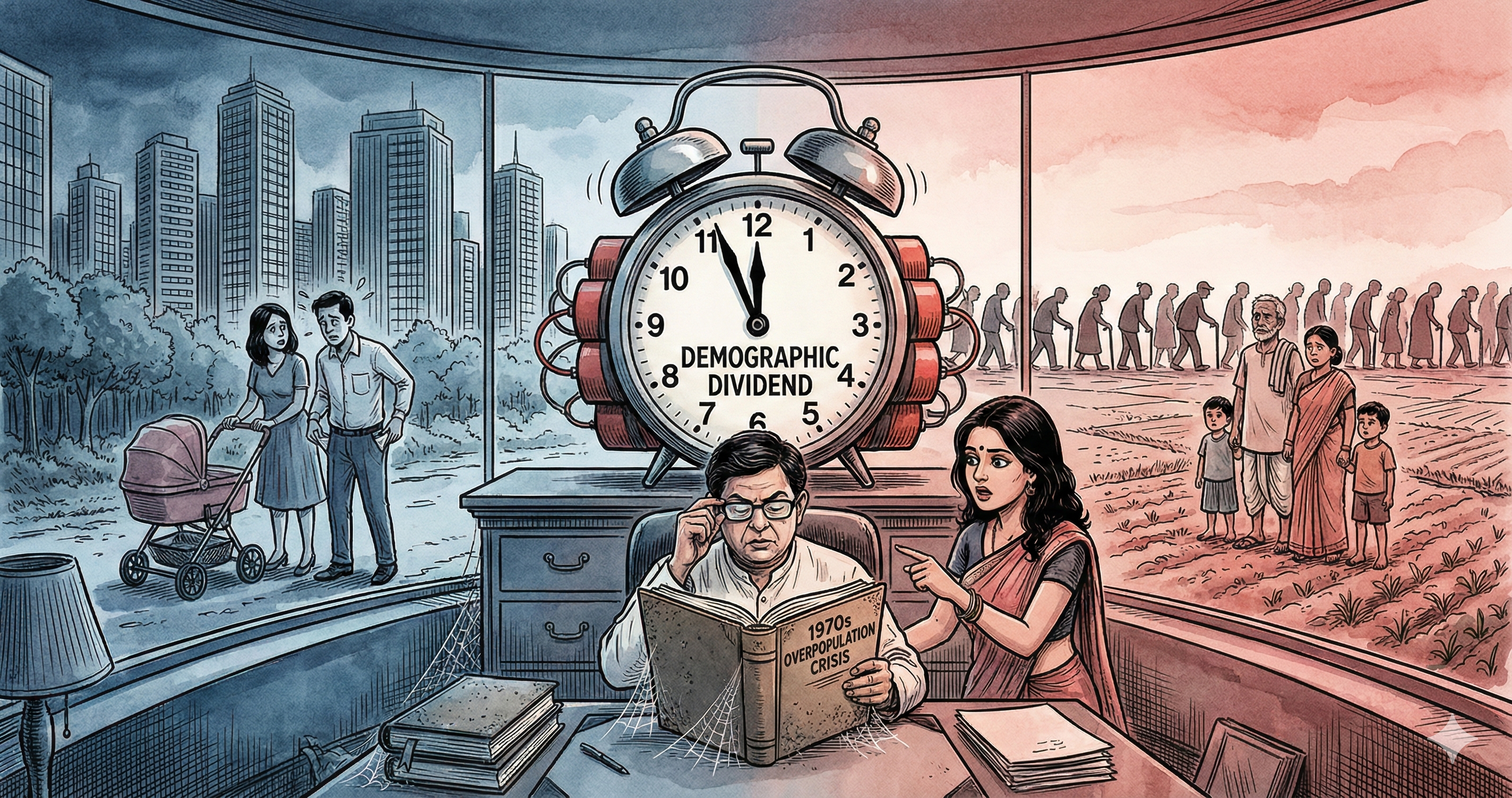
These are not struggling states. These are India’s most economically productive, most educated, most urbanised regions. And they are producing the fewest children.
Bihar, at 2.8, remains the highest — but even Bihar’s TFR has been falling. The direction is the same everywhere. The speed differs.
This pattern is not random. It is a textbook demographic transition — the well-documented global phenomenon where rising education, urbanisation, and women’s workforce participation consistently push fertility rates downward. The question for India is not whether the transition is happening. It already is. The question is whether India is ready for what comes next.
The Replacement Rate Milestone — Why 2.1 Matters More Than It Sounds
2.1 sounds like an arbitrary number. It is not.
Replacement-level fertility means that each generation exactly replaces itself — two parents produce, on average, slightly more than two children to account for mortality before reproductive age. Rates above 2.1 mean a growing population. Rates below 2.1 mean a shrinking one — eventually.
Rural India touching 2.1 in 2023 is significant for two reasons. First, it ends the long story of “India has a population problem” as a uniform national narrative. That narrative was always about rural India — and that chapter is closing. Second, and more importantly, rural TFR is not stopping at 2.1. It was 2.2 in 2022. It will be below 2.1 by 2025 or 2026 at current trajectory. The floor is not the floor. It is a waypoint.
India’s Gross Reproduction Rate — the measure of how many daughters a woman has during her lifetime, which determines generational replacement — has already fallen below one nationally. That means each successive generation of women entering childbearing age will be smaller than the one before. Course correction becomes harder with every passing year.
Demographic Decline India — The State-by-State Picture
The national TFR of 1.9 is an average. And like most averages, it conceals the real story.
Eighteen states and Union Territories have already recorded TFRs below replacement level. In practical terms, that means more than half of India — by economic output and urbanisation — is already in demographic contraction territory.
The regional split is stark:
- South and West India — already well below replacement: Tamil Nadu: 1.3 | West Bengal: 1.3 | Delhi: 1.2 | Maharashtra: 1.4 | Karnataka: 1.5 | Kerala: 1.5 | Andhra Pradesh: 1.5
- North and East India — still above replacement, but falling: Bihar: 2.8 | Uttar Pradesh: 2.6 | Madhya Pradesh: 2.4 | Rajasthan: 2.3
This creates a political and economic tension that India has not yet fully confronted. The states contributing the most to GDP and tax revenue are the ones with the lowest birth rates. The states that still have demographic momentum are the ones with higher poverty rates, lower education indices, and slower economic growth.
In other words: India cannot rely on its high-fertility states to solve its low-fertility problem. The conditions that produce high fertility — lower education, limited women’s workforce participation, agricultural livelihoods — are precisely the conditions India is trying to move away from.
You cannot have the development and the birth rate. Not without deliberate, structural policy intervention.
Why Southern India Hit 1.2 While Bihar Is Still at 2.8
This gap is not a mystery. It is the same pattern that played out in East Asia, Europe, and Latin America before it played out in India.
As education levels rise — particularly female education — women delay marriage, delay childbirth, and choose fewer children. As urbanisation increases, the cost of raising children rises and the economic incentive for large families falls away. As women enter the workforce in larger numbers, the opportunity cost of childbearing increases.
Kerala led this transition decades ago. Its literacy rates, healthcare access, and women’s education put it on a low-fertility path long before the rest of India. Tamil Nadu followed. The metros followed. And now the pattern is spreading.
Bihar, UP, and MP are not immune. They are simply earlier on the same curve. Their TFRs are falling — from 3.4 in Bihar a decade ago to 2.8 today. The direction is identical. The timeline is just different.
The uncomfortable truth is this: India’s demographic window — the “demographic dividend” — is narrowing faster than policymakers appear to have internalized. The Economic Survey 2025-26 has flagged this. The academic literature is clear. But the public conversation is still stuck in the old frame of “too many people.”
India Aging Population — The Real Threat Nobody Wants to Name
Here is the part of this story that gets almost no mainstream coverage in India.
By 2050 — assuming India will be a developed nation by then, and hopefully the Amrutkaal still prevails (or we have entered the next yuga of Amritkaal) — one in five Indians will be 60 years or older. India’s elderly population — currently 7% — is set to expand dramatically as today’s large working-age cohort ages and the younger cohorts behind them shrink.
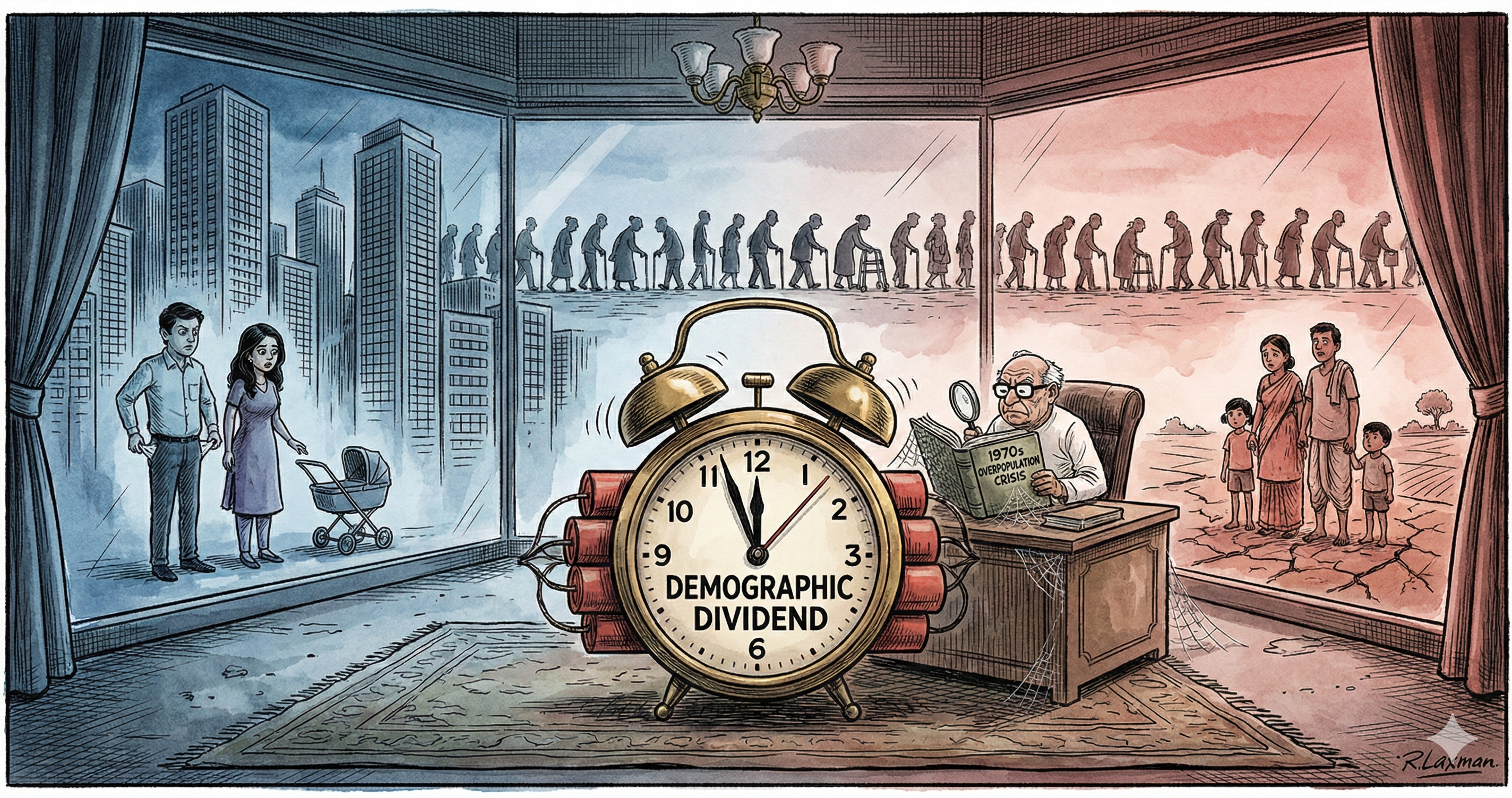
India’s current demographic profile gives it a working-age population of 68% — one of the highest in the world right now. That is the dividend. That is the window. But windows close.
Japan got here first. Its TFR fell below replacement in the 1970s. By the 2000s, Japan had a shrinking workforce, a pension system under severe strain, and an economy that has struggled with deflation and stagnation for three decades. South Korea is now entering the same spiral at an even more extreme pace, with a TFR of 0.72. China, having enforced low fertility for decades with its one-child policy, is now desperately trying to reverse a trend that its own state machinery created.
India is not Japan. Its absolute population is still growing — the country will reach approximately 1.7 billion before the numbers begin to fall, roughly 40 years from now. But demographic momentum is not the same as demographic health. A large but rapidly aging population with a shrinking youth base faces the same structural pressures — just delayed.

Fewer workers supporting more retirees. A pension and healthcare system that was designed for a different age structure. Cities built for growth that will need to be redesigned for aging. These are not hypothetical futures. They are scheduled arrivals.
India Demographic Dividend — Closing Faster Than We Think
The phrase “demographic dividend” has been used so often in Indian policy circles that it has lost its urgency. Let us restore it.
A demographic dividend is the economic boost a country gets when a large share of its population is working-age — productive, earning, spending, tax-paying. India’s window for this dividend is open now. It will not stay open indefinitely.
India’s Gross Reproduction Rate falling below one nationally means the generation entering childbearing age is already smaller than the generation before it. That is not a 2050 problem. That is a structural reality being built into the economy right now, with every year that passes without a serious policy response.
Countries that captured their demographic dividend — South Korea in the 1970s and 80s, China in the 1990s and 2000s, now Vietnam and Bangladesh to varying degrees — did so by pairing large working-age populations with aggressive investments in education, infrastructure, and manufacturing employment. India has made progress on all three fronts. But the window is narrowing. And the birth rate data says it is narrowing faster than official projections often acknowledge.
India Fertility Rate Policy — What the Government Is and Is Not Doing
This is where the story shifts from data to accountability.
India does not currently have a coherent national-level pro-natalist policy framework for urban India. There is no equivalent of France’s childcare subsidy system, no equivalent of Sweden’s shared parental leave structure, and no equivalent of Hungary’s mortgage-relief-for-families programme.
What India has is a family planning apparatus built for a different problem — one designed to reduce fertility in high-fertility rural populations, which was the right policy for the 1970s and 1980s and remains relevant in pockets of Bihar and UP today. But applying that same institutional mindset to urban India — where TFR is 1.5 and falling — is not just inadequate. It is the wrong direction entirely.
The NITI Aayog and various state governments have begun flagging the demographic transition as a policy concern. Andhra Pradesh’s government has floated financial incentives for families with two or more children. Tamil Nadu and Kerala have started discussing elder care infrastructure gaps. The Economic Survey 2025-26 dedicates sections to the demographic trajectory.
But flagging is not acting. And the gap between the data and the policy response remains wide.
What India Must Do Before the Demographic Window Closes
The policy prescription is not complicated. What is complicated is the political will to execute it against competing budget priorities.
- First: Urban housing as family infrastructure. Affordable urban housing is not just a welfare issue — it is a demographic one. Young urban couples delaying children because they cannot afford a two-bedroom flat are a policy failure, not a cultural trend.
- Second: Childcare as public infrastructure. France did not achieve TFR 1.8 by accident. Universal, affordable, quality childcare — available from infancy, not just school age — changes the family formation calculus fundamentally. India’s ICDS programme needs a complete urban overhaul.
- Third: Shared parental leave that is actually usable. India’s maternity benefit law has improved. Paternity leave remains nominal in most private sector contexts. Shared leave structures that allow both parents to participate in early childcare without one partner paying a permanent career penalty are a structural fix, not a symbolic gesture.
- Fourth: Differentiated state policy. Bihar needs different interventions than Delhi. A uniform national fertility policy in 2026 is a category error. India’s demographic divide demands a differentiated, state-level response mapped to actual TFR realities.
The clock is not ticking loudly yet. But it is ticking. And demographic transitions — once entrenched — are extraordinarily difficult to reverse. South Korea is spending billions trying. The lesson is available. The question is whether India will learn it before or after it needs to.
India Urban Rural Fertility Rate 2025 — What This Means for the Country You Live In
If you are reading this in Mumbai, Bengaluru, Delhi, or Pune — you are living in the data. Your city’s TFR is already between 1.2 and 1.5. Your generation is the one the numbers are describing.
If you are a policymaker, an economist, or a journalist — this story is the one that needs to be on the front page, not the footnote. India’s population story is no longer the story of “too many.” It is rapidly becoming the story of “too few, in the wrong places, at the wrong time.”
India still has time. It has a large youth bulge working in its favour right now. It has 68% of its population at working age. That is an asset — but only if it is deployed, educated, employed, and supported in building the next generation.
The two Indias — urban at 1.5, rural at 2.1 — are converging. They are both heading below replacement. The question is not if. The question is how fast, and whether the country that gets there will have built the institutions to manage what comes next.
The Numbers Do Not Lie. The Question Is Whether We Are Listening.
On the sources behind this post: Every statistic in this post is drawn from verified government and international institutional sources: the SRS Statistical Report 2023 published by the Registrar General of India, the UNFPA State of World Population 2025, NFHS-5 (2019-21), UN Population Division projections, and the Economic Survey 2025-26. Where projections are used, they are identified as such. Where data gaps exist, they are noted. This is not opinion dressed as data. This is data, presented as clearly as possible.
The Conversation Continues — Kumar Wants to Hear You
This is the kind of story that looks abstract on paper and very concrete in real life. Are you a young professional in South India — in one of the states where TFR is already at 1.3 — who has thought hard about this? Are you a policymaker or researcher working on India’s demographic future?
The comment section is open. And Kumar, Editor at NewsPatron, is listening.
- ? For daily updates: Follow on Instagram, X (Twitter), YouTube, and Reddit
- ? For national conversations: Like the NewsPatron Facebook page — this demographic series will be discussed there
- ? For instant updates: Subscribe to the NewsPatron WhatsApp Channel — your number stays private
- ?? For quick discussions: Connect on Telegram
- ? For policy and professional exchange: Connect on LinkedIn
All links are on newspatron.com. And while you are thinking about the future of India — take a moment to see what it looks like from above. The DroneMitra channel on YouTube — youtube.com/@dronemitra — captures the country at its most honest and most beautiful. Worth your time. ?
