



Wait — Before You Read This
A quick word on what this post is:
This post is built on verified data — from the United Nations, UNFPA, India’s own Sample Registration System (SRS), and peer-reviewed research. It does not blame men. It does not blame women. It does not blame any generation. It looks at numbers, policies, and real-life costs — and asks a straightforward question: is the system making it harder for Indian families to exist?
If you are a young couple in Mumbai, Bengaluru, or Delhi doing the math on whether you can afford a child right now — this one is for you.
From the Editor’s Desk: The Baby Math Nobody Is Doing Publicly
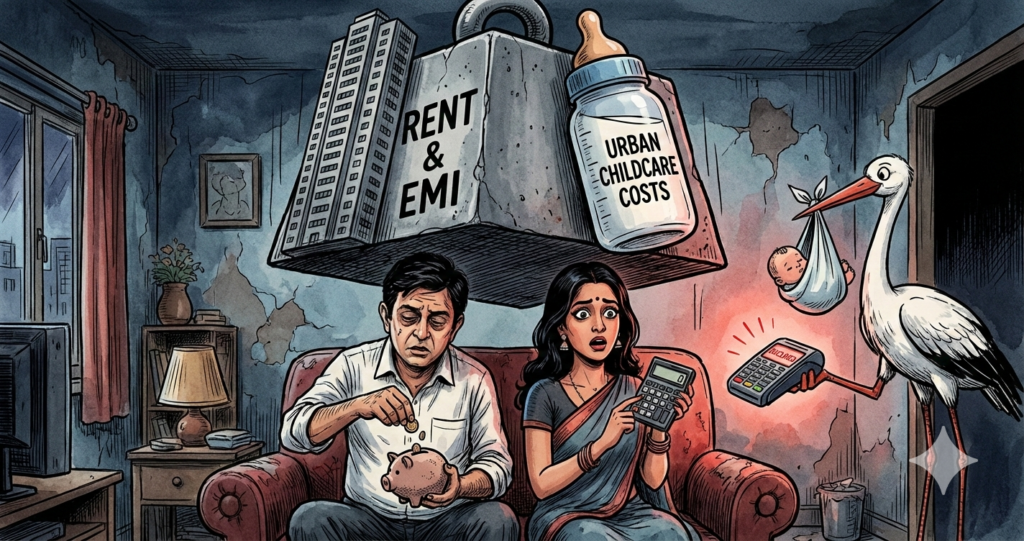
Here is a scene that plays out in thousands of Mumbai homes every month. A couple in their early thirties. Both working. Combined income looks decent on paper. But after rent — or EMI — groceries, fuel, health insurance, and maybe one evening out a week, the number that is left does not feel like the foundation of a family. It feels like survival with a decent Wi-Fi connection.
Housing costs and birth rates in India are connected in ways that national conversations rarely address directly. We talk about population in one breath and housing affordability in another — as if the two have nothing to do with each other. The data says otherwise.
This post breaks down what the numbers actually show, what other countries did about it, and what India’s urban-rural divide reveals about where we are headed. No alarmism. No blame. Just the real picture.
Also — if you love India from above, check out the DroneMitra YouTube channel at youtube.com/@dronemitra for some genuinely stunning aerial shots of the country we are all talking about. Worth a few minutes of your day. ?

Housing Costs Birth Rates India — The Numbers Behind the Delay
Let us start with the global picture, because India does not exist in a vacuum.
In 2025, the United Nations Population Fund — UNFPA — released its State of World Population report. One of its sharpest findings: 39% of people who want children cite financial barriers as the top reason they are having fewer, or none at all. That is not a fringe opinion. That is four in ten people worldwide raising their hand and saying: we want this, but we cannot afford it.
Now zoom into housing specifically. A 2025 study from the University of Toronto found that over 51% of the fertility decline in the United States between 1990 and 2020 can be attributed directly to rising housing costs. More than half. Not culture. Not choice. Not social media. Housing.
Recommended Product
Casio Enticer Men's Analog Green Dial Watch MTP-VD01D
🛒 View on Amazon →As an Amazon Associate, we earn from qualifying purchases. Price and availability may vary.
India tells a similar story, even if the numbers look different. According to the Sample Registration System (SRS) Statistical Report 2023, India’s national Total Fertility Rate (TFR) now sits at approximately 1.9 — below the replacement level of 2.1. Urban India is already at 1.5 to 1.6. Rural India only just crossed replacement level at 2.1 in 2023 — and it is falling.
Meanwhile, property prices in Tier-1 Indian cities have risen 8 to 12% annually for several consecutive years. Real wages for young urban workers, by contrast, have largely stagnated since 2019. The gap between what a home costs and what a young professional earns has not closed. It has widened.
So when young Indians say they are “not ready” for children — it is worth asking: not ready emotionally, or not ready financially? Because for many, those two things have become the same sentence.
What It Actually Costs to Raise a Child in Urban India Today
Let us put a number on it, because vague anxiety is worse than honest arithmetic.
According to local surveys and cost-of-living indices, raising a child from birth through college graduation in a metro Indian city — accounting for education, healthcare, nutrition, extracurriculars, and basic infrastructure — can conservatively cost ?50 lakh to ?1.2 crore depending on the city and lifestyle tier. That figure increases every year with inflation.
Here is a rough city-by-city snapshot for the first five years alone:
| City | Monthly Daycare/Crèche Cost | Avg 2BHK Rent | Combined as % of ?1L/month dual income |
|---|---|---|---|
| Mumbai | ?15,000–?30,000 | ?45,000–?70,000 | 60–100% |
| Delhi NCR | ?12,000–?25,000 | ?30,000–?55,000 | 42–80% |
| Bengaluru | ?12,000–?22,000 | ?28,000–?50,000 | 40–72% |
| Pune | ?10,000–?18,000 | ?22,000–?40,000 | 32–58% |
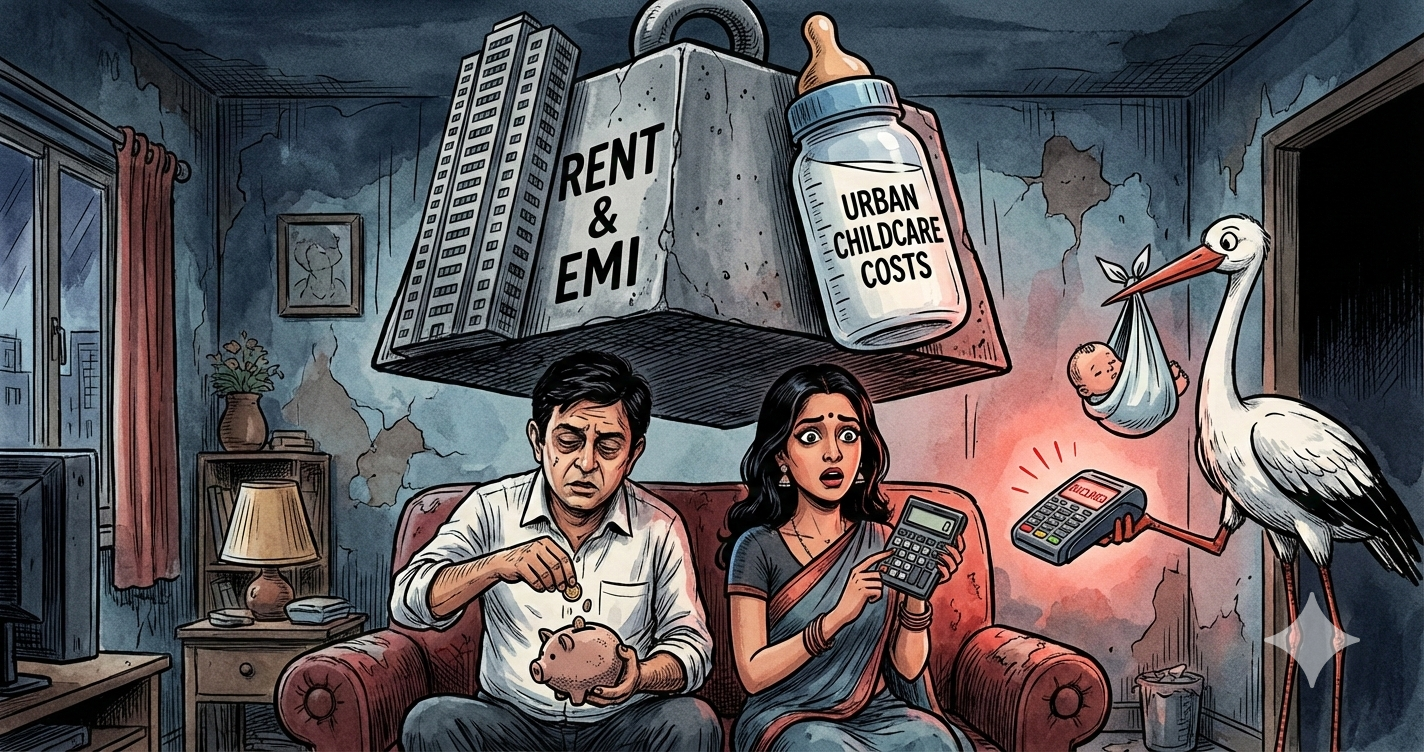
The pattern is consistent. In Mumbai especially, childcare alone can consume 20 to 40% of a dual-income household’s take-home pay — and that is before the rent, the EMI, the school fees that follow, or the career interruption that often falls on one partner. The math does not add up. And young couples are doing that math very clearly.
This is not laziness. This is not selfishness. This is arithmetic.
Wage Stagnation and Family Formation — The Income Gap Nobody Talks About
There is a conversation happening in India’s corporate corridors that rarely makes it into policy discussions: entry and mid-level salaries have not kept pace with the cost of urban life.
Between 2019 and 2024, India’s Consumer Price Index (CPI) rose steadily, driven by food, fuel, and housing costs. At the same time, hiring slowdowns post-pandemic, followed by tech sector contractions and cautious private sector expansion, meant that salary increments for many young professionals hovered between 5 and 8% — barely keeping pace with inflation, let alone building the financial cushion that family formation requires.
NFHS-5 (National Family Health Survey, 2019–21) data already showed a clear pattern: urban women are delaying first births significantly, with median age at first birth rising in metros. Economic pressure is the dominant driver cited in follow-up studies.
The contrast with countries that intervened structurally is stark. France, for decades, maintained a TFR of around 1.8 to 1.9 — well above most of Europe — through a combination of universal subsidised childcare (crèches), generous parental leave, and affordable social housing in urban centres. Sweden built a similar model. Both countries treat family formation as a public infrastructure question, not a personal lifestyle choice.
South Korea, on the other hand, did almost nothing structural. Its TFR in 2023 hit 0.72 — the lowest ever recorded for any country in modern history. Seoul’s housing costs are among the highest in Asia. Childcare is expensive. Young Koreans are simply opting out. The government now spends billions on cash incentives, but the evidence shows that baby bonuses without housing affordability are largely ineffective.
India is not South Korea yet. But the urban trajectory, if left unaddressed, points in a direction that deserves serious policy attention.
The Childcare Cost Fertility Trap in Indian Metro Cities
Here is a trap that is easy to fall into and very hard to climb out of.
A couple has a child. One partner — statistically still more often the woman — scales back work hours or exits the workforce temporarily. Household income drops. Simultaneously, childcare costs spike. The couple is now earning less and spending more on the child than they budgeted. A second child becomes financially inconceivable, not personally unwanted.
This is what economists call the childcare cost fertility trap, and it is operating quietly in every major Indian metro.
India’s Integrated Child Development Services (ICDS) programme was designed decades ago for rural and economically weaker sections. Its reach into urban middle-class areas is limited. The PM Awas Yojana, India’s flagship affordable housing scheme, has delivered significant rural and peri-urban results — but its coverage of the urban professional class priced out of formal housing markets remains thin.
The policy gap is real. And until it is closed, young couples in Andheri, Whitefield, and Gurgaon will keep doing the same calculation and arriving at the same answer: not yet. Maybe never.
India Urban Rural Fertility Rate — The Two Indias Problem
Step outside the city, and the picture changes — for now.
Rural India’s TFR only reached replacement level (2.1) in 2023, according to SRS data. That sounds like good news. But demographers are watching the trajectory, not just the number. Rural TFR is falling, and it is falling for the same reasons urban TFR fell earlier: rising education levels, urbanisation, and the gradual spread of the cost-of-living pressures that already define metro life.
Southern India tells the story most clearly. States like Tamil Nadu, Kerala, Andhra Pradesh, and Karnataka — all relatively more urbanised and educated — have TFRs already in the 1.2 to 1.6 range, well below replacement. Meanwhile, the so-called BIMARU states (Bihar, Madhya Pradesh, Rajasthan, Uttar Pradesh) still record higher rural birth rates, but those too are declining as infrastructure and education improve.
India is, in effect, running two demographic experiments simultaneously. And both are converging toward the same endpoint.
Why Rural India Still Has More Children — And for How Long
The reasons rural India still maintains higher fertility are structural, not cultural in isolation.
Joint family systems spread the cost of child-rearing across multiple earners and caregivers. There is no ?20,000-a-month crèche bill when the grandmother is home. Land and agricultural assets provide a different economic logic — in agrarian households, children historically represented additional labour and old-age security.
But urbanisation is changing that calculation fast. As rural young people migrate to cities for work, they enter the same high-cost environment that is already suppressing urban fertility. They bring city-level costs home with them in remittances, expectations, and aspirations. The joint family buffer weakens with each generation.
Demographers like Stuart Gietel-Basten, who has written extensively on Asian fertility transitions, warn that “India is aging before it gets rich” — a phrase that captures the danger precisely. Unlike Europe or Japan, which became wealthy before their populations aged, India risks entering a demographic slowdown while large portions of its population are still in poverty. The consequences for pension systems, elder care, and economic growth are significant.
Housing Costs Birth Rates India — What Other Countries Did Right
The global evidence on what actually works is, by now, fairly clear.
France has maintained one of Europe’s highest TFRs for decades — around 1.8 — through a combination of universal subsidised childcare from infancy, generous parental leave for both parents, and social housing programmes that keep urban rents manageable. The French government treats having children as a social good worth investing in publicly. The TFR reflects that.
Sweden built a similar model with even more generous parental leave — up to 480 days shared between parents — combined with heavily subsidised childcare and urban housing policy. Result: a stable TFR well above the EU average for decades.
Hungary took a different route: direct cash transfers, loans that convert to grants on the birth of a second or third child, and mortgage relief for larger families. The result has been a modest improvement in TFR, from around 1.25 in 2011 to approximately 1.5 by 2023. Better — but not a structural fix.
South Korea remains the cautionary tale. Successive governments spent over $200 billion on pro-natalist policies over two decades — mostly cash incentives — without addressing the underlying housing and childcare cost crisis. TFR fell anyway. To 0.72.
The lesson is consistent across all cases: you cannot pay people to have children if they cannot afford to house and raise them. Structural affordability comes first. Everything else is secondary.
Can India Fix the Cost of Raising a Child Problem
The honest answer: yes, but not without political will and budget allocation that has not yet materialised at scale.
The levers are known. Urban rental housing reform — expanding affordable formal rental stock so young families are not trapped in exploitative informal markets — would directly reduce the housing cost burden. Childcare subsidies targeted at the urban working and middle class, not just economically weaker sections, would address the crèche cost trap. Tax incentives for parents — beyond the current limited deductions — would provide marginal but meaningful relief.
PM Awas Yojana 2.0 has broadened its urban scope, but the gap between supply and demand for affordable urban housing remains enormous. India’s urban planning and housing finance ecosystem needs a generational upgrade, not incremental adjustments.
Here is a question worth sitting with: If the government announced tomorrow that quality childcare in your city would cost ?3,000 a month instead of ?20,000 — would your family planning conversation change? ?
Tell us in the comments below. Would genuinely lower housing or childcare costs change your timeline for having children?
Reasons Indians Delay Parenthood — Beyond the Economics
Economics is the biggest driver — but it is not the only one.
NFHS-5 data shows that urban Indian women are marrying later, establishing careers first, and, in many cases, choosing to delay or limit childbearing for reasons that go beyond pure financial calculation. The desire for personal stability — not just financial, but emotional and psychological — is real and legitimate.
The Polish survey data referenced by UNFPA is instructive. When asked in an anonymous survey why they were not having children, the most common answer among Polish women was: “I simply do not want to be a parent.” Not housing. Not cost. Just personal choice. India’s urban women are increasingly expressing similar sentiments — not as a cultural collapse, but as an exercise of agency that previous generations did not fully have.
There is also the mental readiness factor. Globally, 27% of respondents in UNFPA research cite feeling mentally unprepared as a barrier to parenthood. That number likely reflects something real: parenting in a hyper-competitive, high-cost urban environment feels enormously high-stakes. The fear of not being able to give a child “enough” — enough education, enough opportunity, enough stability — is a quiet but powerful deterrent.
Social media plays a role too — and that story deserves its own full post. (Watch for Part 3 in this series: how dating apps and social media are reshaping mate selection and loneliness among young Indians.)
The point is this: the economic story and the personal story are not in conflict. Both are true. But the economic barriers are the ones that policy can actually fix. The rest requires a longer cultural conversation — one that starts with honest data, not blame.
What the Housing Costs Birth Rates India Data Means for You
If you are a young Indian professional reading this, here is the practical takeaway.
You are not imagining it. The costs are real. The squeeze is real. The gap between what you earn and what a family costs in your city is not a personal failure — it is a structural problem that governments across the world are only beginning to take seriously.
Watch the 2026 Union Budget and state budget allocations for urban housing and childcare. These are the numbers that will tell you whether policymakers are taking the demographic signal seriously or filing it under “future problem.”
The international evidence is unambiguous: countries that invest in making family formation affordable see better outcomes — not just higher birth rates, but healthier children, more productive parents, and more stable communities. India has the data. The question is whether it will act on it in time.
The Truth About This Conversation
An honest framing before you share this
This post does not argue that women should have more children. It does not argue that men are victims of the system. It does not push any political agenda. It presents data from the United Nations, India’s own government statistical bodies, peer-reviewed academic research, and international policy outcomes.
The decline in birth rates among urban Indians is a complex, multi-causal phenomenon. Economic barriers are the most significant and most actionable factor. Everything else — culture, technology, personal choice — sits on top of a foundation of financial reality. Fix the foundation, and the rest of the conversation changes.
If you found this useful, share it. The more people understand the actual numbers, the better the policy conversation gets. ?
Let Us Stay Connected — Kumar Wants to Hear From You
This story does not end here. And frankly, your experience of this topic is as important as any UNFPA report.
Are you a young couple in Mumbai, Pune, or Delhi who has done this exact math? Did the numbers change your mind about starting a family — or push you to figure it out anyway? Drop your thoughts in the comments. Real stories from real people shape better journalism.
- ? For quick takes and daily updates: Follow on Instagram, X (Twitter), YouTube, and Reddit
- ? For real conversations: Connect on Facebook — like the NewsPatron page to stay updated
- ? For instant updates: Subscribe to the NewsPatron WhatsApp Channel — your number stays private
- ?? For quick chats: Find Kumar on Telegram
- ? For professional exchange: Connect on LinkedIn for policy, media, and industry discussion
All links are on the NewsPatron homepage at newspatron.com. And before you go — if you have ever wondered what India looks like from 400 feet in the air, take five minutes and visit DroneMitra. It is a genuinely different way to see the country we are all trying to make better. ?

[…] Housing Costs Birth Rates India: Why Young Families Are Waiting […]
[…] Housing Costs Birth Rates India: Why Young Families Are Waiting […]