


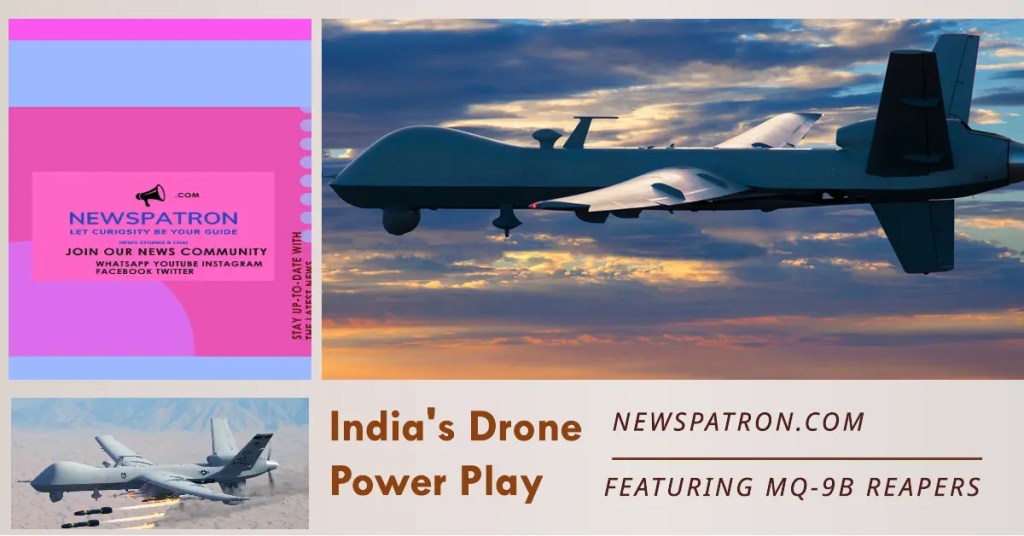

Image Courtesy General Atomics Aeronautical Systems Inc.
India MQ-9B Reaper Drones
Buckle up, folks! We’re about to take off on a thrilling journey into the high-flying world of military drones, where cutting-edge technology meets geopolitical strategy. 🇮🇳🇺🇸🇨🇳
Today, we’re zooming in on India’s quest to acquire the mighty MQ-9B Reaper drones from the USA—a move that has sent ripples across the strategic landscape of South Asia. We’ll dissect the capabilities of this hunter-killer drone, explore its potential impact on India’s defence capabilities, and delve into the complex regional dynamics surrounding drone technology.
But hold on tight, because this isn’t just a dry analysis of military hardware. We’ll also be peeking behind the curtain of the India-US drone deal, examining its implications for the delicate balance of power in the region. Oh, and did we mention the brewing drone rivalry between India and its neighbours, China and Pakistan? It’s a geopolitical chess match with high stakes, and we’re here to break it down for you.
So, whether you’re a seasoned defence analyst or simply curious about the future of warfare, get ready for an exhilarating ride. We’ll be soaring through the skies, exploring the cutting edge of drone technology, and navigating the complex terrain of international relations.
Call to Action
- Don’t forget to check out my YouTube channels, DroneMitra and NewsPatron, for some breathtaking drone footage and tips on how to capture your own aerial masterpieces!
- Want to learn how to edit those stunning drone videos like a pro? Check out my blog post on Davinci Resolve, a free video editing software for both PC and iOS.
- Feeling inspired? We welcome aspiring contributors and future editors to join our team at NewsPatron.
- Got something to say? Join our forums and start a conversation. Share your thoughts on this blog post or any other topic that sparks your interest. We love hearing from our readers!
Let’s connect on social media!
India’s Drone Ambitions Take Flight: A Closer Look at the MQ-9B Reaper Deal
India, a rising power on the global stage, is making bold strides to modernize its military capabilities. One of the most significant developments in recent years has been its pursuit of the MQ-9B Reaper drones, a state-of-the-art unmanned aerial vehicle (UAV) developed by General Atomics Aeronautical Systems in the United States.
This deal, if finalized, would mark a major milestone in India’s defence cooperation with the US and significantly enhance its strategic capabilities. The MQ-9B Reaper, often referred to as the “hunter-killer” drone, is a versatile platform that can perform a wide range of missions, from surveillance and reconnaissance to targeted strikes.
The Strategic Imperative
India’s interest in the MQ-9B Reaper stems from a growing recognition of the critical role that drones play in modern warfare. The changing nature of conflict, characterized by asymmetric threats and the need for precision strikes, has made drones an indispensable asset for any modern military.
Furthermore, India faces unique security challenges, including a long and disputed border with China and ongoing tensions with Pakistan. The MQ-9B Reaper, with its long endurance and advanced capabilities, would provide India with a crucial advantage in monitoring these volatile borders and responding to potential threats.
The Deal in the Making
India and the US have been engaged in negotiations for the acquisition of 31 MQ-9B Reaper drones for several years. The deal, estimated to be worth around $3 billion, has faced several hurdles, including concerns over technology transfer and the high cost of the drones.
However, recent reports suggest that the deal is now in its final stages and could be finalized soon. This would be a major boost for India’s defence capabilities and a testament to the growing strategic partnership between India and the US.
The Road Ahead
The acquisition of the MQ-9B Reaper drones is just one piece of the puzzle in India’s quest to modernize its military. The country is also investing heavily in other areas, such as fighter jets, submarines, and missile systems.
However, the MQ-9B Reaper deal is particularly significant because it represents a shift towards unmanned systems and a recognition of their growing importance in future conflicts. It also signals India’s willingness to partner with the US to counter China’s growing influence in the region.
The road ahead is fraught with challenges, but India’s drone ambitions are taking flight. The MQ-9B Reaper deal, if successful, will mark a new chapter in India’s defense strategy and its role in the evolving geopolitical landscape of South Asia.
Unveiling the MQ-9B Reaper: The Hunter-Killer Drone with a Multitude of Missions
The MQ-9B Reaper, often dubbed the “hunter-killer” drone, is a marvel of modern engineering, a testament to the rapid advancements in unmanned aerial vehicle (UAV) technology. Developed by General Atomics Aeronautical Systems, this remotely piloted aircraft has proven its mettle in numerous conflicts around the world, earning a reputation as a formidable and versatile platform. Let’s take a closer look at its specifications, capabilities, and the diverse range of missions it can undertake.
MQ-9B Reaper: The Specs and Skills
This ain’t your average drone, folks. The MQ-9B Reaper is a beast, boasting a wingspan that rivals that of a small passenger plane. It’s packed with state-of-the-art technology, including a powerful turboprop engine that allows it to soar to altitudes of up to 50,000 feet and stay airborne for a whopping 27 hours. That’s right, this bird can fly for over a day without needing a pit stop! 🤯
But it’s not just about endurance. The Reaper is also a heavy lifter, capable of carrying a payload of up to 3,800 pounds. This includes a wide array of sensors, cameras, and most importantly, weapons. We’re talking Hellfire missiles, laser-guided bombs, and other precision-guided munitions. In short, this drone packs a serious punch. 💪
Mission: Impossible? Not for the Reaper
The MQ-9B Reaper is a true multi-role platform, capable of performing a wide range of missions with remarkable efficiency. Let’s break down some of its key applications:
- Surveillance and Reconnaissance: With its advanced sensor suite, including synthetic aperture radar (SAR) and electro-optical/infrared (EO/IR) cameras, the Reaper can keep a watchful eye on vast areas, tracking targets and gathering intelligence with pinpoint accuracy. 🕵️♂️
- Targeted Strikes: When the situation calls for action, the Reaper can deliver precise strikes against hostile targets, minimizing collateral damage and ensuring mission success. 🎯
- Search and Rescue: In humanitarian missions, the Reaper’s long endurance and powerful sensors can be invaluable in locating missing persons or disaster survivors, even in remote or inaccessible areas. ⛑️
- Border Security: The Reaper can patrol vast stretches of border, monitoring for illegal activities and providing real-time information to ground forces. 🛂
India’s Ace in the Hole?
For India, the MQ-9B Reaper represents a significant leap forward in its drone capabilities. It would provide the Indian military with a powerful tool to address its unique security challenges, from monitoring its vast borders to countering terrorist threats.
The Reaper’s ability to operate at high altitudes for extended periods, coupled with its advanced sensors and weapons, makes it a force to be reckoned with. It could be a game-changer in India’s efforts to maintain peace and stability in the region. 🕊️
India’s Drone Landscape: Challenges and Opportunities
India’s foray into the world of drones has been a mix of ambition and obstacles. While the potential applications of drone technology are vast and exciting, significant hurdles remain. Let’s delve into the key challenges and opportunities India faces in its drone landscape.
Navigating the Technological Terrain
One of the primary challenges facing India is bridging the technological gap in drone development. While the country has made significant strides in recent years, it still lags behind global leaders like the US and China in certain areas, such as artificial intelligence (AI)-based autonomy and swarming capabilities.
India’s push for self-reliance in defence technology, exemplified by the “Make in India” initiative, is a step in the right direction. However, achieving technological parity will require sustained investment in research and development and collaboration with international partners.
The Regulatory Tightrope
Another challenge lies in establishing a robust yet flexible regulatory framework for drones. Striking the right balance between ensuring safety and security while fostering innovation and promoting the commercial use of drones is a delicate task.
India has made progress with the introduction of the Drone Rules, 2021, which aim to streamline the process of obtaining permits and operating drones. However, further refinements and adaptations may be necessary as the drone industry evolves.
The Dark Side of Drones
The potential misuse of drones for nefarious purposes is a serious concern. From smuggling contraband to carrying out terrorist attacks, the risks are real and need to be addressed proactively.
India has already witnessed instances of drones being used for illegal activities, highlighting the need for robust counter-drone measures and effective law enforcement. It’s a constant cat-and-mouse game, but one that India cannot afford to lose.
Soaring to New Heights: The Opportunities
Despite the challenges, the opportunities presented by drone technology are immense. Drones have the potential to revolutionize various sectors, bringing about greater efficiency, productivity, and accessibility. Let’s take a look at a few key areas:
- Agriculture: Drones can be used for precision farming, enabling farmers to monitor crops, assess soil health, and optimize irrigation with unprecedented accuracy. This can lead to increased yields, reduced costs, and more sustainable agricultural practices. 🌱
- Logistics: The use of drones for last-mile delivery, especially in remote or inaccessible areas, can transform the logistics landscape. Imagine packages being delivered to your doorstep by a drone, bypassing traffic congestion and reducing delivery times. 📦
- Disaster Management: In the aftermath of natural disasters, drones can play a crucial role in assessing damage, delivering aid, and conducting search and rescue operations. Their ability to access hard-to-reach areas can be a lifesaver in critical situations. 🆘
The Sky’s the Limit
India’s drone landscape is dynamic and rapidly evolving. While challenges remain, the opportunities are vast and the potential for growth is immense. With the right policies, investments, and technological advancements, India can harness the power of drones to transform various sectors and achieve its developmental goals. The sky’s the limit! 🚀
The Geopolitical Chessboard: Drone Dynamics in South Asia
The rise of drone technology has added a new layer of complexity to the already intricate geopolitical landscape of South Asia. As nations in the region strive to modernize their military capabilities, the acquisition and deployment of drones have become a key strategic priority. However, this technological arms race is not without its challenges and implications.
China’s Expanding Influence: A Looming Shadow
China, with its assertive military posture and rapid advancements in drone technology, casts a long shadow over the region. Its ambition to become a global technological superpower is evident in its strategic investments in unmanned aerial vehicles (UAVs). These drones are not just tools for surveillance and reconnaissance; they are also potential weapons of war, capable of delivering precision strikes and disrupting enemy operations.
China’s willingness to export its drone technology to its allies and partners, particularly Pakistan, has further fuelled concerns in the region. This has created a complex web of alliances and rivalries, with each nation vying for technological superiority and strategic advantage.
Pakistan: A Strategic Pawn in the Drone Game
China’s close military ties with Pakistan add another layer of complexity to the geopolitical chessboard. The “all-weather friendship” between the two nations has seen China providing Pakistan with advanced military equipment, including armed drones. This has raised concerns in India, which shares a tense border with Pakistan and has a history of conflict with its neighbour.
The spectre of Chinese-made drones being used against Indian targets is a real one. Recent reports of Pakistani drones being used for cross-border smuggling and even attacks have further fuelled these anxieties. India’s acquisition of the MQ-9B Reaper drones can be seen as a strategic response to this growing threat.
India’s Balancing Act: A Delicate Dance
India’s decision to acquire the MQ-9B Reaper drones from the US is a significant move in its quest to maintain a balance of power in the region. It signals India’s intent to bolster its own defence capabilities and deter potential adversaries.
The MQ-9B Reaper, with its advanced features and capabilities, provides India with a crucial edge in the drone warfare domain. It enables India to conduct long-range surveillance, gather critical intelligence, and even launch precision strikes if necessary. This not only enhances India’s defensive posture but also gives it a credible offensive capability, which could act as a deterrent against any potential aggression.
The Regional Balance of Power: A Shifting Landscape
The induction of MQ-9B Reapers into the Indian Air Force is likely to have a significant impact on the regional balance of power. It sends a clear message to China and Pakistan that India is committed to safeguarding its national security and will not hesitate to use advanced technology to do so.
The drone deal also underscores the deepening strategic partnership between India and the US. It signifies a shared commitment to counter China’s growing assertiveness in the region and maintain a free and open Indo-Pacific. This has the potential to reshape the geopolitical landscape of South Asia, creating new alliances and realignments.
The Future of Drone Warfare: A New Era
The dynamics surrounding drone technology in South Asia are complex and evolving. India’s acquisition of the MQ-9B Reaper is a significant step towards strengthening its defence capabilities and maintaining a balance of power in the region. However, the challenges posed by China’s drone ambitions and its military partnership with Pakistan cannot be ignored.
The future of drone warfare in South Asia is likely to be shaped by these geopolitical realities and India’s strategic choices. As technology continues to advance at a rapid pace, the role of drones in future conflicts is only set to grow. It is imperative for India to stay ahead of the curve and continue to invest in drone technology to ensure its national security and maintain its position as a regional power.
MQ-9B Reaper vs. Chinese Drones: A Comparative Analysis
In the high-stakes game of drone warfare, technological superiority can often be the deciding factor. As India prepares to induct the MQ-9B Reaper into its arsenal, it’s crucial to understand how this advanced UAV stacks up against its Chinese counterparts. Let’s delve into a comparative analysis of the MQ-9B Reaper and some of the leading Chinese drones, examining their strengths, weaknesses, and implications for India’s defence strategy.
The MQ-9B Reaper: A Technological Powerhouse
The MQ-9B Reaper, developed by General Atomics Aeronautical Systems, is widely regarded as one of the most advanced unmanned aerial vehicles in the world. Its impressive specifications and capabilities make it a formidable asset for any military.
- Endurance and Range: With an endurance of up to 27 hours and a range of over 1,100 miles, the Reaper can conduct long-duration missions, providing persistent surveillance and strike capabilities. This allows it to loiter over target areas for extended periods, gathering intelligence and awaiting the opportune moment to strike.
- Sensor Suite: Equipped with a sophisticated sensor suite, including synthetic aperture radar (SAR), electro-optical/infrared (EO/IR) cameras, and signals intelligence (SIGINT) systems, the Reaper can gather critical intelligence even in challenging environments. This multi-faceted sensor suite enables it to see through clouds, darkness, and even camouflage, providing a clear picture of the battlefield.
- Weapon Systems: The Reaper can carry a variety of precision-guided munitions, including Hellfire missiles and laser-guided bombs, enabling it to engage targets with pinpoint accuracy. This minimizes collateral damage and ensures that strikes are delivered with surgical precision.
- Network Connectivity: The Reaper’s advanced communication systems allow it to operate seamlessly with other manned and unmanned platforms, enhancing situational awareness and coordination. This enables it to share real-time information with ground troops, fighter jets, and other assets, creating a network-centric battlefield.
Chinese Drones: Rising to the Challenge
China has made significant strides in drone technology in recent years, developing a range of UAVs for both military and civilian applications. Some of the leading Chinese drones that could potentially compete with the MQ-9B Reaper include:
- CH-4: Often referred to as the “Chinese Predator,” the CH-4 is a medium-altitude, long-endurance (MALE) UAV designed for reconnaissance and strike missions. While it shares some similarities with the Reaper, it may lack the same level of sophistication in terms of sensors and weapon systems. It is also believed to have a shorter range and endurance compared to the Reaper.
- Wing Loong II: Another MALE UAV developed by China, the Wing Loong II boasts a longer endurance and greater payload capacity than the CH-4. It has been exported to several countries and has seen combat action in various conflicts. However, its overall capabilities, particularly in terms of sensor technology and network connectivity, may still fall short of the Reaper.
The Comparative Edge: MQ-9B Reaper’s Strengths
When pitted against its Chinese counterparts, the MQ-9B Reaper holds several distinct advantages:
- Superior Sensors and Weapon Systems: The Reaper’s advanced sensor suite and precision-guided munitions give it a clear edge in terms of situational awareness and strike capabilities. It can detect, track, and engage targets with greater accuracy and efficiency, even in challenging environments.
- Proven Track Record: The Reaper has been extensively used in combat operations by the US and its allies, demonstrating its reliability and effectiveness in real-world scenarios. This battle-tested experience gives it a significant advantage over its Chinese counterparts, which have seen limited combat use.
- Interoperability: The Reaper’s ability to integrate seamlessly with other US and allied platforms enhances its operational flexibility and effectiveness in joint missions. This allows it to operate as part of a larger network, sharing information and coordinating actions with other assets in real-time.
Implications for India’s Defense Strategy
India’s acquisition of the MQ-9B Reaper drones is a strategic move that strengthens its defence capabilities and enhances its deterrence posture. The Reaper’s advanced features and capabilities provide India with a significant advantage in monitoring its borders, countering terrorist threats, and projecting power in the region.
However, it’s important to note that China’s drone technology is rapidly evolving, and India cannot afford to become complacent. It must continue to invest in research and development, explore collaboration with international partners, and maintain a vigilant eye on the evolving drone landscape.
The MQ-9B Reaper is a valuable addition to India’s arsenal, but it’s just one piece of the puzzle. A comprehensive and multi-layered defence strategy, encompassing both manned and unmanned systems, is essential to ensure India’s national security in the years to come.
Conclusion: India’s Drone Odyssey
India’s pursuit of the MQ-9B Reaper drones marks a significant turning point in its defense strategy, reflecting a growing recognition of the critical role that unmanned aerial vehicles (UAVs) play in modern warfare. It underscores India’s determination to equip its armed forces with the latest technology and maintain a credible deterrent against potential adversaries.
The MQ-9B Reaper, with its impressive capabilities and versatility, offers India a potent tool to address its security challenges, from monitoring its vast borders to countering terrorist threats. It also signals India’s intent to project power in the region and maintain a balance of power with its neighbours.
However, the acquisition of these drones is just one step in India’s drone odyssey. The country faces several challenges, including the need to bridge the technological gap in drone development, establish a robust regulatory framework, and address the potential misuse of drones.
At the same time, the opportunities presented by drone technology are immense. Drones have the potential to revolutionize various sectors, from agriculture and logistics to disaster management and law enforcement. India must seize these opportunities and harness the power of drones to achieve its developmental goals.
The future of drone warfare in South Asia is likely to be shaped by the complex interplay of geopolitical factors, technological advancements, and strategic choices. India’s decision to acquire the MQ-9B Reaper is a bold move that could have far-reaching implications for the region’s security landscape.
As India embarks on this drone odyssey, it must navigate the challenges and seize the opportunities with wisdom and foresight. The MQ-9B Reaper is not just a weapon; it’s a symbol of India’s ambition to become a technological powerhouse and a responsible global player. The sky’s the limit, and India’s drone journey has just begun. 🚀
Don’t forget to check out our other insightful blog posts in the defence category for more in-depth analysis and discussions on military technology and strategy.
[IAF Ditches FGFA: AMCA Soars as India’s Fighter Jet Future]
[Sweat, Grit, & Glory: Inside Indian Army Training]
We also encourage our readers to become contributors and share their knowledge and perspectives with our community. Who knows, you might even graduate to become an editor at NewsPatron!
Join our forums and start a conversation. We love hearing from our readers and value your feedback.
[bbp-single-topic id=7381]
India MQ-9B Reaper Drones
Questions and Answers
Q: What is the status of the deal between India and the US for the purchase of Hunter drones?
A: The deal for India to purchase 30 Hunter drones from the US is in the advanced stage. 15 of these drones, called Sea Guardians, will be used for maritime surveillance by the Indian Navy, while 8 Sky Guardians will be used for air surveillance by the Indian Army and Air Force.
Q: What are the key capabilities of the MQ-9B Reaper or Predator B drone that India is acquiring?
A: The MQ-9B Reaper drone can fly continuously for up to 40 hours at an altitude of 40,000 feet. It has a range of 1,900 km and a top speed of 388 km/h. It can carry a payload of up to 1,700 kg, including air-to-ground missiles and laser-guided bombs.
Q: How does the technology of Chinese drones compare to the American drones that India is acquiring?
A: While China has developed its own drone technology, the American drones like the MQ-9B Reaper are considered more advanced. The American drones have superior radar capabilities, can capture high-quality video for longer durations, and have a higher payload capacity compared to the Chinese counterparts.
Q: What are the key applications and use cases for the drones that India is acquiring?
A: The drones can be used for a variety of applications, including border surveillance, counter-terrorism operations, disaster relief and search-and-rescue missions, as well as for law enforcement purposes along the India-Pakistan border.
Glossary of Drone Terminology
- UAV (Unmanned Aerial Vehicle): An aircraft operated without a human pilot on board.
- MALE (Medium-Altitude Long-Endurance) UAV: A type of drone capable of flying at medium altitudes (typically 10,000-30,000 feet) for extended periods (often exceeding 24 hours).
- SAR (Synthetic Aperture Radar): A radar system that creates high-resolution images by combining multiple radar returns from different positions.
- EO/IR (Electro-Optical/Infrared) Cameras: Cameras that capture images in both the visible and infrared spectrums, allowing for day and night vision.
- SIGINT (Signals Intelligence): The collection and analysis of electronic signals, such as communications and radar emissions.
- Payload: The equipment carried by a drone, such as sensors, cameras, or weapons.
- Precision-Guided Munitions: Weapons that use guidance systems to hit their targets with high accuracy.
- Network-Centric Warfare: A military doctrine that emphasizes the sharing of information and coordination between various forces and platforms.
- Swarming: The coordinated operation of multiple drones acting as a collective unit.
- Counter-Drone Measures: Technologies and tactics used to detect, track, and neutralize hostile drones.
#India #MQ9BReaper #Drones #Defense #Military #UAV #China #Pakistan #Geopolitics #Strategy #UnmannedAerialVehicle #HunterKillerDrone #Surveillance #Reconnaissance #TargetedStrikes #BorderSecurity #GeneralAtomics #MakeInIndia

[…] India’s Drone Power Play: MQ-9B Reapers Soar High […]