




Editorial Note: This article is based on publicly circulated video footage of an incident in Wadala, Mumbai posted on 15 March 2026. The identities of both individuals involved have not been confirmed in any official report, and neither is named here. No FIR or official police statement has been issued at time of publication. All commentary reflects editorial opinion and civic advocacy. Newspatron does not endorse targeting of any individual or community. The footage is used for the purpose of public interest journalism and road-safety commentary.
AdvertisementSubscribe to @newspatron on YouTube — Let Curiosity Be Your Guide.
Let us start with the economics. ?
A Mahindra Thar costs somewhere between ₹14 and ₹20 lakh on road, depending on variant. It is a serious piece of machinery — capable, rugged, the kind of vehicle that makes a statement in Mumbai traffic whether you intend it to or not. An auto-rickshaw costs roughly ₹2–3 lakh. It is not in the same league, financially or physically.
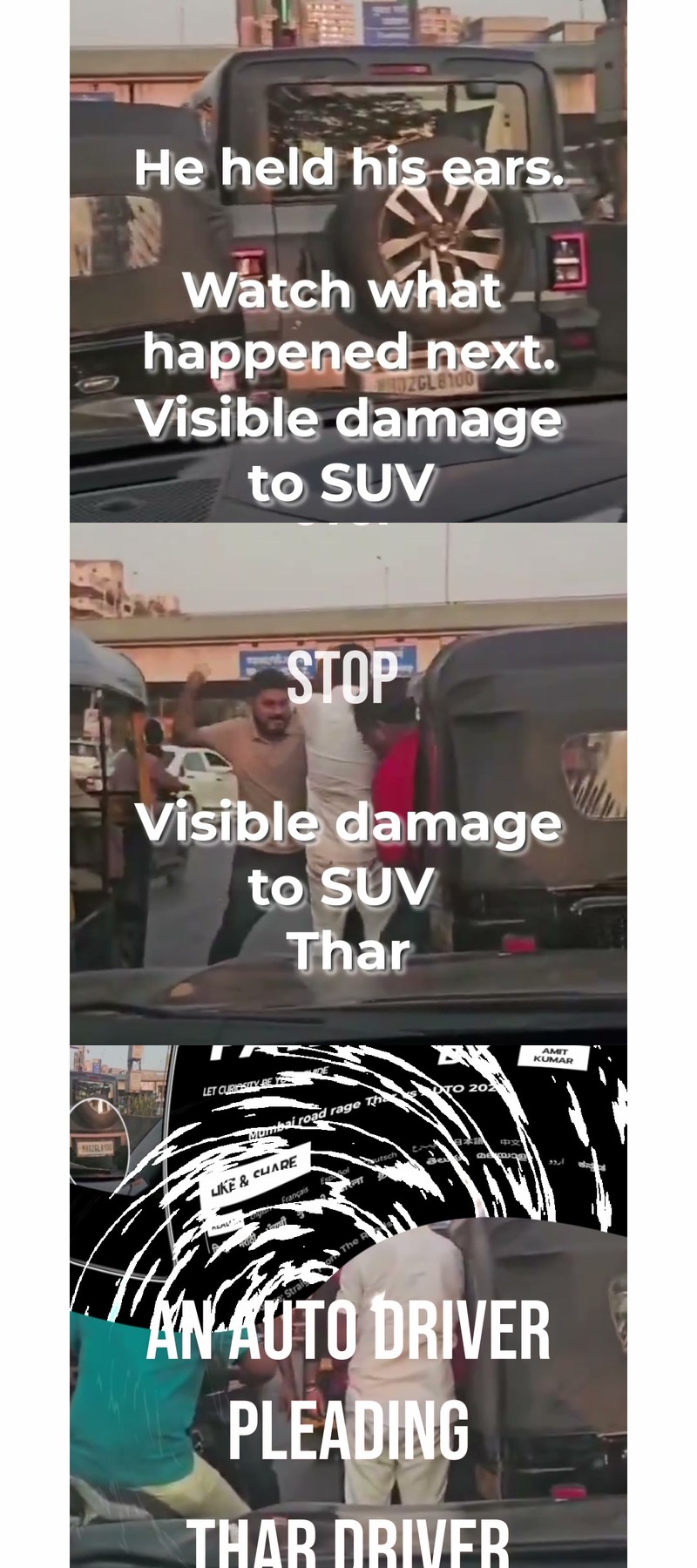
In Wadala, Mumbai, on 15 March 2026, the two met. Minor scrape. The kind of contact that happens approximately four hundred times a day somewhere in this city and is resolved in under sixty seconds because both parties have places to be.
This one was not resolved in sixty seconds.
The Thar owner got out of the vehicle. The rickshaw driver apologised. The rickshaw driver held his ears — the universal, unmistakeable gesture of submission that every Indian recognises as “I am sorry, I am sorry, please let this be over.” The Thar owner hit him anyway. Multiple times. The video is thirty-four seconds long. It has been watched over 220,000 times.
Visible damage to the Thar: approximately zero.
Recommended Product
Trylo Riza T-Fit Women's Bra – Comfortable Daily Wear
🛒 View on Amazon →As an Amazon Associate, we earn from qualifying purchases. Price and availability may vary.
And that, in one sentence, is why “Thar culture” is a phrase that now has its own documented incident history across multiple Indian cities.
What Happened in Wadala
The incident occurred in Wadala, Mumbai. The video was posted publicly on 15 March 2026 and spread rapidly across multiple platforms within hours.
The sequence is straightforward. A Mahindra Thar and an auto-rickshaw make contact — a minor collision, the kind where both vehicles keep moving in most cases. They do not keep moving. The Thar stops. The driver gets out.
What follows is not an argument. It is not a heated exchange that gets out of hand. It is one man hitting another man who is apologising. The rickshaw driver does not raise his hands. He does not shout back. He holds his ears. He stays in the posture of apology throughout.
The Thar owner continues hitting him.
There is no confirmation of either person’s name, or whether a police complaint has been filed. What is confirmed is the video. And the video is unambiguous.
The Comment Section Is Also the Story
Here is what makes this incident more than just a viral clip — the reaction to it is almost as revealing as the footage itself.
The replies split roughly 55/45. Not 90/10. Not the easy consensus you might expect from a video of a man hitting someone who is apologising and holding his ears.
Fifty-five percent: outrage at the violence. Clear, immediate, correct.
Forty-five percent: “autos are road menaces,” “people work their life savings for a ₹20 lakh car,” “why does the Thar always get blamed,” “if the rickshaw had hit him first this would be different.”
Both camps are saying something true. Auto-rickshaws in Mumbai traffic are — and this is a fact, not an opinion — frequently the source of sudden lane changes, unexpected stops, and minor collisions that leave car owners frustrated and occasionally out of pocket when the driver simply disappears. That is real.
And also: a man holding his ears on a public road, apologising, got hit anyway. The apology was not the point. The hitting was the point.
One reply captured something worth examining: “₹0 ka nuksaan, 100% ka drama.” It is funny. It is accurate. And it points at the actual problem — which is not the scrape. The scrape is the excuse. The hitting is the message. The message is: I can do this. Nothing will happen to me.
We have seen that message before. In Nikol, Ahmedabad. In Hyderabad’s Gachibowli. In Noida, Gurugram, Jhansi, and a dozen other cities. The vehicle changes. The message does not.
Thar Culture: A Documented Pattern
We are not picking on a car. The Mahindra Thar is a vehicle. It does not make decisions. But the incidents associated with it have become frequent enough, and consistent enough in their character, that the phrase “Thar culture” has entered everyday Indian discourse — not as a joke, but as a genuine shorthand for a pattern of behaviour that keeps repeating itself on Indian roads.
We have covered several of these incidents on Newspatron. They are worth reading together, because they tell a more complete story than any single clip can.
In Jhansi, a Thar dragged a victim five hundred metres in a hit-and-run that crystallised everything wrong with India’s road-rage enforcement gap:
In Noida Sector 16, a Thar went on a rampage that prompted the question — in the headline, unapologetically — of whether this vehicle should be declared India’s Rashtriya Gundagiri Vehicle:
In Haryana, HR 30 AA 4000 — a VIP-number Thar — nearly crushed bystanders in a stunt filmed by the driver himself:
And in Shimla, the same vehicle that parades through cities with aggressive confidence had to be rescued from snow by a Maruti Jimny — while onlookers asked the question that perhaps needed to be asked: “Itna kharcha karke bhi result na mile, toh kya fayda?”
Read those four together. The Wadala incident is not an outlier. It is an entry in a series.
The Class Warfare Framing: Useful and Incomplete
The “rich car vs poor driver” frame is the first place most people go with this video. It is emotionally satisfying, partially accurate, and — if we are being honest — lets the actual problem off the hook. ?
The problem is not wealth. Plenty of wealthy people in Mumbai are involved in minor collisions every day and resolve them without hitting anyone. The problem is the specific belief that wealth insulates you from consequence. That a ₹20 lakh vehicle is also a ₹20 lakh licence to escalate, to dominate, to hit — and walk away.
That belief is not unique to Thar owners. It is not unique to Mumbai. We saw it in Nikol, Ahmedabad, where an elderly man on a car bonnet said “I won’t file a case” — because he understood that the driver’s calculation was about consequence, not the scrape. We saw it at Nanakramguda in Hyderabad, where a uniformed traffic constable on a Mercedes bonnet was not enough to make the driver stop.
The vehicle is different every time. The calculation is the same: I can do this. Nothing consequential will happen.
And the reason that calculation keeps being made is because, too often, it is correct.
What the Law Says — and What Should Happen
No FIR has been confirmed at time of publication. Here is what the law provides, if it is applied.
IPC Section 323 — voluntarily causing hurt. This is the baseline. A fine and imprisonment up to one year. It applies regardless of whether the victim sustained visible injury — the act of hitting is the offence, not the result.
IPC Section 341 — wrongful restraint. If the rickshaw driver was prevented from leaving the scene during the assault, this section applies alongside 323.
Motor Vehicles Act — a conviction for violent behaviour during a road incident can and should result in referral to the licensing authority for suspension or cancellation of the driving licence. The Thar’s registration number is visible in the video. It is not invisible. It is not unknown.
The rickshaw driver has the right to file a First Information Report. If he chooses not to — out of fear, out of practical calculation about what filing a report against someone with a ₹20 lakh car actually produces for a rickshaw driver in Mumbai — that is a statement about the system, not about the law.
Witnesses can file complaints independently. The video itself is evidence. The only question is whether anyone chooses to use it.
The Rickshaw Driver
He has no name in this story. He did not make the video. He did not post it. He was doing his job.
After the minor collision, he apologised. He held his ears. He stayed in the posture of submission that anyone who has grown up in India recognises as the most unambiguous possible signal: I am sorry, I accept responsibility, please let this be over.
It was not enough.
His income for that day was disrupted. His dignity was publicly removed on a road in Wadala, watched by bystanders, filmed, uploaded, and viewed 220,000 times. He is now a symbol in a debate about class and entitlement that he did not ask to be part of.
He is not a symbol. He is a person who drives an auto-rickshaw for a living, got into a minor scrape, apologised for it, and got hit anyway.
That is the story. Everything else is context.
The Close
The question “Why always Thar?” answers itself — eventually. ?
Not because the car is cursed. Not because Thar owners are uniquely violent. But because a certain kind of buyer, in a certain state of mind, treats a ₹20 lakh vehicle as a ₹20 lakh statement of position on the road. And when that position is challenged — even accidentally, even by a minor scrape, even by someone who is already apologising — some of them respond by demonstrating the statement physically.
The rickshaw driver’s apology deserved to end the confrontation. It did not. That gap — between what should have happened and what did — is not a Wadala problem. It is an India problem. And it will keep producing thirty-four-second videos until the calculation changes.
The calculation changes when the FIR gets filed. When the licence gets suspended. When the consequence is proportionate to the act.
Until then: next incident, next city, same story.
The road belongs to everyone driving on it. Including the people in the ₹2 lakh vehicles.
Have you witnessed or experienced road rage in Mumbai? Tell us in the comments — your account adds to the pattern that data alone cannot document.
A Note on Sources: The video footage used in this report was publicly circulated and is used here for public interest journalism and road-safety commentary. The footage was not filmed or posted by Newspatron. The identities of both individuals are unconfirmed; neither is named in this report. No official police statement or FIR has been confirmed at time of publication. All legal analysis reflects editorial interpretation and does not constitute legal advice.
Newspatron — Let Curiosity Be Your Guide.
