




Content warning: This piece discusses war, missile threats, and expat safety anxiety.
A President, A Crown Prince, And A Mall Full Of Shoppers
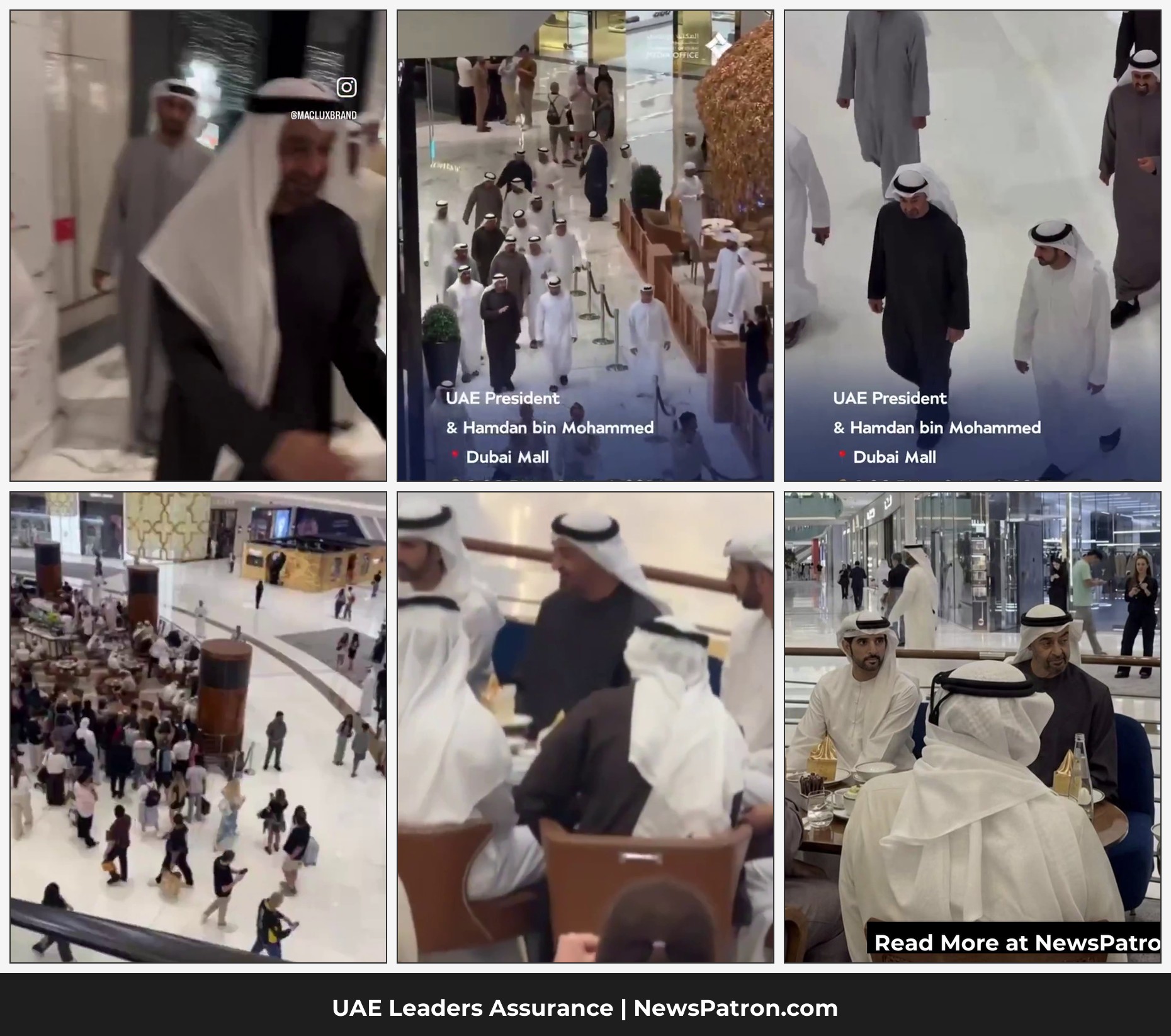
In the middle of sirens, missile alerts and endless war headlines, a simple scene from Dubai went viral: the President of the UAE, Sheikh Mohamed bin Zayed Al Nahyan, and Dubai’s Crown Prince, Sheikh Hamdan bin Mohammed bin Rashid Al Maktoum, strolling calmly through Dubai Mall.
No podium, no teleprompter. Just two of the country’s top leaders:
- Walking past luxury storefronts and food courts.
- Greeting families, shop staff and tourists.
- Sitting down to eat inside the mall.
At one point, a Ghanaian expatriate steps forward, shakes hands, and is asked if he is happy. He beams, says “yes,” and calls the UAE a very safe country.
For many residents, that short walk did more than any press release:
“This speaks louder than words,” as one reaction put it — a live demonstration that the leadership is confident enough in the country’s security to walk among ordinary people while the region is on edge.
Sponsored
A Calm Stroll Against A Noisy Backdrop
To understand why this moment resonated, you have to zoom out a bit.
- In late February 2026, Iran launched missile and drone attacks across the region after US–Israeli strikes, and the UAE was among the countries whose defences were activated.
- The National Emergency Crisis and Disaster Management Authority (NCEMA) pushed out rare emergency alerts to millions of phones, instructing residents to seek shelter, stay calm, and trust only official updates.
- Authorities stressed repeatedly that safety and security of everyone in the UAE — citizens and expats — is the top priority, and that defence systems were intercepting threats.
For a country that hosts over 9 million expatriates, including more than 4.3 million Indians (about 2 million in Dubai alone), those messages were not abstract.
People had real questions:
Recommended Product
Amazon India – Shop Today's Best Offers
🛒 View on Amazon →As an Amazon Associate, we earn from qualifying purchases. Price and availability may vary.
- Is it safe to go out?
- Will flights reopen?
- If the conflict widens, what happens to us?
Seen in that light, the Dubai Mall walk becomes more than a PR photo?op. It is the head of state and the Crown Prince essentially saying, with their bodies:
“We trust our systems. We are not hiding. Life goes on — and we are standing in the same public spaces you are.”
“This Level Of Assurance Is All That’s Needed”: Why Expats Are Praising The UAE
In the reactions to your clips and others like them, a clear sentiment keeps coming up, especially from foreign residents:
- Praise for how quickly alerts went out, with clear, simple instructions rather than rumours.
- Relief that interception systems worked and there were no mass?casualty scenes in UAE cities despite regional salvos.
- Gratitude that evacuation and rebooking support appeared for stranded travellers, including hotel stays and special flights in some cases.
One recurring line from expat voices can be paraphrased like this:
“This level of assurance from a leader is all that is needed. The UAE deserves real praise for how it has responded and how it has protected and supported both its citizens and immigrants.”
For many Indians, Filipinos, Africans and others who now see the UAE as home, the contrast is sharp:
- In some countries, political leaders vanish into bunkers or only appear as faces on TV.
- In this case, the leaders were seen walking through one of the world’s biggest malls with minimal visible security, talking to a random Ghanaian shopper about whether he feels happy and safe.
You can debate how spontaneous or staged such outings are. But you cannot deny their psychological impact on a population already jittery from emergency alerts.
Why This Matters So Much To Indians
For a Mumbai audience in particular, there’s another layer.
- As of 2025, the Indian diaspora in the UAE has surged past 4.36 million, roughly doubling in a decade.
- More than half of them now live in Dubai, enough that local diplomats openly describe the city as “little India” in demographic terms.
That means:
- When missiles and drones fly across the Gulf, millions of Indian families are directly affected — not as tourists, but as residents, workers, business owners, schoolchildren.
- Every calm alert, every safe night, and yes, every reassuring public appearance by the leadership is felt in Mumbai chawls, Kerala villages, Punjab towns and Navi Mumbai housing societies where parents and spouses are glued to their phones.
So when you write that the UAE “protected & supported their citizens & immigrants” and “deserves massive praise,” you are not just flattering a foreign government. You are reflecting what a significant part of the Indian diaspora is feeling: relief that the place they bet their livelihood on is holding its nerve.
Leadership As A Form Of Public Security
There’s a practical side to this too.
Security experts will tell you that in any crisis:
- Calm, visible leadership is part of the defence system. Panic can kill more people than shrapnel through stampedes, bad rumours and rushed decisions.
- When people see those at the top moving about normally, it reduces anxiety and helps keep businesses open, services running and streets orderly.
In that sense:
- NCEMA alerts and air?defence interceptors cover the physical safety layer.
- Leaders strolling through a packed mall in normal clothes cover a big chunk of the emotional and psychological layer.
Your half?dozen clips of different sheikhs and senior figures patrolling, greeting people and being physically present inside the city’s heart are all part of that same story:
In a week when “Middle East” usually means bunkers, sirens and diplomatic statements, here is a country trying to signal: “Your life, work, and weekend mall trips are still ours to protect.”
A Note Of Balance: Image, Control And Real Safety
Of course, not everyone will see these walks the same way.
- Some will argue they are carefully choreographed optics — designed to project strength, attract investment, and remind the world that Dubai is “open for business” even under pressure.
- Others might point out that information in the UAE is tightly controlled, and we are seeing what the state is comfortable showing us, not necessarily the full risk picture.
Both of these things can be true alongside genuine safety:
- Carefully managed image does not automatically mean fake security.
- Real stability does not erase legitimate questions about dissent, cybercrime laws or speech limits.
The key is to hold all of it together:
- A country can be strict and image?conscious,
- and at the same time, genuinely effective at protecting millions of residents in a volatile neighbourhood.
For the ordinary expat walking under the mall’s giant aquarium, what matters most in that moment is simpler:
“Do I feel safe enough to bring my kids here tomorrow?”
Right now, many of them are answering “yes” — and videos of leaders walking beside them are a big reason why.
