




A Whisper from the Chimneys
Hello, friends! Welcome back to Newspatron. Today, we aren’t just reading history; we are walking through the ghost stories of a city we love. If you listen closely to the wind in Lower Parel today, beneath the honking of luxury cars, you might still hear the phantom sirens of the textile mills.
We are going to revisit a defining moment—the Mumbai Textile Strike 1982. This wasn’t just a protest; it was the moment Bombay truly became Mumbai, shedding its blue-collar skin for a glittering, sometimes ruthless, corporate suit. We will uncover the hidden “Polyester Politics” that many ignore and ask a tough question: Is the modern gig economy walking into the same trap?
Before we dive in, if you want to see how this city looks from the skies today—a mix of old scars and new glass—check out my YouTube channel, DroneMitra (“Your Sky is Digital with a Drone as a Friend”). And for more deep dives like this, stay tuned to Newspatron (“Let Curiosity Be Your Guide”).
Let’s turn the clock back.
The Village of Mills: When Bombay Beat to a Cotton Rhythm
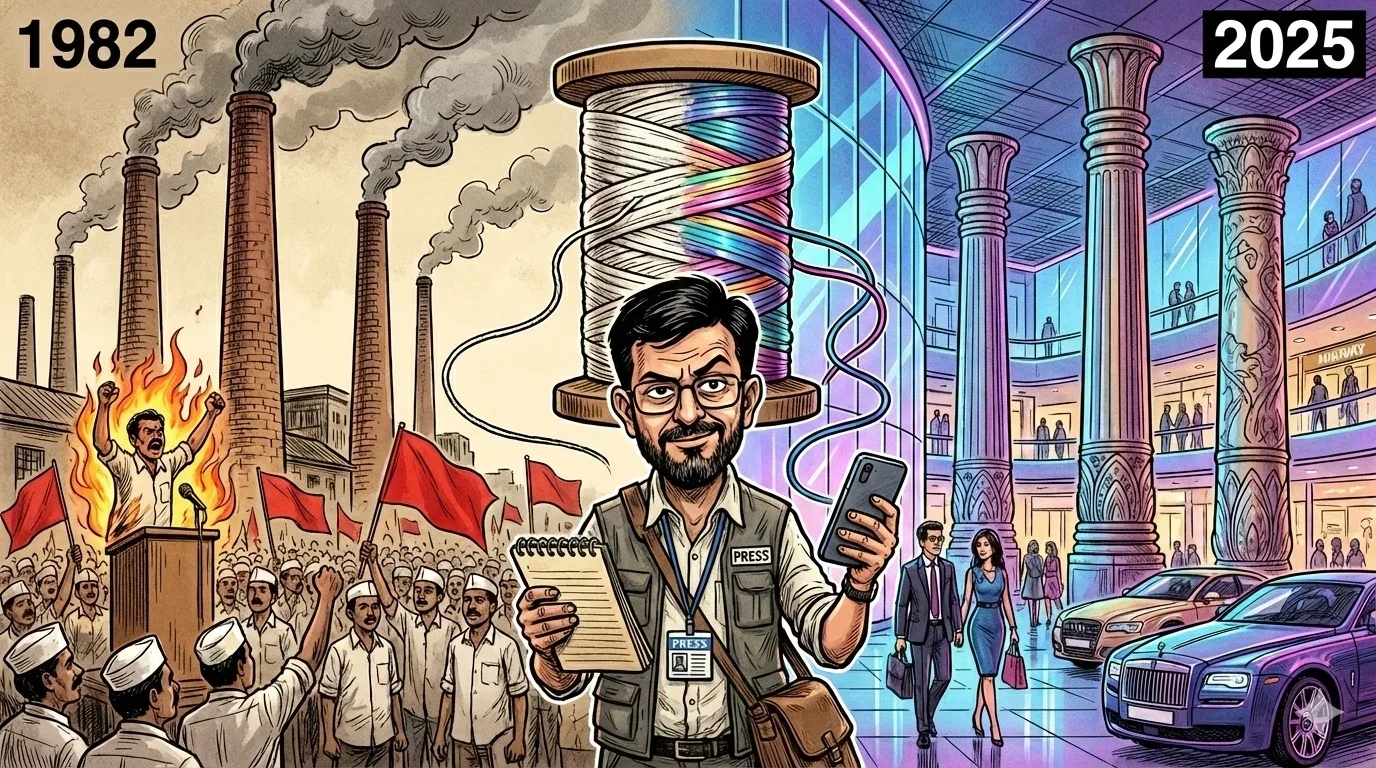
Before the skyscrapers blocked the sun, central Mumbai was known by a different name: Girangaon, or the “Village of Mills.”
Imagine a sprawling 2.4 square kilometer heartbeat in the center of the island city. This wasn’t just a workplace; it was a civilization. At its peak, this area housed nearly 130 textile mills, mostly spinning the cotton that made Bombay the financial capital of India. It all started way back in 1856 with the Bombay Spinning and Weaving Company. By the turn of the century, over 130,000 workers were sweating it out here, shaping a unique culture that defined the city’s spirit.
These workers lived in chawls—tight-knit community housing in areas like Parel, Lalbaug, and Worli. They worked 12-hour shifts (until laws mercifully cut it to 10), fueling the fortunes of legendary business families like the Tatas, Wadias, and Petits. The government loved them, offering long-term leases because these mills were the engine of employment.
But as the 1980s approached, the machinery was getting old, and the mood was getting sour. The stage was set for the Mumbai Textile Strike 1982, a collision that would silence these sirens forever.
The “Knockout Punch”: What Really Happened?
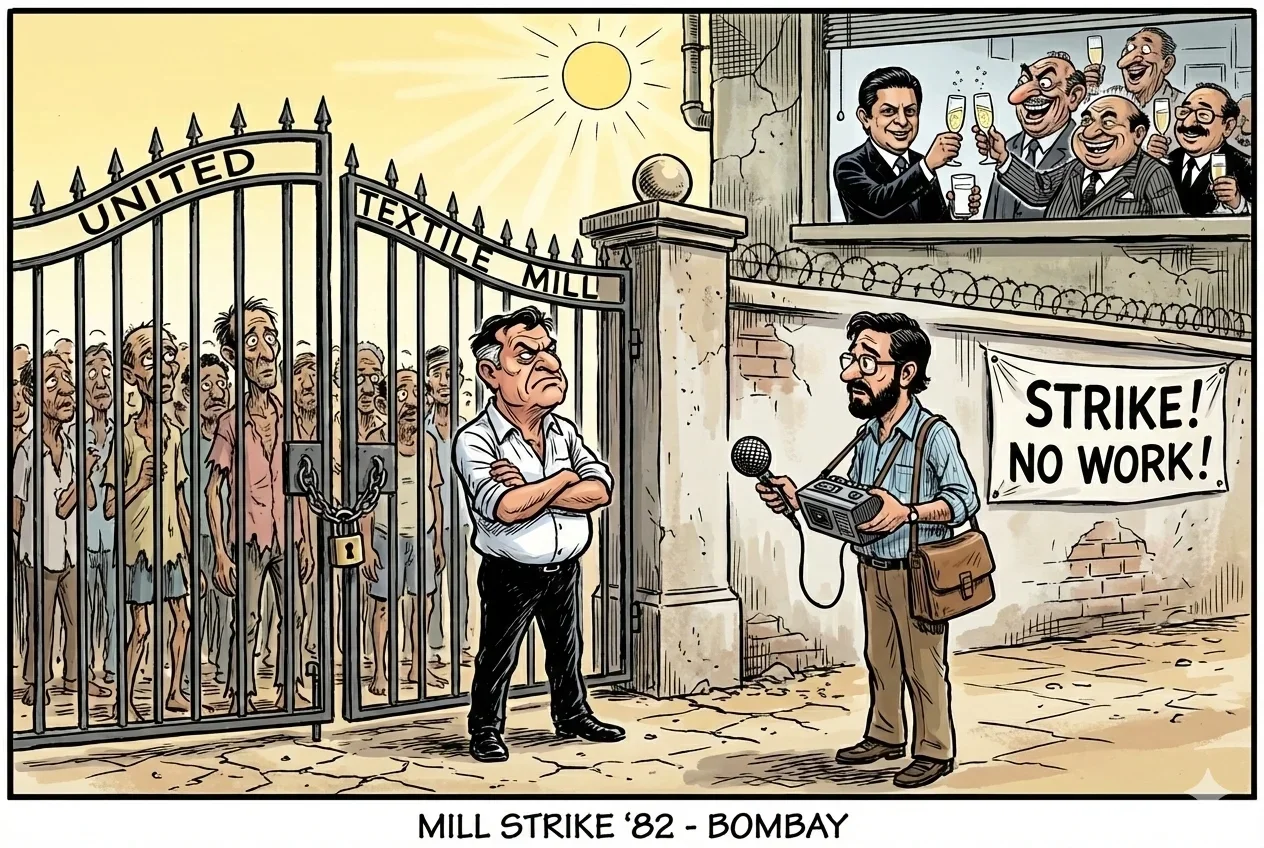
The spark was simple: money and dignity. The workers demanded fair bonuses, wage increases, and permanent status for the thousands of temporary (“badli”) workers who lived in uncertainty. Enter Dr. Datta Samant, a firebrand trade unionist who was known to be a hard nut to crack.
Recommended Product
Amazon India – Shop Today's Best Offers
🛒 View on Amazon →As an Amazon Associate, we earn from qualifying purchases. Price and availability may vary.
Samant led approximately 250,000 workers from 50 mills into what would become an 18-month standoff. In the past, strikes usually ended with a handshake and a compromise. But this time, the mill owners and the government dug their heels in. They refused to negotiate.
As the months dragged on, the strike crumbled. It wasn’t a victory; it was a massacre of livelihoods. Over 90,000 workers faced immediate layoffs. Those who returned did so on weaker terms. Economists today track this event as the “knockout punch” that broke the backbone of organized labor in Mumbai.
But why were the mill owners so willing to let their factories rot for 18 months? That brings us to the hidden war.
The Hidden War: Cotton vs. The Polyester Lobby
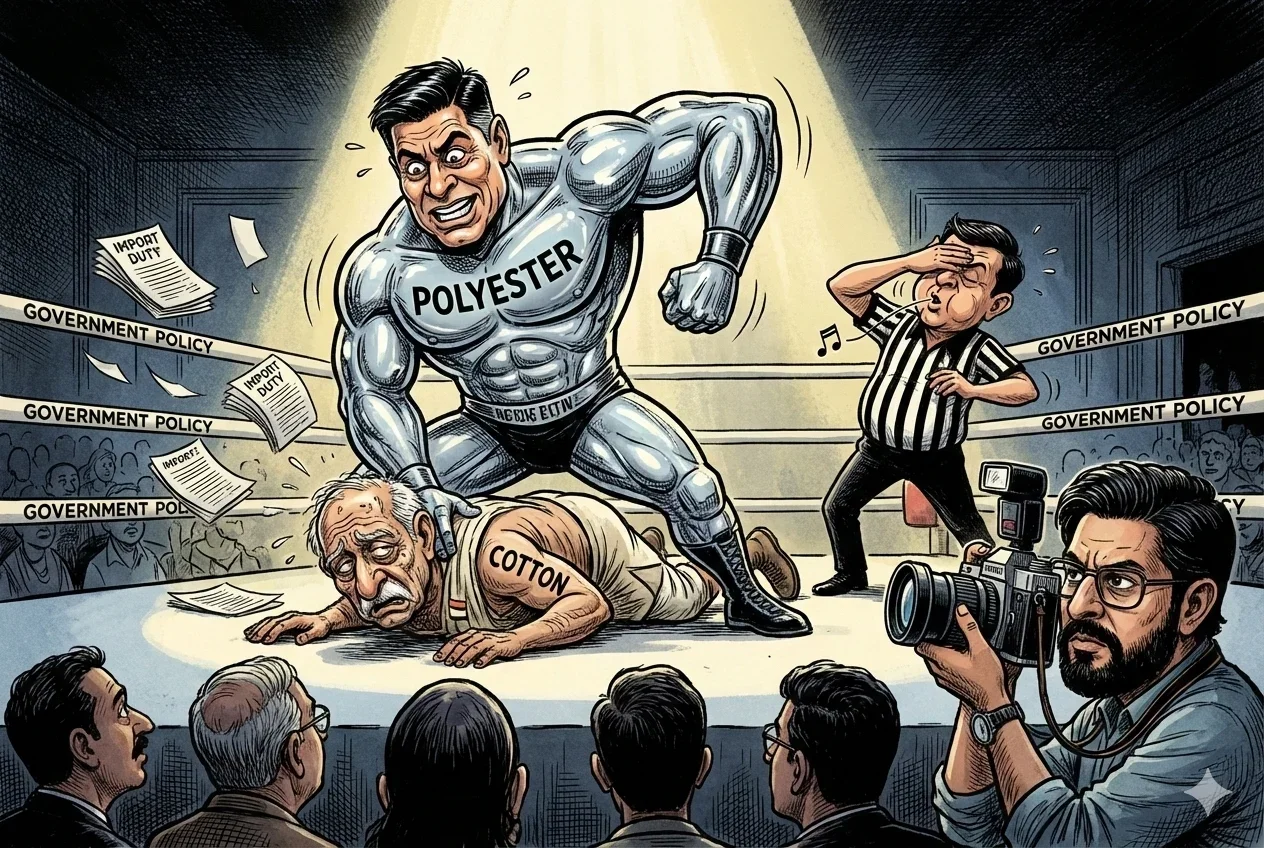
While the workers were shouting slogans in Parel, a quieter, deadlier war was being fought in the policy corridors of Delhi. This was the war between Cotton and Polyester.
For over a century, India’s textile industry—both in Mumbai and Ahmedabad (once known as the “Manchester of the East” with its 120+ mills)—was built on cotton. But in the 1980s, synthetic fibers began their ascent.
How Rules Were “Bended”:
Historical analysis suggests that government policies were manipulated to favor the rise of polyester giants over traditional cotton mills. Import duties on raw materials were tweaked—often described as “bended rules”—making synthetic yarn cheaper and more profitable than cotton.
The “Vimal” Effect:
New players like Reliance (with its Vimal brand) championed polyester as the fabric of the future—durable, shiny, and cheap. The traditional cotton mills, burdened with old machinery and expensive labor, couldn’t compete.
The Ahmedabad Parallel:
It wasn’t just Mumbai. Ahmedabad, the other great textile hub, faced the same systematic decline. The entire ecosystem collapsed. It wasn’t just the mills; the tertiary industries died too. The manufacturers of dyes, the makers of bobbins, and even the transport services that moved raw cotton—all were sent into a tailspin.
So, when the strike hit Mumbai, many mill owners weren’t desperate to reopen. They saw a golden exit route: shut down the “unprofitable” cotton mills and pivot to something far more lucrative.
Timeline: The Rise and Fall of the Mills
To understand the scale of this collapse, let’s look at the timeline of these two industrial giants.
- 1854: The first mill, Bombay Spinning and Weaving Company, is established in Tardeo.
- 1861: Ahmedabad gets its first mill, earning the title “Manchester of the East.”
- 1900-1940: The Golden Age. Mumbai has 130+ mills; Ahmedabad has 120+. They dominate the economy.
- 1980s: The rise of Polyester. Government policy shifts focus to man-made fibers. Cotton mills begin to bleed money.
- 1982: The Great Mumbai Textile Strike begins. 2.5 lakh workers stop work.
- 1983-85: The strike collapses. Closures begin. The “sick unit” label is applied to mills to allow legal shutdowns.
- 1991: Development Control Rules (DCR) are amended, allowing mill owners to sell surplus land.
- 2000s: The Chimneys fall. The age of Malls and Skyscrapers begins.
From Mills to Malls: The Great Real Estate Grab
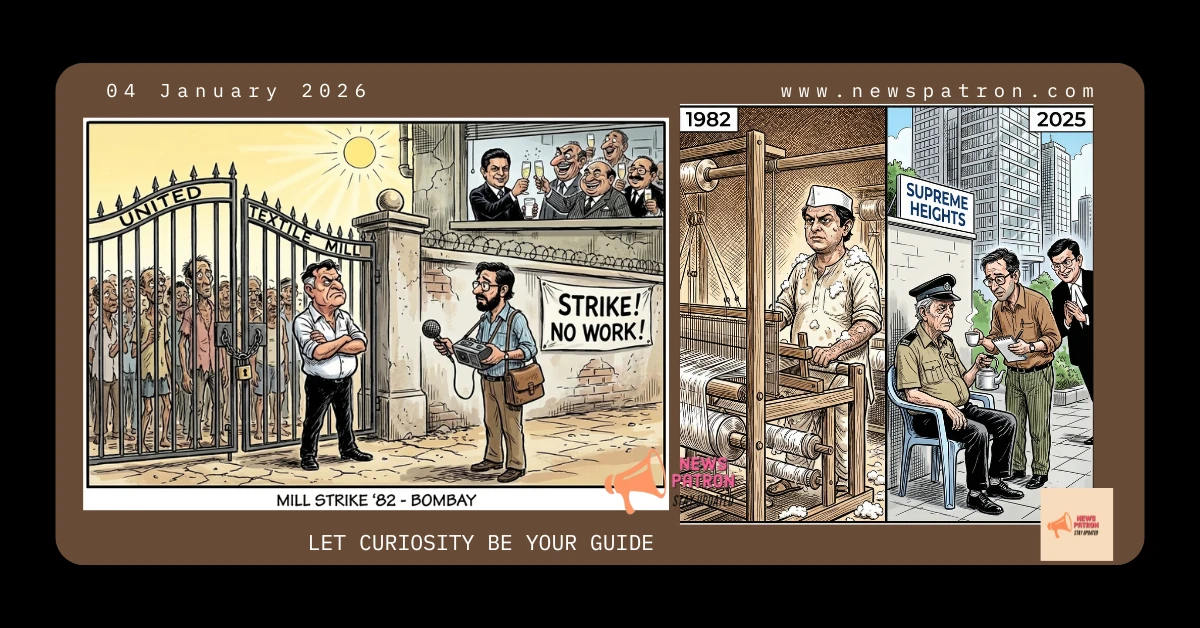
Once the strike broke the unions, the land beneath the mills became worth more than the cloth they produced.
Government rules were amended to allow Mill Land Redevelopment. Theoretically, this was supposed to give land back to the city for open spaces and housing for workers. In reality? It was a real estate gold rush.
Today, if you walk through Lower Parel or Worli, you aren’t walking through factories. You are walking through High Street Phoenix, Peninsula Corporate Park, and Kamala Mills. The beneficiaries were the owners and developers who minted thousands of crores. The losers were the workers, who were displaced to the fringes of the city, their chawls demolished to make way for luxury towers they could never afford to enter.
The Human Cost: A Generational Scar
The tragedy of the strike isn’t just in the numbers; it’s in the stories. Narratives from citizen memory on social media paint a heartbreaking picture.
When the wages stopped, families starved. Men who were once proud, skilled technicians were forced to take jobs as watchmen, security guards, or vegetable vendors. The phrase “from mill worker to watchman” became a bitter proverb in Marathi households.
The Darker Side:
The desperation had a ripple effect on the city’s safety. With fathers unemployed and hunger gnawing at families, many young men from these areas were easily recruited by the underworld. The rise of Mumbai’s gangs in the 80s and 90s has a direct correlation to the economic vacuum left by the mill closures. As one observer noted, “The strike didn’t just kill jobs; it created delinquents.”
Warning Signs for Today: The Gig Economy Trap
Why are we talking about 1982 in 2025? Because history has a nasty habit of repeating itself.
Today, we see Gig Workers (delivery partners, cab drivers) protesting for better rights. The parallels are chilling. Just as the mill workers were fighting for stability, gig workers are fighting for fair pay. And just as the mill workers were replaced by automation (powerlooms) and real estate, today’s workers face the threat of drones and AI.
Social media is buzzing with warnings: “Startup instead of strike.” The fear is that if modern unions push too hard without adapting, companies will simply automate them out of existence, leaving another generation jobless.
Conclusion: Learning from the Silence
The Mumbai Textile Strike 1982 serves as a complex case study. For some, it was a heroic stand against exploitation. For others, it was a tragic lesson in how rigid ideology can destroy an entire industry.
As Mumbai continues to race toward the future, the silent chimneys of Parel stand as monuments to a time when the city stopped working—and in doing so, changed forever. The mills are gone, but the lesson remains: Progress that leaves the worker behind is not progress; it is just a makeover.
Connect with the Editor
I’m always eager to hear your thoughts. Do you have a family connection to the mills? Connect with me, Kumar, Editor at Newspatron, on your favorite platform:
For some fantastic drone shots of the city infrastructure, check out my YouTube channel DroneMitra (Your Sky is Digital with a Drone as a Friend), and for more insightful content, subscribe to the new Newspatron channel (Let Curiosity Be Your Guide).
- For quick updates: Follow me on Instagram, Twitter, YouTube, or Reddit.
- For deeper conversations: My Facebook profile is open to new friends!
- For instant updates: Subscribe to my WhatsApp Channel (your privacy is protected).
- For professional networking: Let’s connect on LinkedIn.
You can find all the relevant links on the Newspatron homepage. Looking forward to connecting with you!

[…] (Read more: Mumbai Textile Strike 1982: How a Silence Changed the City Forever) […]