




Editorial Note: This blog covers a case of child sexual assault and murder. The victim is referred to by her first name, as it has been used publicly by her family and community in their call for justice. No graphic details of the assault are included. If you are experiencing distress, please contact iCall India at 9152987821.
If you need support:
- CHILDLINE India: 1098 (free, 24/7, for children in distress)
- iCall India: 9152987821 (mental health support)
- National Commission for Protection of Child Rights (NCPCR): 1800-121-2830
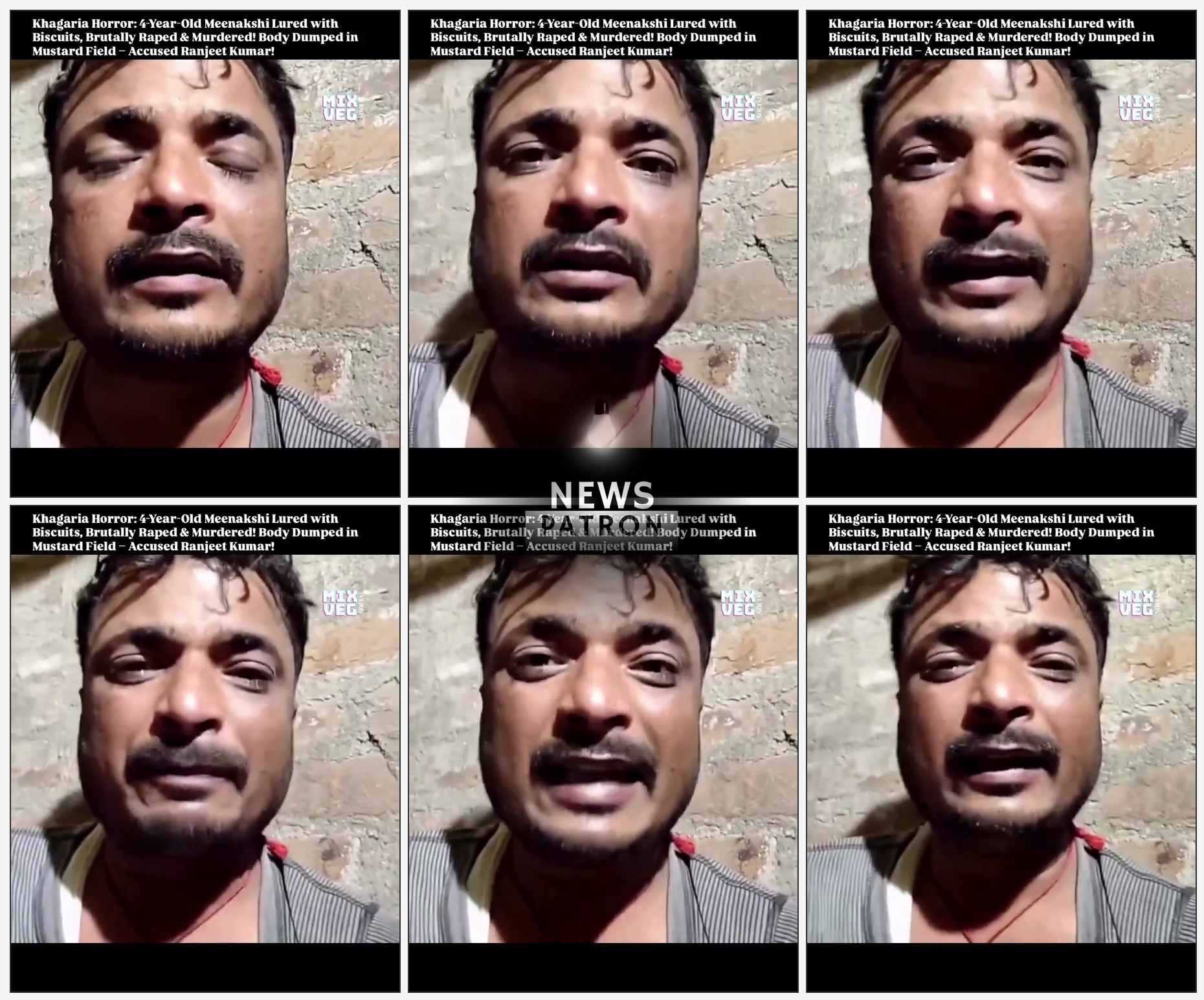
There is a moment in the father’s video that is impossible to sit through without something breaking inside you.
He is not screaming. He is not incoherent. He is a man who has been awake since the night his four-year-old daughter did not come home, and he is speaking directly into a phone camera, addressing his brothers, his neighbours, his state’s Home Minister, and anyone who will listen.
He says: “Today it happened to me. Tomorrow it will happen to all of you.”
He says: “A girl whose milk teeth hadn’t even fallen out. Who hadn’t even seen the world.”
And then his voice breaks, and he says he cannot speak any more — but he keeps going. Because what else does a father do when the district administration has not yet moved, when the man who killed his child is still out there, and when the only tool he has left is a phone and a prayer that someone connected enough will see it and act?
Meenakshi was four years old. She was playing near her home in Khagaria, Bihar. A neighbour, identified as Ranjeet Kumar, lured her with biscuits. Her body was found the next morning in a mustard field. The postmortem confirmed what her family had feared.
The accused has since been arrested. The protests that erupted — thousands of residents blocking roads, storming the collectorate, demanding the death penalty and the removal of a local police officer for alleged negligence — forced the machinery of the state to move faster than it otherwise might have.
But the father’s question has not been answered.
Recommended Product
Jockey Women's Hipster Brief – Comfort Fit, Assorted Colors
🛒 View on Amazon →As an Amazon Associate, we earn from qualifying purchases. Price and availability may vary.
What is happening in Bihar? What is happening to our children?
The Night a Child Did Not Come Home
Meenakshi went missing while playing. She was four years old.
The hours that follow a missing child are among the most brutal a parent can experience — the expanding circle of search, the questions to neighbours, the growing weight of silence where a child’s voice should be.
By the next morning, there was no more uncertainty. Her body was found in a mustard field near the village. The cause of death, confirmed by medical examination, was strangulation. The nature of what had been done to her before she died was confirmed as well.
Ranjeet Kumar — a neighbour, a familiar face, someone known to the family — was identified by witnesses. He had lured her away from the safety of her home with something as ordinary as a biscuit.
The trust that a four-year-old places in an adult she recognises. The ease with which it was used. These are details that should be allowed to settle before any of us moves too quickly toward policy language and systemic analysis — because at the centre of this story is a child who was four years old and is now gone.
She was everyone’s daughter. Her father said so himself. He was right.
A Father Speaks. A State Must Listen.
The father’s video circulated widely and reached people far beyond Bihar.
What made it impossible to ignore was not its raw grief — though that was present in every word. It was its clarity. This man, in the worst moment of his life, was not simply crying out. He was making specific demands of specific people. He named the Home Minister by name. He referenced the administration’s own stated commitments to law and order. He asked, with the precision of someone who had thought about nothing else for twenty-four hours, why those commitments were not protecting his daughter.
One online source, sharing the video with the wider public, framed it with a plea of their own: that connected people — those with access to decision-makers, those with platforms — not treat this as another viral tragedy to be watched and scrolled past. That they make calls. That they use what they have.
Another observer, reflecting on the pattern of such incidents, put it plainly: when we do not treat each other’s suffering as our own — when we assume these things happen only to others — we create the conditions for them to keep happening to everyone.
The father understood this before they did. He said it himself: “Today it happened to me. Tomorrow it will happen to all of you.”
That is not a threat. That is a diagnosis.
(Read the full story in our previous blog about the Nashik teenager who posted her own video after being harassed — and how a young woman’s courage forced the system to act within hours)
The Accused, the Arrest, and What Comes After
Ranjeet Kumar was arrested. Bihar Police’s official account acknowledged the case and forwarded it to the Khagaria district authorities.
The Bihar Chief Minister gave assurances of swift action. The case was designated high-priority. The apparatus of the state, pushed by the protests of thousands of ordinary people who blocked roads and stood at the gates of the collectorate in the heat of grief and fury, began to move.
This is the part of the story where it is tempting to say: the system worked. The accused was caught. Justice is on its way.
That would be premature.
An arrest is not a verdict. A designation of high-priority is not a fast-track trial. Assurances from a Chief Minister are not a conviction, and a conviction is not an execution, and none of the above brings Meenakshi back or answers the father’s question about what Bihar is doing — and not doing — to protect its children.
The POCSO Act, which governs the prosecution of crimes against children in India, mandates fast-track trials. Courts specifically designated for child abuse cases exist in law. The framework for swift, serious, and complete justice in a case like this is already written.
What India has learned, again and again, is that a law’s existence and a law’s enforcement are two different things. The gap between them is where fathers record videos in the dark, pleading with strangers on the internet because they have no other recourse.
What the Numbers Say — and What They Cannot Capture
Per NCRB data, India recorded over fifty thousand cases under the POCSO Act in 2025. Fifty thousand. In a single year.
That number represents fifty thousand children — not statistics, but children — for whom the law’s protection either arrived too late, or not at all, or in a form so delayed that the trial became a secondary trauma layered on top of the first.
The majority of perpetrators in child sexual abuse cases in India are known to the victim. A neighbour. A relative. Someone familiar enough to be trusted. Someone whose presence at the door would not alarm a four-year-old playing near her home.
This is not a detail that makes the crime more complicated. It makes it more preventable — because it means the risk is not a stranger lurking in an unknown place. It is often someone already within the circle of daily life.
Community vigilance, parental awareness, and children who are taught — in age-appropriate, clear language — that no adult should ask them to go somewhere alone, regardless of who that adult is: these are not foolproof solutions. But they are real ones. And they are discussed far less than the demands for the death penalty that follow each case.
The death penalty debate is legitimate. It is ongoing. It is contentious, with serious legal and empirical arguments on multiple sides. This blog will not resolve it.
What can be said is this: the deterrent value of any punishment — including the maximum — is determined entirely by the certainty of its application. A death penalty that is theoretically available but practically never applied, after a process that takes years, is not a deterrent to the man who lures a child with biscuits on an ordinary afternoon.
Speed of justice matters as much as severity. The father asked for both.
(Read the full story in our previous blog about the UP school headmistress who used children as personal servants — and what it reveals about who holds power over India’s most vulnerable kids)
What One Observer Said That Everyone Should Hear
Among the responses to this case, one online comment — shared without the author’s name, as the person preferred — addressed something that the outrage cycle often skips past.
The observation was this: the accused is not a monster from outside society. He is a product of it — of a society that does not consistently enforce consequences for harm done to the vulnerable, that does not adequately protect children in its care, and that too often responds to these crimes with grief that fades before the trial is over.
The commenter put it in words that translate across every language and every region: those who commit such acts against the innocent deserve consequences that are equally severe. Because, they said, you cannot fight an act of inhumanity by treating its perpetrator with the gentleness due to a human being who has behaved like one.
It is a hard position. It reflects a harder reality.
And it is the position of a community that has run out of patience with a system that asks for that patience every single time.
What Justice for Meenakshi Must Actually Include
The protests in Khagaria were not disorder. They were a community demanding that its children be worth the same investment of institutional attention that is given to other priorities.
What Meenakshi’s case demands — what every case like hers demands — is a response that goes beyond the arrest of one man.
- Fast-track trials must be fast. POCSO designations should trigger automatic timelines — not aspirational ones, but enforced ones, with judicial accountability for delays.
- Community child safety programmes must be funded and implemented in rural Bihar and across India’s most underserved districts. Children who know their rights. Adults who know how to report. Systems that respond before a body is found in a field.
- Police accountability must be real. The demand for the local SHO’s removal reflected a community’s judgment that negligence had occurred. That judgment deserves a formal independent review — not dismissal, not deflection.
- The father must be supported. A man who has lost his child and then threatened the lives of his entire family out of despair is a man in acute psychological crisis. He needs access to grief support, legal aid, and the sustained presence of the state as an ally — not as an institution that delivers a press statement and disappears.
This Is Not the Last Time — Unless We Make It So
Meenakshi’s father ended his video by saying he could not speak any more.
And then he kept speaking. Because the alternative — silence — was not something he could accept on behalf of his four-year-old daughter.
We owe him — and her — the same refusal of silence.
Not just in the days when the video is viral. Not just when the protests are blocking roads. But in the months that follow, when the case moves through the courts, when the public attention drifts, when the next tragedy arrives and this one recedes.
Justice for Meenakshi is not a hashtag. It is a verdict, a sentence, and a system reformed enough that the next father does not have to record a video in the dark and hope that someone connected enough is watching.
It is the least — the absolute least — that a four-year-old girl deserves.
Newspatron — Let Curiosity Be Your Guide.
