




We Almost Scrolled Past This One. Then We Watched the Clip.
What this post is built on — and how it treats the topic
This post takes its central observation from a widely circulated interview in which Elon Musk — in conversation with Lex Fridman — described how Instagram’s architecture functions as an engine of social comparison. That observation is paired with a 2025 Pune-based clinical study measuring depression, anxiety, and stress scores in heavy Instagram users; a meta-analysis comparing Indian adolescent mental health outcomes against global averages; data from India’s Economic Survey 2025–26; and a 2026 LocalCircles survey on parental concern over digital addiction. Where the science is nuanced, this post says so. Where the impact is real and documented, this post does not soften it. Mental health is not a dramatic topic. It is a daily one. ?
The Most Honest Thing Anyone Has Said About Instagram in a While
Watch that clip before reading the rest of this.
The observation Elon Musk makes is not complicated, and that is precisely why it lands so hard. You open Instagram. Everyone looks extraordinary. The skin is flawless, the light is perfect, the holiday destination is stunning, the relationship looks effortless, and the smile — God, the smile — looks like the kind of happiness you have not felt in months. And somewhere in the background of your brain, below the level of conscious thought, a calculation begins. They have all of that. I have this. Therefore: something must be wrong with me.
What Musk points out — simply, without jargon, and with evident first-hand awareness — is that the version of a person you see on Instagram is not that person. It is a carefully curated, best-angle, best-light, post-processed, algorithmically boosted performance of that person, capturing the specific moments they chose to show you while hiding the much larger volume of ordinary, difficult, and sometimes genuinely miserable hours that constitute an actual life.
Nobody posts their 2am anxiety spiral. Nobody posts the argument they had before the beach photo. Nobody posts the debt, the loneliness, the body they are ashamed of, or the relationship that is held together with hope and silence.
They post the moment they looked best. And then they filter it.
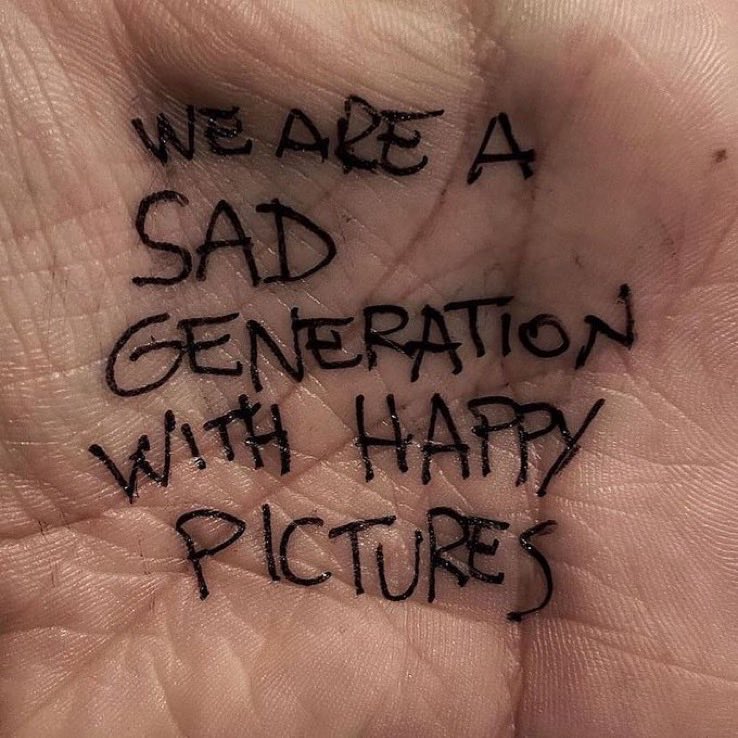
The result, as Musk puts it: people seem “way better looking and happier than they really are.” And if you are on the receiving end of that performance — which is everyone who opens the app — you are measuring your unedited, unfiltered, full-spectrum real life against a gallery of everyone else’s highlight reels. The comparison is structurally rigged. You cannot win it. And you were never meant to.
“Some of the happiest seeming people are actually some of the saddest people in reality.”
Recommended Product
Casio Enticer Men's Analog Green Dial Watch MTP-VD01D
🛒 View on Amazon →As an Amazon Associate, we earn from qualifying purchases. Price and availability may vary.
That sentence deserves more than a like. It deserves a long look in the mirror.
The Science Has a Name for What You Are Feeling
Psychologists call it upward social comparison — the cognitive tendency to evaluate your own standing, appearance, or achievements relative to people who appear to be doing better. It is not a weakness. It is a hard-wired human behaviour, originally useful for calibrating social position in small communities where you actually knew the people you were comparing yourself to.
Instagram did not invent social comparison. It industrialised it.
Before social media, your social reference group was roughly the size of your actual social circle — your neighbourhood, your school, your workplace. Now it is every person on the platform who has ever posted a photo, algorithmically sorted to show you the content with the highest engagement, which is to say the most aspirational, the most beautiful, the most enviable content — whether or not that content has any relationship to the person’s actual life.
The 2024 meta-analysis of Indian adolescent studies found that upward social comparison, body image dissatisfaction, cyberbullying, and sleep disruption are the four primary mechanisms through which heavy social media use translates into measurable mental health decline. And critically: the correlations between problematic Instagram use and both depression (r=0.38–0.62) and anxiety (r=0.45–0.59) in Indian adolescents are significantly higher than global averages (approximately r=0.27–0.35).
India is not just participating in the global social media mental health crisis. In certain age cohorts, it is ahead of the curve — and not in a direction worth celebrating.
What Is Happening to Indian Youth Specifically — The Numbers That Should Concern Every Parent
India has over 398 million young users on social media. The post-TikTok-ban landscape shifted enormous short-form video consumption onto Instagram Reels and YouTube Shorts — maintaining all the same addictive mechanisms of infinite scroll, dopamine-timed notifications, and algorithmically curated aspirational content, with zero of the regulatory friction that triggered the original ban.
A clinical study conducted in Pune in 2025 measured depression, anxiety, and stress scores across young adults aged 16–25 using the validated DASS-21 scale. Heavy Instagram users showed significantly elevated scores across all three measures — depression (p=0.003), anxiety (p=0.019), and stress (p<0.001). The study also found that engagement with food and restaurant content specifically predicted higher distress outcomes — a finding with sharp relevance in a city where food influencer culture is part of everyday social media consumption.
The broader picture compounds this:
- 27% of Indian teenagers show features of social media dependency including difficulty concentrating, academic decline, and emotional dysregulation, according to NIMHANS.
- India’s Economic Survey 2025–26 formally flagged digital addiction as a major healthcare issue — linking excessive social media use to anxiety, depression, low self-esteem, cyberbullying stress, and reduced attention spans in adolescents.
- 1 in 7 young people aged 15–24 in India show depressive symptoms, according to UNICEF’s South Asia mental health tracking.
- 49% of urban parents reported that their child shows signs of addiction to social media, OTT platforms, or gaming — a figure from a 2026 LocalCircles survey that represents a near-majority of the urban Indian parent population.
The 65% of Indian teenagers who report feeling measured against the standard set by influencers and peers on social media are not being melodramatic. They are describing the precise psychological mechanism Musk identified in that clip: a comparison engine that runs continuously in the background of daily life, making every ordinary moment feel like a deficit.
It Is Not Just the Teenagers — The Adults Are Drowning Too
The conversation around social media and mental health defaults to adolescents, and for good reason — the developmental vulnerability of the 13–17 window is well-documented and significant. But the harm does not stop at 18.
For young professionals and millennials in their mid-to-late twenties and thirties, the Instagram comparison engine runs on slightly different content but the same underlying mechanic. Instead of body image and academic performance, the reference points shift to careers, relationships, homes, holidays, and the aesthetic of a curated adult life. The person who spent the American millennial transcript saying he has nothing to show for a lifetime of work — no house, no savings, no stability — is not living in a social vacuum. He is opening the same app everyone else opens and watching people who appear to have all of those things, in attractive lighting, with captions about gratitude.
The burnout is economic. But the story Instagram tells about that burnout makes it feel personal.
For older adults, the picture is more mixed. Social media can reduce isolation, maintain family connections, and provide genuine community for people whose mobility or circumstance limits in-person socialising. But heavy use in older cohorts — particularly when it replaces rather than supplements real-world connection — links to similar patterns of loneliness and distress, alongside a misinformation exposure risk that younger users are more alert to.
The harm is not uniform. But it is not age-gated either.
The Saddest People in the Room Are Smiling the Hardest Online
Here is the part of Musk’s observation that deserves the most attention — and that gets the least:
“Some of the happiest seeming people are actually some of the saddest people in reality. Nobody looks good all the time. It doesn’t matter who you are.”
The social media mental health conversation usually positions the problem as: people who feel bad consuming content made by people who feel good. The reality is more uncomfortable than that. Many of the people producing the aspirational content — the influencers, the lifestyle creators, the people whose Instagram grids look like a professionally curated life — are performing that contentment for an audience while experiencing something very different in private.
Multiple documented cases of high-follower content creators across India, the UK, and the United States have come forward in the last three years describing clinical depression, anxiety disorders, and a profound sense of disconnection — maintained entirely behind a grid of smiling photos. The performance of happiness, repeated daily for an audience of thousands, becomes its own form of psychological labour. And the feedback loop — posts that show distress perform less well; posts that show aspiration get rewarded with engagement — trains the creator to suppress authenticity in favour of the content that gets the dopamine hit of validation.
The audience sees a person living beautifully. The person is sitting alone after the shoot wondering why they feel nothing.
This is not a rare edge case. It is the structural consequence of a platform that financially rewards performed happiness. And it is why Musk’s instinct — that the system is working exactly as designed, and that the design is the problem — is more accurate than most platform defences would like to acknowledge.
The Feed You Actually Deserve — What Comes After You Put the Phone Down
This section exists because identifying the problem without offering any direction forward is just very articulately delivered helplessness.
The goal is not to tell you to delete Instagram. That is a personal decision, and for many people — particularly those who use it for genuine community, creative expression, or professional work — deletion is not the right answer. The goal is to change the relationship with the platform so that it stops running the comparison engine in the background of your life without your permission.
Practical shifts that the research supports:
- Audit your follow list once, properly. Every account you follow that consistently produces an emotional response of inadequacy, envy, or self-criticism is algorithmically serving you content designed to generate that response. Unfollow it. This is not about negativity — it is about recognising that your attention is a resource and the platform has an incentive to monetise it through emotional stimulation, not your wellbeing.
- Set a hard daily limit, not a vague intention. Most smartphones allow screen time limits by app. The research on intentional usage limits consistently shows improvement in self-reported mood and reduced FOMO within two to three weeks. Thirty minutes of deliberate, purposeful Instagram use produces significantly better outcomes than two hours of passive scroll.
- Distinguish between creation and consumption. Posting content you genuinely care about — a hobby, a skill, a project — engages the platform in a fundamentally different way than passive consumption of other people’s highlights. Creation gives you a sense of agency. Consumption without creation can produce a feeling of being permanently on the outside of a life you are supposed to want.
- Protect the first 30 minutes of your morning and the last 30 minutes before sleep. These are the windows where social comparison has the most impact on mood. Starting the day with a comparison engine primes the entire day for deficit thinking. Ending it the same way disrupts sleep quality and emotional regulation overnight.
- Create offline wins before opening social media. A walk, a meal cooked from scratch, ten pages of a book, a conversation with someone physically in the same room. These are experiences the algorithm cannot monetise and cannot compare. They are also, consistently, the experiences that people report as most meaningful when asked at the end of a day.
For parents specifically:
The NIMHANS data showing 27% of Indian teenagers with dependency features is not a reason to confiscate every device in the house. It is a reason to have an honest, non-alarmist conversation — perhaps starting with the clip in this post — about the difference between what social media shows and what life actually is. Children who are helped to understand the mechanics of the highlight reel at a young age develop significantly better resistance to its effects. The conversation is the protection.
One More Thing — You Have Read This Before, In a Different Context
The relationship between screens and real human connection is a thread that runs through multiple conversations this blog has covered. If the mental health angle in this post resonates, the piece below — on what smartphones are quietly doing to intimacy and real connection — takes the same theme into a different room of the same house.
The platforms that make us feel inadequate in public are the same platforms making us absent in private. The two conversations are the same conversation.
Kumar Is Here — Tell Him Where You Are With This
Have you caught yourself putting the phone down after a scroll and feeling quietly worse than before you picked it up? Have you quit Instagram — or significantly reduced it — and noticed a change? Are you a parent, a therapist, a school counsellor, or a young person in Mumbai navigating exactly the pressure this post describes?
The comment section is the most real thing on this page. Use it.
Kumar, Editor at NewsPatron, is on every platform:
- ? Daily updates: Follow on Instagram (yes, the irony is noted), X (Twitter), YouTube, and Reddit
- ? Community conversation: Like the NewsPatron Facebook page — mental health and digital wellness posts generate some of the most honest exchanges there
- ? Instant alerts: Subscribe to the NewsPatron WhatsApp Channel — your number stays private, always
- ?? Direct chat: Find Kumar on Telegram
- ? Professional exchange: Connect on LinkedIn — especially for education, mental health, or digital wellness conversations
All links at newspatron.com.
And when the algorithm feels like too much — DroneMitra on YouTube is content that asks nothing of you except to look at something beautiful: youtube.com/@dronemitra and youtube.com/@dronemitra/shorts. ?
