




Disclaimer: This article is based on publicly available research, user opinions shared online, media reports, and offline sources as referenced throughout. Patanjali Creamfeast ingredient data is sourced directly from the official Patanjali Ayurved website. Palm oil health data is sourced from WHO, NIH, ICMR, Indian Express, and clinical nutritionist commentary. Palm tocotrienol research is ongoing and not conclusively established as a health benefit in ultra-processed food contexts. Written in public interest for consumer awareness.
You trusted that biscuit since you were six years old. Your mother packed it in your school tiffin. Your grandfather ate it with his evening chai. It said Crème on the front in a rich, looping font — and somewhere in your mind, that word meant dairy. It meant richness. It meant something real.
Now flip the packet. Read ingredient number three. That is not cream. That is creme biscuit palm oil — and it has been sitting there in plain sight the whole time, dressed up in French spelling so nobody would ask too many questions. ?
A simple, unsponsored video uploaded by a concerned citizen in late 2025 made the point without drama. The creator held up a popular chocolate crème biscuit packet — front first — and then flipped it. Ingredient number three. Refined palm oil. The video was not monetised. It was just someone in a kitchen with a packet and a phone, asking a question millions of Indian parents had never thought to ask. Comments fell into two camps: one compared it directly to tobacco marketing — something that harms you visibly but is sold with cheerful packaging — another demanded India adopt Japan-style front-of-pack mandatory disclosure rules, forcing companies to name harmful ingredients where you can actually see them before you buy. One lone commenter replied: “?? ????? ????????? ???” The conversation that followed suggested most people were not satisfied with that answer.
This article is not about panic. It is about information that food companies have buried beneath French spelling, attractive packaging, and the trust that comes with feeding something to a child.
Before we begin — if you learn better by watching, DroneMitra covers India’s biggest consumer and health stories with on-ground video breakdowns. Subscribe at youtube.com/@dronemitra — shorts at @dronemitra/shorts — full videos at @dronemitra/videos. ?
Creme Biscuit Palm Oil — The Spelling Trick That Has Fooled India for Decades
What Creme Really Means on Your Biscuit Packet
There is a very simple legal reason why your biscuit says Crème and not Cream. Under FSSAI regulations the word cream is a dairy term with a legal definition — it must be derived from milk and contain milk fat. A product cannot call itself “cream filling” unless it actually contains dairy.
Food companies borrowed a French word — crème — that sounds identical in casual speech, implies dairy quality, and carries zero legal dairy obligation. FSSAI’s own Labelling Regulations 2020, Clause 3(3), explicitly state that a label “shall not be described or presented in a manner that is false, misleading or deceptive or likely to create an erroneous impression regarding its character.” Whether the word crème on a packet whose filling is primarily palm oil creates an erroneous impression is exactly the question hundreds of consumers have asked online. FSSAI has not answered them.
Flip the Pack — Palm Oil Is Ingredient Number 3
Pick up any popular cream biscuit in India and flip it over. Ingredients are listed in descending order of quantity. What you will typically find: Refined wheat flour (Maida). Sugar. Edible vegetable oil (Refined Palm Oil/Palmolein). The “crème” filling that gives the biscuit its name is primarily sugar and palm oil — not milk, not cream, not butter. The word that made you reach for it is printed large on the front. The ingredient that tells you what it actually is appears in eight-point font on the back. ?
Recommended Product
Waterproof Car Body Cover for Maruti Dzire 2017-2023
🛒 View on Amazon →As an Amazon Associate, we earn from qualifying purchases. Price and availability may vary.
G Is No Longer Great — What Does the Alphabet Actually Stand For
For decades the letter G on that iconic yellow packet meant one thing in every Indian household: Great. The biscuit that kept railway platforms running, fuelled midnight chai sessions, and survived in every grandmother’s steel dabba. Humble, honest, cheap, and trusted.
Now flip that packet. The G is still there. But in 2026 the question worth asking is: does it stand for Great — or has it quietly become Ghatiya? No milk. No whole wheat. No locally sourced goodness. Just refined wheat flour stripped of everything useful, sugar in two industrial forms, and edible vegetable oil from palm plantations in Indonesia and Malaysia — island-nation industrial oil, not something grown or pressed anywhere in India. That combination available in a pack of ten for under ?100 is the economics of ultra-processing at its most brutally efficient. ?
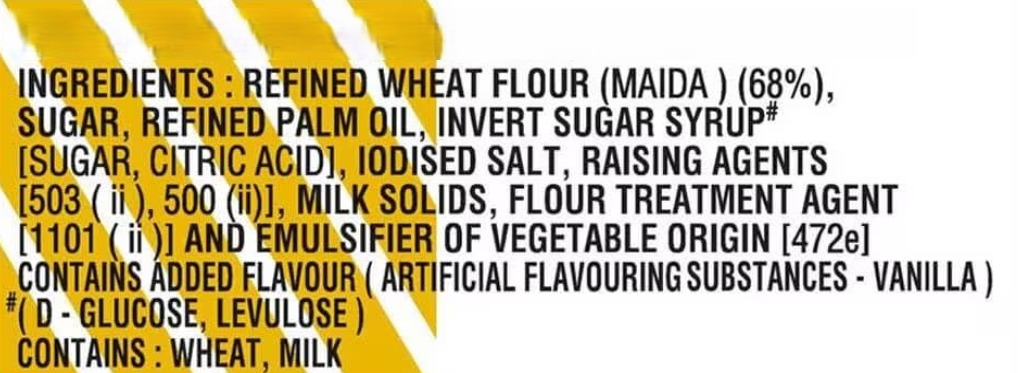
The packet costs ?10. A pack of ten costs less than ?100. Somewhere inside that pricing miracle — between the Indonesian palm oil, the double-dosed industrial sugar, and the maida that gave up its fibre on the factory floor — is the answer to why it costs what it costs. The question is not why it is cheap. The question is: what did they take out to make it that cheap? ?
What Is Actually Inside That Glucose Biscuit — Label Breakdown
- Refined Wheat Flour (Maida) — first ingredient, no percentage given. Stripped of bran and germ — what remains is almost pure starch that digests rapidly, causes sharp insulin spikes, and delivers calories with none of the fibre that would slow those spikes down. The manufacturer does not tell you if this is 60% or 80% of the product.
- Sugar and Invert Sugar Syrup — a double sweetener hit. Invert sugar is processed to be sweeter per gram and to keep the biscuit moist for longer shelf life. Two forms of high-glycemic sweetener in one bite — chosen for palatability and preservation, not nutrition.
- Refined Palm Oil — low cost, high saturated fat, sourced industrially. Not cold-pressed. Not local. Industrially refined palmolein from large-scale tropical plantations — the cheapest stable fat available at that production volume.
- Milk Solids — present but functionally invisible. Without a declared percentage this could be 0.5% to 1% — just enough to put “milk” on the label, not enough to deliver meaningful calcium, protein, or fat-soluble vitamins.
- Leavening agents (503ii, 500ii) — ammonium and sodium bicarbonate — listed by code, not name.
- Emulsifier (472e) — a chemically modified fat to blend water and oil, improve dough volume, and extend shelf life. Flagged in food science literature for further research on gut microbiome effects with regular daily consumption.
- Flour Treatment Agent (1101i) — a protease enzyme added for industrial dough processing. The label states what it does; not how much residue remains in your biscuit after baking.
- Artificial Flavouring Substances (Vanilla) — synthetic vanillin derived from wood pulp lignin or petrochemical sources. Not vanilla pods. The specific compound is unnamed. Long-term safety data for daily consumption is not disclosed.
The Loopholes — Technically Compliant, Practically Opaque
- No QUID. A plain “Glucose Biscuit” is not required to declare the percentage of milk solids. It could be 0.5%. The label does not have to say so.
- Trans fat rounding trick. Under Indian rules anything under 0.2g per serving rounds to zero. If serving size is two biscuits and trans fat is 0.19g — the panel says zero. Eat ten biscuits and the actual trans fat consumed is not zero. It is simply not disclosed.
- Processing aid residues. Flour treatment agents appear by code and function only. Concentration and digestive behaviour over years of daily consumption are not consumer-facing information.
What an Honest Biscuit Label Would Look Like
A genuinely transparent label: Whole Wheat Flour (65%), Butter (15%), Jaggery (12%), Whole Milk (6%), Salt, Baking Soda. Six ingredients. Every one named in plain language. Percentages declared. No codes. No emulsifiers. No enzymes. No synthetic flavouring. No palm oil. That label tells you exactly what you are eating and exactly how much. ?
| Feature | Industrial Glucose Biscuit | Clean Label Alternative |
|---|---|---|
| Primary Base | Refined Wheat Flour — no % given | Whole Wheat or Millets — % specified |
| Fat Source | Refined Palm Oil — ~50% saturated fat | Butter or Cold-Pressed Oils |
| Sweetener | Sugar + Invert Sugar Syrup | Jaggery, Raw Cane Sugar, or Dates |
| Milk Content | Milk Solids — unknown %, likely under 1% | Whole Milk or Butter — 10–15% specified |
| Additives | Emulsifiers (472e), Enzymes (1101i), Artificial Vanillin | None, or natural leavening only |
| Transparency | Coded, no key percentages | All named plainly with percentages |
Why Palm Oil Is in Every Indian Packaged Snack — And What It Does to Your Body
Cheap, Stable, and Loaded With Saturated Fat
Palm oil became dominant in Indian packaged foods because it is exceptionally cheap, has a very long shelf life, and is produced in enormous quantities. It is approximately 50% saturated fat — one of the highest of any commonly used vegetable oil, compared to roughly 15% for corn oil or olive oil. Clinical nutritionist Dr. Archana Ainapure summarised the research in January 2026: “Palm oil is nearly 50% saturated fat. During industrial refining most protective compounds are removed. Regular consumption is linked to rising cholesterol, post-meal inflammation, reduced insulin sensitivity, and loss of blood vessel flexibility — contributing over time to heart disease, diabetes, and metabolic dysfunction.”
The refining process raises further concern. Research referenced by European regulators has identified byproducts from high-temperature palm oil refining — 3-MCPD esters and glycidyl esters — associated with kidney damage, DNA injury, and increased cancer risk in infant studies. European food safety authorities have issued specific advisories. India has issued no equivalent public advisory to date.
Hook for regulators: This is precisely the risk profile governments are required to investigate before approving large-scale use of an ingredient in products marketed to children. FSSAI has the authority and mandate to commission exactly this safety review. The question is whether it will — or whether it will continue waiting for European labs to do the work first.
What Real Dairy Cream Has That Palm Oil Cannot Give You
Real dairy cream contains Vitamins A and D, Conjugated Linoleic Acid (CLA) associated with improved immunity and protective effects against certain cancers, and short and medium-chain fatty acids associated with faster energy conversion and less cardiovascular burden. None are present meaningfully in refined palm oil. In 2024, ICMR and NIN released updated dietary guidelines explicitly linking ultra-processed food consumption to rising rates of obesity, diabetes, and heart disease in India. A biscuit built on refined palm oil, maida, and synthetic flavouring meets ICMR’s own UPF definition. India has officially acknowledged the problem. Regulatory response has, so far, been silence. ?
The Ayurvedic Lens — Refined Palm Oil as Visha
Heavy, Heating, and Hard on Your Doshas
In Ayurvedic terms refined palm oil is a Rajasic and Tamasic substance — heavy, heating, industrially altered. It aggravates Pitta and Kapha doshas. The industrial refining process — high heat, chemical solvents, bleaching, deodorising — removes what little natural quality raw palm oil might have had, leaving something Ayurveda would classify as fundamentally devoid of Prana. Ayurveda does not condemn all fats — it reveres ghee, cold-pressed coconut oil, and sesame oil as nourishing. The contrast is not fat versus no-fat. It is between fats that are alive and minimally processed versus fats stripped and added to products purely for shelf life and cost. ?
Ama — The Hidden Slow Poison in Your Daily Snack Packet
Ayurveda describes ama — undigested residue that accumulates when food is incompatible, improperly processed, or nutritionally inert. Heavy refined oils consumed repeatedly in ultra-processed forms alongside refined flour and sugar — exactly as in creme biscuits — are considered prime generators of ama. Over time, ama buildup is linked to fatigue, foggy thinking, digestive sluggishness, and a gradual weakening of Ojas — the essence of vitality and immunity. The ancient texts did not use the word palm oil. But they described precisely this category: visha — slow poison — that harms not through a single encounter but through daily, habitual, trusted consumption. The biscuit in the tiffin box. Every single day. For years. ?
Patanjali Creamfeast Exposed — Swadeshi Packaging, Same Palm Oil Inside
Baba Ramdev Says Avoid Junk — His Own Packet Says Palm Oil
Patanjali Ayurved has built its entire market identity on one promise: we are not like those MNC junk food companies. We are swadeshi. We are Ayurvedic. We are natural. For millions of health-conscious Indian households, Patanjali is the brand you switch to when you want to escape the very ultra-processed products that everyone is now outraged about.
So flip the Patanjali Creamfeast Elaichi Biscuit. Directly from the official Patanjali Ayurved website: “Wheat flour (Atta) 49.91%, Sugar, Edible vegetable oil (Palm Oil), Invert sugar syrup, Dextrose, Raising agents, Iodized salt, Maize Starch, Nature identical and Artificial flavouring substances (Vanilla), Emulsifiers, Colours, Acidity Regulator, Sweetened Condensed Milk.” Ingredient number three: Palm Oil. The Creamfeast Chocolate variant is identical. Every Creamfeast variant. The crème filling in Baba Ramdev’s Ayurvedic biscuit range is built on the same palm oil as every Britannia and Parle product the same audience is demanding FSSAI action about. The irony is printed directly on the packet. ?
Who Actually Comes Closest to Real Dairy Cream
| Brand / Product | Palm Oil Position | Dairy Content | Front Claims |
|---|---|---|---|
| Britannia Bourbon | #3 Refined Palm/Palmolein | Minimal milk solids | None specific to dairy |
| Parle Hide & Seek | #3 Palmolein Oil | Trace | “Chocolate” |
| ITC Dark Fantasy | #2–3 Refined Palm | Trace | Premium packaging |
| Patanjali Creamfeast Elaichi | #3 Palm Oil | Sweetened Condensed Milk — listed last | “Ayurvedic”, “Swadeshi” |
| Patanjali Creamfeast Chocolate | #3 Palm Oil | Milk Solids after palm oil | “Natural”, “Herbal” |
No major Indian mass-market creme biscuit delivers a filling that is primarily dairy. All use refined palm oil as the fat base. Patanjali says “Ayurvedic” while using the same formula as everyone else. That makes it worse, not better. ?
FSSAI Creme Biscuit Labelling — Consumers Are Asking. The Regulator Is Silent.
Japan Bans It — India Labels It in French
Japanese food law requires that if a product name implies a specific ingredient, that ingredient must be present in meaningful quantities. A “Cream Biscuit” in Japan must contain actual cream. Front-of-pack colour-coded warnings make high-fat, high-sugar content immediately visible before purchase. India, meanwhile, allows companies to write crème in stylised French font on the front while actual ingredients appear in eight-point font on the back. FSSAI’s Clause 3(3) prohibits descriptions “likely to create an erroneous impression.” Whether crème on a palm-oil-filled packet does exactly that is a question a High Court bench could reasonably ask. ?
Hook for lawmakers: The crème vs cream labelling question is a perfect Parliamentary test case — a clear regulatory loophole, documented consumer impact, and a straightforward fix: mandate that any term suggesting dairy must either meet the dairy standard or carry a front-of-pack disclaimer: “Contains no dairy cream — primarily refined palm oil.”
Should Creme Biscuits Carry Front-of-Pack Warnings Like Tobacco
The comparison to tobacco is proportional and precise. Tobacco products in India carry mandatory pictorial warnings on 85% of the packet surface — because a product causing documented harm, consumed habitually, introduced in childhood, must carry visible health information at the point of purchase. Ultra-processed foods with refined palm oil consumed daily by Indian children in tiffin boxes meet multiple criteria of the same framework. ICMR’s 2024 dietary guidelines have established the link between UPF consumption and chronic disease. FSSAI’s response to the ongoing consumer tagging campaign is, as of February 2026: silence. ?
The Rs 10 Snack Trap — Creme Biscuit Palm Oil Is Just the Beginning
Kurkure, Dal, Namkeen — The Full Ultra-Processed Problem
The creme biscuit is the most visible example but far from the only one. Walk into any kirana store and look at the Rs 5 to Rs 20 snack shelf. Kurkure — refined flour, palm oil, added flavouring. Fried dal and chana packs — split pulses fried in refined palmolein. Wafers, namkeen, bhujia, sev — almost universally produced with refined palm oil as the frying medium because of its cost, high smoke point, and shelf stability. Every single one meets ICMR’s 2024 UPF definition. Every single one is consumed daily by Indian children and adults across every income group. One commenter online put it bluntly: “We Indians are used to eating any shit. Once sick — no one will help. Take care of yourself.” That is not polished commentary. That is what frustration sounds like when it has nowhere else to go. ?
Should India Tax Ultra-Processed Foods
Mexico introduced a specific tax on high-calorie packaged foods in 2014. Chile introduced black front-of-pack warning labels in 2016. The UK’s Soft Drinks Industry Levy measurably reduced sugar content within three years. In India, the 2024 Union Budget introduced GST rationalisation discussions but no UPF-specific tax or labelling mandate was enacted. The research from ICMR and NIN is government-generated. The political will is the missing piece. The next FSSAI oversight discussions in Parliament are the next formal opportunity. ??
How to Read Indian Biscuit Labels — Palm Oil Check in 30 Seconds
Three Things to Check Before Buying Any Packaged Snack
- Position of oil in the ingredient list. If “edible vegetable oil,” “palmolein,” or “refined palm oil” appears in positions 1, 2, or 3 — that product is built on palm oil. The filling, frying medium, or texture agent is primarily that oil.
- Scan for “hydrogenated” or “partially hydrogenated.” These are trans fats with a different label. Even greater cardiovascular risk than saturated fats alone. If you see those words — put the packet down.
- Look for actual dairy positioned early. Not “crème.” Not “flavouring.” The actual dairy ingredient — butter, cream, whole milk — in the top three. If milk solids appear at position 9 out of 14 there is functionally no meaningful dairy content regardless of what the front says.
What RSPO Means — And Why It Is Not a Health Pass
RSPO (Roundtable on Sustainable Palm Oil) certification means the palm oil was sourced with environmental sustainability standards — reduced deforestation, fair labour practices. What RSPO does not mean is that the palm oil is healthier. It is still approximately 50% saturated fat. Still industrially refined. Still the same metabolic concerns. RSPO is an environmental label. Buying RSPO-certified products is better for the planet. It is not better for your arteries. The distinction matters enormously when a parent reads “RSPO certified” and concludes they have made a healthier choice for their child. They have not. ?
Creme Biscuit Palm Oil and the Global Picture
Canada Buttergate 2021 — How Angry Consumers Changed an Industry in Weeks
In February 2021 a column in Journal de Montréal ignited what Canadians called Buttergate. Consumers noticed their dairy butter was no longer softening at room temperature — the answer was palm-based feed supplements given to dairy cows to increase milk production. Palm oil had worked its way into the milk fat supply chain. Within weeks of the story breaking, Canadian dairy supply chains adjusted and palm-based feed additives were voluntarily paused. Consumer power — expressed loudly and specifically — produced rapid industrial response. The lesson for India is plain: when consumers ask specific, documented questions about their food system and refuse to accept silence, change becomes possible. ??
Indonesia’s $32 Billion Palm Oil Empire — The Industry Behind Every Indian Biscuit Pack
Indonesia is the world’s largest palm oil producer with an export industry valued at $32.7 billion. Fourteen of Indonesia’s 32 billionaires built their wealth entirely on palm oil cultivation and export. The industry also funds research into palm tocotrienols — a form of Vitamin E being studied for potential brain and cardiovascular protective effects. That research is early-stage. Note: Current evidence does not establish palm tocotrienols as a meaningful health benefit in refined palm oil consumed through ultra-processed foods — industrial refining removes much of the natural tocotrienol content. Raw palm fruit and refined palmolein added to biscuit filling are not the same substance. ??
Better Choices Right Now — For Indian Families at Every Price Point
The goal is not zero biscuits forever. It is informed consumption. When looking for options closer to real ingredients:
- High milk solid or butter fat positioned early in the ingredient list — ideally in the top three
- Shorter ingredient lists overall — six ingredients is generally preferable to eighteen
- Whole grain or whole wheat flour as the primary ingredient
- Absence of artificial colours — particularly INS 102, INS 110, INS 124
- Local artisanal options — many Indian cities have small bakeries making genuinely butter-cream filled biscuits without industrial palm oil
- Sattvic alternatives at home: Nankhatai (ghee, whole wheat, natural sugar), dry fruits and nuts, ragi cookies from small-batch producers, home-made murmura chivda — the Indian snack tradition before packaging was genuinely more nourishing than any Rs 20 shelf option today
5 Cheap Indian Superfoods Better Than Fancy Foreign Brands — Or the Local Crème Biscuit

No supplements. No imported superfoods. No dragon fruit from Thailand or avocado from Mexico. Just what is available right now at the roadside fruit stall two minutes from wherever you are reading this.
If you are stepping out and have a choice between the Rs 10 biscuit at the kirana counter and the Rs 10 banana at the fruit cart — take the banana. Three bananas for Rs 10 delivers potassium, natural sugars with fibre, B vitamins, and sustained energy without a single gram of refined palm oil, maida, or synthetic vanillin. ?
- Guava (Amrood) — one of the highest natural Vitamin C concentrations of any fruit available in India, higher than oranges, Rs 20–40 per kg in season. The imported equivalent costs five times more for comparable or lesser nutrition.
- Banana — energy, potassium, fibre, and natural sugars. Portable, non-refrigerated, non-packaged. The original Indian fast food.
- Grapes (local Indian varieties) — seasonal, affordable, naturally high in resveratrol and antioxidants, without the food miles of imported Chilean or South African varieties.
- Watermelon and Muskmelon — summer hydration with natural electrolytes, fibre, lycopene, and Vitamin A. Under Rs 30 per kg in peak season.
- Local Apples (Himachali, Kashmiri, Uttarakhand varieties) — not the New Zealand or Washington apples at Rs 300 per kg. Local varieties cost a fraction of that without months of controlled-atmosphere cold storage.
On the subject of imported “superfoods” and the influencers who sell them — an honest observation. There is a joke that captures the situation perfectly. A customer walks into a restaurant and asks the waiter: “Where is the owner at this hour?” The waiter replies: “He has gone to the restaurant for lunch.” Not this one. The other one. The one that serves real food. That is precisely the state of affairs with a certain category of health influencer. On Monday they post a sixty-second reel asking you to buy imported avocado, dragon fruit, or keto protein biscuits. On Tuesday, off camera, they eat home-cooked dal, fresh curd, seasonal vegetables, and local fruit — because they actually know what works. They are all different on the outside. They are all the same on the inside. Or perhaps more accurately: they are all the same, but different. ?
The influencers who load heaps of praise onto imported ingredients are, in most documented cases, paid by importers and distributors. They have a following, a ring light, and a brand deal. The celebrity who tells you to apply that imported cream or eat that overpriced supplement is backstage using cold-pressed coconut oil and eating food cooked in their mother’s kitchen. They are all different, but the same. ?
Read More — Indian Superfoods vs Imported Alternatives on NewsPatron
And speaking of the gap between how urban India performs its food identity and what actually nourishes it — this short video is one of the most hilariously accurate portraits of that contradiction. The fake accent. The English-Hindi hybrid that signals sophistication. “Bhaiya aapke paas English vegetables nahi hai?” ?
Carry home-cooked food when you can. Stop at the fruit cart when you cannot. Eat what India grows. It has been feeding a billion people for thousands of years without a single ingredient listed by a four-digit code. ???
One Final Check Before You Go
You bought the biscuit. You trusted the brand. You fed it to your child every day in the tiffin for years because it said Crème in a font that implied quality. You were not wrong to trust. You were simply not told the truth.
Now you know. And knowing changes what you do next at the kirana store. Not panic — information. Not never eating a biscuit again — just reading the back of the packet first. The creme biscuit palm oil story is not about one brand or one viral video. It is about a systematic gap between what India’s packaged food industry shows on the front and what it quietly lists on the back. FSSAI has the regulations. The law is already there. What is missing is enforcement — and the public pressure that makes enforcement unavoidable.
Share this article with every parent you know. Ask the question the industry does not want asked: if it were real cream, why would they need a French spelling? ?
Stay Connected — Kumar, Editor, NewsPatron
- ? Breaking updates: Instagram, Twitter (X), YouTube, Reddit
- ? Real conversations: NewsPatron Facebook page
- ? Instant alerts, zero spam: NewsPatron WhatsApp Channel
- ? Real-time discussion: Telegram
- ? Never miss a story: RSS feed
- ? Professional exchange: LinkedIn — especially if you work in food policy, consumer law, or public health
All links on the NewsPatron homepage. If you flipped your biscuit packet after reading this — tell us what you found in the comments below. Every label check you share is one more data point that parents across India can use. ?

[…] Creme Biscuit Palm Oil: What You Are Really Eating […]
[…] Creme Biscuit Palm Oil: What You Are Really Eating […]