




Check out DroneMitra (your sky is digital with a drone as a friend!) and Newspatron (let curiosity be your guide!) on YouTube for some fantastic drone shots and more insightful content.
Picture this. ?
You are walking your dog in your apartment complex. Your dog — as dogs do — decides that this particular patch of ground is the ideal restroom. Nature called. The dog answered. As far as the dog is concerned, this is a completely resolved situation.
The senior citizens walking nearby have a different opinion.
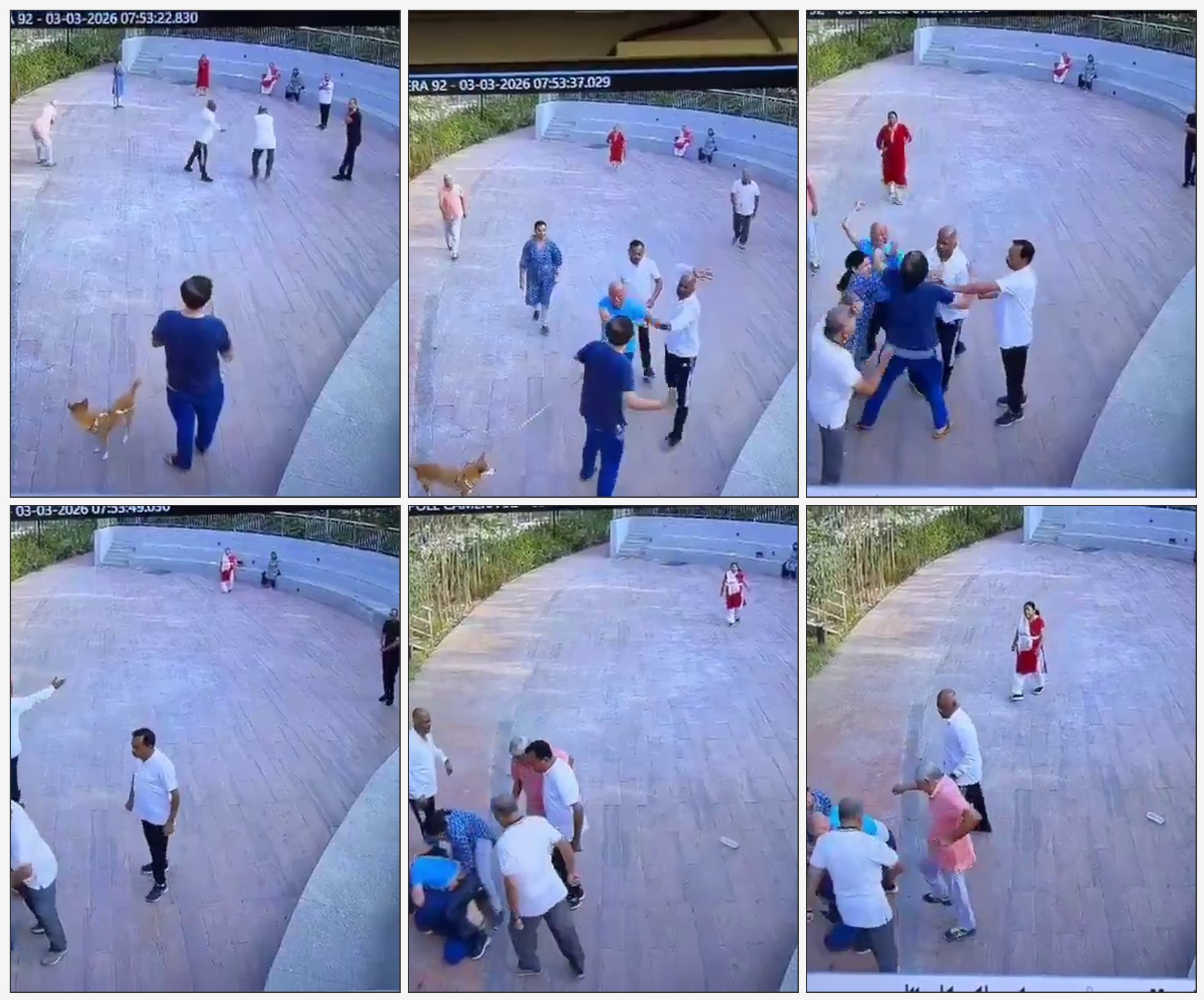
And before anyone has time to say “let’s discuss this calmly,” a group of elderly residents has surrounded the pet owner, a phone has been thrown, punches and kicks have been delivered, and the dog — arguably the most sensible individual present — has turned around and simply walked away.
The CCTV footage from Brigade Utopia, Varthur, Bengaluru captured all 44 seconds of it. The clip went viral almost immediately. And what followed was not just outrage — it was an entire national conversation about pets, apartment society rules, group behaviour, and the very Indian question of who gets to decide what a “public” space is for.
Let us get into it. ?
What Actually Happened: The 44-Second Version
On March 6, 2026, pet owner Tarun Arora was walking his dog in the common area of Brigade Utopia, a residential apartment complex in Varthur, east Bengaluru.
The dog urinated in a section of the walking area used by senior residents for their morning walks.
Recommended Product
Jockey Women's Hipster Brief – Comfort Fit, Assorted Colors
🛒 View on Amazon →As an Amazon Associate, we earn from qualifying purchases. Price and availability may vary.
A confrontation began. It escalated. Seven to eight senior citizens surrounded Arora. Physical blows were exchanged — or delivered, depending on which complaint you believe. A phone was reportedly thrown. Arora claims he was attacked without provocation. A counter-complaint from a woman alleges he assaulted her during the confrontation and made threatening remarks.
Both parties filed complaints at Varthur Police Station. No arrests have been reported. The investigation is ongoing.
And the dog? The dog took one look at the chaos, decided this was not his problem, and left. ?
Honestly, the dog showed more emotional intelligence than anyone else in the video.
The Reaction Online: India Had Opinions. Many, Many Opinions.
The clip spread rapidly and the responses it generated were — predictably — all over the place.
A large section of people found the whole thing hilarious. The detail that the dog itself walked away mid-confrontation became its own subplot. One widely shared observation pointed out that when a group of agitated adults starts behaving irrationally, animals — having better instincts for self-preservation — tend to exit the situation. The dog, several people noted, may have been the only one who made a good decision that morning.
The senior in the pink shirt attracted particular attention, with observers noting that he waited patiently at the back of the group before apparently delivering a few well-timed contributions toward the end of the video. Whether that is admirable or alarming depends entirely on your perspective. ?
But beyond the humour, there were sharper observations too.
Several commenters noted that the throwing of someone’s personal property — regardless of what preceded it — is not acceptable. Attacking one person from behind, as a group, is not a proportionate response to a dog urinating on a path. It is, in fact, several things at once: legally problematic, physically dangerous, and not the model of conflict resolution that senior citizens are generally expected to model for younger residents.
One commenter made the point with some force: no one has the right to physically assault another person over something this minor. Whatever the provocation, group violence against a single individual is cowardly — and the fact that the perpetrators are elderly does not change the legal or moral reality of what occurred.
The flip side of that argument was equally vocal. A number of people pointed out that the pet owner’s responsibility did not end when his dog finished urinating. The standard expectation — clearly, and regardless of the legal framework — is that a pet owner cleans up after their animal in a shared space. Whether or not that happened in this case, the expectation is reasonable. Shared spaces require shared responsibility.
The Question Nobody Wants to Answer: Who Actually Owns the Common Area?
Here is the thing about apartment complexes in Indian cities. ?
Everyone who lives there has a legitimate claim to the common areas. The family with the toddler. The teenagers who want to play cricket in the courtyard. The seniors who want a quiet walking path in the morning. The pet owners. The people who just want to sit outside without being bothered.
All of them are right. All of them have rights. And all of them will, at some point, irritate each other.
The issue in Varthur is not really about one dog and one incident. It is about what happens when shared spaces have no clear, agreed, and enforced rules — and different groups fill the vacuum with their own assumptions about what is acceptable.
A well-functioning housing society would have designated walking zones. Designated pet-walking times or areas. Clearly marked zones where pets are and are not permitted. A process for raising and resolving complaints that does not involve seven people surrounding one person near a hedgerow.
Without that framework, what you get is this: ad hoc enforcement, escalating confrontations, and CCTV footage that half the country finds hilarious and the other half finds deeply troubling.
One observer — who clearly had patience for nuance — made the argument that if certain areas within a private complex are to be restricted from pets, those areas must be clearly marked as pet-free zones. Signs. Physical designations. Communicated policy. Not a verbal confrontation enforced by group dynamics on a Tuesday morning.
The observation about group dynamics is worth pausing on. When several people are gathered together and one person in the group escalates, the others tend to follow — not necessarily because they all feel as strongly, but because group situations amplify individual reactions. One person’s anger becomes a crowd’s action before anyone has stopped to think whether this is proportionate. The seniors in this video likely did not plan to surround and physically confront someone when they left their flats that morning. The situation created a momentum of its own. That is not an excuse. It is an explanation — and understanding it is the first step toward preventing the next version of this incident.
The Mumbai Comparison: What Good Pet Rules Actually Look Like
Since we are having this conversation, it is worth knowing what the legal framework actually says — because most people on both sides of this debate are operating without it.
In Mumbai, cooperative housing societies operate under a clear and enforceable set of guidelines. The key points that every apartment resident across India should know:
- No housing society can ban pets outright. This is not a matter of opinion — it is supported by national animal welfare legislation, directives from the Animal Welfare Board of India, and consistent court rulings including from the Bombay High Court and the Supreme Court. Any resolution passed at an AGM that bans pets is legally challengeable and will not hold up.
- Breed discrimination is also invalid. Rules that say “only small dogs” or “no dogs above a certain weight” are generally unenforceable unless tied to a specific, documented incident — and even then, courts scrutinise heavily.
- Pets cannot be denied access to passenger lifts. A society cannot require pet owners to use only service lifts. They can suggest etiquette — keep the pet calm, leashed, avoid peak rush — but the restriction on lift access is not permitted.
What societies CAN enforce:
- Leashing in all common areas — lobbies, gardens, walkways, parking areas
- Vaccination proof and BMC registration (in Mumbai; equivalent local licences elsewhere)
- Immediate waste cleanup — with fines or notices for non-compliance
- Designated feeding spots for community animals, away from entrances and high-footfall areas
- Noise complaints, handled through formal channels — not physical confrontation
The critical takeaway for Bengaluru: If Brigade Utopia wants a pet-free walking zone for seniors, that is a legitimate goal — but it must be achieved through formal society policy, communicated clearly, with designated signage, and enforced through official channels. Not through a group of residents physically confronting a pet owner before the rest of the complex has woken up.
The Bigger Picture: 37 Lakh Dog Bite Cases and a Conflict That Is Only Growing
Here is a number worth sitting with: India recorded over 37 lakh reported dog-related incidents nationwide in 2024. That works out to more than ten thousand incidents every day on average.
Not all of those are fights between pet owners and senior citizens. Many involve stray dogs, and those incidents carry genuinely serious public health consequences — bites, infections, and in the most tragic cases, fatalities. That is a separate, urgent problem that deserves its own serious treatment.
But the urban pet conflict — between residents who own pets and those who do not want to share every inch of the common area with them — is a different category of problem, and it is growing in proportion to the number of urban households adding pets to the family.
One commenter framed it as a coming “civil war” between elite dog owners and everyone else — which is perhaps overdramatic, but not entirely without a point. The gap between how pet owners and non-pet owners experience shared spaces in Indian apartment complexes is wide, poorly managed, and producing exactly the kind of CCTV footage that ends up going viral.
The solution is not more confrontation. It is not more viral videos, more police complaints, and more neighbours who cannot look each other in the eye at the lift. The solution is straightforward, dull, and almost never happens until a crisis forces it: a clearly written, mutually agreed, formally adopted pet policy in every housing society — and a process for updating it as the community changes.
The people who walked away from this Bengaluru incident with the most credibility were the ones who said the same thing: handle it calmly, resolve it through conversation, and build rules that everyone can live with before the next dog has an urgent moment on the walking path. ?
A Note on the Seniors — With Some Genuine Sympathy
Let us be fair here, because this blog is not a pile-on.
The residents who confronted Tarun Arora are not villains. They are people who use a shared space every morning, who have presumably raised complaints before through whatever channels exist in their society, and who reached a point of frustration that boiled over badly.
One observer — with more empathy than most — noted that many seniors in apartment complexes like this are in a particular life stage: reduced mobility, health pressures, and children who are too busy or too far away to visit regularly. The common area walking path is not just exercise. It is community. It is purpose. It is the part of the day that belongs to them.
When that space feels invaded — day after day, without resolution — the frustration is real. The response, in this case, was disproportionate and legally problematic. But the underlying frustration came from somewhere legitimate.
That does not make kicking someone acceptable. It makes it understandable. And understanding it is the only path to actually fixing the dynamic — rather than simply generating more CCTV footage and more Twitter threads.
What Both Sides Need to Do — Starting Tomorrow
If you are a pet owner in any apartment complex:
- Carry waste bags. Always. No exceptions.
- Leash your pet in every shared space, every time.
- Learn your society’s actual pet policy — and if one doesn’t exist, propose one at the next AGM.
- If a resident raises a concern, respond without defensiveness. The first conversation sets the tone for all the ones that follow.
If you are a non-pet-owner resident:
- Physical confrontation is never the answer. Not for this. Not ever.
- File a formal complaint with the society management. If the management doesn’t act, escalate to the cooperative registrar.
- Advocate for a clearly written, formally adopted pet policy that includes designated zones, cleaning standards, and a complaint resolution process.
- The law protects pet owners’ rights — but it also supports reasonable regulations. Use the system. Don’t bypass it with group action.
If you are on a housing society committee anywhere in India:
- A pet policy is not optional anymore. Urban India has pets. Urban India has seniors. Urban India has shared spaces. These three things will keep producing conflict until your society has a written framework that all three groups helped create.
The dog did not cause this problem. The missing policy did. ?
Newspatron — Let Curiosity Be Your Guide.

[…] Dog. Pee. Seniors. Chaos. And One Very Wise Dog Who Simply Left. […]