



US Naval Blockade of Venezuela: A Timeline and Analysis (December 2025)
The United States’ imposition of a naval blockade on Venezuela in December 2025 marks one of the most aggressive policy shifts in decades. Announced by President Donald Trump on December 16, the blockade targets Venezuela’s oil exports—its primary revenue source—amid broader U.S. military operations in the Caribbean framed as counter‑narcotics efforts.
This report compiles verified details from official statements, military disclosures, and international reactions, drawing on declassified updates, diplomatic cables, and market data. It highlights the blockade’s enforcement, human costs, economic ripple effects, and diplomatic fallout, providing a foundation for deeper geopolitical analysis.
For a quick summary, read our Neural Explainer on the Venezuela Blockade.
Background and Trigger
The blockade stems from a months‑long U.S. buildup under Operation Southern Spear, initiated in September 2025 as a counter‑drug initiative but increasingly tied to regime change objectives.
- August 2025: Trump authorizes military action against Latin American cartels, doubling the bounty on Maduro to $50 million.
- September–November 2025: Deployment of ~15,000 U.S. troops, over a dozen warships (including the USS Gerald R. Ford carrier group), and F‑35 jets to Puerto Rico and the Caribbean. Airstrikes target alleged drug vessels, killing 82 by early December.
- December 10, 2025: Seizure of the Skipper tanker, the first direct enforcement action against Venezuelan oil shipping.
Trump’s announcement on Truth Social explicitly linked the blockade to alleged Venezuelan theft of U.S. “oil, land, and other assets” from expropriations dating to the Chávez era, alongside claims of funding “drug terrorism, human trafficking, murder, and kidnapping.”
Pentagon Framing and Enforcement Operations
The Pentagon has framed the blockade as an extension of counter‑narcotics enforcement, emphasizing legal authority under existing sanctions rather than a formal declaration of war. Secretary of War Pete Hegseth reiterated that operations target “narco‑terrorist” networks, including the Cartel de los Soles.
Enforcement involves U.S. Coast Guard interdictions, naval patrols, and seizures under Treasury sanctions. As of December 18:
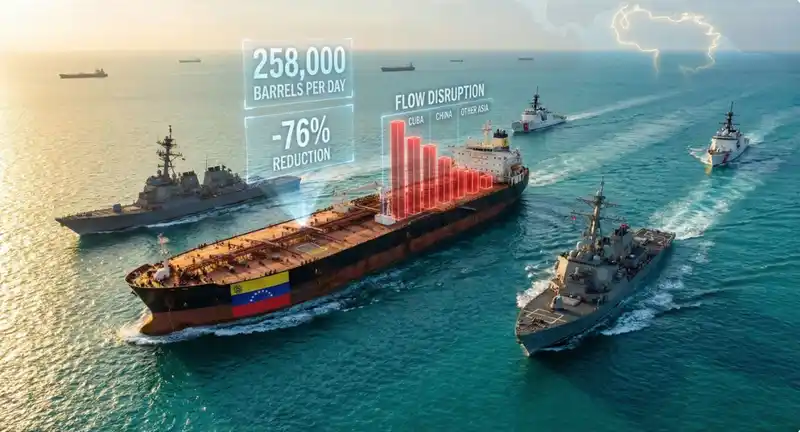
* Vessel Monitoring: Over 30 sanctioned tankers operate in Venezuelan waters; exports down 76% since the Skipper seizure.
* Venezuelan Countermeasures: Maduro ordered Venezuelan Navy escorts for tankers, risking confrontation.
* Airspace Closure: U.S. jets conducted training flights over the Gulf of Venezuela, signaling escalation.
Key Seizures
The blockade’s first major action was the seizure of the Skipper, a 330,000‑barrel VLCC flagged under Liberia but operated via a “dark fleet.”
| Vessel Name | Seizure Date | Location | Cargo | Outcome | Casualties |
|---|---|---|---|---|---|
| Skipper | Dec 10, 2025 | Caribbean Sea | 1.8M barrels Crude | Towed to Galveston, TX | None |
Casualty Figures
Operation Southern Spear’s strikes have killed 99 people across the Caribbean and Pacific. Critics allege extrajudicial killings, while the Pentagon frames them as anti‑narco‑terrorist actions.
Statements and Responses
- Trump: Tied blockade to restitution for expropriated U.S. assets.
- Maduro: Called blockade “barbarism,” vowed resistance.
- Cuba: Condemned seizure as “maritime terrorism.”
Regional Diplomatic Reactions
- Mexico: Urged UN mediation.
- Brazil: Offered mediation, warned of “Vietnam‑style” conflict.
- China: Opposed U.S. unilateralism.
- Colombia: Condemned blockade as piracy.
- Russia: Backed Maduro.
- UN: Called for dialogue.
Energy Market Impacts
- Venezuela’s ~780k bpd exports represent ~1% of global supply.
- Brent crude rose 2.5% post‑announcement.
- Blockade risks hyperinflation and famine in Venezuela.
- China may pivot to Russian/Iranian supplies.
Conclusion
The blockade represents a turning point in U.S.–Venezuela relations. With warships enforcing interdictions and casualties mounting, the Caribbean faces a prolonged siege with global energy consequences.

[…] Want the full timeline?Read the detailed analysis on the blockade operation. […]