

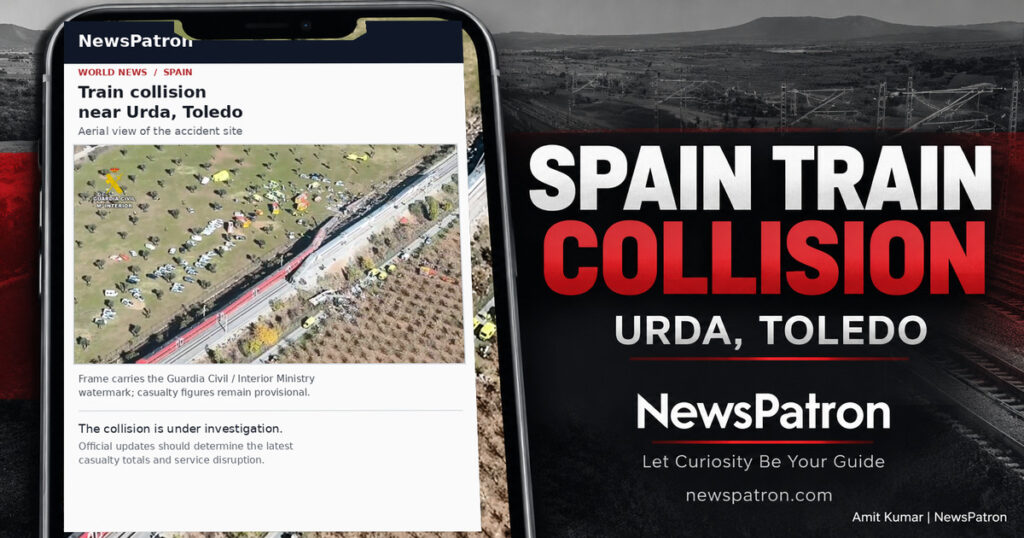

The aerial view shows two high-speed trains stranded beside a damaged stretch of track, with emergency vehicles gathered around the scene. Yet images alone cannot answer the most urgent questions: what happened in the seconds before the collision, how many passengers have been affected, and why did a train come into contact with another that was stopped ahead?
The Urda train collision occurred on the morning of 28 October 2026 in Toledo province, central Spain. A Renfe AVE train struck an Iryo train from behind near kilometre point 118 of the Madrid–Andalusia high-speed line. The line was suspended while emergency teams worked at the scene. The casualty figures reported during the day have differed between sources, and the cause remains under investigation.
The aerial frame used in the NewsPatron featured image carries the Guardia Civil and Spanish Interior Ministry watermark. The footage has also been published by Spanish news outlets as aerial imagery released by the Guardia Civil. It documents the visible condition of the site; it does not establish the final death toll or explain the cause of the collision.
Urda train collision: what the aerial images show
The supplied frame shows the trains running along the same railway corridor, with badly damaged rolling stock and scattered material near the track. Emergency vehicles and personnel can be seen in the surrounding area. News coverage of the Guardia Civil footage describes derailed carriages and a large response involving rescue, medical and investigative teams.
Antena 3’s report carrying the first aerial images identifies the footage as imagery from the accident near Urda and describes the Civil Guard response. Granada Hoy also published the aerial video and attributed it to the Guardia Civil. These are useful visual records, but the pictures should not be used to infer injuries, identities or the sequence of signalling events.
Urda train collision: what is known about the trains
Adif confirmed a rear-end collision between a Renfe train and an Iryo train serving the Madrid–Seville route. RTVE identified the Renfe service as AVE 2080 and the Iryo service as 6076. The collision occurred at approximately 08:54 Spanish local time near the section between Mora and Orgaz and Urda, in Toledo province.
Reports said the Renfe train carried 397 passengers. The Iryo train carried about 147 people, including an infant. Together, the trains were reported to have around 544 passengers aboard. The Iryo train was described as stopped when it was struck from behind. Reports differ on whether two or three carriages derailed or fell down the embankment; the exact damage and sequence must be established through the investigation.
Adif’s network notice placed the incident at kilometre point 118 and confirmed that the Madrid–Andalusia high-speed line had been interrupted. The operator also listed assistance points at Madrid-Puerta de Atocha, Sevilla-Santa Justa, Córdoba and Málaga María Zambrano.
Urda train collision: casualty figures remain inconsistent
The death and injury totals changed as rescue work continued, and published reports did not agree on one figure. A Granada Hoy report published at 12:03 on 28 October, citing the Castilla-La Mancha regional government, reported 30 deaths and 176 injured. RTVE’s report, updated at 12:42, continued to cite at least 30 deaths and described the toll as potentially rising.
Recommended Product
Top Electronics Bestsellers on Amazon India
🛒 View on Amazon →As an Amazon Associate, we earn from qualifying purchases. Price and availability may vary.
At 12:17, Antena 3 reported 50 deaths and more than 179 injured, attributing those figures to Castilla-La Mancha’s Civil Protection service. That is a materially different tally. NewsPatron has not been able to reconcile the conflicting numbers against a single final official statement. The figures must therefore be read with their source and time attached, not as a definitive final toll.
The initial social-media wording of “46 killed and 179 injured” should not be repeated as a verified total. The sources reviewed for this report give different provisional counts, including 30 deaths and 176 injured in one update and 50 deaths with more than 179 injured in another. Authorities’ subsequent statements and hospital or emergency-service updates are needed to establish the final figures.
Urda train collision: the Guardia Civil and emergency response
The Civil Guard released aerial imagery of the crash site and deployed officers to support rescue work, site security and the investigation. Reports describe personnel from Toledo, including public-security officers, SEPRONA and traffic units, alongside additional units from Ciudad Real and Albacete. They also list the Civil Guard’s air service, drone teams, the Reserve and Security Groups, cavalry, canine teams, criminalistics specialists and judicial police.
Regional emergency services, firefighters, Civil Protection teams and medical personnel also responded. Castilla-La Mancha activated its PLATECAM emergency plan, while medical teams established an advanced treatment point. The work at the site included assisting passengers, evacuating the injured, securing the area and documenting evidence.
The aerial images are one part of the public record. They show the scene from above, while passenger accounts, railway operating records, signalling data and the physical evidence will be needed to reconstruct how the two trains came to occupy the same section of track.
Urda train collision: the cause has not been established
Reports have raised a possible signalling problem and a preliminary human-error hypothesis. RTVE reported that the line was operating with an alternative signalling arrangement after a problem with the main LZB system. It quoted a railway engineering expert who suggested that an error in authorising the train behind to proceed could be one possible explanation, while explicitly warning that the explanation remained conjectural.
That distinction is essential. A technical problem, an operating decision and the response of safety systems are separate questions. A reliable conclusion will require investigators to examine the signalling and protection systems, train and control-centre records, communications, event recorders and the precise movement of each train. No individual or operator should be assigned responsibility before the evidence and formal findings support it.
The investigation must establish why the Iryo train was stopped, what information was available to the control centre and the drivers, what instructions were issued, and whether the applicable safety protections operated as designed. The aerial images cannot answer those questions on their own.
Urda train collision: high-speed services suspended
Adif said that high-speed traffic on the Madrid–Andalusia line was interrupted following the collision. Its network update stated that trains on the route were being held at stations along the corridor and directed passengers to the relevant operators for current information. Assistance points were opened at major stations, including Madrid, Seville, Córdoba and Málaga.
Renfe and Iryo issued passenger guidance for affected services, including arrangements for changes or cancellations. Travellers should use their operator’s latest announcement and ticket information rather than assume that a train has resumed or that an earlier timetable remains valid. The reports reviewed for this article did not provide a firm reopening time.
What investigators and the public still need to know
The immediate priority is to account for passengers, provide medical care and complete recovery operations safely. The next stage is to establish a clear, evidence-based account of the collision. That means publishing updated casualty figures with timestamps, explaining the relevant signalling conditions and identifying which parts of the timeline are confirmed, still being tested or not yet known.
For passengers, a separate practical need is timely information about suspended services, alternative travel arrangements and ticket changes. The route’s return to service will depend on the work at the site and decisions by the responsible authorities; no reopening time should be inferred from the release of aerial images or from an unofficial estimate.
The responsible conclusion at this stage is that a serious rear-end collision occurred near Urda between two high-speed passenger trains operating on the Madrid–Seville corridor. The line was suspended and a major emergency response was underway. The casualty totals reported during the day remain inconsistent, and the cause has not been finally established. Further official statements and the formal investigation should determine what happened and why.
What should a public railway investigation disclose first: the verified sequence of train movements, the signalling-system timeline, the emergency response or the passenger-service recovery plan? Readers can share their views and discuss the evidence in the comments below. Please distinguish verified information from early reports and speculation.
NewsPatron — Let Curiosity Be Your Guide.
Sources and further reading
- Adif — State of the rail network and service interruption notices
- RTVE — What is known about the collision and the preliminary signalling hypothesis
- RTVE — Aerial and ground photographs from the accident site
- Antena 3 — First aerial images and its reported casualty figures
- Granada Hoy — Guardia Civil aerial footage and the regional government’s provisional figures
- Reuters — Initial report on the collision and suspension of the Madrid–Andalusia line
Questions and answers
Where did the Urda train collision happen?
The collision occurred near Urda in Toledo province, at approximately kilometre point 118 of the Madrid–Andalusia high-speed line, on the section between Mora and Orgaz and Urda.
Which trains were involved?
Reports identify a Renfe AVE service, numbered 2080, and Iryo service 6076. Both were serving the Madrid–Seville route. Reports said the Renfe train struck the Iryo train from behind while the latter was stopped.
How many people were killed or injured?
The figures reported on 28 October differed. Granada Hoy reported 30 deaths and 176 injured, citing the regional government, while Antena 3 later reported 50 deaths and more than 179 injured, citing Civil Protection. The totals remained provisional and have not been reconciled in the sources cited here.
What do the aerial images confirm?
They show the trains and visible damage at the site, along with emergency activity around the railway. They do not establish the final casualty count, the precise sequence of signalling instructions or the cause of the collision.
Has the cause been confirmed?
No final cause has been established in the sources reviewed. Reports discuss a possible signalling problem and a preliminary human-error hypothesis, but those remain investigative questions rather than a confirmed finding.
Are high-speed trains between Madrid and Andalusia running normally?
Adif reported the corridor suspended after the collision and directed passengers to the operating companies for updates. No firm reopening time was confirmed in the reports cited here, so passengers should check current information before travelling.
