



Editorial note: This is opinion and strategic analysis based on public reports, including the U.S. Supreme Court ruling of February 20, 2026 (Learning Resources, Inc. v. Trump, 607 U.S. ___), White House proclamations and clarifications issued February 20–21, 2026, the United States–India Joint Statement of February 8, 2026, and contemporaneous coverage from NDTV, The Hindu, CNBC-TV18, Reuters, The New York Times, Bloomberg, Times of India, and official U.S. government fact sheets. Trade policy is fluid. Final outcomes depend on executive actions, Congressional moves, ongoing bilateral negotiations (an Indian team is currently in Washington), and possible further legal or legislative steps.
?? The chess clock has been reset. And India is at the board.
In the space of a single day — February 20, 2026 — the entire architecture of U.S. tariff policy shifted under the world’s feet. The U.S. Supreme Court, in a landmark 6-3 ruling in Learning Resources, Inc. v. Trump, struck down President Trump’s use of the International Emergency Economic Powers Act (IEEPA) to impose tariffs. Chief Justice John Roberts, writing for the majority, was blunt: a tariff is a tax. And the U.S. Constitution does not vest taxing power in the executive branch. IEEPA’s long list of presidential powers — to investigate, block, regulate, nullify, compel — nowhere includes the word “tariff.” So those tariffs? Gone. Constitutionally invalid.
Trump’s response? He signed a new executive order within hours. Same destination, different road.
Welcome to Section 122 of the Trade Act of 1974. The tool most trade lawyers hadn’t looked at in decades. And right now, the tool shaping every Indian exporter’s next 150 days. ?
The Tariff Journey So Far — From Zero to Chaos to Reset
To understand where we are, you need to understand how we got here. Because this isn’t a single decision. It’s a sequence — a deliberate escalation ladder that India has been navigating since early 2025.
It started with zero. India and the U.S. had a functional, if imperfect, trade relationship. Then Trump returned to office and began his second-term tariff offensive. By mid-2025, India faced 25% reciprocal duties — framed as a response to India’s own relatively high import tariffs on American goods. Then came the geopolitical layer: India’s continued large-scale purchases of discounted Russian crude oil post-Ukraine invasion drew specific penalties, stacking effective rates on some export lines toward 50%.
Fifty percent. On India’s textiles, pharmaceuticals, gems, engineering goods — the backbone of India’s export economy.
Then came a breakthrough. After nearly ten months of negotiations, India and the U.S. signed a bilateral interim trade framework on February 6, 2026, backed by a joint statement on February 8. Tariffs on Indian goods came down to 18%. India committed to eliminating or reducing tariffs on U.S. industrial goods and agricultural products. Both sides flagged a $500 billion bilateral trade target. It wasn’t perfect — but it was progress.
Recommended Product
Waterproof Car Body Cover for Maruti Dzire 2017-2023
🛒 View on Amazon →As an Amazon Associate, we earn from qualifying purchases. Price and availability may vary.
Then the Supreme Court threw the whole framework into the air.
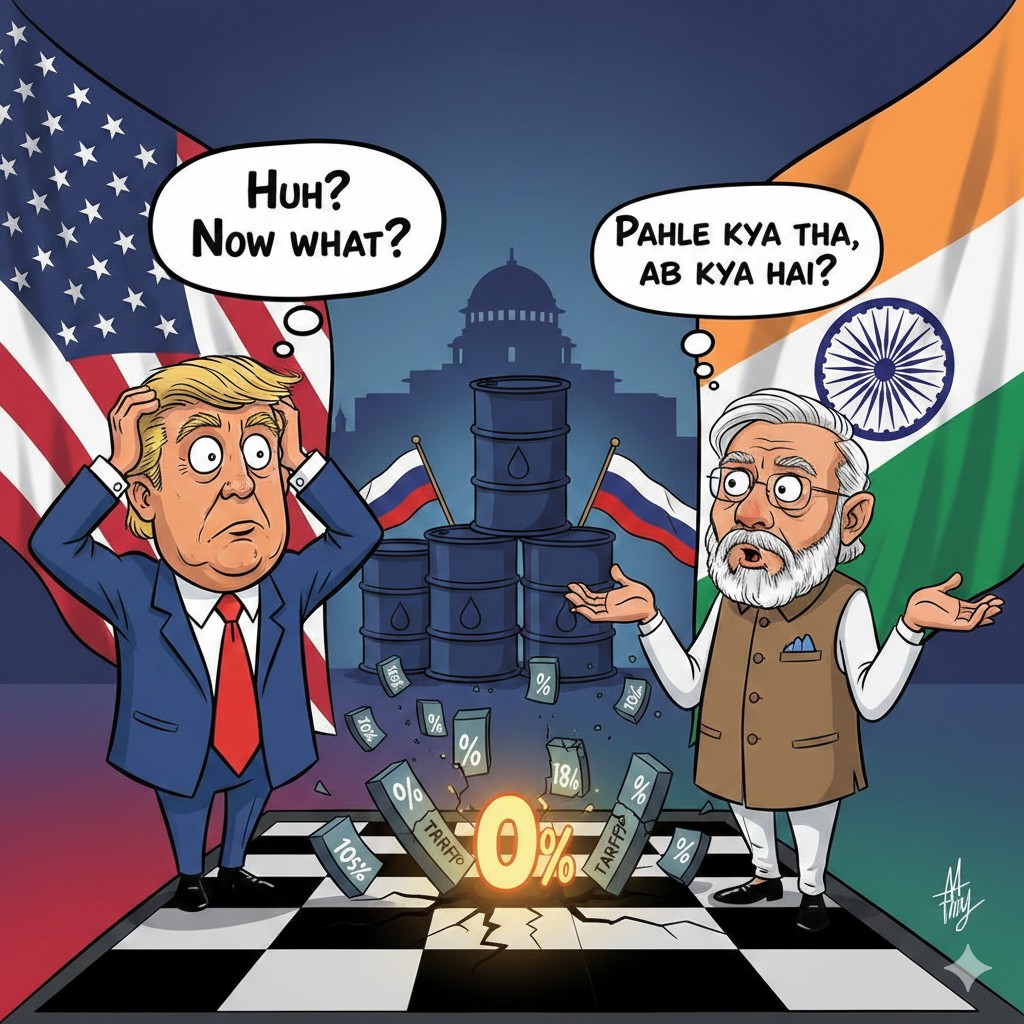
With IEEPA tariff authority invalidated, Trump moved immediately to Section 122 — imposing a 10% global tariff effective February 24, for up to 150 days. This rate applies to India, the EU, Japan, South Korea, Vietnam, Bangladesh — everyone. No special bilateral deals. A flat global floor. Trump himself confirmed: “Nothing changes” for India — meaning the bilateral framework understanding holds, but the universal 10% applies on top of it regardless.
What Is Section 122? The Emergency Tool Nobody Saw Coming
Most people haven’t heard of Section 122 of the Trade Act of 1974 (codified as 19 U.S.C. § 2132). It was designed in the Nixon era as a rapid-response tool for a very specific problem: serious U.S. balance-of-payments deficits or risks of a sharp dollar depreciation. Think of it as the president’s emergency fire extinguisher for trade crises — not a long-term policy lever.
Here is what it allows — and critically, what it does not:
- ? The president can impose import surcharges of up to 15% ad valorem — or apply import quotas — with no lengthy investigation required
- ? Only a presidential determination that balance-of-payments conditions exist is needed — fast, unilateral, immediate
- ? Applies globally — not just one country or sector
- ? Hard cap at 15% — Trump’s 10% is within the limit, but there is no room to escalate much further under this authority
- ? Expires after 150 days — automatically, unless Congress passes legislation to extend it
- ? Not designed for permanent or indefinite trade policy — explicitly a short-term correction tool
One more critical point: Section 122 has never been used as a tariff instrument before in U.S. history. It sat dormant for over fifty years. Trump is the first president to deploy it this way — which is exactly what makes legal analysts nervous and trade partners wary. The balance-of-payments justification (the U.S. trade deficit) is legally contestable. India and others could challenge it at the WTO. But WTO timelines are long, and the 150-day window will likely expire before any ruling. For now, the 10% stands.
Why Trump Does This — And Why It Actually Makes Strategic Sense
Trump’s tariff playbook rests on a core economic conviction: America has been subsidizing the world through unbalanced trade for decades. Persistent deficits drain manufacturing capacity, hollow out industrial towns, and weaken national security. Tariffs correct that imbalance by raising costs on foreign goods, protecting domestic producers, and creating negotiating leverage.
When India kept buying heavily discounted Russian crude post-2022, Trump read it as a geopolitical signal — a refusal to align with U.S. and Western pressure on Moscow. The penalty tariffs targeting India’s Russia oil exposure were deliberate pressure to shift behaviour. And they worked: India signalled a diversification pivot toward U.S. shale, Gulf, and allied sources. Rates eased to 18% as a result.
The Supreme Court disrupted the IEEPA playbook — but not the strategy. Section 122 gives Trump a 150-day bridge to pursue more durable tools. The administration has explicitly signalled three paths forward:
- ? Section 301 of the Trade Act of 1974 — Targets specific countries or sectors for unfair trade practices, IP theft, or subsidies. Trump explicitly paired the Section 122 order with new Section 301 probes. This is the most direct “next chapter” authority — it can produce country-specific, sector-specific tariffs well beyond 10% and well beyond 150 days. India has been flagged before under Section 301 for data localisation rules, pharmaceutical pricing, and agricultural import restrictions.
- ? Section 232 of the Trade Expansion Act of 1962 — National security tariffs on specific sectors. Already active on steel, aluminium, automobiles, copper derivatives. The Supreme Court ruling didn’t touch these. They remain fully in force.
- ?? Congressional legislation — The administration has signalled intent to seek a statutory basis for permanent tariff authority that the courts cannot overturn. If Congress acts, the entire tariff architecture becomes durable.
The 10% universal rate also serves a tactical purpose: it levels the competitive field. No country gets a bilateral discount while negotiations continue. Vietnam, Bangladesh, the EU — all at 10%, same as India. This removes any competitive advantage India gained from the 18% interim agreement, temporarily, and reinforces: everyone negotiates on American terms, or no one gets preferential treatment.
Why Modi Responds the Way He Does — Detachment as Strategy
Prime Minister Modi’s approach to this entire tariff episode has been a masterclass in what diplomatic professionals call strategic patience — and what everyone else calls not taking the bait.
India did not retaliate publicly when tariffs climbed toward 50%. It did not issue sharp statements when penalties were linked to Russia oil. It did not escalate when the interim 18% framework was thrown into uncertainty by Washington’s internal legal battles. Instead, India quietly did three things:
- ?? Adjusted its energy sourcing — signalling a pivot away from Russian crude toward U.S., allied, and Gulf suppliers, earning diplomatic credit in Washington
- ? Opened sectors — committing in the joint statement to reduce tariffs on U.S. industrial goods, food products, and working toward the $500B bilateral trade target
- ?? Sent negotiators — an Indian trade team is currently in Washington finalising the legal text of the Bilateral Trade Agreement. Quiet negotiation while the cameras are elsewhere.
Why the rhetorical detachment? Because public confrontation with Trump is almost always counterproductive. It triggers escalation, plays into U.S. domestic politics, and forces Trump into a corner where backing down feels like weakness. Private bargaining, in contrast, lets both sides claim wins. Modi preserves India’s dignity and strategic autonomy while delivering concessions that ease tariff pressure. Pragmatism over pride.
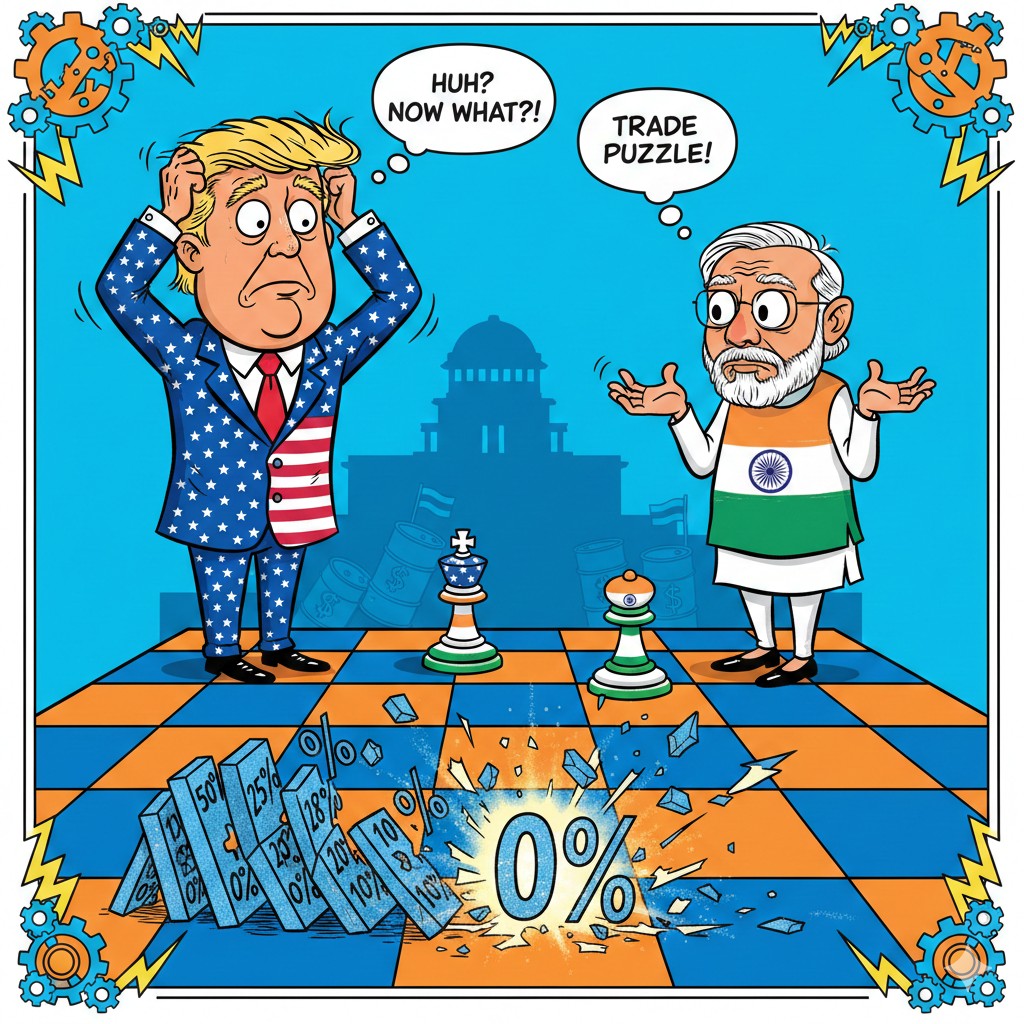
Both leaders are acting rationally within their mandates. Trump extracts maximum concessions for American workers, security, and industry. Modi safeguards India’s growth trajectory, energy needs, and sovereignty. Neither is winning or losing in absolute terms. Each is advancing core national interests on a shared board. ??
What It Means for India — Short, Medium, and Long Term
Short term (now through June 2026): The 10% rate is lower than the 18% interim — temporary relief for Indian exporters in textiles, pharma generics, gems, and engineering goods. Pharmaceutical exports are separately exempted under ongoing Section 301 probes. USMCA goods are excluded. India must track carve-outs carefully; the White House fact sheet notes the surcharge applies in addition to existing MFN duties, except where Section 232 tariffs are already in place.
Medium term (next 6–18 months): The uniform 10% erodes any bilateral edge India negotiated. When Vietnam, Bangladesh, Sri Lanka, and Cambodia all face the same rate, India’s relative cost-competitiveness resets. If the 150 days expire without Congressional extension, tariffs technically lapse — but Section 301 probes or new legislation will almost certainly step in. India must watch for Section 301 investigations into IT services, pharma pricing, data localisation rules, and agricultural import restrictions — all previously flagged by Washington.
Long term (the bilateral deal): Everything depends on whether India and the U.S. successfully conclude the Bilateral Trade Agreement (BTA). A ratified agreement — with Congressional backing — insulates India from future executive action swings. That is the prize. The 150 days are not a crisis. They are a window.
India’s Trade Toolkit — Not Defenceless
One frequently misunderstood aspect of this debate: India is not defenceless. It doesn’t have a direct equivalent to Section 122’s executive speed — but it has WTO-consistent tools that matter:
- ?? Section 8B — Customs Tariff Act, 1975 (Safeguard Duties): Allows temporary increased duties on imports causing serious injury to domestic industry — after a DGTR investigation. Slower than a presidential order, but available and WTO-consistent.
- ?? Anti-dumping and Countervailing Duties: India regularly deploys these against below-cost imports and subsidy-backed foreign goods. Significant retaliatory toolkit, already active in dozens of sectors.
- ? Quantitative Restrictions under the Foreign Trade Act, 1992 — Import licensing and quantity caps on specific categories when national interest requires.
- ? WTO Dispute Settlement — India has brought and won WTO disputes before. Section 122’s balance-of-payments justification is legally contestable. A challenge is possible — though timelines make it a long-game tool.
The honest contrast: U.S. executive action under Section 122 can impose a 10% global tariff in hours. India’s safeguard process takes months. But India’s real leverage isn’t in the speed of retaliation — it’s in the scale of the market access it offers and the strategic value it provides the U.S. in a multipolar world. That asymmetry is why quiet negotiation, not loud retaliation, is the right tool in India’s hands right now.
The Bigger Picture: What This Episode Reveals
Step back from the percentages and statutes for a moment. What does this episode tell us about the world India is navigating?
U.S. executive trade power has real limits — but real resilience. The Supreme Court reasserted Congressional primacy over taxation. Yet within hours, the same administration found another statutory avenue. India must plan for a U.S. that will continue to use trade as a pressure instrument regardless of which specific legal authority is invoked.
Bilateral agreements are more valuable than ever. A ratified Bilateral Trade Agreement — not just an interim framework or a presidential proclamation — is what insulates India from future executive pivots. Congressional backing creates legal durability that executive action cannot override. The team in Washington right now is working on arguably the most consequential trade document India has negotiated in a generation.
Diversification is a requirement, not a fallback. Whether it’s export markets (EU, ASEAN, Africa, the Gulf) or import sources (energy, semiconductors, critical minerals) — the lesson of the past year is clear. Concentration in any single bilateral relationship creates vulnerability. India’s supply chain strategy must build redundancy as a foundational principle.
Trade is not charity. It has never been charity. It is power competition — conducted with spreadsheets and statutes instead of armies. Both Washington and New Delhi understand that equation deeply. The next 150 days will test whether the interests of the world’s oldest democracy and the world’s largest democracy can align tightly enough to move beyond the chess match — toward something more durable, more mutual, and more resilient for both sides.
The board is set. The clock is running. ?
? Follow NewsPatron for live updates as the India–U.S. bilateral trade talks progress in Washington. We will update this analysis as the Section 122 clock counts down and negotiation outcomes emerge. Subscribe to our YouTube channel for video breakdowns of each development. ?
