


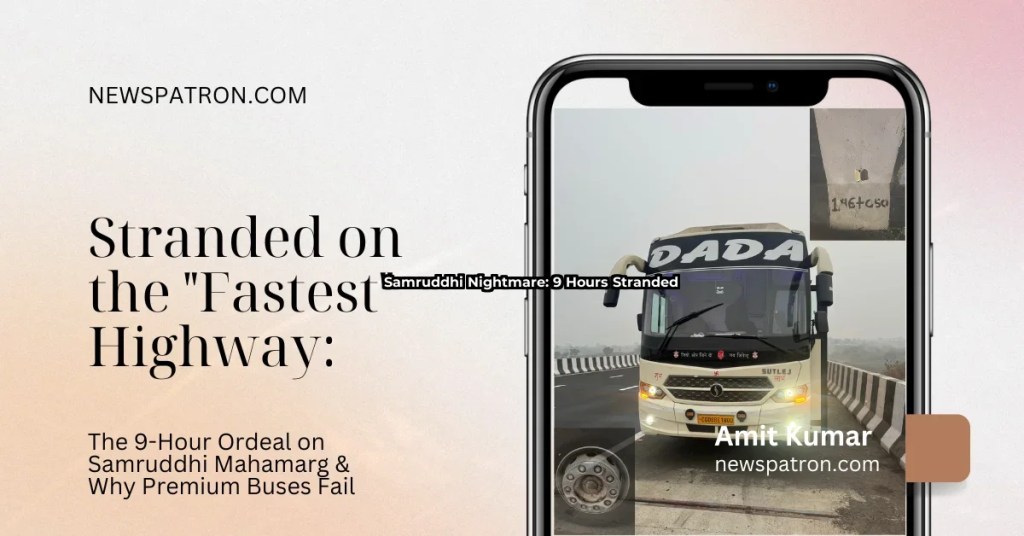

Imagine being stuck on India’s most modern expressway, surrounded by miles of nothingness, for nine straight hours. No food. Limited water. And deafening silence from the authorities.
This isn’t a scene from a survival movie. It is the reality faced by over 50 passengers on a Samruddhi Mahamarg bus breakdown near Igatpuri just this morning. While the expressway promises speed, this incident exposes the terrifying gaps in our highway emergency response.
Let’s hit the road and analyze what went wrong, why even premium buses like Bharat Benz stall in the rain, and exactly who is responsible when you are left stranded.
The Igatpuri Nightmare: 9 Hours, 50 Lives, Zero Answers
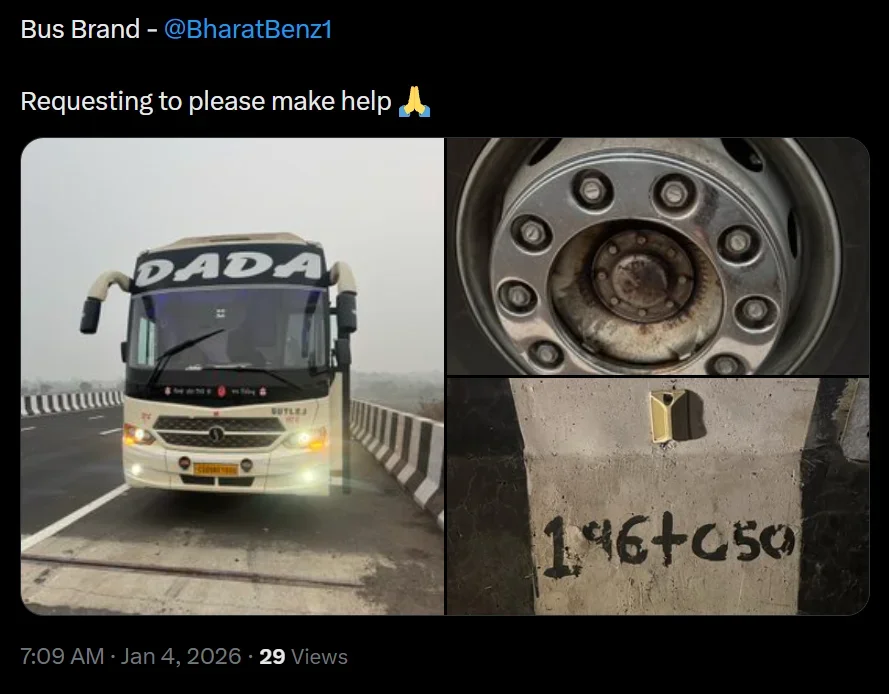
Early on January 4, 2026, a desperate cry for help appeared on social media platforms. A stranded commuter flagged a massive crisis: a private sleeper coach had suffered a mechanical meltdown near Igatpuri.
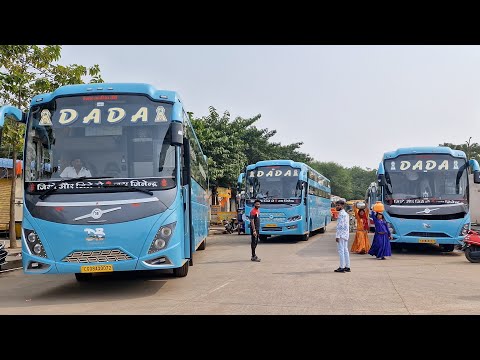
The vehicle in question? A Bharat Benz sleeper coach operated by Dada Brothers (Travels), bearing the registration number CG 08 BE 1800.
What was supposed to be a high-speed inter-state shuttle turned into a parking lot ordeal. The bus was stranded for over nine hours. There were elderly passengers and children on board, facing dwindling resources and rising panic.
The Silence of the System
Perhaps the most shocking aspect wasn’t the breakdown itself, but the response.
- MSRDC (Maharashtra State Road Development Corporation): Zero official statements.
- Highway Police: No alerts issued.
- The Operator: Dada Brothers (Travels) reportedly offered no immediate replacement vehicle.
It was a classic case of “infra ghosting”—where the infrastructure is world-class, but the support system vanishes when you need it most.
Recommended Product
Top Electronics Bestsellers on Amazon India
🛒 View on Amazon →As an Amazon Associate, we earn from qualifying purchases. Price and availability may vary.
Why Do “Invincible” Buses Fail in the Rain?
You might wonder: How does a rugged Bharat Benz or a premium Volvo simply give up? The answer often lies in the “monsoon gremlins”—water, mud, and vibrations.
While these buses are engineering marvels, they have specific vulnerabilities that get amplified on wet Indian highways.
1. The “Air Brake” Trap
Modern heavy vehicles use pneumatic (air) suspension and brakes. On rough, pothole-ridden patches—common during monsoons—debris can puncture these pneumatic lines. The Result: A pressure drop triggers safety sensors, causing the wheels to lock up automatically. The bus literally refuses to move.
2. Sensor Overload & “Limp Mode”
These buses are computers on wheels. Critical sensors (ECU, ABS) are often located near the undercarriage. The Failure: Driving through flooded sections pushes water into “air intake levels” or shorts out the sensors. The bus computer detects a fault and triggers “Limp Mode,” cutting power to protect the engine.
3. The Vibration Factor
Highways like Samruddhi allow speed, but unseen undulations or monsoon potholes cause intense vibrations. This can loosen electrical connections or crack components like exhaust bolts, leading to sudden electrical stalls.
The Operator: Who is Dada Brothers (Travels)?

The bus involved belongs to Dada Brothers (Travels), a major operator with headquarters in Rajnandgaon, Chhattisgarh. They operate a large fleet including multi-axle Volvos and Bharat Benz sleepers across routes like Pune, Nagpur, and Hyderabad.
While they promote passenger comfort and “live tracking” on their website, incidents like this highlight the gap between digital promises and ground reality.
The Gripes: Frequent travelers on online forums often discuss mixed experiences, sometimes pointing to maintenance delays on long-haul inter-state routes. Fleet insiders suggest that operators running heavy rotation on these long routes must adhere to strict “monsoon-grade” preventive maintenance—like waterproofing sensors or upgrading to hydrophobic fuel filters—to avoid such catastrophic breakdowns.
The Visual Proof: See For Yourself
Know Your Rights: The “1033” Lifeline

As a frequent traveler, you need to know this: You are not helpless. The Samruddhi Mahamarg helpline 1033 is not just a suggestion; it is a mandate.
1. The “Fuel & Fix” Rule
There is a common belief that if you run out of fuel, the operator must help. This is true. QRVs (Quick Response Vehicles) are stationed across the 701 km stretch, equipped to provide basic aid (fuel, jump-starts) within 30 minutes.
2. Towing is (Mostly) Free
If your vehicle breaks down and blocks traffic, towing to a safe bay is often free for the first 50km or for minor obstructions. Toll operators are contractually bound to patrol every 10-15 km.
3. What if They Don’t Show Up?
If the Samruddhi Mahamarg Helpline 1033 fails or the operator delays beyond 30 minutes, it is a breach of contract. Users can report this negligence directly to MSRDC or via the official highway tracker app. Operators face heavy fines (?1-5 lakh) for such lapses.
The Verdict: Accountability Gap
The incident near Igatpuri proves that while we have built a “Super Communication Expressway,” the communication part is broken. A 9-hour wait for a replacement bus or a tow truck is unacceptable in 2026.
Until MSRDC enforces stricter penalties on operators like Dada Brothers for poor maintenance and slow response, the “fastest” highway will remain a gamble for the common commuter.
Connect with the Editor
I’m always eager to hear your thoughts. Have you ever been stranded on the Samruddhi Mahamarg? Did 1033 work for you? Connect with me, Kumar, Editor at Newspatron, on your favorite platform:
For some fantastic drone shots of the highways we discuss, check out my YouTube channel DroneMitra (Your Sky is Digital with a Drone as a Friend), and for more insightful content, subscribe to the new Newspatron channel (Let Curiosity Be Your Guide).
- For quick updates: Follow me on Instagram, Twitter, YouTube, or Reddit.
- For deeper conversations: My Facebook profile is open to new friends!
- For instant updates: Subscribe to my WhatsApp Channel (your privacy is protected).
- For professional networking: Let’s connect on LinkedIn.
You can find all the relevant links on the Newspatron homepage. Let curiosity be your guide!
