




By the NewsPatron Political Desk
#RSS100 #ShatakTheMovie #IndianPolitics #CulturalWar #ShivJayanti2026
On October 2nd, 2025, the Rashtriya Swayamsevak Sangh (RSS) completed 100 years.
Let us be clear about what this means. It was not just a birthday. It was the culmination of a century-long project to transform a small group of men in Nagpur into the gravitational center of Indian politics.
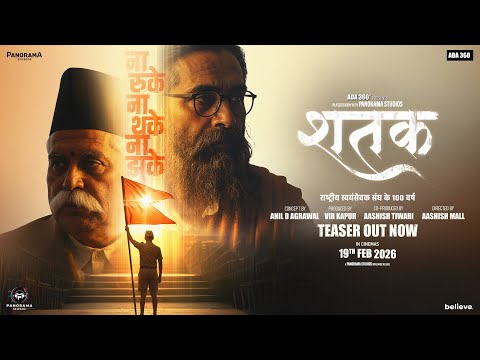
For decades, the RSS was the “political untouchable” of India—banned, ridiculed, and isolated. Today, it is the sun around which the entire system orbits. The upcoming release of the film “Shatak: Sangh Ke 100 Varsh” on February 19, 2026, is not a coincidence. It is a declaration.
It is the final stamp on what Guruji Golwalkar once famously said: “Work fast, but slowly.”
But as the saffron flag prepares to flutter on the silver screen, we must ask the uncomfortable questions. How did they get here? And where are they taking us?
The Fear of the “Larger” Leader
If you analyze the RSS’s history without the rose-tinted glasses of devotion or the black glasses of hatred, one pattern is undeniable: The Organisation terrifies the Individual.
Whenever a Swayamsevak becomes “bigger than the Sangh,” Nagpur gets uncomfortable. We saw this friction with Atal Bihari Vajpayee. The Sangh fears the Cult of Personality because the Cult threatens the Code.
Today, with Narendra Modi, that dynamic has shifted. Modi hasn’t just survived the Sangh’s discomfort; he has reshaped it. He has delivered what the Sangh craved for 90 years—cultural dominance via political power. But make no mistake: The DNA of the Sangh remains the Shakha, not the Neta.
The Four Avatars of the Sangh
To understand the 100-year journey, you must understand its four distinct evolutions:
- The Hedgewar Era (1925-1940): The era of sharp political instinct. Dr. Hedgewar demanded “Complete Independence” when the Congress was still begging for dominion status. He engaged with everyone—Savarkar, Gandhi, Aurobindo. Dialogue was his weapon.
2. The Golwalkar Era (1940-1973): The era of spiritual depth but political suicide. The decision to stay out of the 1942 Quit India Movement cost them dearly. It handed the Congress a stick to beat them with for decades.
3. The Deoras Era (1973-1994): The course correction. Balasaheb Deoras realized that without political power, cultural work is a sitting duck. He fought the Emergency, opened the doors to Dalits, and laid the brickwork for the BJP.
4. The Bhagwat Era (2009-Present): The era of “Systematic Expansion.” Mohan Bhagwat isn’t running an NGO; he is running a parallel governance structure. The strategy is ruthless and brilliant: First awaken religious identity, then create a “Protector” mentality, and finally, convert that gratitude into a vote.
‘Shatak’: Cinema is the New Shakha ?
The release of Shatak on February 19—Chhatrapati Shivaji Maharaj Jayanti—is strategic genius.
Recommended Product
Jockey Women's Hipster Brief – Comfort Fit, Assorted Colors
🛒 View on Amazon →As an Amazon Associate, we earn from qualifying purchases. Price and availability may vary.
For 90 years, the RSS relied on word-of-mouth. Now, they are deploying the most potent weapon of the 21st century: The Screen.
Online discourse is already on fire. Supporters call it the “untold truth of RSS sacrifices during Partition and Emergency.” Critics call it “election-year propaganda.”
But that debate is the victory. By forcing the country to debate RSS history on their terms, they have already won the narrative war. This is “Soft Power” at its peak. Just as The Kashmir Files shifted the window of discourse, Shatak aims to cement the RSS legacy.
The Missing Blueprint: Where is the Science? ?
Here is the critique no one in the Sangh wants to hear.
They speak of Param Vaibhav (Supreme Glory). But in the modern world, glory is built on two pillars: Science and Economics.
Does the RSS have a blueprint for Artificial Intelligence? Do they have a doctrine for global trade deficits? Or are they still viewing the 21st century through the lens of 19th-century cultural revivalism?
Awakening religious identity is easy. Building a $10 Trillion economy requires more than just shakhas.
The Verdict: The Long Game
The RSS didn’t win because they were lucky. They won because they were patient.
They suffered the ban in 1948. They suffered the isolation in 1992. But they kept walking.
As the movie hits the screens, the message to the opposition is clear: You are fighting an election; they are fighting a civilization war. And right now, they are winning.
Shocking Truth: The Bengal Files Movie Explained
This editorial includes views of Senior Political Analyst and Journalist Prashant Dixit of Maharashtra.
?? Let’s Connect: I’m Kumar, Editor at Newspatron.
? WhatsApp •
? LinkedIn •
? Facebook •
? Telegram
Follow for daily viral stories & insights ??
