




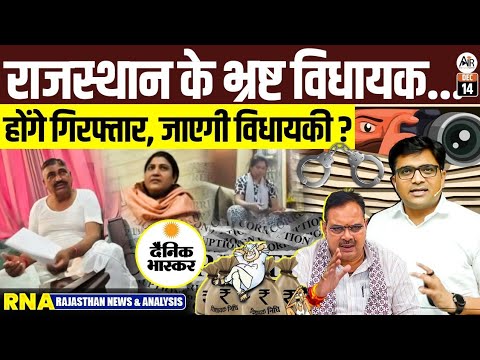
In an era where public trust in governance hangs by a thread, investigative journalism remains our bulwark against systemic rot. A shocking new sting operation in Rajasthan has peeled back the layers of local governance to reveal a thriving “commission raj.” The parallels to the infamous Narada exposé are chilling, revealing how corruption devours development funds across India’s political landscape.
This isn’t just about one rogue politician; it is a dissection of how the machinery of development is being held hostage by those elected to grease its wheels. From demand percentages that defy belief to the normalization of bribery, the Rajasthan sting offers a blueprint for how public money is siphoned off before a single brick is laid.
The Rajasthan Sting: A Blueprint for Bribery
Rajasthan’s political corridors are reeling from a Dainik Bhaskar sting that captured BJP MLA Rewant Ram Danga on camera demanding a staggering 40% commission—?20 lakh—on a ?50 lakh development work order from his Local Area Development (LAD) fund.
Posing as a contractor, the undercover reporter handed over ?50,000 as token money. Instead of rejecting it, Danga pushed for a full ?10 lakh advance while issuing a recommendation letter. The conversation wasn’t just about his cut; it was a masterclass in bureaucratic corruption. He casually advised the “contractor” on further payouts: 10% for officers and 5% for staff.
“Give 40 per cent, I will give work worth ?50 lakh,” Danga stated, underscoring a normalized racket where contractors are left with slim profits, inevitably leading to the use of subpar materials and crumbling infrastructure.
The video, clocking over 11 minutes, casts a wide net. It also implicates:
- Congress MLA Anita Jatav: Captured demanding ?50,000 for an ?80 lakh project.
- Independent MLA Ritu Banawat: Implicated via her husband, who was seen negotiating deals worth ?40 lakh.
This isn’t isolated greed; it is a symptom of how LAD funds—meant for constituency upliftment—have become personal piggy banks for legislators.
Public Outrage: “India Will Never Be China”
Social media platform X (formerly Twitter) erupted as the viral clip shared by handle @IndianGems_ crossed 500,000 views. The thread became a digital town hall for public fury.
Replies flooded in, tagging Prime Minister Narendra Modi and the BJP’s official handles. One user quipped, “Na khaunga, na khane dunga?” (I will neither eat [bribes] nor let others eat), echoing the PM’s famous anti-corruption pledge.
Recommended Product
Magnesium Body Spray – Muscle Recovery & Lavender Scent
🛒 View on Amazon →As an Amazon Associate, we earn from qualifying purchases. Price and availability may vary.
Others broke down the math of corruption with grim precision: “Subtract 20% department cuts, 20% contractor profit, 12% GST—now, what work can be done?” The sentiment was bleak, with one user lamenting, “India will never be China with this shit.” The consensus is clear: when total cuts exceed 70%, the “development” that reaches the ground is merely a facade.
Echoes of Narada: The Cash-for-Favors Fiasco
The Rajasthan sting feels like a déjà vu of 2014. The Narada News undercover operation used the exact same playbook: journalists posing as fake firm representatives to snag favors.
Over 52 hours of footage exposed heavyweights from the Trinamool Congress (TMC) in West Bengal pocketing bribes ranging from ?5 lakh to ?50 lakh. The bribes weren’t always cash; they took the form of saris and electronics, all for “facilitating” state deals.
Transcripts That Shook the System
The Narada transcripts reveal the banality of graft:
- Mukul Roy (then TMC MP): Directed the cash flow, saying, “Give it to my office… I am not taking it straightaway.”
- Subrata Mukherjee: Accepted ?4 lakh with a curt “Ok.”
- Firhad Hakim: Discussed tenders for Adani-linked projects, instructing aides to handle the cash discreetly.
Like in Rajasthan, the corruption was tied to elections and infrastructure. Suvendu Adhikari was seen taking ?5 lakh on camera. While the sting led to CBI probes and arrests, enforcement has lagged—a worrying precedent for the current situation in Rajasthan.
A Pan-India Malaise
These stings are not outliers. They are dots in a connected pattern of systemic failure.
- Goa (2025): A Republic TV probe uncovered “hafta” for nightclub licenses, enabling fire-trap buildings that resulted in eight deaths in Arpora.
- Maharashtra (2001/2010): From Operation Chakravyuh to the Adarsh scam, MLAs have been caught demanding 10–20% cuts in housing.
- Karnataka (2011): The Bellary mining sting exposed a ?16,000 crore loot.
Conclusion: Reform or Perish
The Rajasthan sting, laced with the ghosts of Narada, spotlights a predatory system. Corruption is not partisan; it is structural. MLAs wield unchecked power over LAD funds, siphoning crores meant for roads and schools.
Post-2005 reforms audited these funds, but weak enforcement breeds impunity. The message from the viral fury is clear: We need digitized allocations, caps on discretionary spending, and zero-tolerance enforcement via independent watchdogs. Until then, every pothole on an Indian road whispers the story of pilfered lakhs.
Understanding LAD Funds: The Cash Behind the Corruption
To understand the gravity of this sting, one must understand the pot of gold these politicians are raiding. The Local Area Development (LAD) schemes were designed to empower elected representatives to fix local problems—a broken road here, a missing water pump there. Instead, they have often become slush funds.
What are LAD Funds?
Essentially, they are taxpayer rupees placed at the disposal of your MP or MLA. They recommend projects, and the district administration releases the money.
- MPLADS (Central): Members of Parliament get ?5 crore annually to spend on their constituency.
- MLALADS (State): MLAs get similar funds, though the amount varies by state (e.g., Delhi MLAs get ?10 crore/year).
The “Non-Lapsable” Loophole
Unlike most government budgets, these funds are “non-lapsable.” If an MP doesn’t spend their ?5 crore this year, it carries over. This creates a massive accumulation of unspent cash, which often gets hurriedly “allocated” (read: siphoned off via commissions) just before elections.
Recent Changes & Controversies
While the government has tried to tighten the screws—introducing the e-SAKSHI portal in 2023 for direct vendor payments—the human element remains the weak link. Currently, MPs are demanding a hike to ?15 crore per year, arguing inflation. However, as the Rajasthan sting proves, increasing the fund size without fixing the corruption pipeline might only mean bigger bribes, not better roads.

[…] When ruling-party legislators publicly raise concerns, it often signals localized administrative stress rather than ideological disagreement. Such moments highlight that governance performance is uneven across regions. This scrutiny echoes past instances where internal friction has made headlines, such as the controversies explored in our earlier report: Rajasthan Sting Operation: MLAs Demand 40% Cuts. […]