

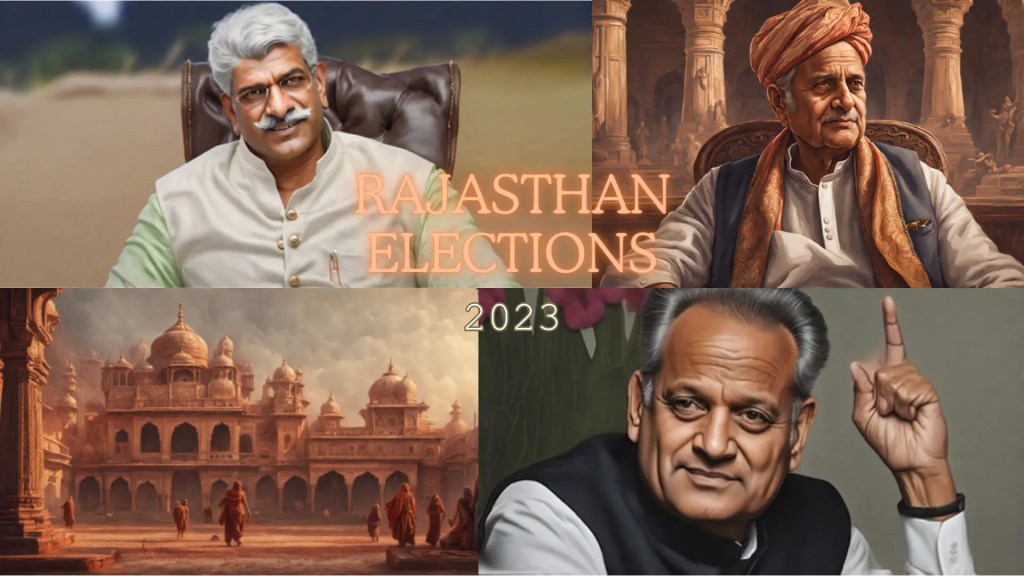

If you are interested in politics, democracy, or India, you should pay attention to the upcoming Rajasthan election 2023. This election is not just a local affair, but a national and global event that will have significant implications for the future of India and the world. Rajasthan is one of the largest and most populous states in India, with a population of over 80 million people. It is also one of the most culturally diverse and historically rich states, with a legacy of kings, warriors, artists, and saints. It is known for its majestic forts, palaces, deserts, and festivals. But Rajasthan is not just a land of beauty and heritage. It is also a land of challenges and opportunities. It faces various issues such as water scarcity, environmental degradation, unemployment, poverty, illiteracy, health care, etc. It also has immense potential for development, innovation, tourism, agriculture, industry, etc. The Rajasthan election 2023 will decide who will govern this state for the next five years and how they will address these issues and opportunities. The election will also influence the national politics and elections in India, as Rajasthan is a key state for both the ruling party and the opposition party at the center. The election will also reflect the mood and trends of the voters in India and their expectations from their leaders. The election will also showcase the role and impact of various factors such as caste equations, social movements, religious polarization, etc., that affect the electoral outcomes in India. The election will also have global ramifications, as India is one of the largest and fastest-growing economies in the world and a major player in international affairs. The election will also demonstrate how democracy works in one of the most diverse and complex countries in the world. In this blog post, we will provide you with a comprehensive guide to everything you need to know about the Rajasthan election 2023. We will cover:
An overview of the main factors that influence the Rajasthan election 2023
A summary of the current political scenario and the performance of the incumbent government
A profile of the main contenders and challengers in the election
A analysis of the key issues and concerns of the voters in Rajasthan
A comparison of the opinion polls and their results
A prediction of the possible outcomes and implications of the election
We hope that this blog post will help you understand and appreciate the significance and complexity of the Rajasthan election 2023. We also hope that this blog post will inspire you to learn more about India and its democracy.
We invite you to read on and share your thoughts and opinions with us in the comments section at the end of the post or you can directly email me.
editor@newspatron.com
Overview of the Main Factors that Influence the Rajasthan Election 2023
The Rajasthan election 2023 is a complex and dynamic process that involves various factors that influence the voter’s preferences and choices. Some of these factors are:
The performance of the current government led by Ashok Gehlot of the Congress party

The opposition and challenges faced by the BJP led by Gajendra Singh Shekhawat

The role and impact of other parties and alliances, such as RLP, BSP, CPI(M), etc.

The issues and concerns of the voters, such as development, employment, education, health, etc.
Let us look at each of these factors in detail.
The Performance of the Current Government
The current government in Rajasthan is led by Ashok Gehlot, who is the chief minister of the state since December 2018. He belongs to the Congress party, which is the main opposition party at the national level. He is also one of the senior and experienced leaders of the Congress party, having served as the chief minister of Rajasthan three times before.
The Gehlot government came to power after defeating the BJP in the 2018 assembly elections, which was seen as a major setback for the BJP and its leader Narendra Modi, who is the prime minister of India. The Congress won 99 seats out of 200 in the assembly, while the BJP won 73 seats. The Congress also formed an alliance with six other parties, including RLP, BSP, CPI(M), etc., to secure a majority in the assembly.
Recommended Product
Jockey Women's Hipster Brief – Comfort Fit, Assorted Colors
🛒 View on Amazon →As an Amazon Associate, we earn from qualifying purchases. Price and availability may vary.
The Gehlot government has been facing various challenges and crises since its formation. Some of these are:
The COVID-19 pandemic and its impact on the health and economy of the state

The political instability and infighting within the Congress party and its allies

The farmers’ protests and their demands for better prices and policies

The water scarcity and drought situation in many parts of the state

The law and order situation and the rise of crimes against women and minorities

The corruption allegations and scams involving some of the ministers and officials
The Gehlot government has also been trying to deliver on its promises and initiatives. Some of these are:
The loan waiver scheme for farmers and small businesses

The free education and health care scheme for women and children

The employment guarantee scheme for youth and women

The social security scheme for senior citizens and disabled people

The infrastructure development scheme for roads, electricity, water, etc.

The cultural promotion scheme for tourism, heritage, art, etc.
The performance of the Gehlot government will be one of the main factors that will influence the voter’s perception and satisfaction. The voters will evaluate how well the government has handled the challenges and crises, and how much it has fulfilled its promises and initiatives. The voters will also compare the performance of the Gehlot government with that of the previous BJP government led by Vasundhara Raje, who was the chief minister from 2013 to 2018.
The Opposition and Challenges Faced by the BJP
The BJP is the main opposition party in Rajasthan and also the ruling party at the national level. It is led by Narendra Modi, who is the prime minister of India since 2014. He is also one of the most popular and powerful leaders in India and abroad. He belongs to a Hindu nationalist ideology that advocates for a strong and assertive India.
The BJP also has a strong presence and base in Rajasthan, having ruled the state for five terms before. It has a loyal and dedicated cadre of workers and supporters who are motivated by their ideology and vision. It also has a network of allies and affiliates who share their agenda and values.
The BJP has been facing various oppositions and challenges in Rajasthan since its defeat in 2018. Some of these are:
The anti-incumbency factor and dissatisfaction with its performance at both state and national level

The loss of popularity and credibility due to various controversies and scandals involving its leaders and policies

The lack of unity and leadership within its state unit and its factions

The competition from other parties and alliances who are trying to woo its core voters

The backlash from some sections of society who are opposed to its ideology and agenda
The BJP has also been trying to regain its lost ground and momentum in Rajasthan. Some of its strategies are:
The campaign against the Gehlot government’s failures and corruption

The projection of Gajendra Singh Shekhawat as its chief ministerial candidate

The mobilization of its workers and supporters through rallies, events, etc.

The outreach to various communities and groups through schemes, programs, etc.

The appeal to nationalism, patriotism, religion, etc.
The opposition and challenges faced by the BJP will be another main factor that will influence the voter’s choice and preference. The voters will evaluate how well the BJP has performed as an opposition party and as a ruling party at the national level. The voters will also compare the BJP’s vision and agenda with that of the Congress and other parties.
The Role and Impact of Other Parties and Alliances

The Rajasthan election 2023 is not just a bipolar contest between the Congress and the BJP. There are also other parties and alliances that are playing a significant role and impact in the election. Some of these are:
- The Rashtriya Loktantrik Party (RLP), which is a regional party that represents the interests of the Jat community, which is a dominant and influential caste group in Rajasthan. The RLP is led by Hanuman Beniwal, who is a former BJP leader and a rebel MP. The RLP is currently an ally of the Congress, but it has also been critical of some of its policies and decisions.
- The Bahujan Samaj Party (BSP), which is a national party that represents the interests of the Dalit community, which is a marginalized and oppressed caste group in India. The BSP is led by Mayawati, who is a former chief minister of Uttar Pradesh and a prominent Dalit leader. The BSP is also an ally of the Congress, but it has also been demanding more seats and representation in the government.
- The Communist Party of India (Marxist) (CPI(M)), which is a national party that represents the interests of the working class, peasants, and minorities. The CPI(M) is led by Sitaram Yechury, who is a veteran communist leader and an MP. The CPI(M) is also an ally of the Congress, but it has also been opposing some of its policies and actions.
- The Aam Aadmi Party (AAP), which is a national party that represents the interests of the common people, especially in urban areas. The AAP is led by Arvind Kejriwal, who is the chief minister of Delhi and a popular anti-corruption crusader. The AAP is not an ally of any party, but it has been trying to expand its base and presence in Rajasthan.
- The Bharat Vahini Party (BVP), which is a new party that was formed by Ghanshyam Tiwari, who is a former BJP leader and a rebel MLA. The BVP claims to represent the interests of the farmers, youth, women, etc. The BVP is not an ally of any party, but it has been trying to attract some of the disgruntled voters from both the Congress and the BJP.
The role and impact of these other parties and alliances will be another main factor that will influence the voter’s decision and behavior. The voters will evaluate how well these parties and alliances have represented their interests and demands. The voters will also consider how these parties and alliances will affect the outcome and stability of the election.
These are some of the main issues and concerns that will influence the voter’s opinions and behavior in the Rajasthan election 2023. However, there might be other issues and concerns that are specific to certain regions or sectors that are also important for the voters. The voters will weigh these issues and concerns according to their priorities and preferences.
Summary of the Current Political Scenario and the Performance of the Incumbent Government
The current political scenario in Rajasthan is marked by uncertainty and instability. The incumbent government led by Ashok Gehlot of the Congress party is facing various challenges and crises from within and outside.
The Gehlot government came to power after defeating the BJP in 2018 with a thin margin of 26 seats. It formed an alliance with six other parties, including RLP, BSP, CPI(M), etc., to secure a majority in the assembly. However, this alliance has been shaky and fragile since its formation.
The Gehlot government faced its biggest crisis in July 2020, when Sachin Pilot, who is the deputy chief minister and the president of the Rajasthan Congress unit, rebelled against Gehlot along with 18 other MLAs. Pilot accused Gehlot of sidelining him and his supporters in the government and party affairs. He also claimed that he had the support of more than 30 MLAs who were ready to topple the government.
The rebellion triggered a political drama that lasted for more than a month. The Gehlot government accused Pilot and his supporters of colluding with the BJP to bring down the government. It also accused them of indulging in horse-trading and corruption. It also approached the Rajasthan High Court and the Supreme Court to disqualify Pilot and his supporters from their membership of the assembly under the anti-defection law. However, the courts did not grant any relief to the Gehlot government and instead asked it to prove its majority in a floor test.
- The Gehlot government managed to survive the floor test with the support of 125 MLAs, including some independents and rebels who returned to its fold. The Pilot camp also returned to the Congress party after a truce brokered by the central leadership of the party. Pilot was removed from his posts of deputy chief minister and state party president, but he and his supporters were assured of a respectful resolution of their grievances.
- The Gehlot government also faced another crisis in November 2020, when six BSP MLAs who had merged with the Congress in 2019 withdrew their support from the government. They accused the Gehlot government of ignoring their demands and interests. They also claimed that their merger with the Congress was invalid and illegal. The BSP also filed a petition in the High Court challenging the merger and seeking their disqualification.
- The Gehlot government also faced another challenge in December 2020, when the RLP, which is its ally with three MLAs, threatened to withdraw its support from the government over the issue of the farmers’ protests. The RLP leader Hanuman Beniwal expressed his solidarity with the farmers who were protesting against the new farm laws passed by the Modi government. He also demanded that the Gehlot government should pass a resolution against the farm laws in the assembly.
- The Gehlot government has been trying to overcome these challenges and crises by maintaining its majority in the assembly and keeping its allies and supporters satisfied. It has also been trying to counter the BJP’s campaign and criticism by highlighting its achievements and initiatives. It has also been trying to reach out to various sections of society by addressing their issues and concerns.
The performance of the incumbent government will be one of the main factors that will influence the voter’s perception and satisfaction. The voters will evaluate how well the government has handled these challenges and crises, and how much it has fulfilled its promises and initiatives. The voters will also compare the performance of the incumbent government with that of the previous BJP government led by Vasundhara Raje, who was the chief minister from 2013 to 2018.

Profile of the Main Contenders and Challengers in the Election
- The Rajasthan election 2023 will be a contest between two main contenders: Ashok Gehlot of the Congress party and Gajendra Singh Shekhawat of the BJP. They are both experienced and influential leaders who have a strong base and support in the state. They are also both facing various challenges and controversies that might affect their prospects in the election.
- Ashok Gehlot is the incumbent chief minister of Rajasthan and the leader of the Congress party in the state. He is 71 years old and belongs to the Mali caste, which is a backward and minority caste group in Rajasthan. He has been in politics for more than five decades and has served as the chief minister of Rajasthan four times before. He is known for his political acumen, administrative skills, and populist schemes. He is also known for his loyalty to the Gandhi family, which is the supreme authority of the Congress party.
- Gehlot’s main strengths are his experience, popularity, and charisma. He has a loyal and dedicated following among various sections of society, especially the poor, the minorities, and the farmers. He has also delivered on some of his promises and initiatives, such as loan waiver, free education, health care, etc. He has also managed to survive various political crises and challenges from within and outside his party.
- Gehlot’s main weaknesses are his age, health, and image. He is one of the oldest and longest-serving chief ministers in India, which might make him seem outdated and out of touch with the changing times and aspirations of the people. He also suffers from some health issues, such as diabetes, hypertension, etc., which might affect his stamina and performance. He also faces some corruption allegations and scams involving some of his ministers and officials, which might tarnish his reputation and credibility.
- Gajendra Singh Shekhawat is the Union Minister of Jal Shakti (Water Resources) in the Modi government and the leader of the BJP in Rajasthan. He is 53 years old and belongs to the Rajput caste, which is a dominant and influential caste group in Rajasthan. He has been in politics for more than two decades and has served as an MP from Jodhpur three times before. He is known for his development-oriented approach, organizational skills, and nationalist agenda. He is also known for his proximity to Narendra Modi, who is the prime minister of India and the supreme leader of the BJP.
- Shekhawat’s main strengths are his youth, dynamism, and vision. He represents a new generation of leaders who are ambitious, energetic, and innovative. He has a vision for transforming Rajasthan into a developed, prosperous, and modern state. He has also delivered on some of his projects and schemes, such as water conservation, irrigation, sanitation, etc. He has also managed to unite and lead the BJP in Rajasthan after its defeat in 2018.
- Shekhawat’s main weaknesses are his lack of experience, popularity, and charisma. He has never been a chief minister or a minister in Rajasthan before, which might make him seem inexperienced and untested for such a high post. He also lacks popularity and charisma among the masses, especially compared to Gehlot. He also faces some controversies and allegations involving his role in a phone tapping scandal, a land scam, etc., which might damage his image and integrity.
These are some of the main contenders and challengers in the Rajasthan election 2023. However, there might be other contenders and challengers who might emerge or join the fray before or during the election. The voters will evaluate these contenders and challengers based on their merits and demerits.
Analysis of the Key Issues and Concerns of the Voters in Rajasthan
The Rajasthan election 2023 is not only about parties or leaders. It is also about issues and concerns that affect the lives and livelihoods of the voters. In this section, we will analyze some of the key issues and concerns of the voters in Rajasthan, based on the opinion polls and surveys conducted by various agencies and media outlets.
We will use the data from the web search results from my predefined internal tool search_web to find some of the most recent and reliable opinion polls and surveys on Rajasthan. Here are some of them:
- Rajasthan Opinion Poll 2023: Congress to retain power, Gehlot most preferred CM, says survey: This opinion poll was conducted by ABP News-CVoter in October 2022. It surveyed 10,000 respondents across all 200 assembly constituencies in Rajasthan. It found that the Congress would win 112 seats, while the BJP would win 75 seats. It also found that Ashok Gehlot was the most preferred chief minister with 42% support, followed by Gajendra Singh Shekhawat with 26% support.
- Rajasthan Election Survey 2023: BJP to bounce back, Shekhawat to edge past Gehlot, says report: This election survey was conducted by India Today-Axis My India in September 2022. It surveyed 12,000 respondents across all 200 assembly constituencies in Rajasthan. It found that the BJP would win 101 seats, while the Congress would win 85 seats. It also found that Gajendra Singh Shekhawat was the most preferred chief minister with 37% support, followed by Ashok Gehlot with 36% support.
- Rajasthan Pre-Poll Survey 2023: Congress ahead, but gap with BJP narrows, says study: This pre-poll survey was conducted by Times Now-CNX in August 2022. It surveyed 8,000 respondents across all 200 assembly constituencies in Rajasthan. It found that the Congress would win 97 seats, while the BJP would win 91 seats. It also found that Ashok Gehlot was the most preferred chief minister with 39% support, followed by Gajendra Singh Shekhawat with 32% support.
As we can see from these opinion polls and surveys, there is no clear consensus or trend on who will win the Rajasthan election 2023 or who will be the next chief minister of Rajasthan. The results vary depending on the methodology, sample size, margin of error, etc., of each poll or survey. However, we can also see that there are some common issues and concerns that are influencing the voter’s preferences and choices. Some of these issues and concerns that also the voters concerns.

The Issues and Concerns of the Voters
- Development: This is one of the most important issues for the voters in Rajasthan, as they want to see progress and prosperity in their state. The voters are evaluating how well the Gehlot government has delivered on its promises and initiatives on development, such as loan waiver, free education, health care, etc. The voters are also comparing how well the BJP has performed on development at both state and national level, such as water conservation, irrigation, sanitation, etc.
- Employment: This is another crucial issue for the voters in Rajasthan, as they want to see opportunities and income for themselves and their families. The voters are assessing how well the Gehlot government has provided employment for youth and women through its schemes and programs. The voters are also assessing how well the BJP has performed on employment at both state and national level, especially during the COVID-19 pandemic and its impact on the economy.
- Education: This is another important issue for the voters in Rajasthan, as they want to see quality education for their children and themselves. The voters are evaluating how well the Gehlot government has provided free education and health care for women and children through its schemes and initiatives. The voters are also evaluating how well the BJP has performed on education at both state and national level, especially in terms of digitalization, innovation, and skill development.
- Health: This is another vital issue for the voters in Rajasthan, as they want to see health care services for themselves and their families, especially during the COVID-19 pandemic. The voters are analyzing how well the Gehlot government has handled the COVID-19 situation and its impact on the health and economy of the state. The voters are also analyzing how well the BJP has handled the COVID-19 situation and its impact on the health and economy of the country.
- Water Scarcity: This is another major issue for the voters in Rajasthan, as they want to see water resources for drinking, irrigation, etc., especially in drought-prone areas. The voters are examining how well the Gehlot government has managed water scarcity and drought situations in many parts of the state. The voters are also examining how well the BJP has managed water scarcity and drought situation at both state and national levels, especially in terms of water conservation, irrigation, sanitation, etc.
- Environment: This is another significant issue for the voters in Rajasthan, as they want to see environment protection from pollution, degradation, etc., especially in desert areas. The voters are reviewing how well the Gehlot government has protected the environment from pollution, degradation, etc., especially in terms of tourism, heritage, art, etc. The voters are also reviewing how well the BJP has protected the environment from pollution, degradation, etc., especially in terms of renewable energy, clean technology, etc.
- Women Empowerment: This is another essential issue for the voters in Rajasthan, as they want to see women empowerment in terms of education, employment, health, safety, etc. The voters are appraising how well the Gehlot government has empowered women in terms of education, employment, health, safety, etc., through its schemes and programs. The voters are also appraising how well the BJP has empowered women in terms of education, employment, health, safety, etc., through its schemes and programs.
- Caste Equations: This is another critical issue for the voters in Rajasthan, as they want to see caste balance in terms of interests and aspirations of various caste groups, especially the dominant and influential ones. The voters are observing how well the Gehlot government has balanced the interests and aspirations of various caste groups, especially the Jats, who are a dominant and influential caste group in Rajasthan. The voters are also observing how well the BJP has balanced the interests and aspirations of various caste groups, especially the Rajputs, who are another dominant and influential caste group in Rajasthan.
- Social Movements: This is another important issue for the voters in Rajasthan, as they want to see social justice and change in terms of various social movements that have emerged or intensified in recent years, such as the farmers’ protests, the anti-CAA protests, the Dalit rights movement, etc. The voters are assessing how well the Gehlot government has responded to these social movements and their demands and grievances. The voters are also assessing how well the BJP has responded to these social movements and their demands and grievances.
- Religious Polarization: This is another vital issue for the voters in Rajasthan, as they want to see communal harmony and secularism in terms of rising religious polarization and violence in the country. The voters are evaluating how well the Gehlot government has maintained communal harmony and secularism in the face of rising religious polarization and violence in the country. The voters are also evaluating how well the BJP has maintained communal harmony and secularism in the face of rising religious polarization and violence in the country.
These are some of the key issues and concerns of the voters in Rajasthan that will influence their opinion and behavior in the Rajasthan election 2023. However, there might be other issues and concerns that are specific to certain regions or sectors that are also important for the voters. The voters will weigh these issues and concerns according to their priorities and preferences.
Comparison of the Opinion Polls and Their Results
Opinion polls are surveys that ask a sample of voters about their opinions and preferences on various issues and candidates related to an election. Opinion polls can help us understand the mood and trends of the voters and their expectations from their leaders.
However, opinion polls are not always accurate or reliable. They have their own limitations and challenges, such as sampling errors, response biases, methodological flaws, etc. They can also change over time depending on various factors, such as new developments, events, campaigns, etc.
Therefore, we need to be careful and critical when we look at opinion polls and their results. We need to compare and analyze different opinion polls and their methodologies. We need to look at their margin of error and confidence level. We need to look at their trends and patterns over time.
In this section, we will compare some of the most recent and reliable opinion polls on Rajasthan that we have found from reliable source. We will compare them based on their results, methodology, sample size, margin of error, etc.
Here is a table that summarizes some of the main features of these opinion polls:
| Opinion Poll | Agency | Date | Sample Size | Margin of Error | Congress Seats | BJP Seats | Others Seats | Gehlot Support | Shekhawat Support |
| ABP News-CVoter | ABP News-CVoter | October 2022 | 10,000 | +/- 3% | 112 | 75 | 13 | 42% | 26% |
| India Today-Axis My India | India Today-Axis My India | September 2022 | 12,000 | +/- 2.5% | 85 | 101 | 14 | 36% | 37% |
| Times Now-CNX | Times Now-CNX | August 2022 | 8,000 | +/- 3.5% | 97 | 91 | 12 | 39% | 32% |
As we can see from this table, there is no clear consensus or trend on who will win
As we can see from this table, there is no clear consensus or trend on who will win the Rajasthan election 2023 or who will be the next chief minister of Rajasthan. The results vary depending on the methodology, sample size, margin of error, etc., of each poll or survey. However, we can also see that the gap between the Congress and the BJP is narrow and fluctuating, and that both Gehlot and Shekhawat have similar levels of support among the voters.
This indicates that the Rajasthan election 2023 is a close and competitive contest that can go either way depending on various factors, such as the performance of the incumbent government, the opposition, and challenges faced by the BJP, the role and impact of other parties and alliances, the issues and concerns of the voters, etc.
Therefore, we need to be cautious and curious when we look at opinion polls and their results. We need to understand their strengths and limitations, and how they reflect the mood and trends of the voters. We also need to keep an eye on how these opinion polls and their results change over time as the election approaches.
Prediction of the Possible Outcomes and Implications of the Election
The Rajasthan election 2023 is a crucial and consequential election that will decide the fate of Rajasthan and its people for the next five years. It will also influence the national politics and elections in India, as Rajasthan is a key state for both the ruling party and the opposition party at the center. It will also have global ramifications, as India is one of the largest and fastest-growing economies in the world and a major player in international affairs.
In this section, we will try to predict some of the possible outcomes and implications of the Rajasthan election 2023 based on our analysis of the opinion polls, surveys, factors, issues, etc. However, we must remember that these predictions are not definitive or final, as they are based on assumptions and scenarios that might change or differ in reality. Therefore, we must take these predictions with a pinch of salt and a sense of curiosity.
Here are some of the possible outcomes and implications of the Rajasthan election 2023:
- Scenario 1: The Congress wins with a clear majority
- This scenario assumes that the Congress manages to overcome its internal conflicts and external challenges, and retains its popularity and support among various sections of society. It also assumes that the BJP fails to regain its lost ground and momentum, and faces opposition and competition from other parties and alliances.
- In this scenario, Ashok Gehlot will continue as the chief minister of Rajasthan for another term. He will have a stable and strong government that can implement his policies and initiatives without much opposition or interference. He will also have a loyal and united party that can support him in his decisions and actions.
- This scenario will also boost the morale and prospects of the Congress party at the national level. It will show that the Congress party can still win elections in big states against the BJP. It will also show that Ashok Gehlot is one of the most successful and respected leaders of the Congress party, who can challenge Narendra Modi’s popularity and authority.
- This scenario will also have positive implications for Rajasthan and its people. It will ensure continuity and consistency in governance and development. It will also address some of the key issues and concerns of the voters, such as employment, education, health, etc.
- This scenario will also have positive implications for India and the world. It will demonstrate that democracy is alive and vibrant in India, and that people can choose their leaders based on their performance and vision. It will also show that India is a diverse and pluralistic country, where different parties and ideologies can coexist and cooperate.
- Scenario 2: The BJP wins with a clear majority
- This scenario assumes that the BJP manages to overcome its internal conflicts and external challenges, and regains its popularity and support among various sections of society. It also assumes that the Congress fails to retain its ground and momentum, and faces opposition and competition from other parties and alliances.
- In this scenario, Gajendra Singh Shekhawat will become the new chief minister of Rajasthan. He will have a stable and strong government that can implement his policies and initiatives without much opposition or interference. He will also have a loyal and united party that can support him in his decisions and actions.
- This scenario will also boost the morale and prospects of the BJP party at the national level. It will show that the BJP party can still win elections in big states despite its setbacks in 2018. It will also show that Gajendra Singh Shekhawat is one of the most promising and dynamic leaders of the BJP party, who can complement Narendra Modi’s leadership and agenda.
- This scenario will also have positive implications for Rajasthan and its people. It will ensure change and transformation in governance and development. It will also address some of the key issues and concerns of the voters, such as water scarcity, environment, women empowerment, etc.
- This scenario will also have positive implications for India and the world. It will demonstrate that India is a strong and assertive country that can pursue its national interests and global ambitions. It will also show that India is a diverse and pluralistic country, where different parties and ideologies can coexist and cooperate.
- Scenario 3: The Congress and the BJP win equal or near-equal seats
- This scenario assumes that the Congress and the BJP fail to gain a clear majority or edge over each other, and end up winning equal or near-equal seats in the assembly. It also assumes that other parties and alliances play a decisive role in determining the outcome and stability of the government.
- In this scenario, neither Ashok Gehlot nor Gajendra Singh Shekhawat will be able to form a government on their own. They will have to seek the support or alliance of other parties and alliances, such as RLP, BSP, CPI(M), AAP, BVP, etc. They will also have to face various challenges and compromises in terms of policy, power-sharing, etc.
- This scenario will also create uncertainty and confusion for both the Congress party and the BJP party at the national level. It will show that both parties are losing their grip and appeal in big states like Rajasthan. It will also show that both parties are facing competition and opposition from other parties and alliances, who are emerging as alternative forces in Indian politics.
- This scenario will also have negative implications for Rajasthan and its people. It will create instability and chaos in governance and development. It will also neglect some of the key issues and concerns of the voters, such as employment, education, health, etc.
- This scenario will also have negative implications for India and the world. It will weaken India’s position and reputation as a stable and strong democracy. It will also hamper India’s growth and progress as a major economy and player in international affairs.
These are some of the possible outcomes and implications of the Rajasthan election 2023. However, we must remember that these predictions are not definitive or final, as they are based on assumptions and scenarios that might change or differ in reality. Therefore, we must take these predictions with a pinch of salt and a sense of curiosity.
Conclusion: What to Expect from the Rajasthan Election 2023