




Content warning: This story involves family breakdown, police threats, emotional distress, and discussion of alleged misuse of criminal laws.
“You See These Tears? This Is What Your Marriage Did To Your Mother.”
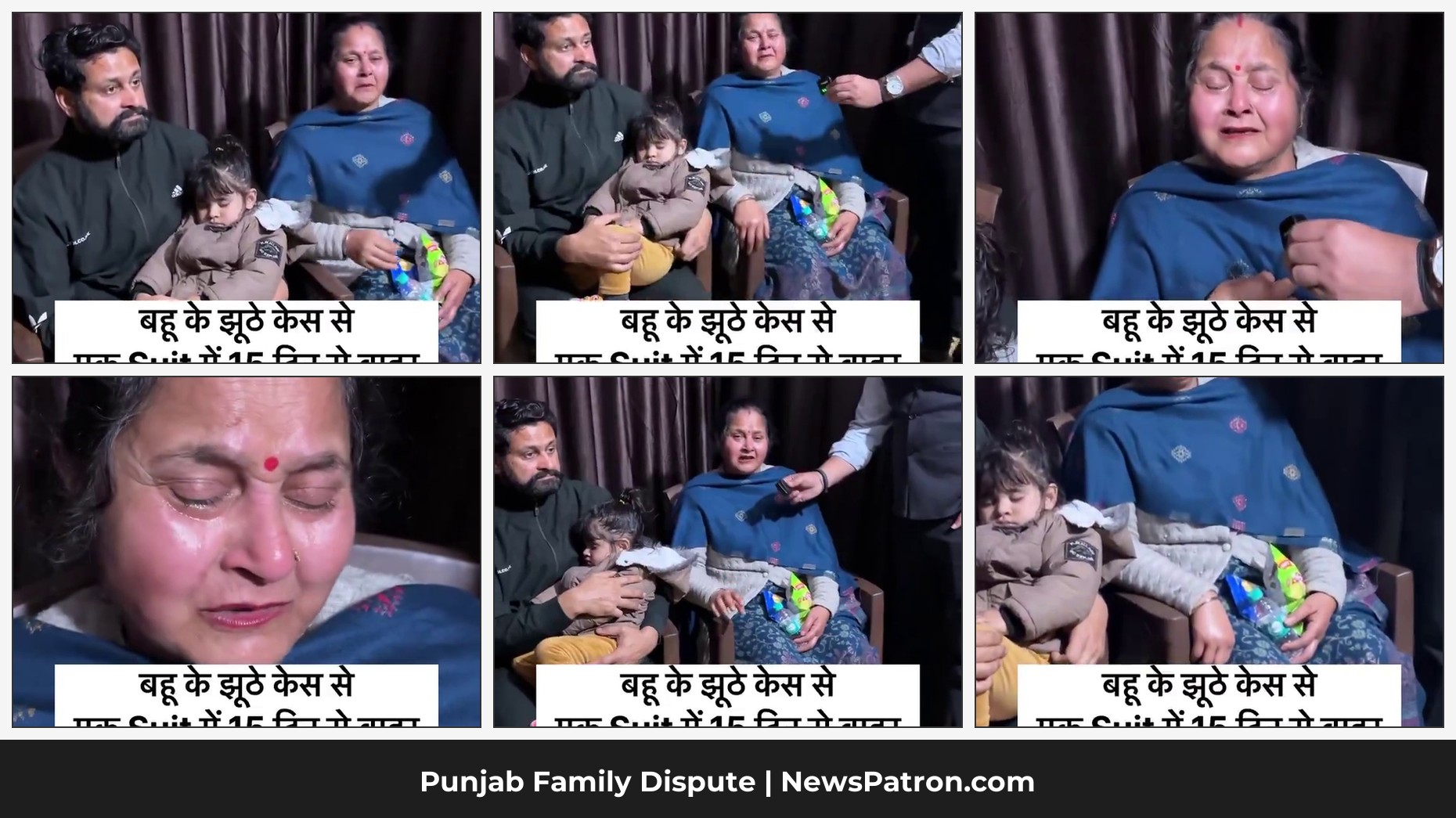
In a short, raw video from Punjab, a family sits in a small room and cries.
A young woman, an older man who appears to be the father, and a grandmother‑figure trying to speak through sobs. The host turns the camera towards her and says, roughly:
“You see these tears in her eyes? That’s why I tell you — stand up for your sons. Your marriages were not meant to bring tears to your mothers’ eyes.”
Then he looks straight into the lens and throws the question upwards:
- Will anyone in the state police answer for each tear rolling down this woman’s face?
- Will the Chief Minister talk about safety before handing out ₹1,000 schemes and slogans?
This is not about dowry demands or drunk sons beating their wives. This is the story of a mother who says she lost her home and her son’s peace after a breakdown with her daughter‑in‑law — and the fear of being finished off in a synthetic drug case.
“My Daughter‑In‑Law Left On Her Own. We Were Told We’d Be Finished In A ‘Chitta’ Case.”
When the host asks what she wants to say to the Chief Minister, the woman tries to steady herself and speaks.
Paraphrased, her words are:
- She appreciates campaigns against drugs, but asks: where is safety for families like ours?
- She says she fought for her son for four years, finally had him home, and still could not keep him with her.
- According to her, the daughter‑in‑law left the house on her own, after inflicting cuts on her own body.
- She says neighbours saw everything on cameras, including how the daughter‑in‑law walked away.
- Despite that, the family was allegedly threatened that they would be trapped in a “Chitta” case — a synthetic drug charge — and “finished off.”
In panic, she says they locked their house and have been on the run:
“I have been away from my home for 15 days, wearing only this one suit, moving from place to place.”
Advertisement
The host summarises it with a sentence that will resonate with a lot of mothers:
“Because of the daughter‑in‑law and these threats, this mother has been away from her own home for 15 days. Is there any accountability? Stand up for yourselves. You might suffer from a wrong marriage decision, but your mothers should not be made to pay this price.”
Whether every detail of this case is true or not will be for investigators and courts to decide — if it ever reaches them. But the pattern is familiar enough that thousands of families instinctively recognise it.
When Laws Meant To Protect Are Felt As Weapons
India’s criminal justice system has two parallel truths:
- It under‑protects many genuine victims of cruelty, harassment and violence.
- It is also experienced as a weapon by some families who say they are being dragged into false or exaggerated cases.
What the data actually shows
The National Crime Records Bureau does not publish a single “false case percentage” for all crimes. It does, however, track things like:
- Cases closed by police as “mistake of fact”, “civil dispute”, or explicitly “false” during investigation.
- How many cases reach trial, and of those, how many end in conviction vs. acquittal.
One section comes up again and again in debates about misuse: the old Section 498A IPC (cruelty by husband or relatives), now mirrored in Section 85 of the new code.
From recent NCRB Crime in India reports up to 2023:
- Around 1.2–1.3 lakh cases are filed under this category each year.
- Police file charge sheets in roughly 84–90% of them.
- But the conviction rate is only about 12–18%, among the lowest for any major section.
- That means roughly 75–85% of tried cases end in acquittal or discharge.
- Police explicitly close only a small fraction — roughly 4–8% in some years — as “false” or “mistake of fact” during investigation.
These numbers do not prove that most cases are fake. Low conviction rates plague many serious offences in India (from rape to murder) because of weak investigation, hostile or intimidated witnesses, compromise and pressure to withdraw, and huge delays that break people’s will to fight.
But for families who feel falsely accused, the combination of easy registration, difficult bail, and years of trial with a high chance of acquittal can feel less like justice and more like slow punishment without verdict.
What the Supreme Court has been saying
Over the last two decades — and especially through several 2024–2025 judgments — the Supreme Court has walked a careful line:
- It has refused to strike down Section 498A, calling it an important shield for women facing genuine cruelty and dowry harassment.
- It has simultaneously acknowledged misuse, especially when entire families, including elderly parents and distant relatives, are dragged into vague, omnibus FIRs.
- It has ordered that police must not make automatic arrests under this section, that a preliminary inquiry and written reasons are required before arrest, and that courts should refuse to entertain vague, copy‑paste allegations.
In one recent case, the Court went so far as to dissolve a marriage, quash all related proceedings, and direct the complainant to issue an apology after false sweeping allegations led to months of jail for the husband and his father.
The message from the top court is clear:
- Genuine cruelty must be punished.
- Genuine misuse must be checked with safeguards.
- The law stays; the way we apply it has to improve.
Mothers, Sons, Daughters‑In‑Law: What Can We Learn From This Punjabi Video?
Whatever the hidden layers of this particular family’s conflict, a few hard lessons are visible on the surface.
1. Marriages are not just about two people
The host’s first line is deliberately provocative:
“Your marriages were not meant to bring tears to your mothers’ eyes.”
Young couples often experience the relationship as a private contract between two adults. In practice, especially in Punjab and most of India, marriage is a network: parents, siblings, in‑laws, cousins, neighbours — and, increasingly, the police and courts.
When things go wrong:
- A decision to walk out can collide with social stigma, ego, and property fights.
- A decision to file a case can bring in criminal process, bail, and public shaming.
- A wrong move or bad‑faith allegation can ripple into years of fear for elderly parents who never expected to see a police station from the inside.
That doesn’t mean anyone should stay in an abusive or unsafe marriage. It does mean that how we exit matters — and so does how quickly we escalate to criminal law.
2. Weaponising serious offences erodes trust for real victims
If people believe that a drug‑related offence can be casually used as a threat tool in a domestic dispute, or a cruelty law can be used as a pressure tactic over property or ego, then over time, society’s willingness to believe genuine victims of drugs, violence or cruelty gets weaker.
The result is a lose‑lose:
- Families like the one in the video become hyper‑defensive, seeing any complaint as blackmail.
- Women (and men) facing real abuse may hesitate to come forward, fearing they’ll be seen as just “another false case.”
3. Running away isn’t a solution — but neither is blind trust
The mother in the video says she locked her house and has been hiding for 15 days in a single suit, out of sheer fear.
From a legal risk point of view:
- Disappearing can sometimes make a family look more suspicious if a case is actually filed.
- Panicking and signing whatever is put in front of you can trap you in statements you don’t understand.
A better approach, as unglamorous as it sounds, is to document everything calmly, take early legal advice, and rely on timelines, evidence and consistency.
Safety, Accountability And The Role Of The State
The woman in the clip directs one line straight at the Chief Minister:
“You do everything against drugs, but there is no safety for us.”
For her, “safety” here doesn’t mean street crime. It means protection from false threats of being branded as drug peddlers, protection from arbitrary or politically motivated FIRs, and a system where truth can be sorted from lies without destroying ordinary families in the process.
From the state’s side, that demands three things:
- Better investigation, not just more cases. If threats of being implicated in drug cases are real, they must be traced and punished. If CCTV shows someone leaving unharmed, that should be weighed against later self‑harm allegations.
- Transparent use of data. States can use data to identify police stations and sections where misuse or weak investigation is chronic, and fix those hotspots.
- Implement Supreme Court safeguards in spirit, not just on paper. No automatic arrests in domestic disputes. Real preliminary inquiries. Willingness by magistrates to question vague FIRs and refuse mechanical remand.
What This Video Asks From Us
Behind the crying grandmother in Punjab are thousands of other mothers, in every state, who are scared of the same thing from opposite angles:
- Some fear losing their daughters to real cruelty and dowry harassment.
- Some fear losing their sons and homes to false or exaggerated cases and weaponised threats.
The law has to protect both groups — and that is hard, messy work.
The least we can do, as families and as voters, is to stop treating every marital dispute as a war that must be won at any cost, use criminal law when there is genuine violence, cruelty or coercion, and demand from the state not just new schemes, but honest, even‑handed policing.
Because once the police file is opened, nobody in that room will ever forget how it felt to hear a knock on the door — or to sit 15 days away from home in the same suit, wondering which version of the story the system will choose to believe.

[…] “We Locked Our House And Ran”: When Marriage, Fear And The Law Break A Punjabi Family […]