




Sources and references at the end of this post ?
A Police Force… With Pigeons?
Most of us think of police communication as walkie?talkies, control rooms, encrypted apps. In one corner of eastern India, the story is different.
In Odisha, the state police still maintain a pigeon service — not as a mainline communication tool anymore, but as a living piece of history. Rows of Belgian homing pigeons sit in neat lofts, tiny message capsules on their legs, just like they did before wireless sets, mobile towers and fibre?optic cables existed.
And they have one story that still makes people smile: the day a pigeon carried the Prime Minister’s message faster than his own convoy.
Nehru’s 1948 Test: Sambalpur To Cuttack In 5 Hours 20 Minutes
On 13 April 1948, a few months after Independence, Jawaharlal Nehru was in Sambalpur in western Odisha. The same day, he was scheduled to address a public meeting in Cuttack, roughly 265 km away. He needed to send an urgent instruction to the police in Cuttack about how that meeting should be arranged.
Local officers suggested using their newest pride: the police pigeon service. Nehru was reportedly sceptical when he saw the messenger — not a motorbike or a telegram operator, but a bird.
- At 6:00 a.m., a trained pigeon took off from Sambalpur with his handwritten message.
- At around 11:20 a.m., it landed in Cuttack with the note still in its leg capsule.
The text of the message, as recorded in multiple accounts, was simple but telling:
“The arrangements for the public meeting should not be such as to separate the speaker too much from the audience.”
When Nehru reached Cuttack later and saw his original message — delivered by the same pigeon — he was, according to local officers, genuinely delighted and impressed.
Recommended Product
Amazon Renewed — Best Deals of the Day
🛒 View on Amazon →As an Amazon Associate, we earn from qualifying purchases. Price and availability may vary.
In that one flight, the “low?tech” option beat the motorcade.
How The Odisha Police Pigeon Service Was Born
The pigeon service has its roots in the aftermath of the Second World War:
- 1946: About 200 pigeons were handed over to Odisha Police by the army on an experimental basis.
- Original purpose: maintain contact with remote, hilly and forested areas where there were no telephone lines or wireless sets.
- Headquarters and main breeding centre were set up in Cuttack, with additional lofts in other districts over time.
These are not random street birds. They are trained Belgian Homer pigeons:
- Messages are written on thin onion?skin paper, rolled, placed in a tiny capsule, and tied to the bird’s leg.
- Training starts when the birds are five to six weeks old. Handlers gradually release them farther from the loft so they learn to return on instinct.
- Speeds recorded: roughly 55–80 km/h over distances that can reach 250–500 km in ideal conditions.
Over the decades, they weren’t just a curiosity. They were a backup lifeline.
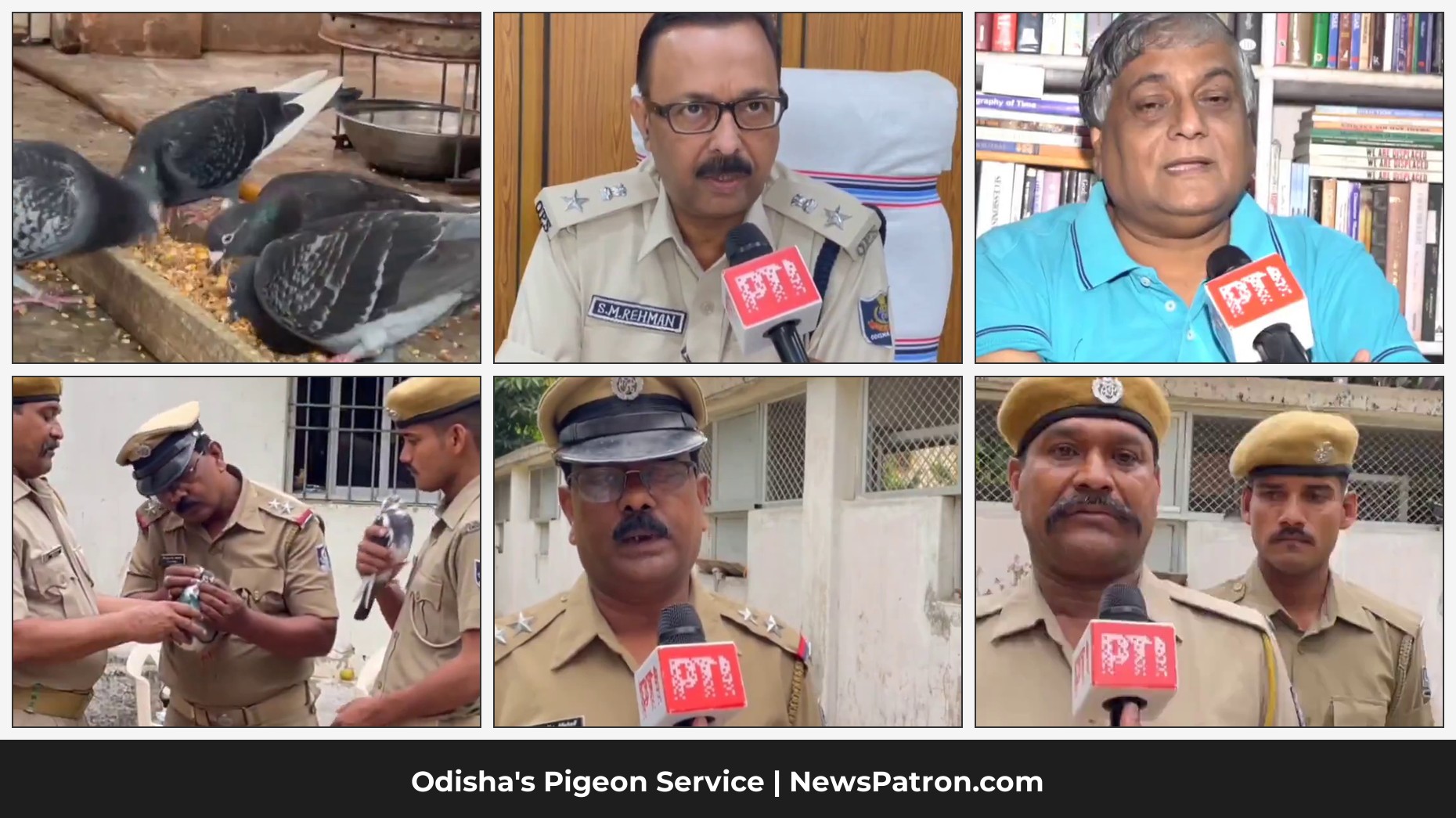
When Technology Failed, The Birds Didn’t
Even after phones and radios arrived, Odisha kept its pigeons. Two big disasters justified that decision:
- 1982 floods: Communication lines went down in parts of the state. Pigeons carried updates and instructions between cut?off areas and police control.
- 1999 super cyclone: As coastal districts were devastated, birds again helped link broken pockets to district headquarters when other channels were crippled.
Police officers and heritage experts quoted in recent reports make one point again and again:
“Even in the unlikely event that every mode of communication breaks down tomorrow, the pigeons will never fail.”
That reliability is why, even as satellites and fibre took over, Odisha chose not to let this unit simply vanish.
Officially Discontinued. Quietly Preserved.
The pigeon messenger service was formally discontinued on 31 March 2008 as an operational communication tool. By then, wireless sets, mobile phones, satellite links and digital networks were everywhere.
But instead of shutting the unit completely, the state took a different call:
- Of the earlier network of lofts, two were retained — one at the police headquarters in Cuttack and one at the police training college at Angul.
- Around 150 trained pigeons are still maintained between these two centres.
- A small team of officers and constables is assigned full?time to their care and training.
Today, the birds are used mainly for:
- Ceremonial flights on Independence Day, Republic Day and police events in Bhubaneswar and Cuttack.
- Demonstrations for schoolchildren, heritage walkers and visitors, where pigeons are released with symbolic messages about peace, love and freedom.
One retired police chief called the service “no less than a heritage… the pride of the state.”
Why This Story Still Matters In 2026
On paper, this could be filed under “cute trivia”: somewhere in India, police pigeons still fly. But there are a few deeper reasons why the story keeps coming back every few years — and why the recent video of officers proudly showing their birds is getting shared again:
- It reminds us that redundancy is strength. In an age where “single point of failure” can take down entire systems, a simple, parallel, analog channel is not as silly as it sounds.
- It shows a state choosing heritage over easy cost?cutting. Feeding, housing and staffing 150 pigeons is not free. Odisha decided that some traditions are worth the line item.
- It carries a different kind of pride. For many in Odisha, the pigeon unit is a quiet symbol that their police force has its own unique history — one that can stand proudly next to drones and digital control rooms.
The idea is not to romanticise birds over broadband. It is to remember that when Nehru’s message needed to cross 265 km in 1948, one small pigeon did the job in 5 hours and 20 minutes — and that, even today, somewhere in Cuttack and Angul, a few hundred pairs of wings are still ready, just in case.
Sources
Historical accounts of the Odisha Police pigeon service and Jawaharlal Nehru’s 1948 test flight from Sambalpur to Cuttack. Technical details of Belgian Homer pigeons, their flight speeds, and the methodology of training and messaging. Records from the 1982 floods and 1999 super cyclone demonstrating the operational use of the birds during communication blackouts. Official status of the pigeon service following its formal operational discontinuation in 2008, updated with recent information regarding ceremonial uses and heritage preservation at Cuttack and Angul.
