



This Is Not a Crime Report. It Is a Warning That Just Knocked on Your Neighbour’s Door.
Who this post is for — and what it is built on
Everything in this blog begins with a real incident: a Vashi resident’s detailed first-hand account of a two-wheeler theft attempt in broad daylight outside his building on 22 February 2026. His name has been changed to Suresh to protect privacy; the facts are drawn from his account as shared in local online community forums and have been cross-verified against documented vehicle theft racket busts by Navi Mumbai Police Crime Branch (January–February 2026), Delhi Police records, Mumbai Mirror’s documented Chor Bazaar nexus reporting, and public NCRB patterns on two-wheeler theft in Maharashtra. The Chor Bazaar section describes how a documented urban vehicle-stripping economy works — not as an accusation against any community, but as a plain explanation of why recovered vehicles are almost always unrecoverable parts. ?
Sunday Afternoon. 3:30 PM. His Building. His Scooter.
Suresh had a list in his head that afternoon — milk, onions, maybe a quick call to his mother. Standard Sunday. He lives in the old part of Vashi, the kind of residential lane where everyone knows everyone’s car, and the footpath doubles as an informal parking lot because there is simply no other option.
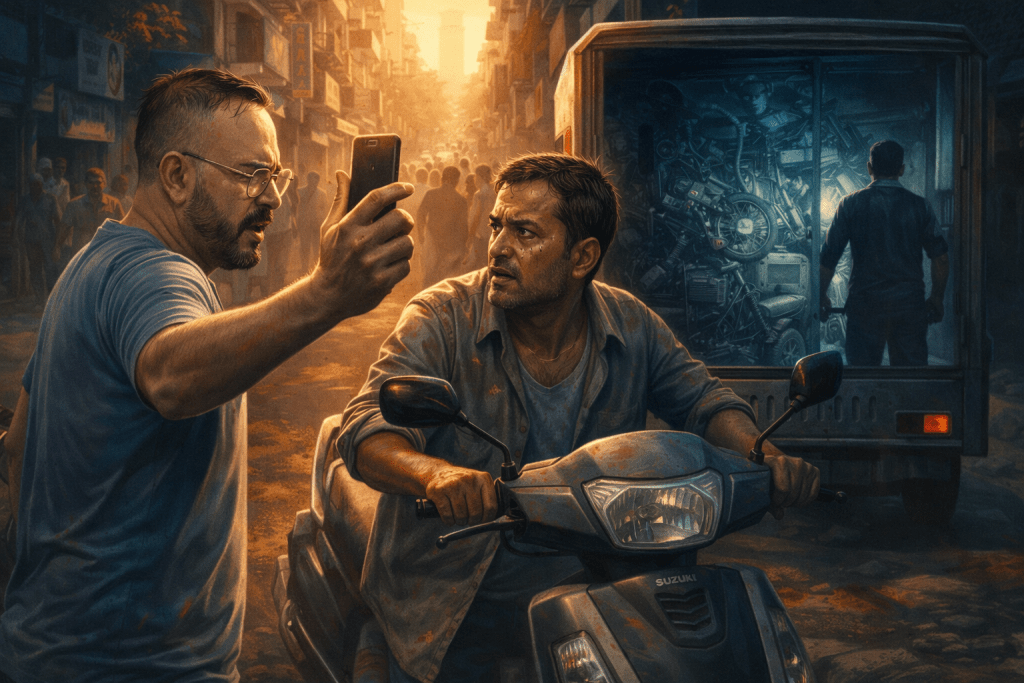
He was walking back toward his building when something registered — not urgency, just a small wrong note. A tempo, unmarked, engine still running, was parked half-on-the-road outside his building. Two men were working beside it. One was crouched low near the rear wheel of a Suzuki Access. The second was standing by the tempo’s open back, almost casually leaning against it.
It was his scooter.
It took him a second — that specific, stomach-dropping second — to understand what was happening. Then he walked straight toward them.
“Which garage sent you? For which repair?”
The first man straightened up and named a garage in the area. Routine, polite, entirely convincing — if you did not know that Suresh had not sent his scooter anywhere.
He called the garage owner immediately, right there, in front of the men. The garage owner said he had sent no one. Nobody. He had not seen that scooter and had not spoken to Suresh in weeks.
Recommended Product
Top Electronics Bestsellers on Amazon India
🛒 View on Amazon →As an Amazon Associate, we earn from qualifying purchases. Price and availability may vary.
In the five seconds it took for that phone call to confirm what his gut already knew, one of the men disappeared. Gone. Into the lane, around the corner, into the afternoon crowd — nobody saw which way he went.
The second man — the one holding the scooter’s handlebar — did not have the same exit. Suresh blocked him. Neighbours heard the raised voices and came out. A few more people appeared. The man stopped moving.
The police were called. The tempo was examined. And then the story started getting more complicated than a simple theft catch.
What Happened After the Police Arrived — And What It Suggested About How Organised This Was
According to Suresh’s account, the tempo owner — when questioned — claimed the scooter had been sold to him by someone named “Raju” (the name in Suresh’s account has been changed here). A name, a transaction, a story to explain why a vehicle they did not own was being loaded into their vehicle.
One of the accused, Suresh’s account states, was identified during questioning as a Bangladeshi national. The other appeared to be a bhangerwala — a scrap and junk trade worker — operating in the area.
And then — the detail that makes this more than a “lucky catch” story — someone allegedly called Suresh from a number claiming to be a police contact, suggesting that a settlement would be easier than a case.
Let that sentence sit for a moment. A man trying to steal your scooter, in the middle of the afternoon, outside your building, had a “police contact” available within minutes of being caught.
This is not a lone wolf operation. This is a chain.
How the Chain Actually Works — From Your Parking Spot to Chor Bazaar
What Suresh interrupted at 3:30 PM is one link in a supply chain. Understanding the whole chain is what turns this story from an interesting neighbour’s account into something you will act on.
Link 1: The Scout
Before a tempo arrives on your street, someone was already there. The scout could be anyone — a chai vendor, a vegetable cart, a daily-wage worker sitting on a wall. Their job is to identify regularly parked vehicles with no extra security, note the best pickup window (when the owner is usually away), and flag the make and model to the next link. In Suresh’s case, his scooter was parked in the same spot — a predictable schedule is a gift to the scout.
Link 2: The Lifters
These are the two or three men who physically take the vehicle. They usually come in a tempo or a similar load carrier. In the Chor Bazaar model documented by Mumbai Mirror, these men operate in skilled specialisations: one drives, one handles the lock or ignition bypass, one manages the physical load. They carry basic tools — a universal key or bypass wire, sometimes a hydraulic trolley for heavier bikes. In well-practised teams, a standard scooter with no extra lock takes under two minutes to move.
Link 3: The “Story Man”
As Suresh’s case demonstrates, someone in the chain is responsible for the plausible cover: a “garage pickup” story, a “seller named Raju” explanation, or a ready-made receipt that shows a fake transaction. This is the lubricant that buys the lifters ten extra seconds when someone questions them.
Link 4: The Buffer Garage / Dismantling Point
This is where the vehicle goes if it is not stopped. Not to a buyer. Not to another state. Directly to a dismantling point. In Delhi, a police press note documented how a stolen car weighing 1,000–1,500 kg was sold for ?13/kg scrap — ?13,000 to ?19,500 for an entire car. A bike worth ?60,000 fetched ?2,000 in scrap form. A car was dismantled in just over four hours. A bike was a heap of iron scrap within two hours.
Link 5: The Parts Distribution Network
What comes out of dismantling is not scrap — it is a catalogue.
- The engine goes to one buyer (a small workshop repairing “broken-down” bikes)
- The body panels go to another (a “second-hand parts” shop)
- The wheels and tyres go to a third
- The electrical system — wiring harness, meters, lights — goes to small auto-electrical shops
- The silencer and exhaust are sold separately
Each part is now untraceable, because it is no longer a vehicle. It is components from a hundred vehicles, mixed together on a hundred shelves.
Link 6: Reassembly or Cross-State Export
The most sophisticated end of the chain does not sell parts. It reassembles them.
In the Nuh (Haryana) gang bust documented by Hindustan Times, police found that:
- Cars stolen from Delhi-NCR were dismantled in Nuh
- Parts were sold to syndicates in Uttar Pradesh
- UP syndicates reassembled the vehicles using parts from multiple stolen cars
- The finished product — a “new” vehicle with a cloned or fake chassis number — was then sold to buyers in Arunachal Pradesh, Assam, and Manipur, where cross-checking RTO records is harder
A ?12-lakh car disappeared into this chain and reappeared in the Northeast as a ?6-lakh “second-hand deal” that no one could easily trace.
You Know Where They Operate From. Let Us Say It Clearly.
Chor Bazaar.
Mutton Street, Grant Road, South Mumbai. The market that calls itself a flea market and antiques bazaar, and is, among other things, the most openly documented destination for vehicle parts of uncertain provenance in Maharashtra.
Here is what actually happens there — documented, not invented:
- As you enter the automobile section, you will see old scooters, bikes, and cars being chopped down while customers watch. Not hidden in back rooms. On the street.
- Four people can strip a car in minutes in this market — the Grand Mumbai travel guide that describes Chor Bazaar as a “tourist attraction” notes this as casually as a cooking tip.
- Parts come off — engines, doors, mudguards, tyres, metal frames, brakes, horns — and are immediately displayed in adjacent shops for sale.
- Mumbai police busted a shopkeeper here — documented in Mumbai Mirror — who had a designated list of car accessories to procure and hired a three-member gang (a driver, a lock specialist, a mechanic) to steal them to order. The shopkeeper would pay an advance, provide a vehicle, and give them a shopping list of parts to steal.
When Suresh’s Suzuki Access would have arrived at a dismantling point, an engine number and chassis number would be ground off within the first 15 minutes. After that, it is not a vehicle. It is an anonymous catalogue.
Navi Mumbai Vehicle Theft Racket Busts — January–February 2026
| Date | Case | Accused | Vehicles Recovered | Areas Affected | Key MO |
|---|---|---|---|---|---|
| January 28, 2026 | Dombivli theft racket bust | 4 arrested | 26 stolen vehicles (21 motorcycles + 5 autorickshaws), worth ?40.46 lakh | Navi Mumbai, Thane, Mumbai, Raigad | Watched social media theft tutorials; replaced number plates with fakes; posed as genuine owners to sell |
| February 3, 2026 | Second Navi Mumbai racket bust | 1 arrested: Nasir Sadiq Khan (58), 92 prior cases | 17 stolen vehicles | Navi Mumbai, Mumbai | Veteran thief; garage background; erased engine/chassis numbers |
| February 22, 2026 | Vashi scooter attempt (this incident) | 1 caught, 1 fled | 1 Suzuki Access (recovered same day) | Vashi, Navi Mumbai | Tempo pickup, fake “garage story”, “police contact” pressure tactic |
Context: Navi Mumbai’s stolen property value reached ?48.99 crore in 2025, but police recovered only ?18.30 crore worth — barely 37%. Detection rate for property crime fell from 72% (2024) to 54% (2025). More property being stolen. Less of it coming back.
The Organised Racket — Who Plays Which Role
To be absolutely clear about how interconnected this is:
| Role | Who they are | What they do |
|---|---|---|
| Scout / Spotter | Looks like any ordinary person — vendor, passerby, local odd-job worker | Identifies target vehicles, notes patterns, reports to operator |
| Operator / Financer | Often never seen at the crime scene | Funds the operation, decides which vehicles are worth lifting, handles buyer arrangements |
| Lifter Team | 2–3 people, often skilled: driver + mechanic + loader | Physically lifts the vehicle and loads it; uses basic bypass tools |
| Story Man | Sometimes the operator, sometimes the tempo owner | Provides cover story in case of confrontation; has fake receipts or names ready |
| Police Fixer | May be a retired policeman, a “contact”, or simply a bluff | Calls during confrontation to intimidate the victim into backing off |
| Dismantler | Mechanic-trained; works at a buffer garage or designated point | Strips the vehicle completely; removes all identifying numbers within minutes |
| Parts Seller | Small shop owners in spare parts markets | Buys individual components at throwaway prices, sells them as “used parts” |
| Reassembler / Exporter | Operates in states with weaker RTO cross-checking | Rebuilds vehicles from multiple stolen sources; registers them with cloned/fresh documents in other states |
What You Should Do Before You Park Tonight
This section is not about fear. It is about five things that actually make a difference.
- Add a visible second lock before you walk away.
A disc-brake lock or wheel chain does not make theft impossible. It makes your vehicle slower to steal than the one next to it. Gang operations work on speed — visible resistance changes the calculation. - Vary your parking spot whenever possible.
The scout identifies patterns. If your scooter is in the exact same spot at the exact same time every day, you are helping someone build a schedule around you. - If you see a tempo in a residential lane with the engine running and nobody actively loading/unloading anything — note the number.
Write it down. Take a photo from your balcony. You do not need to confront anyone. A tempo idling in a residential lane with no obvious commercial purpose is worth a WhatsApp message to your building group, and a call to Navi Mumbai Police Control: 022-27562516 or 100. - Photograph your engine and chassis numbers now, before anything happens.
Take clear photos of the numbers on your vehicle’s physical frame and engine, not just the RC scan. If your vehicle is stolen, police need these to identify parts in a dismantling raid. A WhatsApp note to yourself with these numbers takes 30 seconds. - If confronted with a “police contact” during a theft confrontation — do not back down.
This is a documented manipulation tactic. Ask for the officer’s name, rank, and station. Real police will have no problem giving it. Call your local station independently. The local Vashi police station number is 022-27832660.
What Suresh Did Right — And What He Would Tell You
He looked. He questioned. He called his mechanic before anyone asked him to trust the stranger’s story. He blocked the exit. He got neighbours involved. And he made sure the police came before any “settlement” could be organised.
He also got lucky — in the sense that he happened to come home at that exact moment.
The two-wheeler parked outside your building right now does not have that luck built in.
Reader Poll
Have you ever had a two-wheeler stolen or come close in Navi Mumbai, Mumbai, or the MMR?
- ? Yes — it was stolen and not recovered
- ? Yes — it was stolen but recovered (without parts intact)
- ? Close call — I caught something suspicious in time
- ? No, never — but now I’m installing an extra lock tonight
Drop your answer and your area in the comments. Every data point helps the community map where these gangs are most active right now.
Kumar Is Watching This Story
If you have had a similar experience in Vashi, Nerul, Kharghar, Belapur, Airoli, Ghansoli, or anywhere in the MMR — contact Kumar directly. Real stories from real residents are the only thing that creates actual pressure on police and municipal systems.
Kumar, Editor at NewsPatron, is on every platform:
- ? Civic alerts, crime awareness, local stories: Follow on Instagram, X (Twitter), YouTube, and Reddit
- ? Community discussion: Like the NewsPatron Facebook page — neighbourhood safety posts travel furthest there
- ? Instant alerts: Subscribe to the NewsPatron WhatsApp Channel — your number stays private, always
- ?? Direct tips (confidential): Find Kumar on Telegram
- ? Connect for professional discussion: LinkedIn
All links at newspatron.com. And for the Mumbai that is worth protecting — DroneMitra on YouTube and Shorts. ?
