


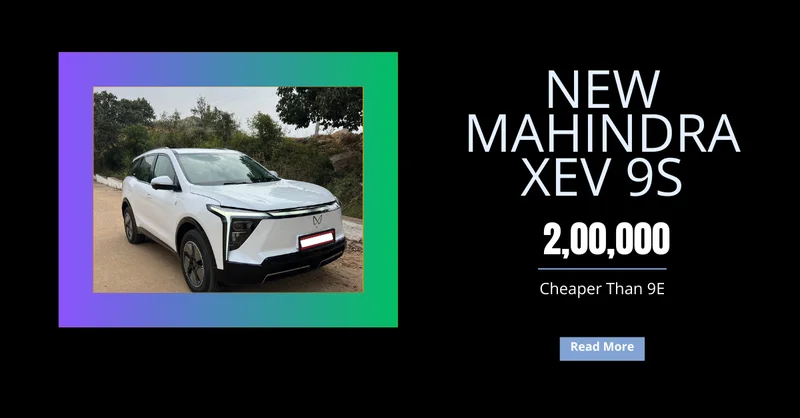

India’s electric vehicle market has reached a new milestone with the launch of Mahindra’s XUV 9S, a seven-seater electric SUV positioned to bridge the gap between mass-market EVs and premium family vehicles. Until now, buyers looking for an electric SUV with three-row seating had very limited options. The XUV 9S changes that equation by combining long range, fast charging, and full-size SUV practicality.
The XUV 9S enters the market with a starting price of ?22 lakh and extends up to ?35 lakh for the top variant. It is designed for buyers who want space, comfort, and technology without moving into luxury-brand pricing. Mahindra’s strategy appears focused on value, flexibility, and everyday usability rather than headline-grabbing gimmicks.
This article examines what the XUV 9S offers, where it compromises, and how it fits into India’s evolving EV landscape.
For a quicker overview, read our quick explainer on the Mahindra XUV 9S.
What the Mahindra XUV 9S Is
The Mahindra XUV 9S is the company’s first fully electric seven-seater SUV. It is built on Mahindra’s established EV architecture and shares mechanical elements with the XEV 9E, while offering a longer cabin layout to accommodate three rows of seating.
The SUV is positioned below Mahindra’s more premium electric offerings, but above compact electric crossovers. It targets families upgrading from internal combustion SUVs and buyers considering hybrid alternatives such as the Innova HyCross.
Battery Options and Pricing Structure
Mahindra offers the XUV 9S with three battery configurations:
* 59 kWh (base variant)
* 70 kWh (mid variant)
* 79 kWh (top variant only)
The price difference between the 59 kWh and 70 kWh battery is approximately ?2.5 lakh, while upgrading from the 70 kWh to the 79 kWh battery costs around ?1.1 lakh. This tiered structure allows buyers to balance budget and range without being forced into the top variant for essential features.
The 79 kWh version produces approximately 380 Nm of torque and delivers strong highway performance, while the smaller batteries focus on urban and mixed-use efficiency.
Recommended Product
Jockey Women's Hipster Brief – Comfort Fit, Assorted Colors
🛒 View on Amazon →As an Amazon Associate, we earn from qualifying purchases. Price and availability may vary.
Claimed Range and Real-World Expectations
Mahindra claims the following ranges:
* 59 kWh: 521 km
* 70 kWh: 600 km
* 79 kWh: 679 km
In real-world conditions, the largest battery is expected to deliver around 500 km with moderate driving. The step-up between battery sizes is roughly 80 km, which aligns with typical EV efficiency trends.
Charging Capabilities
The XUV 9S supports fast charging up to 180 kW, allowing a 20% to 80% charge in approximately 20 minutes under ideal conditions. This makes it suitable for highway travel and intercity use.
For home charging:
* An 11 kW fast charger can be installed at an additional cost of ?60,000–?70,000
* A 7 kW AC charger is also supported for residential setups
The charging port is positioned on the left side of the vehicle for easier access.
Exterior Design and Dimensions
Visually, the XUV 9S draws inspiration from the XUV 7O, with subtle design changes to distinguish it as an electric model. The front profile features projector headlamps, LED fog lamps, connected DRLs, and sequential indicators.
Key exterior highlights include:
* 200 mm ground clearance
* Alloy wheels with 235/60 R18 tyres
* Disc brakes on all four wheels
* Rear spoiler, shark-fin antenna, and high-mounted stop lamp
Mahindra has also introduced a 540-degree camera system, expanding on the conventional 360-degree setup by improving low-speed visibility and parking assistance.
Image credit for exterior visuals: Photo courtesy of Parth Gohil, via X/Twitter
Interior Layout and Features
Inside, the XUV 9S blends elements from Mahindra’s existing lineup. The dashboard houses three 12.3-inch displays for infotainment, driver information, and passenger interaction.
Interior highlights include:
* Electrically adjustable front seats with memory function
* Harman Kardon audio system
* Wireless charging and multiple USB Type-C ports
* Touch-based climate controls
* Electric parking brake with auto-hold
Material quality is mixed, with soft-touch surfaces on the upper dashboard and harder plastics elsewhere, reflecting its pricing strategy.
Second and Third Row Practicality
The second row offers:
* Ventilated seats
* Flat floor layout
* ISOFIX child-seat mounts
* Rear air vents and wireless charging
The third row is best suited for children or short trips. While under-thigh support is limited, Mahindra has included rear speakers, air vents, and a separate cooling coil that can be switched on or off.
With the third row folded, boot capacity increases to 527 litres. However, there is no spare wheel; instead, Mahindra provides a puncture mobility kit.
Safety and Driver Assistance
The XUV 9S includes:
* ADAS Level 2
* Hill descent control
* Traction control
* Multiple parking sensors
Keyless access is supported via NFC card, smartphone, and conventional key fob.
Market Position and Early Reactions
Early driving impressions suggest that Mahindra has priced the XUV 9S aggressively for its feature set. Automotive journalist Parth Gohil noted that the vehicle offers strong value below ?25 lakh and may appeal to buyers considering premium hybrids and mid-range electric SUVs.
The strategy appears clear: offer maximum equipment across variants so buyers are not forced into the most expensive trim.
What This Launch Signals
The XUV 9S signals a shift in India’s EV market toward family-oriented electric vehicles rather than niche urban solutions. While compromises exist—such as the lack of an electric tailgate and spare wheel—the overall package emphasizes practicality, charging speed, and interior comfort.
For buyers waiting for a usable, long-range, three-row electric SUV, the XUV 9S marks a significant step forward.
