




Editor’s Note: Short on time? Read the Quick Travel Guide here.
India is a country most people believe they understand. The cities, the crowds, the familiar noise. But far away from the mainland—so distant that even a dot on the map would feel oversized—there exists a place that quietly unsettles that certainty.
Out in the middle of the Arabian Sea, surrounded entirely by water, lies Lakshadweep.
Lakshadweep is not a single island but a chain of 36 islands, most of them uninhabited. Together, they form India’s smallest Union Territory. The landmass is so small that entire cities could swallow it without noticing. And yet, within this fragile footprint exists one of the most delicate ecosystems in the country.
Getting there is not effortless. You either travel for hours by ship from Kerala or land at the territory’s only airport on Agatti Island. The moment you arrive, something feels different. There is no skyline. No distant landmass. Only water in every direction.
Blue That Rewrites Reality
The first thing that registers is the colour of the sea.
Not metaphorically blue. Not poetically blue. But so vividly blue that it disrupts your sense of reality. Standing on Agatti’s shore, you can see boats anchored offshore—and beneath them, their shadows resting clearly on the seabed. The water feels transparent rather than reflective.
Closer to the beach, the sea glows turquoise. A few metres out, the colour deepens suddenly into a darker blue, as if the ocean itself changes personality without warning.
You may have seen clear beaches before. You may have travelled widely. But this feels different—especially within India.
Recommended Product
Alpino Peanut Butter Chocolate Protein Bar – Gluten Free
🛒 View on Amazon →As an Amazon Associate, we earn from qualifying purchases. Price and availability may vary.
Agatti is small enough that a scooter becomes the most practical way to move around. Coconut trees line narrow roads, and the sea never leaves your side. At one stretch, the land thins so much that water appears on both sides at once. From this point, you can watch the sun rise and set over the ocean without moving.
At the island’s edge, the land simply ends. Coral rock drops abruptly into deep water. Waves crash with force—not because of storms, but because the seabed falls away suddenly, without gradual depth.
Life Built on Coral
Everything here exists because of coral.
Lakshadweep is not metaphorically made of coral—it is physically built on it. Corals are living organisms that grow in colonies under the sea. Over centuries, their skeletons harden, forming reefs. These reefs soften the ocean’s force, creating calm lagoons where life can exist.
? The Atoll Ecosystem
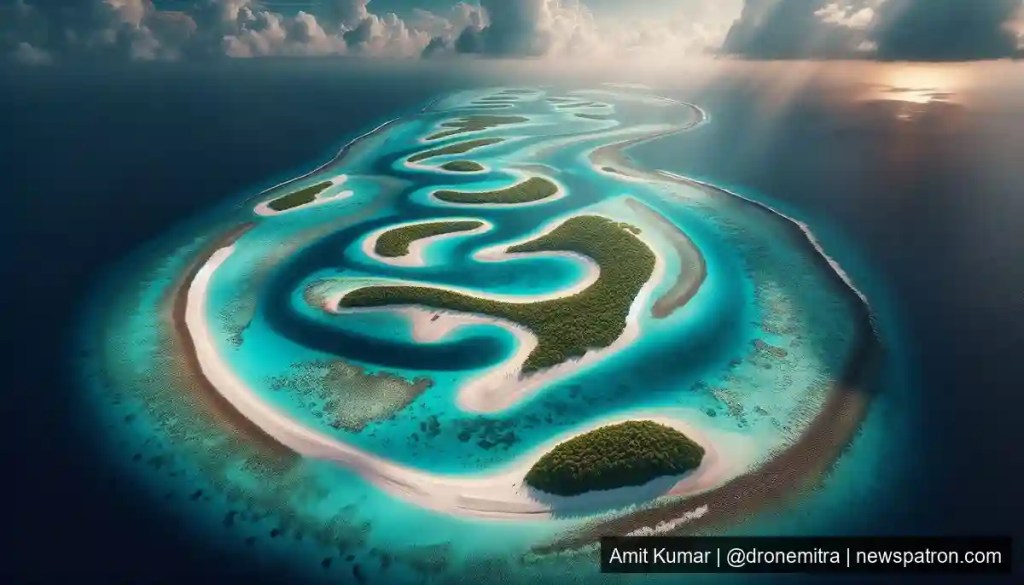
Lakshadweep is India’s only coral atoll chain. Unlike volcanic islands, these are formed by coral reefs growing on submerged volcanic peaks. The “lagoon” acts as a natural shield, protecting the delicate land from the open ocean’s fury.
This is why the beaches here are called lagoon beaches. When coral reefs form a ring, enclosing shallow waters, an island becomes a coral atoll—something found in India only in Lakshadweep.
On Kavaratti, the capital island, you can still find homes built from coral stone. Some are over a century old. The walls carry faint fossil patterns—imprints of ancient marine life. Despite the humidity, the interiors remain naturally cool. Kitchens were traditionally built outside the main structure to manage heat.
Before modern infrastructure arrived, life here relied entirely on adaptation. Medicines came from plants. Oils treated wounds. Every decision reflected scarcity and balance rather than abundance.
Fear, Then Flow
On Kavaratti’s beach, you are offered the chance to scuba dive.
For someone unfamiliar with swimming, the idea feels intimidating. Breathing underwater is unnatural. The sea feels vast. The ground disappears quickly.

At first, breathing becomes shallow. The mask blocks the nose. The regulator feels intrusive. Panic hovers close.
Then, slowly, breathing steadies.
Once it does, something shifts. The sea no longer feels hostile. You are not sinking or swimming—you are floating. Fish move past effortlessly. Coral spreads below like a living map. Time loses urgency.
When you surface, the fear has dissolved. And often, the next day, you find yourself wanting to return.
Luxury, and Loneliness
From Agatti, speedboats take you to Bangaram Island—often described as Lakshadweep’s most luxurious destination. There is no permanent population here. Only a resort, designed to remain visually modest rather than imposing.
The beaches are narrow. In some places, the sea appears on both sides at once. At high tide, parts of the island vanish entirely. Sandbanks appear and disappear, reminding you that even land here is temporary.
At night, the ocean surprises you again. As waves break on the shore, tiny blue lights flicker beneath the surface. Bioluminescence. The sea glows softly, briefly, like something alive responding to movement.
Nearby Parali Island is home to a single family. Fishing sustains them. Solar panels provide electricity. A well doubles as a natural refrigerator—vegetables remain cool in its shaded depth. To ease isolation, the radio becomes company.
Here, simplicity is not aesthetic. It is necessity.
When Nature Refuses to Pause
The sea does not adjust itself for documentation.
A sudden wave can surge farther than expected. Equipment can slip. Saltwater shows no patience for technology. Loss here is not symbolic—it is immediate and expensive.
The lesson arrives quickly: nature does not pause for storytellers. The ocean continues. It does not apologise.
What Lakshadweep Leaves Behind
Days here recalibrate something internal. You begin to notice how blue can exist in layers. How communities survive with less, not more. How fear loosens its grip when breathing slows.
Perhaps travel is not about escape. Perhaps it is about perspective. About remembering that life can still move according to tides rather than deadlines.
Lakshadweep does not ask for attention. It waits quietly, surrounded by blue.
And once you leave, the memory lingers—long after the horizon disappears.



[…] Want the full immersive story? Read the Narrative Essay here. […]