



A railway terminal is more than a dot on a timetable. It shapes how passengers begin and finish their journeys, how trains are turned around, and how well one part of a city connects to another. The temporary move of the Karnavati Express from Mumbai Central to Bandra Terminus for November 2026 brings that larger question into view: is Mumbai planning its railway facilities as a connected network, or mainly as individual stations and projects?
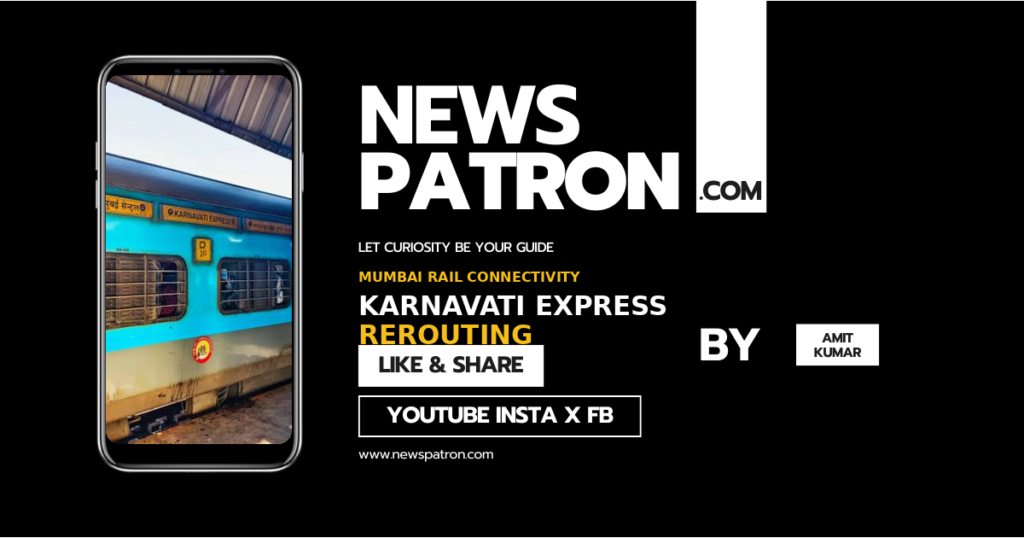
The terminal change is temporary, not an announcement that Karnavati Express has been permanently shifted. Two reports published on 27 October say Train Nos. 12933 and 12934 will use Bandra Terminus instead of Mumbai Central from 1 to 30 November while reconstruction work is carried out in the Mumbai Central yard. The reported timings are 1:55 pm departure for Train No. 12933 and 12:20 pm arrival for Train No. 12934. Passengers should check the current details on their tickets and official railway enquiry services before travel.
The related public post from DRM – Mumbai Central, Western Railway is included below for readers to consult in its original context. It forms part of the public record around this railway discussion; the article’s proposals remain distinct from any project or operating arrangement formally announced by the Railways.
That operational adjustment is the news. The wider questions in this article are proposals for discussion and technical study, not approved projects: could Mumbai make terminal changes work better for passengers, improve interchange between railway corridors, or study new links where they would provide a clear public benefit?
1. Why the Karnavati Express terminal change matters
Mumbai Central and Bandra Terminus serve different locations and passenger catchments. A passenger who usually boards at Mumbai Central may need to change the road or suburban part of the journey to reach Bandra Terminus. For someone whose origin or destination is closer to Bandra, the change may be more convenient. The impact therefore depends on where passengers are travelling from and to, as well as the connections available at each station.
The change also offers a useful way to understand the difference between a terminal and a connected transport hub. A terminal must have more than a platform: train paths, platform availability, pit and stabling lines, yard movements, crew arrangements and a workable return schedule all matter. Passenger access is another question. Even when a train can be accommodated operationally, the station should make the overall journey practical for the people using it.
NewsPatron has also examined the purpose of the Bandra terminal in a short explainer. It provides a useful companion to the immediate question raised by the November change.
The temporary change should not be read as evidence that the terminal has surplus capacity for every additional service, or that moving other trains would be straightforward. Each service has its own path, platform, maintenance and timetable requirements.
2. Mumbai needs to think about capacity as well as connectivity
Adding a train is not simply a matter of finding an empty slot on a timetable. A service needs a usable train path, appropriate signalling, platform and yard capacity, and a plan for where the train will wait, turn around and begin its next working. It must also fit around suburban and long-distance movements that share sections of the network. A bottleneck in one place can affect services well beyond that location.
Recommended Product
Trylo Riza T-Fit Women's Bra – Comfortable Daily Wear
🛒 View on Amazon →As an Amazon Associate, we earn from qualifying purchases. Price and availability may vary.
The Ministry of Railways reported in July 2026 that Mumbai handled around 120 originating Mail and Express trains and about 3,200 suburban train services daily. Its published list includes station and corridor works intended to increase train-handling capacity. Those figures show the scale of the operation; they do not mean every part of the network has spare capacity at every hour.
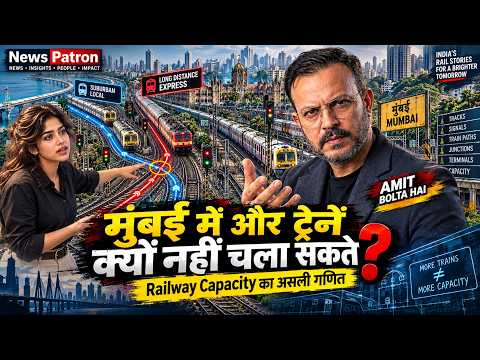
NewsPatron’s first video in this railway series explains this capacity problem in more detail: the real calculation involves train paths, signalling, terminal operations and the way different services interact, not just the number of tracks visible on a map.
The same question is explored briefly in this NewsPatron Short on why Mumbai cannot simply keep adding local trains whenever demand rises. It is a short introduction to the wider network constraints discussed above.
3. Passenger interchange is not the same as a railway connection
Three ideas are often blended together, even though they solve different problems. Passenger interchange means people can move between services, for example by using a footbridge or an internal station connection. A terminal change moves the point where a train begins or ends its service. Through-running means a train can physically continue from one railway corridor onto another over a suitable, authorised route.
A better footbridge can make a transfer easier, but it does not let a train cross from Central Railway tracks to Western Railway tracks. Likewise, changing a train’s terminal does not create a new railway route. To assess whether a proposed connection is useful, the infrastructure and the passenger journey must be considered separately.
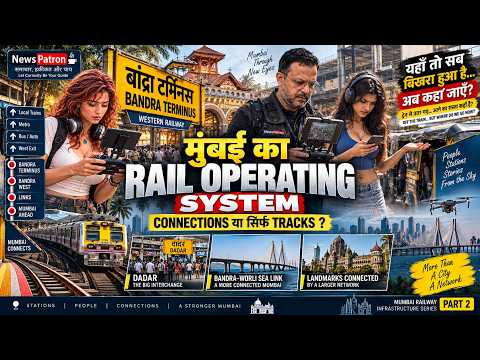
This is the central issue explored in NewsPatron’s second video, which looks at the connectivity gap between Bandra Terminus, the suburban network and Dadar. It asks what it means for a terminal to function as part of a more connected transport system.
4. What could Dadar do, and what does it not prove?
Dadar is a major interchange between the Central Railway and Western Railway suburban systems. Its importance for passengers should not be mistaken for proof that a Central Railway long-distance train can simply continue on Western Railway’s mainline, or vice versa.
A report published by The Indian Express on 9 February 2024 described Central Railway work to expand Dadar’s platform 4 and reduce the need for long-distance Mail and Express trains to use a loop line. The report discussed improvements to the handling of long-distance trains at Dadar. It did not establish that a new through-running connection between the two mainline systems was available.
A new mainline connection in or around Dadar would need a separate engineering assessment. That would examine track geometry, junction conflicts, signalling and interlocking, overhead electrical equipment, platform length and availability, train speeds, land constraints and effects on suburban operations. An at-grade movement across busy tracks could create conflicts; a grade-separated option might reduce some conflicts but could involve major civil engineering and cost.
Dadar is therefore one location to assess, not a preselected answer. Other junctions or operational approaches could be compared using train-movement simulations, passenger demand, cost and construction impact.
5. Could a Borivali–Thane railway link help connect the network?
A more ambitious idea is to study a railway corridor between Borivali and Thane. Depending on its alignment and connections to existing lines, such a corridor could create another path between the western and central parts of the metropolitan area. Whether that would improve journeys enough to justify the investment is an open technical and financial question.
A useful study would need to specify what the link is intended to carry. A frequent-stop suburban service has different needs from a long-distance train. Engineers would have to assess gradients, curves, land availability, built-up areas, environmental constraints, tunnels or bridges, junction capacity, electrification, signalling and the routes available at each end. They would also need to model whether the connection would relieve pressure at existing interchange points or simply move the bottleneck somewhere else.
One important distinction is that the Thane–Borivali Twin Tube Tunnel promoted by the Mumbai Metropolitan Region Development Authority is a road project. It should not be described as a railway tunnel or as evidence that a Borivali–Thane railway has been approved. A rail proposal would require its own planning, route study, approvals and funding decision.
The question is not whether a line between two places looks attractive on a map. It is whether a feasible route would carry useful services, connect to the existing network without creating serious new conflicts, and provide enough passenger benefit to justify its cost and construction effects.
6. Could Karnavati Express ever run to CSMT?
Another proposal is to study whether Karnavati Express could use an alternative Mumbai terminal on selected days, potentially including Chhatrapati Shivaji Maharaj Terminus (CSMT). This is a question for feasibility analysis, not a description of an approved service. The temporary move to Bandra Terminus does not mean the train can already continue to CSMT.
Before any such option could be considered, railway planners would need to establish whether a suitable continuous route and authorised track connection exist, whether the train could be accommodated at the receiving terminal, and how the movement would affect suburban and mainline timetables. Crew arrangements, rake positioning, servicing, return working and the availability of train paths would all matter. If the required connection does not exist, the cost and disruption of constructing it would need to be compared with less ambitious alternatives.
Alternative-terminal planning can still be useful even where a new track is not justified. Authorities could compare passenger access, station capacity and the operational advantages or disadvantages of different terminals before making any decision. A change should be judged by the whole journey and the reliability of the service, not solely by the terminal’s name.
7. Mumbai already has capacity projects, but each solves a different problem
Government project information shows that Mumbai’s railway capacity programme includes works such as the sixth line between Mumbai Central and Borivali, the Harbour Line extension from Goregaon towards Borivali, additional lines on other suburban sections, and the Airoli–Kalwa elevated suburban corridor link. These are distinct projects with their own scope and status. A suburban corridor link should not automatically be treated as a template for a long-distance mainline connection.
The Ministry of Railways’ published information also lists platform, pit-line and other train-handling improvements at locations including Bandra Terminus, Mumbai Central, Jogeshwari, Dadar, Panvel–Kalamboli, Kalyan, Lokmanya Tilak Terminus and Parel. Such facilities matter because trains need space for arrival, departure, servicing and turnaround as well as a track on which to run.
The public value lies in joining these decisions together. Additional tracks can create room for more movements; a better interchange can shorten passenger transfers; and suitable terminal facilities can make services easier to operate. No single measure automatically solves all three problems.
8. Railway congestion is a corridor issue as well as a Mumbai issue
Long-distance railway delays elsewhere in India offer another illustration of why corridor capacity matters. NewsPatron’s Short on the Mumbai–Howrah route discusses reported delays affecting trains such as the Gitanjali Express around the Chakradharpur–Tatanagar section. That is a separate corridor and a different set of operating conditions; it is not evidence about the capacity of Mumbai’s suburban lines or proof that any of the proposed Mumbai connections would work.
The larger lesson is that a railway route can be old, essential and heavily used while still facing bottlenecks at particular sections. Identifying those bottlenecks requires train-running data, timetable analysis and infrastructure records—not a conclusion drawn from a single delayed journey.
9. Train design and operating practice matter too
Network planning also involves the way trains are configured and operated. NewsPatron’s Amrit Bharat 3.0 explainer introduces the broader train upgrade story, while the follow-up Short explains the purpose of a push-pull arrangement with locomotives at both ends. These videos cover a different engineering topic from Mumbai’s proposed rail links, but they illustrate why train performance and operating practices are part of railway planning.
The Part 2 explainer looks more closely at the coordination required when locomotives work together, including traction and braking. It should not be read as a claim that push-pull operation solves Mumbai’s junction or terminal constraints; those would need separate operating and infrastructure studies.
Five ideas worth comparing in a public feasibility study
1. Make terminal changes easier to understand and use
When a train’s terminal changes, the passenger information should make the revised boarding point, timing and interchange options clear. Any operational benefit should be compared with the extra travel or transfer burden for passengers.
2. Improve passenger interchange where it will save time
Better walking routes, signage, platform access and connections to suburban trains and other public transport can improve journeys without requiring a new mainline. The benefit should be measured in walking time, accessibility, crowding and ease of transfer.
3. Examine whether existing junctions can handle more useful movements
At Dadar and other suitable locations, engineers could compare operational changes with new crossovers or track connections. The assessment should show which train movements become possible, what conflicts arise and whether the proposal improves reliability without reducing other services’ capacity.
4. Test the case for a Borivali–Thane rail corridor
A proper study should estimate demand, route options, land and environmental effects, construction cost, journey-time benefit and the capacity needed at both ends. The result could support the proposal, reshape it or explain why another option would provide better value.
5. Publish the choices and the evidence
A comparative study should set out costs, passenger benefits, engineering constraints, service assumptions and implementation risks. It should distinguish existing infrastructure, sanctioned works, projects under construction and conceptual proposals so that passengers can tell the difference between a real project and an idea worth investigating.
Conclusion: connect the journey, not just the station
The temporary Karnavati Express terminal change is a practical reminder that railway planning affects the whole passenger journey. Mumbai’s next improvements will depend not simply on adding tracks or building terminals, but on how train paths, platforms, junctions, suburban services and passenger interchanges work together.
A Central–Western mainline connection, a Borivali–Thane railway corridor and a possible alternative-terminal arrangement for Karnavati Express remain questions for technical evaluation, not established projects. The city deserves an evidence-based comparison of these ideas against improvements that can be made to existing stations, tracks and interchanges.
What would make the biggest difference to your journey: an easier interchange, more reliable long-distance operations, better terminal access or a new rail link? Share your experience and your reasoning in the comments below. The most useful discussion will separate what already exists from what has been announced and what still needs to be studied.
NewsPatron — Let Curiosity Be Your Guide.
Sources and further reading
- Gujarat Samachar, 27 October 2026 — Karnavati Express terminal change for November
- DeshGujarat, 27 October 2026 — temporary operation from Bandra Terminus
- Press Information Bureau, Ministry of Railways, 22 July 2026 — railway projects and Mumbai capacity augmentation
- Press Information Bureau, Ministry of Railways, 25 July 2025 — Mumbai suburban rail infrastructure projects
- The Indian Express, 9 February 2024 — Dadar platform expansion and loop-line use
- Mumbai Metropolitan Region Development Authority — Thane–Borivali Twin Tube Tunnel road project
- NewsPatron Railway Infrastructure video playlist
Questions and answers
Is Karnavati Express permanently shifting to Bandra Terminus?
No. The reports cited here describe a temporary terminal change from 1 to 30 November 2026 while reconstruction work takes place in the Mumbai Central yard. Passengers should check their ticket and official railway enquiry information for the service date.
What are the reported November timings?
The reports state that Train No. 12933 is scheduled to depart Bandra Terminus at 1:55 pm and Train No. 12934 is scheduled to arrive there at 12:20 pm during the temporary arrangement. Check official railway information before travel in case of a later revision.
Does Dadar already provide a direct Central–Western mainline connection?
Dadar is an interchange for passengers between the Central Railway and Western Railway suburban systems. That passenger interchange is not, by itself, proof that a long-distance train can directly pass from one mainline corridor to the other.
Is the Borivali–Thane railway link approved or under construction?
The sources cited in this article do not establish that a Borivali–Thane railway line has been approved or is under construction. The Thane–Borivali Twin Tube Tunnel described by MMRDA is a road project. A railway corridor would need separate planning, appraisal and approvals.
Could Karnavati Express run to CSMT on selected days?
That is a proposal for study, not a currently confirmed service. Railway authorities would first need to establish route continuity, the required track connections, platform and timetable capacity, operating arrangements and the cost of any infrastructure that does not already exist.
Why not simply add more trains to Mumbai’s network?
Every additional service needs a workable path through the network, signalling, platform and terminal capacity, and a schedule that fits with other movements. More trains can only be added sustainably where the relevant parts of the network can handle them without making reliability worse.
How can readers contribute to this discussion?
Readers can leave a comment below describing the journey or interchange problem they experience. Specific examples—such as a difficult transfer, an unclear terminal change or a route that appears to lack a useful connection—help make the debate more practical. Suggestions are welcome, with the distinction between existing infrastructure and proposed projects kept clear.
