




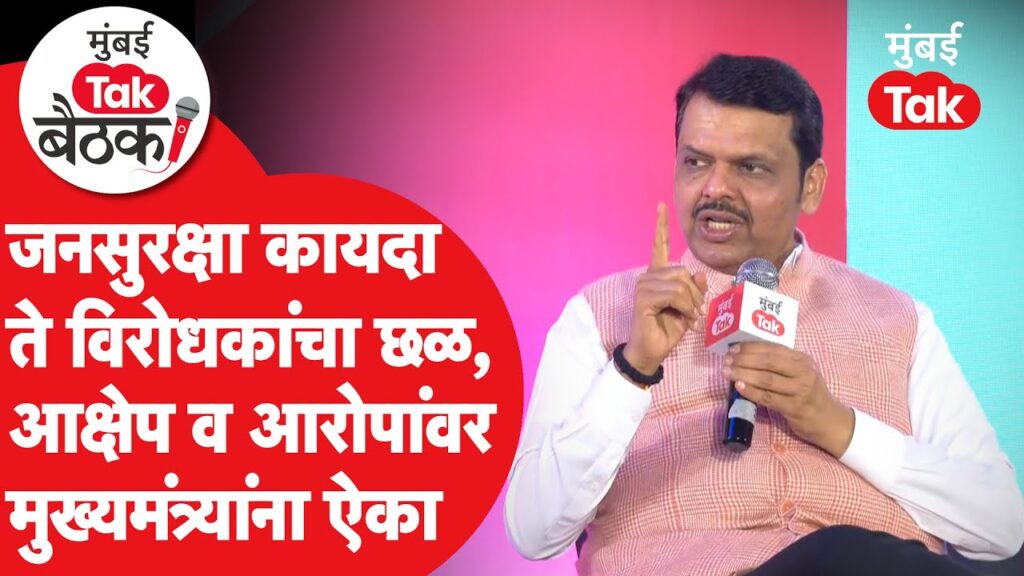


Navigating Maharashtra’s New Security Landscape: A Deep Dive into the Jansuraksha Law
The political landscape of Maharashtra is buzzing with discussions surrounding the recently introduced Jansuraksha Law Explained. This legislation, championed by figures like Devendra Fadnavis in his Mumbai Tak interview, aims to bolster the state’s security framework. But what exactly does this new Maharashtra Security Act entail, and how does it fit into India’s existing legal architecture? Join us as we delve into the objectives of this pivotal law. We will explore its safeguards and the critical role it plays in confronting contemporary security challenges.
For more insightful analyses and to stay updated on critical developments, make sure to check out our channels! Our old channel, DroneMitra (“Your Sky is Digital with a Drone as a Friend”), offers unique perspectives. Our new YouTube channel, Newspatron (“Let Curiosity Be Your Guide”), is your go-to source for in-depth journalistic content.
Politics Archives | NEWSPATRON
Maharashtra Politics News & Analysis | NewsPatron Archives
Unpacking Maharashtra’s Jansuraksha Law: A New Layer of Security
Maharashtra’s political corridors have been abuzz with the introduction of the Jansuraksha Law. This new legislation has sparked considerable debate, prompting both support and skepticism about its necessity. Many observers question whether the existing legal frameworks are adequate to handle the state’s security concerns. Yet, proponents of the law argue that it introduces a vital new layer of protection. It is specifically designed to counter evolving threats that current laws do not fully cover. This law signifies a significant step in how Maharashtra intends to manage internal security, setting a precedent for other regions.
The Viral Moment: Watch It Unfold
Jansuraksha Law Explained: Why Another Act?
A central point of discussion revolves around the need for the Jansuraksha Law Explained. This discussion arises even though the Unlawful Activities (Prevention) Act (UAPA) is already in force. The UAPA is a comprehensive law aimed at preventing unlawful activities, but it has specific limitations. For instance, in the notable Professor Saibaba case, there was evidence of financial and logistical support for unlawful activities. Still, direct involvement in a terror act was required for UAPA to be applied. This case highlighted a critical gap. The UAPA’s focus on direct acts made it difficult to prosecute individuals. It was challenging for those providing indirect support.
The Jansuraksha Law, nevertheless, addresses this by primarily focusing on banning organizations involved in unlawful activities. It does this rather than solely targeting individuals for direct participation. This distinction is crucial. It allows the state to dismantle the organizational infrastructure facilitating illicit operations. This occurs even when proving direct links to terror acts against specific members is difficult. The new law complements UAPA. It provides a broader scope for proactive intervention. It targets groups that foster an environment conducive to illegal activities.
Recommended Product
Amazon Renewed — Best Deals of the Day
🛒 View on Amazon →As an Amazon Associate, we earn from qualifying purchases. Price and availability may vary.
The Urgent Need for Maharashtra’s Security Act
The implementation of the Maharashtra Security Act is not an isolated event; it reflects a broader trend across India. Four other states have already adopted similar legislative measures. This precedent suggests a recognized need for such laws to combat specific types of threats. The absence of a similar law in Maharashtra has inadvertently turned the state into a hub. Various banned organizations now operate there. These groups, incapable of running freely in states with stricter laws, have seemingly gravitated towards Maharashtra.
Statistical data further emphasizes this urgent need. Approximately 64 unlawful organizations are now active in Maharashtra. This is in stark contrast to the 12 to 20 typically found in other Naxal-affected states. This significant disparity underscores the severity of the challenge Maharashtra faces. The Jansuraksha Law Explained aims to rectify this imbalance. It provides the state with the necessary legal tools to curtail the activities of these groups. This will enhance overall security.
Safeguards and Scrutiny: Ensuring Fair Application of the Jansuraksha Law
A critical aspect of the Jansuraksha Law Explained is its robust framework for preventing misuse. The law incorporates a rigorous, multi-step judicial review process. Before any organization can be officially declared unlawful, compelling evidence must be presented to a specialized board. This board is more than just an administrative body. It comprises a High Court judge. It also includes a District Court judge and a Public Prosecutor. Their collective skills guarantee a thorough and impartial examination of the evidence.
Moreover, the law includes a vital provision for appeal. Once an organization receives notification of its unlawful status, it has 30 days to appeal. They must give the appeal to the High Court. This multi-layered scrutiny acts as a significant safeguard, ensuring that the law is applied fairly and only to legitimate cases. This commitment to due process distinguishes the Jansuraksha Law from more arbitrary measures. It reinforces its legitimacy and prevents its weaponization against innocent entities.
Free Speech and the Maharashtra Security Act: Clearing the Air
Concerns have naturally arisen about the potential impact of the Maharashtra Security Act on fundamental rights. These include freedom of speech, the right to protest, and the ability to criticize the government. Nevertheless, proponents of the law, including Devendra Fadnavis in his interview, have explicitly refuted these claims. They emphasize that the law is not a blanket measure to suppress dissent. Instead, it is specifically targeted at “hardcore left-wing” organizations.
This distinction is crucial for understanding the law’s intent. It aims to counter groups actively engaged in unlawful activities, not to stifle legitimate political discourse or ideological differences. The analogy often used is the difference between a broad ideology, like “left-wing” thought, and extremist elements. It is much like distinguishing between Islam as a religion and terrorist groups like ISIS. The law’s focus remains on dismantling networks that actively promote anarchy. It targets those that engage in recruitment through clandestine means. This is particularly aimed at urban youth and university students.
Historical Echoes: Jansuraksha Law in Contrast to The Emergency
When discussing new security legislation, historical parallels often emerge. Some critics have drawn comparisons between the Jansuraksha Law Explained and India’s Emergency period under Indira Gandhi. Yet, a closer examination reveals fundamental differences. During the Emergency, individuals were often incarcerated without access to legal recourse, and fundamental rights were suspended. The executive wielded immense power, often bypassing judicial oversight.
In stark contrast, the Jansuraksha Law incorporates robust provisions for judicial review and appeals. Every step, from the first declaration of an organization as unlawful to its appeal, is exposed to judicial scrutiny. This adherence to due process ensures that the law operates within the constitutional framework. It safeguards individual liberties. It also addresses security concerns. The law’s design prioritizes legal recourse, a stark departure from the arbitrary actions seen during the Emergency.
The “Urban Naxal” Challenge: Why the Jansuraksha Law is Opportune
The introduction of the Jansuraksha Law Explained seems counterintuitive to some. This perception arises especially given the Home Minister’s recent statements about the decline of Naxalism. Yet, this obvious contradiction dissolves when one understands the distinction between traditional Naxalism and the contemporary threat of “Urban Naxals.” The Home Minister’s remarks refer to the diminishing armed conflict linked to traditional Naxal movements. The Jansuraksha Law, conversely, targets a more insidious and evolving challenge.
“Urban Naxals” work through covert networks, disseminating anarchy and recruiting individuals, often within educational institutions and urban centers. These groups engage in ideological subversion, aiming to destabilize society through non-violent but equally damaging means. The law is specifically designed to disrupt these hidden operations. It aims to protect the state from this specific form of ideological infiltration. Assurances from the interview confirm that the law will not be used arbitrarily. It will not target political opponents or those with mere ideological differences. It is a targeted measure against specific threats.
Connect with Me
I am always eager to hear your thoughts and perspectives on these critical topics. Feel free to share your comments below or connect with me, Kumar, Editor at Newspatron, on your favorite platform!
For quick updates and insights, follow me on Instagram, Twitter, YouTube, or Reddit. You can also check out our Newspatron Sub-Reddit for community discussions.
For deeper conversations, my Facebook profile is open to new friends! Feel free to send a friend request from your authentic profile (no fake accounts, please!). Alternatively, you can like the Newspatron Facebook page to stay updated on all the latest happenings.
For a visual journey, follow me on Tumblr for captivating content and inspiring imagery.
For instant updates, subscribe to our WhatsApp Channel. Be the first to know about new posts and announcements. Your privacy is protected. We can only see the subscriber count, not your phone number. You can also connect via Telegram for quick chats and discussions, or join our Telegram Channel.
For a convenient way to stay in the loop, subscribe to our RSS feed and never miss a post.
For professional networking, let’s connect on LinkedIn and share our industry insights.
You can find all the relevant links on the Newspatron homepage too. Looking ahead to connecting with you!
