


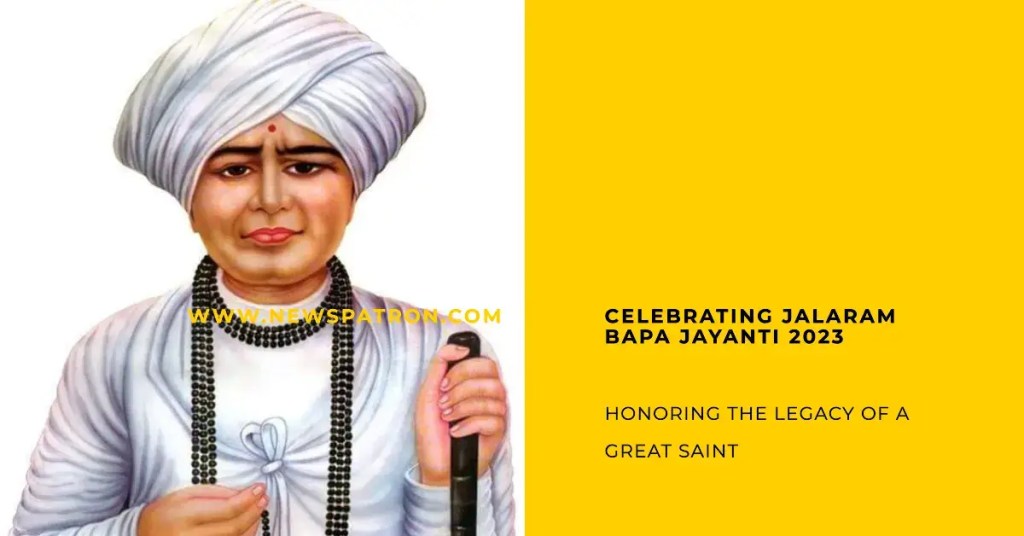

Welcome to our blog, where we explore the fascinating and diverse aspects of Indian culture, belief, and festivals. In this article, we will celebrate the birth anniversary of Jalaram Bapa, ( Jalaram Bapa Jayanti 2023 ) a Hindu saint who is revered by millions of devotees across the world. Jalaram Bapa was a humble and compassionate man who dedicated his life to serving God and humanity. He is also known for his many miracles that demonstrate his divine grace and power. In this article, we will cover the following topics:
– Jalaram Bapa’s early life and how he developed his devotion to God
– Jalaram Bapa’s service to others and how he established a free food center that feeds thousands of people every day
– Jalaram Bapa’s miracles and how they inspire faith and gratitude among his followers
– Jalaram Bapa’s legacy and how his samadhi (shrine) in Virpur, Gujarat, is a popular pilgrimage site
– How to celebrate Jalaram Jayanti 2023 and what are the rituals and customs associated with it
– Jalaram Bapa’s teachings and how they can help us live a better life in today’s world
We hope that this article will enrich your knowledge and appreciation of Jalaram Bapa and his contribution to Hinduism and humanity.
We also hope that this article will inspire you to follow his example of devotion and service and to seek his blessings on this auspicious occasion.
editor@newspatron.com
Jalaram Bapa’s Early Life and Devotion to God
Jalaram Bapa was born in Virpur, Gujarat, India, in 1799 (1799-1881 AD). He was the son of a poor Brahmin couple, Pradhan Thakkar and Rajbai Thakkar. He had to work from an early age to help support his family. Despite his poverty, Jalaram Bapa was always generous with what little he had. He was also known for his honesty and integrity.
Jalaram Bapa was a deeply religious man. He was devoted to the Hindu god Vishnu, and he spent many hours each day praying and meditating. He was also a strict vegetarian and a teetotaler. He was influenced by his maternal uncle, Vala Ram, who was a follower of Ramananda, a famous Hindu saint and reformer. Jalaram Bapa also admired another saint, Bhoja Bhagat, who lived in nearby Manavadar. Jalaram Bapa often visited Bhoja Bhagat and learned from his teachings and example.
When Jalaram Bapa was 16 years old, he married Virbai, the daughter of Thakkar Pragji Somaiya. Virbai was also a pious and charitable woman who supported Jalaram Bapa’s spiritual pursuits. Jalaram Bapa and Virbai had a happy and harmonious marriage, but they did not have any children. They decided to adopt a son, Hariram, who later became a saint himself.

Jalaram Bapa’s devotion to God grew stronger as he matured. He wanted to renounce the worldly life and become a sadhu (a wandering ascetic). However, his parents and his guru, Ramananda, advised him to stay in the household and serve God and humanity. Jalaram Bapa accepted their advice and dedicated his life to the path of bhakti (devotion) and seva (service). He also received a mantra (a sacred utterance) from Ramananda, which he chanted constantly. The mantra was “Sita Ram”, the names of the divine couple, Sita and Ram, who are incarnations of Vishnu and his consort Lakshmi. Jalaram Bapa believed that by chanting this mantra, he would attain the grace and blessings of God.
Jalaram Bapa’s Service to Others and His Free Food Center
Jalaram Bapa was a compassionate and caring man. He was always willing to help others, regardless of their caste or religion. He was especially kind to the poor and downtrodden. He believed that serving others was the best way to serve God. He often quoted a verse from the Bhagavad Gita, a sacred Hindu scripture, that says: “The one who sees me in all beings, and all beings in me, is never separated from me, nor am I separated from him.”
One of the most remarkable examples of Jalaram Bapa’s service to others was his establishment of a free food center, known as Shri Jalaram Prasad, in Virpur. He started this center in 1822, when he was 23 years old. He had a small shop where he sold groceries and spices. He used the profits from his shop to buy food grains and cook meals for anyone who came to his door. He also distributed food to the travelers, pilgrims, and sadhus who passed by Virpur. He did not discriminate anyone based on their caste, creed, or status. He treated everyone as his guest and served them with love and respect.
Jalaram Bapa’s free food center soon became famous and attracted many people from far and wide. Jalaram Bapa did not have any fixed time or limit for serving food. He served food day and night, as long as there were people who needed it. He also did not have any fixed quantity or quality for serving food. He served food according to the taste and preference of his guests. He also served food according to the season and the availability of ingredients. He sometimes served simple food like roti (bread) and dal (lentil soup), and sometimes served elaborate food like puri (deep-fried bread) and shrikhand (sweet yogurt). He also served fruits, sweets, and drinks to his guests.
Recommended Product
Waterproof Car Body Cover for Maruti Dzire 2017-2023
🛒 View on Amazon →As an Amazon Associate, we earn from qualifying purchases. Price and availability may vary.
Jalaram Bapa’s free food center was run by his family and his devotees. His wife, Virbai, was his main helper and supporter. She cooked the food and served the guests along with Jalaram Bapa. She also managed the household and the shop. She was a devoted and dutiful wife who never complained or interfered with Jalaram Bapa’s service. She also shared his generosity and kindness. She often gave away her own clothes and jewelry to the poor and needy women who came to her. She also adopted and raised many orphaned and abandoned children as her own.
Jalaram Bapa’s free food center was also supported by his guru, Ramananda, who gave him a deity of Ram, Sita, and Lakshman, the divine trio of Hinduism. Jalaram Bapa installed this deity in his house and worshipped it daily. He also offered the first portion of the food to the deity before serving it to his guests. He believed that the deity was the source of his food and his blessings. He also believed that the deity was present in every guest who came to his house. He often said: “Ram is my father, Sita is my mother, and Lakshman is my brother. All the guests who come to my house are Ram, Sita, and Lakshman. I am serving them as my family.”
Jalaram Bapa’s free food center is still running today, more than 140 years after his death. It is managed by his descendants and his devotees. It serves more than 10,000 people every day, free of cost. It is considered as one of the largest and oldest free food centers in the world. It is also considered a symbol of Jalaram Bapa’s service and generosity. It is said that no one who comes to Jalaram Bapa’s house goes hungry or unhappy. It is also said that Jalaram Bapa’s food has a healing and soothing effect on the body and the mind. Many people have reported experiencing miracles and blessings after eating Jalaram Bapa’s food.
Read an Article About the Festival of Cows
Vagh Baras, Vasu Baras, or Govatsa Dwadashi
Jalaram Bapa’s Miracles and His Divine Grace
Jalaram Bapa is said to have performed many miracles during his lifetime. These miracles include healing the sick, raising the dead, and feeding the hungry. These miracles demonstrate his divine grace and power, and also his compassion and generosity. Many of these miracles are recorded in the books and songs written by his devotees. Some of the most famous miracles of Jalaram Bapa are:
The miracle of the Akshay Patra (the inexhaustible vessel):
Jalaram Bapa used a small metal pot to cook and serve food to his guests. He never ran out of food, even when there were thousands of people to feed. He believed that the pot was blessed by God and that it would always provide enough food for everyone. He also believed that the pot was connected to the deity of Ram, Sita, and Lakshman, and that the food was actually coming from them. He often said: “This is not my pot, this is Ram’s pot. This is not my food, this is Ram’s food. I am just a servant of Ram.”
The miracle of the neem tree (the bitter tree):
Jalaram Bapa planted a neem tree near his house and watered it daily. He also worshipped it as a symbol of God. He said that the neem tree was a manifestation of God and that it would fulfill the wishes of anyone who prayed to it. He also said that the neem tree had a special quality: it could turn bitter into sweet. He said that anyone who ate the leaves of the neem tree would experience a sweet taste in their mouth, and that anyone who had a bitter or unhappy life would experience a sweet and happy life after praying to the neem tree.
The miracle of the snake bite (the venomous bite):
Jalaram Bapa was once bitten by a venomous snake while he was sleeping. He did not feel any pain or fear, and he did not seek any medical help. He simply woke up and continued his normal routine of serving food to his guests. He said that the snake bite was a blessing from God and that it would not harm him. He said that the snake was actually a messenger of God and that it had come to test his faith and devotion. He also said that the snake had given him a boon: anyone who touched his feet would be cured of any disease or affliction.
The miracle of the rain (the drought relief):
Jalaram Bapa lived in a time when Gujarat was suffering from a severe drought. There was no rain for many years, and the crops and animals were dying. The people were starving and thirsty, and they prayed to God for relief. Jalaram Bapa also prayed to God and asked him to send rain to the land. He said that he would not eat or drink anything until it rained. He also said that he would not serve food to anyone until it rained. He said that he would only serve water to his guests and that the water would quench their hunger and thirst. He also said that the water was actually the tears of God and that it would bring rain to the land. As he said, it soon started to rain, and the drought was over. The people rejoiced and thanked Jalaram Bapa for his miracle.
These are just some of the many miracles of Jalaram Bapa. There are many more stories of his miracles that are told and retold by his devotees. These stories inspire faith and gratitude among his followers and also attract new people to his fold. They also show that Jalaram Bapa was not an ordinary man, but a divine being who was sent by God to help and heal humanity.

Jalaram Bapa’s Legacy and His Samadhi in Virpur
Jalaram Bapa Jayanti 2023
Jalaram Bapa’s samadhi is a simple and modest structure that reflects his humble and unassuming personality. It is located in the same house where he lived and served food to his guests. It is also adjacent to his free food center, which is still running today. The samadhi consists of a small room where Jalaram Bapa’s body is buried under a marble platform. On the platform, there is a statue of Jalaram Bapa sitting in a meditative pose. There is also a small altar where the deity of Ram, Sita, and Lakshman is placed. The samadhi is decorated with flowers, lamps, and pictures of Jalaram Bapa and his family.
The samadhi is visited by thousands of pilgrims every day, especially on Jalaram Jayanti, his birth anniversary. The pilgrims come from different parts of India and the world, and they belong to different castes, religions, and backgrounds. They come to pay their respects to Jalaram Bapa, to seek his blessings, and to experience his miracles. They also come to enjoy his food, which is served free of cost to everyone who visits the samadhi. The food is prepared and served by Jalaram Bapa’s descendants and devotees, who follow his tradition of service and generosity.
The samadhi is also a place of worship and celebration. There are daily prayers and rituals performed at the samadhi, such as aarti (a ritual of waving lamps), bhajan (a devotional song), and katha (a story-telling session). There are also special events and festivals organized at the samadhi, such as annakut (a mountain of food offerings), rath yatra (a chariot procession), and utsav (a grand celebration). These events and festivals are attended by thousands of people who participate in the joy and devotion of Jalaram Bapa.
Jalaram Bapa’s samadhi is not only a physical structure, but also a spiritual symbol. It symbolizes Jalaram Bapa’s love and grace, his service and generosity, and his devotion and faith. It also symbolizes the unity and harmony of humanity, as people of different backgrounds and beliefs come together to honor Jalaram Bapa. It also symbolizes the power and presence of God, as Jalaram Bapa’s miracles and blessings are still witnessed and experienced by his devotees.
Jalaram Bapa’s samadhi is a living testament to his legacy and his contribution to Hinduism and humanity. It is a place of inspiration and transformation for anyone who visits it. It is also a place of gratitude and reverence for anyone who remembers Jalaram Bapa.
How to Celebrate Jalaram Jayanti 2023 and What are the Rituals and Customs Associated with It
Jalaram Jayanti is the birth anniversary of Jalaram Bapa, which falls on the seventh day of the bright fortnight of the Hindu month of Kartik. In 2023, Jalaram Jayanti will be celebrated on November 8th. Jalaram Jayanti is a major festival for the devotees of Jalaram Bapa, who celebrate it with great enthusiasm and devotion. Jalaram Jayanti is also a national holiday in Gujarat, where Jalaram Bapa was born and lived.
There are many ways to celebrate Jalaram Jayanti, depending on the region, tradition, and preference of the devotees. Some of the common ways to celebrate Jalaram Jayanti are:
Visiting Jalaram Bapa’s samadhi in Virpur and paying homage to him. Many devotees also visit other places associated with Jalaram Bapa, such as his birthplace, his shop, his neem tree, and his akshay patra. They also participate in the events and festivals organized at the samadhi, such as aarti, bhajan, katha, annakut, rath yatra, and utsav. They also enjoy Jalaram Bapa’s food, which is served free of cost to everyone who visits the samadhi.
Attending special puja ceremonies at the temples or homes dedicated to Jalaram Bapa. Many devotees also perform their own puja at their homes, where they worship Jalaram Bapa’s statue or picture, along with the deity of Ram, Sita, and Lakshman. They also offer flowers, fruits, sweets, and other items to Jalaram Bapa, and chant his mantra, “Sita Ram”. They also listen to or recite the stories and songs of Jalaram Bapa and his miracles.
Fasting and praying on Jalaram Jayanti. Many devotees observe a fast on Jalaram Jayanti, either for the whole day or for a part of the day. They abstain from eating or drinking anything except water or milk. They also spend the day in prayer and meditation, and seek Jalaram Bapa’s blessings for themselves and their families. They also ask Jalaram Bapa to forgive their sins and to grant their wishes.
Serving others and donating to charity on Jalaram Jayanti. Many devotees follow Jalaram Bapa’s example of service and generosity, and help others in need. They feed the poor and the hungry, clothe the naked and the cold, heal the sick and the injured, and comfort the sad and the lonely. They also donate money, food, clothes, and other items to the temples, ashrams, orphanages, hospitals, and other organizations that serve the needy. They also volunteer their time and skills to various social and humanitarian causes.
These are some of the ways to celebrate Jalaram Jayanti 2023 and to honor Jalaram Bapa’s life and teachings. By celebrating Jalaram Jayanti, the devotees express their love and gratitude to Jalaram Bapa, and also strengthen their faith and devotion to God.

Jalaram Bapa’s Teachings and How They Can Help Us Live a Better Life in Today’s World
Jalaram Bapa’s teachings are based on the principles of Hinduism, which is not just a religion, but a way of life. He taught his followers to be honest, compassionate, and generous.
He also taught them to be devoted to God and to serve others as a form of worship. He also taught them to be humble, content, and detached from worldly pleasures and pains. He also taught them to be optimistic, grateful, and joyful in all situations.
Jalaram Bapa’s teachings are based on the principles of Hinduism, which is not just a religion, but a way of life. He taught his followers to be honest, compassionate, and generous. He also taught them to be devoted to God and to serve others as a form of worship. He also taught them to be humble, content, and detached from worldly pleasures and pains. He also taught them to be optimistic, grateful, and joyful in all situations.
Jalaram Bapa’s teachings are just as relevant today as they were when he was alive. In a world that is often filled with violence and hatred, Jalaram Bapa’s message of peace and love is more important than ever. In a world that is often driven by greed and selfishness, Jalaram Bapa’s example of service and generosity is more inspiring than ever. In a world that is often plagued by stress and anxiety, Jalaram Bapa’s wisdom of devotion and detachment is more soothing than ever.
By following Jalaram Bapa’s teachings, we can live a better life in today’s world. We can improve our relationships with ourselves, with others, and with God. We can also improve our health, happiness, and harmony. We can also contribute to the welfare of the society and the environment. We can also attain the ultimate goal of life, which is to realize our true nature and to merge with God.
Some of the practical ways to follow Jalaram Bapa’s teachings are:
Be honest in your thoughts, words, and actions. Do not lie, cheat, or harm anyone. Speak the truth with kindness and respect. Act with integrity and responsibility.
Be compassionate to all living beings. Do not hurt, kill, or exploit anyone. Help those who are in need. Share what you have with others. Forgive those who have wronged you. Love everyone as yourself.
Be generous with your time, money, and resources. Do not be greedy, stingy, or wasteful. Give to the poor and the needy. Support the noble causes. Donate to the temples, ashrams, and other organizations that serve the society and the environment.
Be devoted to God and to your chosen deity. Do not be arrogant, proud, or egoistic. Pray to God daily and chant his name. Worship him with love and faith. Surrender to his will and accept his grace. Seek his guidance and protection.
Serve others as a form of worship. Do not be lazy, selfish, or indifferent. Work for the benefit of others. Serve the guests who come to your house. Serve the travelers, pilgrims, and sadhus who pass by your place. Serve the animals, plants, and the earth. Serve God in all beings.
Be humble and content with what you have. Do not be jealous, envious, or dissatisfied. Appreciate the gifts and blessings that God has given you. Do not compare yourself with others or crave for more. Be happy with what you have and use it wisely.
Be detached from the worldly pleasures and pains. Do not be attached, addicted, or dependent on anything. Enjoy the pleasures with moderation and without expectation. Endure the pains with patience and without complaint. Do not let the pleasures and pains affect your peace and happiness. Remember that they are temporary and illusory.
Be optimistic and grateful in all situations. Do not be pessimistic, negative, or ungrateful. Look at the bright side of everything. See the good in everyone and everything. Thank God for everything that happens to you. Express your gratitude to God and to everyone who helps you.
Be joyful and spread joy to others. Do not be sad, angry, or depressed. Smile and laugh often. Sing and dance with joy. Celebrate the festivals and occasions with enthusiasm. Make others happy and cheerful.
These are some of the ways to follow Jalaram Bapa’s teachings and to live a better life in today’s world. By following Jalaram Bapa’s teachings, we can become his true devotees and his worthy children. We can also become closer to God and to ourselves.
I hope you enjoyed reading it and learned something from it. I also hope that you will celebrate Jalaram Jayanti 2023 with love and devotion, and seek Jalaram Bapa’s blessings for yourself and your family.
Thank you for reading this article. Please share your feedback and comments with me. I would love to hear from you. ?
Read More About Jalaram Bapa
Jalaram Jayanti – Birth Anniversary of Sri Jalram Bapa | Hindu Blog (hindu-blog.com)
YouTube Channel
Subscribe to the YouTube Channel
