


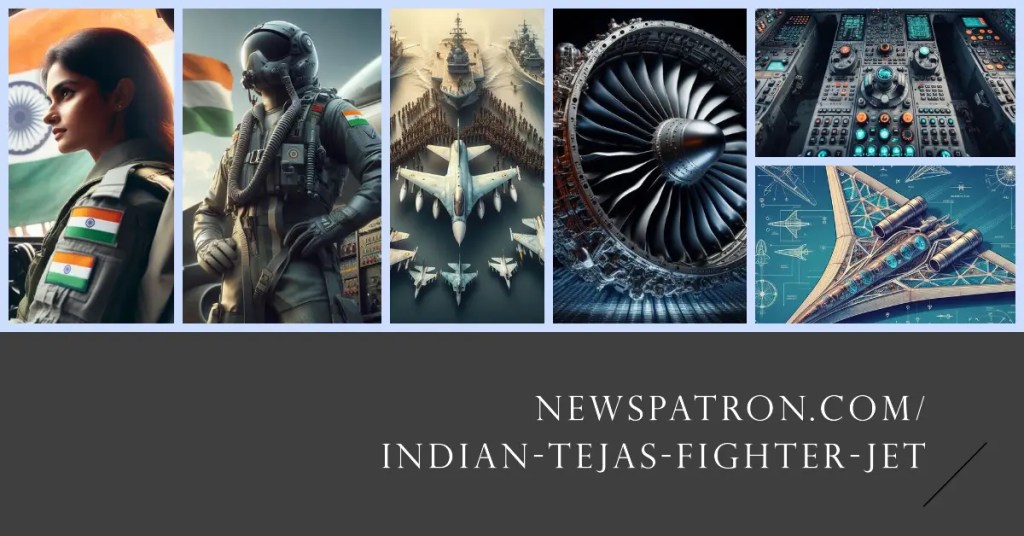

The HAL Tejas is a symbol of India’s growing aerospace prowess. Learn about this advanced Indian Tejas fighter jet, its history, capabilities, and its crucial role in the Indian Air Force.
Kumar A | editor@newspatron.com
The Indian Air Force (IAF) plays a crucial role in safeguarding India’s vast airspace. In our previous discussion, we explored the challenges the IAF faces with aging aircraft, the complexities of modernization, and the importance of building a strong indigenous defence industry. The HAL Tejas light combat aircraft stands as a testament to India’s ambitions in this arena.
Designed and manufactured within India, the Tejas symbolizes the nation’s determination to boost its aerospace capabilities and reduce its reliance on foreign imports. The Tejas’s development journey, spanning decades, hasn’t been without its hurdles. But can this homegrown fighter jet live up to its promise and become a cornerstone of the Indian Air Force? Let’s take a closer look.
The Indian Air Force (IAF) and Its Indigenous Fighter Jet
Tejas Fighter Aircraft Development Timeline
1980s: The Foundation
- 1983: India’s Defense Research and Development Organization (DRDO) initiates the Light Combat Aircraft (LCA) program.
- 1984: The Aeronautical Development Agency (ADA) is established to manage the LCA program.
- 1985: The Indian Air Force finalizes its requirements for the LCA.
1990s: Design and Development
- 1990: The LCA’s design is finalized.
- 1993: Full-scale development work begins.
2000s: Flight and Further Development
- 2001: The LCA, now renamed “Tejas,” completes its maiden flight.
- 2006: The Indian government orders an initial batch of twenty Tejas fighters.
2010s: Operational History Begins
Recommended Product
Casio Vintage A168WA Digital Watch – Classic Retro Style
🛒 View on Amazon →As an Amazon Associate, we earn from qualifying purchases. Price and availability may vary.
- 2015: Tejas officially enters service with the IAF.
- 2016: The first IAF Tejas squadron becomes operational.
2020s: Advancements and Future Prospects
- 2023 (Projected): The upgraded Tejas Mark 1A is expected to enter production.
- 2027 (Projected): The Tejas Mark 2, featuring significant enhancements, is estimated to complete its development process.
Introduction to the HAL Tejas
The story of the HAL Tejas is a story of Indian ambition and persistence. Born in the 1980s from a desire to strengthen India’s aerospace industry, the Tejas faced a long and often challenging development path.
Yet, its evolution from a design concept to an operational fighter jet demonstrates India’s determination to achieve self-reliance in defence technology. In this section, we’ll explore the key features and specifications that define this homegrown fighter aircraft.
[Read our previous article about The Future of Indian Air Force Fighter Jets]

HAL Indian Tejas fighter jet: Key Features and Specifications
The HAL Tejas is a modern, lightweight fighter aircraft designed for a variety of roles within the Indian Air Force (IAF). Beyond its symbolic importance as an indigenously developed aircraft, the Tejas boasts a range of advanced features and capabilities that contribute to its performance and versatility.
While its development has faced challenges, the IAF is committed to integrating the Tejas and its future variants into its fleet. Let’s explore some of the critical specifications that define this aircraft, along with the planned evolution of the Tejas program.
Design and Construction
- Delta Wing: Agility in the Air: The Tejas features a tailless, compound delta-wing design. This configuration, also used in aircraft like the Dassault Mirage 2000 and the Eurofighter Typhoon, gives the Tejas excellent maneuverability, allowing for tight turns and rapid changes in direction during combat.
- Lightweight Construction: Built for Speed: Composite materials, stronger and lighter than traditional metals, are used extensively in the Tejas’s construction. This keeps its weight low, boosting its acceleration and overall agility.
- Unstable Design: Precision Control: The Tejas is intentionally designed with aerodynamic instability. This might seem counterintuitive, but it’s managed by a sophisticated fly-by-wire control system, which makes constant tiny adjustments to keep the aircraft stable. This instability makes the Tejas incredibly responsive to pilot input, enhancing its maneuverability in dogfights.
Cockpit and Avionics
- Glass Cockpit: Eyes on the Skies: The Tejas features a modern glass cockpit, replacing traditional gauges with multifunctional digital displays. These displays provide pilots with critical flight data, target information, and aircraft status in a clear and customizable format, reducing workload and improving situational awareness.
- Night Vision Compatibility: Adapting to Darkness: The cockpit is designed to work seamlessly with night-vision goggles (NVGs). This allows pilots to conduct missions in low-light conditions or complete darkness, enhancing the Tejas’s operational flexibility.
- Advanced Avionics: Seeing Beyond the Horizon: The Tejas’s avionics suite is its electronic “eyes and ears.” It includes a multi-mode radar for detecting and tracking targets, an electronic warfare system to jam enemy communications or radar, and other sensors for navigation and threat identification.

Engine and Performance
- Current Engine: Power with Limitations: The Tejas Mk1 and Mk1A are powered by the F404-GE-IN20 turbofan engine manufactured by General Electric. While reliable, this engine has been a point of criticism due to its limited thrust, especially when the Tejas is carrying a heavy fuel and weapons load.
- Performance Metrics: The Tejas has a top speed of approximately Mach 1.8 (2,225 km/h). Its combat radius, the distance it can fly to execute a mission and return, is over 500 km, but this can vary depending on factors like weapons carried and flight profile.
- Engine Concerns: The Quest for Self-Reliance: Plans are underway to integrate a more powerful, indigenously developed engine in the Tejas Mk2 and future variants. This would improve performance and reduce India’s reliance on foreign suppliers.
Armaments
- Air-to-Air: Engaging the Enemy: The Tejas can carry a variety of air-to-air missiles. This includes short-range, heat-seeking missiles for close-in dogfights and beyond-visual-range (BVR) missiles for engaging enemy aircraft from greater distances.
- Air-to-Surface: Supporting Ground Forces: The Tejas can be equipped with precision-guided bombs, unguided rockets, and other munitions for striking ground targets. This allows it to support troops, take out enemy air defences, or destroy infrastructure.
- Flexibility: Adapting to the Mission: The Tejas’s weapons load-out can be tailored for different missions, giving it the flexibility to perform air superiority, ground attack, and reconnaissance roles.
Variants and Future Roadmap
- Tejas Mk1: The Foundation: The initial production variant of the Tejas serves as the backbone of the current IAF Tejas fleet. It introduced the core technologies and capabilities of the aircraft, paving the way for further advancement.
- Tejas Mk1A: Bridging the Gap: The Tejas Mk1A represents a significant upgrade, incorporating an advanced Active Electronically Scanned Array (AESA) radar for enhanced target detection, improved electronic warfare systems for self-defence, and refinements to increase ease of maintenance. The IAF views the Mk1A as a critical stepping stone in replacing its retiring MiG-21 and Jaguar fleets, boosting its combat capabilities.
- Tejas Mk2: A Leap Forward: The Tejas Mk2, anticipated for rollout by 2026, promises a major evolution. It will feature a more powerful engine for improved performance, a larger airframe with greater internal fuel and weapons capacity, and design enhancements to reduce its radar signature. The Mk2 aims to place the Tejas on par with some of the most advanced 4.5 generation fighter jets in the world.
Addressing Concerns
Critics have raised concerns about the Tejas’s serviceability, limited range, and payload capacity compared to some larger foreign fighters. Here’s how the IAF and HAL are responding:
- Serviceability: Improving Reliability: HAL is working to streamline maintenance procedures, improve the supply chain for spare parts, and incorporate design changes in the Mk1A and future variants to reduce the time aircraft spend on the ground. The goal is to increase the Tejas’s availability for both training and operational missions.
- Range and Payload: Finding Solutions: The Tejas’s smaller size does inherently limit its range and payload compared to heavier fighters. However, the IAF is exploring solutions such as mid-air refuelling to extend its reach and ongoing upgrades to optimize weapons loadouts for maximum effectiveness. Additionally, the Tejas’s agility compensates for some of its limitations; it can manoeuvre quickly and out-turn some larger adversaries.
- Evolutionary Development: The Tejas program is a continuous work in progress. The Mk1A and the planned Mk2 are designed to address many of the current criticisms. The IAF sees the Tejas as a platform for long-term development, with further potential to incorporate new technologies and capabilities in the future.
Disclaimer: The information regarding the Tejas’s capabilities and potential limitations has been compiled from various online sources. As the Tejas program continues to evolve, some technical details and assessments are subject to change.
The Tejas in Combat: Missions and Capabilities
The HAL Tejas, India’s indigenous multirole light combat aircraft, is a significant step towards self-reliance in defense aviation. With its induction into the Indian Air Force (IAF), the Tejas has not only replaced aging fleets but also introduced modern combat capabilities. This section delves into the various combat roles the Tejas can undertake and assesses its potential on the battlefield, drawing insights from the proven effectiveness of lightweight fighters throughout history.
Air Superiority and Interception
The Tejas is designed to establish air superiority by engaging enemy fighters in dogfights and intercepting hostile aircraft before they pose a threat. Equipped with beyond-visual-range missiles like the Astra BVRAAM and close combat missiles such as the R-73, the Tejas can effectively neutralize aerial threats.
- Hypothetical Scenario: In a tense border situation, a squadron of Tejas fighters could be scrambled to intercept enemy aircraft intruding on Indian airspace. Utilizing its advanced avionics and radar, the Tejas could lock onto intruders from a distance and, if necessary, engage with air-to-air missiles to defend national sovereignty.
Ground Attack and Close Air Support (CAS)
The Tejas’s ground attack capabilities are bolstered by its ability to carry an array of air-to-surface missiles and precision-guided munitions. It can provide Close Air Support (CAS) to ground troops, disrupt enemy supply lines, and take out strategic targets.
- Hypothetical Scenario: During an offensive operation, Tejas aircraft could be deployed to support advancing ground forces. By delivering precision strikes on enemy fortifications, armor, and suppressing hostile counterattacks, the Tejas can significantly enhance the effectiveness of ground operations.
Reconnaissance
With the integration of advanced reconnaissance pods like the Rafael Litening pod, the Tejas can perform intelligence, surveillance, and reconnaissance (ISR) missions. This allows for real-time battlefield awareness and crucial data collection.
- Hypothetical Scenario: In preparation for a major operation, Tejas fighters equipped with ISR pods could fly pre-emptive surveillance missions along the border. They could gather intelligence on enemy troop movements, fortifications, and infrastructure, relaying critical information back to command centers.
Naval Variant
The development of a naval variant of the Tejas aims to extend its capabilities to carrier operations. This version includes modifications for deck landings and takeoffs, enabling it to serve aboard aircraft carriers like INS Vikramaditya and the indigenous INS Vikrant.
- Hypothetical Scenario: A fleet of naval Tejas fighters could be deployed from an aircraft carrier to maintain air dominance over a maritime region, intercepting hostile aircraft and providing air support for naval vessels or amphibious landing operations.
Integrating the Tejas into a Wider Force
The Tejas is designed to operate as part of a larger integrated force within the IAF. Let’s consider a hypothetical scenario where the Tejas works in tandem with other assets:
- Hypothetical Scenario: In a major conflict scenario, heavy fighters like the Su-30MKI could lead the charge, suppressing enemy air defences and clearing the airspace. Tejas squadrons could then follow, exploiting the advantage by striking ground targets or engaging remaining enemy fighters. Meanwhile, AWACS aircraft could provide an overarching picture of the battlefield, coordinating the fighters and maximizing their effectiveness.
Limitations and Advantages While the Tejas boasts several advantages such as agility, advanced avionics, and multirole capabilities, it also faces limitations. Serviceability issues and the need for further technical enhancements are areas that the IAF and HAL are addressing to fully realize its combat potential.
- Acknowledging Limitations: In high-altitude engagements, the Tejas’s performance could be affected by its current engine’s thrust-to-weight ratio, potentially limiting its manoeuvrability against more powerful adversaries. However, the Mk2 variant, with a more powerful engine, is designed to address this directly.
- Emphasizing Strengths: The Tejas’s small size, advanced electronic warfare systems, and agility give it advantages in specific combat scenarios.
Historical Precedents of Lightweight Fighters in Combat
History bears witness to the effectiveness of lightweight fighters, which often outperform expectations due to their agility, affordability, and the skill of their pilots. Here are a couple of illuminating examples:
- The Northrop F-5’s Global Impact: The Northrop F-5, known for its cost-effectiveness and high performance, has seen action in various regional conflicts since the 1960s. It was designed with ease of maintenance and operation in mind. The F-5 proved its worth in the Vietnam War and continued to be deployed in later conflicts. Its agility and lower radar signature often allowed it to surprise and outmaneuver larger, more heavily armed opponents.
- The MiG-21’s Role in Indo-Pakistani Conflicts: The MiG-21, operated by the Indian Air Force, has been a crucial player in the Indo-Pakistani conflicts. Despite being an older design, the MiG-21 showcased its capabilities in the 1971 war, achieving a remarkable success ratio against Pakistani Air Force aircraft. Its speed, agility, and the prowess of Indian pilots allowed it to effectively counter more modern aircraft and contribute significantly to air superiority during the conflict.
[Explore other Fighter Jet options]
The Tejas Advantage
These historical examples highlight the potential of the Tejas in modern combat. Like its predecessors, the Tejas leverages agility and advanced technology to achieve greater effectiveness. Its continued development, the planned Mk2 variant, and its integration into a wider network of IAF assets ensure it will remain a vital component in securing India’s airspace and supporting ground operations.
The Tejas vs. Global Competitors: A Comparative Analysis
The HAL Tejas, India’s indigenously developed light combat aircraft, stands as a symbol of the country’s ambition in defence technology. As it takes its place within the Indian Air Force (IAF), it’s insightful to compare the Tejas with other prominent fighters worldwide. It’s important to remember, however, that warfare is a complex arena, where technical specifications are only one part of the picture. Geopolitical factors, a nation’s unique defence needs, and the evolving nature of aerial combat all influence fighter aircraft selection. Let’s explore some key comparisons:
The Tejas vs. F-16 Fighting Falcon: A Comprehensive Comparison
The Tejas and the F-16 Fighting Falcon represent two generations of fighter aircraft design. The Tejas is a single-engine, delta wing, multirole light fighter designed for versatility and agility. It is the smallest and lightest in its class of supersonic combat aircraft. The F-16, developed by General Dynamics (now Lockheed Martin), is a single-engine, multirole fighter known for its manoeuvrability. It has been in service with numerous countries for decades and remains a formidable aircraft.
- Performance: The Tejas has a top speed of Mach 1.8 (2,225 km/h) and a service ceiling of 16,500 meters. The F-16 boasts a top speed of 1,333 mph (2134 km/h) and a service ceiling of over 50,000 feet (15,240 meters). The F-16’s higher speed and ability to operate at greater altitudes give it an edge in some combat scenarios.
- Armament: The Tejas is equipped with a variety of air-to-air and air-to-surface missiles, bombs, and an internal cannon. The F-16 also has an internal cannon and a wide selection of weapons, owing to its larger size and 11 hardpoints. This allows it to carry a heavier and more diverse payload.
- Strategic Considerations: The Tejas offers India the significant advantage of domestic production, reducing reliance on foreign suppliers and allowing for customization to the IAF’s specific needs. The F-16, with its decades of service and upgrades, represents a proven and reliable system adopted by numerous air forces worldwide.
Conclusion: Both the Tejas and the F-16 Fighting Falcon are capable aircraft. The Tejas marks India’s impressive entry into indigenous fighter production, while the F-16 continues to be a testament to American aerospace excellence. The Tejas’s continued development and its potential on the export market will influence its future position against competitors like the F-16.
The Tejas vs. Chengdu J-10: A Comparative Analysis
The Tejas and the Chengdu J-10, also known as the Vigorous Dragon, are both important players in the Asian fighter aircraft market. The Tejas is designed for versatility and agility, while the Chinese J-10 adopts a delta wing and canard design, providing aerodynamic performance in various conditions.
- Performance: The Tejas has a top speed of Mach 1.8 and a service ceiling of 16,500 meters. The J-10 enjoys a slight advantage, with a top speed of Mach 2.1 and a service ceiling of 20,000 meters.
- Armament: Both aircraft are equipped for air-to-air and air-to-surface missions. The Tejas carries a maximum payload of 4,000 kg, while the J-10 boasts a significantly higher payload capacity of approximately 8,400 kg, allowing it to carry a heavier mix of weapons.
- Engine: The Tejas is powered by a General Electric F404 engine, while the J-10 utilizes the indigenous WS-10 engine. The WS-10 offers greater thrust, contributing to the J-10’s superior speed and payload capacity.
- Strategic Implications: The Tejas symbolizes India’s self-reliance in defense, while the J-10 is a cornerstone of China’s efforts to modernize its air force.
Conclusion: The Tejas and the J-10 each have their strengths. The J-10’s larger size, more powerful engine, and greater payload capacity give it advantages in certain combat situations. However, the Tejas is highly manoeuvrable and is a major step forward for Indian defence capabilities.
The Tejas vs. Saab Gripen: A Comparative Analysis
The Tejas and the Saab Gripen are both modern, lightweight, multirole fighters designed with specific national needs in mind. The Tejas emphasizes agility, while the Gripen, particularly its newer E-series, boasts a powerful engine and advanced avionics, including an AESA radar.
- Performance: The Tejas has a top speed of Mach 1.8 and a service ceiling of 16,500 meters. The Gripen, with its more powerful engine, has a higher top speed and carries a heavier payload. It also excels in survivability due to its sophisticated electronic warfare suite.
- Armament: Both aircraft carry a mix of air-to-air and air-to-surface weapons. The Gripen is also noted for its rapid combat turnaround time, allowing for fast re-arming and redeployment.
- Strategic Value: The Tejas represents India’s self-reliance, while the Gripen embodies Sweden’s focus on defence exports, offering flexibility, ease of maintenance, and ongoing upgrades.
Conclusion: The Tejas and the Saab Gripen are both capable fighters. The Tejas is a significant step for India, while the Gripen is a versatile and technologically advanced option for other air forces. Their continued development and potential success in the export market will further solidify their positions.
The Tejas and India’s Defense Strategy
The HAL Tejas is more than just an advanced fighter aircraft; it embodies a crucial element in realizing India’s broader strategic defence goals. Let’s explore how the Tejas is positioned to strengthen the Indian Air Force (IAF) and contribute to national security.
Filling the Gap
The Tejas program was born partly out of necessity. With the retirement of the aging MiG-21 fleet, a significant gap in the IAF’s capabilities needed to be filled. The Tejas, with its modern design and advanced features, is specifically designed to replace these older aircraft and bolster the IAF’s overall strength. The planned introduction of Tejas squadrons over the coming years will ensure a smooth transition, maintaining operational readiness even as older platforms are phased out.
Force Multiplier
The Tejas isn’t simply a one-for-one replacement. It introduces a new level of versatility to the IAF. Its advanced avionics, multi-role capabilities, and integration with other IAF assets make it a genuine force multiplier. While heavier fighters like the Su-30MKI excel in certain roles, the Tejas’s agility, ease of maintenance, and ability to perform air superiority, ground attack, and reconnaissance missions provide the IAF with greater operational flexibility.
Network-Centric Warfare
Modern warfare is increasingly defined by seamless communication and coordination between different branches of the military. The Tejas is designed with this reality in mind. Its ability to share and receive real-time battlefield information with AWACS aircraft, ground forces, and naval assets allows it to play a vital role in integrated operations. This ability to function as part of a larger network maximizes the effectiveness of the IAF as a whole.
Addressing Regional Challenges
India faces a complex geopolitical landscape with a range of potential security threats. The Tejas, with its ability to be deployed quickly and its advanced weapons systems, gives the IAF a greater capacity to respond to these challenges decisively. Whether it’s border tensions, counter-terrorism operations, or ensuring maritime security, the Tejas provides a robust and reliable option to protect India’s national interests.
The Future of the IAF
The Tejas isn’t a short-term solution. The planned upgrades, the more powerful Tejas Mk2, and the potential for ongoing development underscore India’s commitment to making the Tejas a cornerstone of its airpower for decades to come. The Tejas, and its future variants, are expected to be mainstays of the IAF, reflecting India’s focus on self-reliance, technological advancement, and the development of a world-class air force.
[Read more about the Indian Air Force Fighter jets The Fleet of Tommorrow]
UPGRADE ALERT: THE FUTURE OF INDIAN AIR FORCE FIGHTER JETS

[…] The HAL Tejas: India’s Amazing Homegrown Fighter Jet […]