




The ‘Second Chicken’s Neck’: Has India Found Bangladesh’s Weak Spot?
The Strategic Shift: For decades, Indian defense planners have lost sleep over the ‘Chicken’s Neck’ (Siliguri Corridor)—the narrow strip of land connecting the Northeast to the mainland. Vulnerable and narrow, it was our geography’s greatest weakness. But in late 2025, a silent but massive military buildup in Mizoram suggests the script is flipping.
1. The Silent Buildup (Late 2025)
While the world was focused on the political chaos in Dhaka, satellite intel and ground reports indicated a rapid deployment of Indian troops in Tripura and Mizoram. These units were positioned within striking distance (50–100 km) of the Chittagong Hill Tracts (CHT).
This movement wasn’t random. It followed intense clashes between Bangladeshi forces and the Kuki-Chin National Front (KNF), a rebel group operating in the Bandarban and Rangamati districts.
2. The ‘Second Chicken’s Neck’
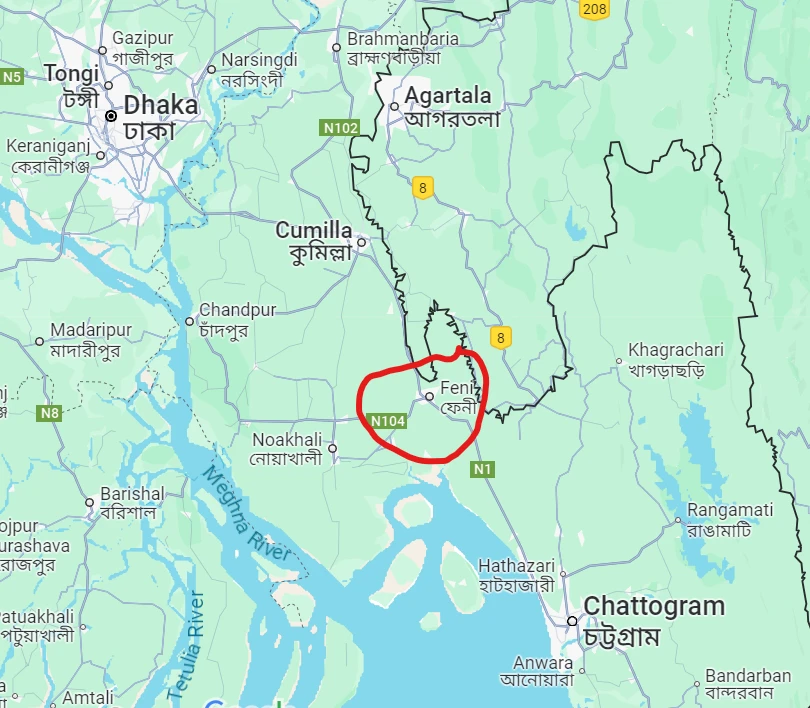
Why is the CHT so critical? Geographically, it is Bangladesh’s Achilles’ heel. It is the country’s only major hilly region, bordering India and Myanmar.
Analysts believe that by exerting influence here, India effectively creates a ‘Second Chicken’s Neck’ for Bangladesh. If the Siliguri Corridor is India’s choke point, the CHT is the high ground that overlooks Bangladesh’s critical port access. Control or leverage here reduces India’s dependence on Siliguri and opens a potential direct route to the Bay of Bengal.
3. The Covert Strategy & The KNF
Following the rise of anti-India sentiment under the interim government in Dhaka, and nearly 2,900 reported attacks on minorities, New Delhi’s stance hardened. Experts suspect that beyond humanitarian aid to refugees, India may be establishing a leverage point by quietly supporting local autonomy groups like the KNF.
This isn’t just about expansion; it’s about defensive offense. By supporting a buffer zone in the CHT, India counters Chinese influence in Myanmar and secures its own Northeast borders from insurgent spillover.
4. The 1947 Mistake
The irony is that the CHT was 97% non-Muslim in 1947. It was awarded to Pakistan by the Boundary Commission despite local leaders hoisting the Indian flag. Today’s strategy seems to be a correction of that historical oversight, utilizing the region’s unique tribal and religious demographics (Buddhist/Hindu) which differ significantly from the plains of Bangladesh.
Conclusion: A High-Stakes Game
Any overt move to annex or formally control the CHT would trigger massive international backlash and potential conflict. However, the influence game is already afoot.
Recommended Product
Casio Enticer Men's Analog Green Dial Watch MTP-VD01D
🛒 View on Amazon →As an Amazon Associate, we earn from qualifying purchases. Price and availability may vary.
India seems to have realized that waiting for goodwill from Dhaka is no longer a viable strategy. Instead, it is securing its own ‘Gateway to the East’—not through diplomacy alone, but through strategic positioning in the hills.
Connect with the Editor
Is the CHT the solution to India’s Siliguri dilemma? Share your thoughts. Connect with me, Kumar, Editor at Newspatron, on your favorite platform:
- For quick updates: Follow me on Instagram, Twitter, YouTube, or Reddit.
- For instant updates: Subscribe to my WhatsApp Channel.
