




Sources and references at the end of this post ?
A Constable On The Bonnet, A Car That Wouldn’t Stop
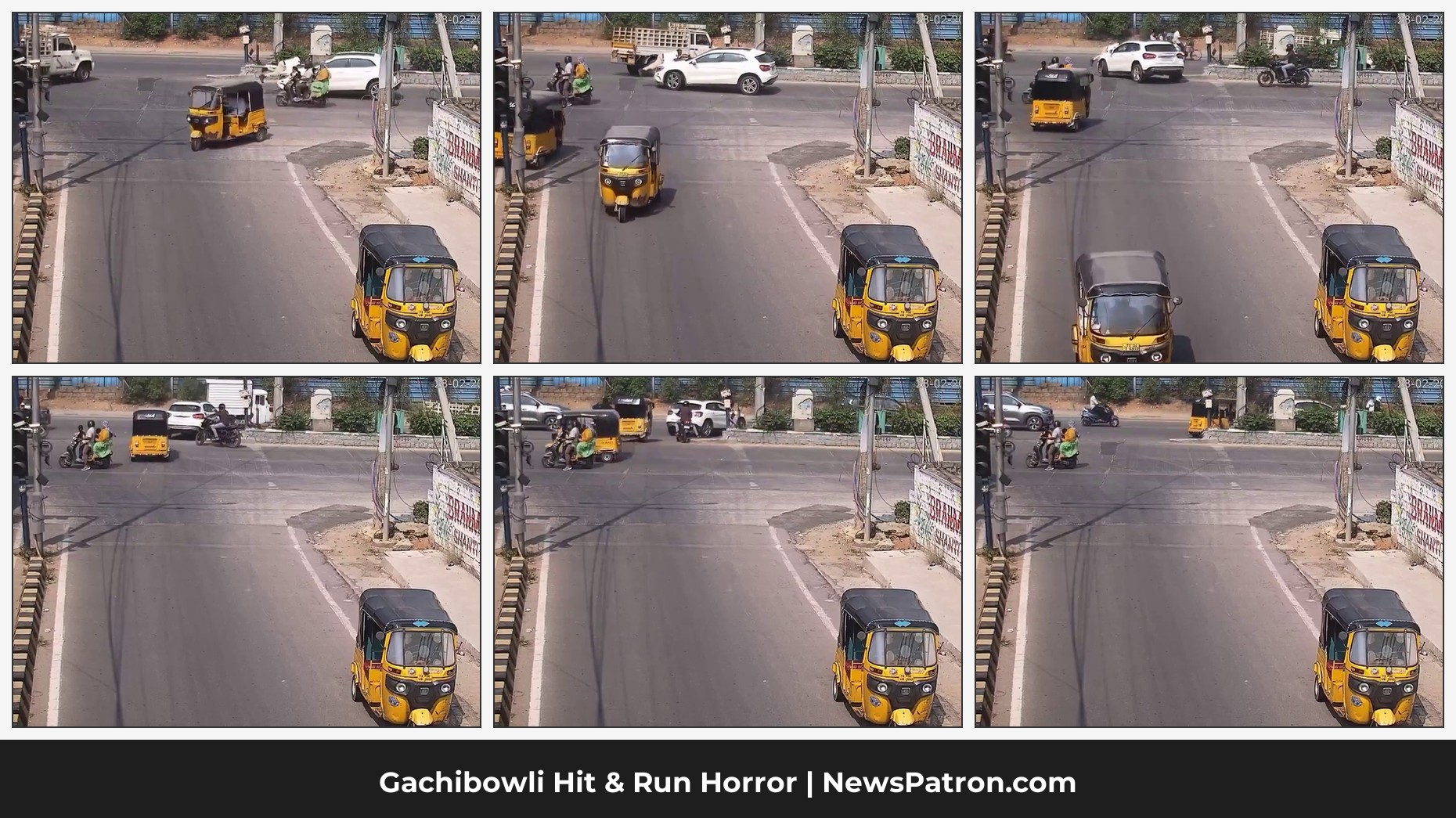
At Nanakramguda in Gachibowli, near Hyderabad’s IT corridor, a white Mercedes hits another car and then does what too many drivers try to do: it flees.
A traffic constable steps in front of the vehicle, signalling it to stop. Instead of braking, the driver accelerates with the constable still on the bonnet, dragging him for close to a kilometre through city traffic before other motorists force the car to finally halt.
The CCTV footage is the kind you watch with your breath held — a uniformed officer clinging on for dear life while a luxury car treats him like an obstacle to be shaken off.
The Case: Young Driver, Expensive Car, Familiar Pattern
Local reports identify the driver as a 24?year?old named Tarun, behind the wheel of a Mercedes?Benz bearing Telangana registration.
Key facts from police and media reports:
- The car allegedly rear?ended another vehicle near Nanakramguda and tried to escape.
- Traffic constable E. Narsimhulu / Narasimha Goud attempted to stop the car at a junction near the IT institutes.
- The driver did not stop, dragging the constable on the bonnet for roughly 800 metres to 1 km.
- Other motorists chased and boxed in the Mercedes, forcing it to stop.
- A breathalyser test reportedly showed alcohol levels above the legal limit.
- The driver was arrested, the car seized, and cases registered both for the initial crash and for endangering the officer.
Miraculously, the constable survived with comparatively minor injuries. The miracle is not the system; it is his grip and sheer luck.
“Drive On Indian Roads At Your Own Risk”
For many who watched the video, the takeaway was brutally simple: every trip on Indian roads is a gamble.
People reacting to the incident point out:
Recommended Product
Jockey Women's Hipster Brief – Comfort Fit, Assorted Colors
🛒 View on Amazon →As an Amazon Associate, we earn from qualifying purchases. Price and availability may vary.
- This is not a rare freak event but part of a long list of high?speed, high?ego crashes involving expensive cars and young drivers.
- The equation feels disturbingly familiar: wealth + impunity + weak enforcement = danger for everyone else, including the very officers tasked with keeping order.
- There is a grim expectation that, after a few days of outrage, the driver will post bail, hire a lawyer, and treat this as an inconvenience, while the constable goes back to standing in the sun at the next junction.
Behind the anger sits a question that refuses to go away:
On paper, a traffic cop is a public servant. In practice, what is his life really worth when it is up against a speeding luxury car?
The Value Of A Uniform — And Of Those Without One
This incident forces us to think about two kinds of people who stand in the middle of India’s chaotic roads:
- Official traffic police
- They have a uniform, a badge, and nominal legal backing.
- Yet, as this case shows, they are often physically unprotected — no crash barriers, no protective gear, no specialised vehicles to shield them.
- When something goes wrong, they become soft targets: easy to run down, easy to blame, easy to forget once the clip stops trending.
- Unofficial traffic attendants and volunteers
- The people who stand at busy intersections or outside schools, trying to untangle jams or help pedestrians cross, without being on any official payroll.
- They wave, whistle, signal and guide with almost no recognition, no insurance, and often no legal protection if a driver hits them or abuses them.
- Many are there because no one else is — filling in gaps where the state has failed to staff properly.
If a man in full uniform can be dragged on a bonnet for a kilometre, what chance does a volunteer or unofficial attendant have when they step out to stop a reckless driver?
“Rich Car, Poor Constable” — The Anger Under The Video
The conversation after the incident is not just about drunk driving. It is also about class, power and credibility.
Viewers are saying, in different ways:
- A public servant earning a modest salary is expected to risk his body to stop a dangerous driver.
- The driver, by contrast, sits in a multi?lakh imported car, confident enough to accelerate with a human being clinging to the hood.
- There is a widespread belief that money and connections will cushion the consequences — that the worst outcome will be a brief spell in custody, a fine, and a return to life as usual.
That perceived imbalance eats away at trust. If the people enforcing rules are not safe, and the people breaking them feel untouchable, the social contract at the heart of traffic laws collapses.
Beyond Outrage: What Would Real Respect Look Like?
If we are serious about answering the question “what is the value of a traffic police officer in India?”, the answer cannot come from statements alone. It has to show up on the road:
- Physical protection: Better designed junctions with islands and barriers that put concrete, not just courage, between officers and speeding vehicles.
- Equipment and backup: Body?worn cameras, quick?response teams, and technology (including drones and automated cameras) that reduce the need for officers to physically step into harm’s way every time a car misbehaves.
- Legal certainty, not lottery: Fast?track mechanisms where attacks on traffic staff (official or authorised attendants) carry clear, non?negotiable consequences — and where those consequences are actually enforced, regardless of the badge on the car’s grille.
- Respect for the invisible helpers: Recognition, training and some form of protective cover for the unofficial attendants and volunteers who risk themselves daily without even the shield of a uniform.
Until then, clips like the Gachibowli Mercedes case will keep reminding us that, on too many Indian roads, the real speed limit is not set by the signboard but by how much you think you can get away with — and how little you think someone else’s life is worth.
Sources
Reports on the Gachibowli incident involving a Mercedes-Benz hitting another car, attempting to flee, and dragging a traffic constable on its bonnet before being stopped by other motorists, including details on the driver’s arrest and alleged drunk driving. Background coverage on Hyderabad’s drunk-driving enforcement and broader Indian road safety concerns, highlighting the risks faced daily by traffic police and informal traffic attendants.
