




Sources and references at the end of this post ?
Beams In The Air, Traffic Underneath
From above, the scene looks almost normal at first: a busy road in Hyderabad, vehicles flowing in both directions, people on their way to work or home.
Then you notice what is happening right above them.
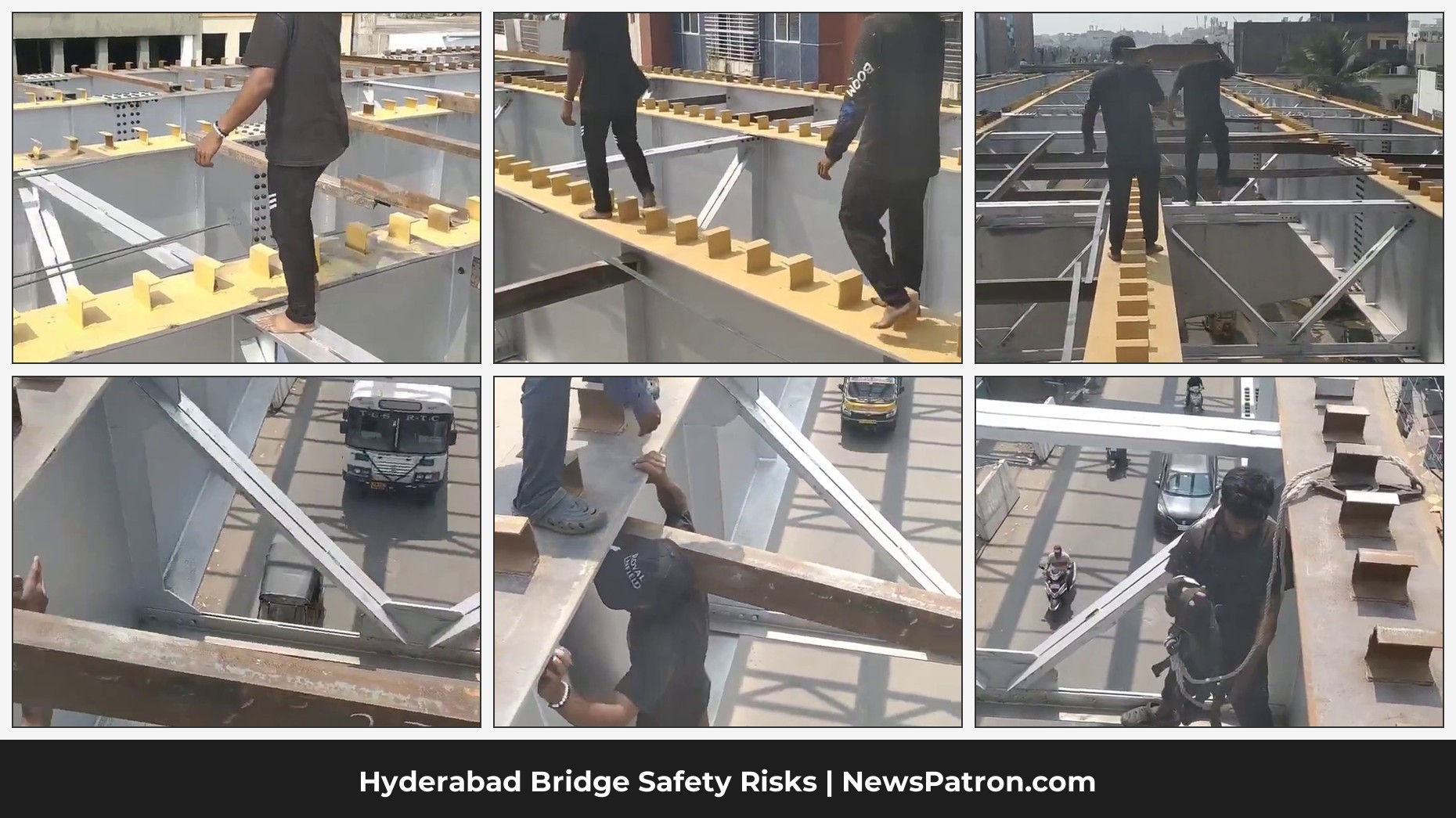
On an under?construction bridge, workers are lifting and manoeuvring heavy iron beams directly over live traffic, with no visible safety nets, no full barricading below, and no sign that vehicles have been stopped or diverted. One mistake, and a girder does not just fall on concrete — it falls on families.
“Your Life Is Worth A Compensation Cheque”
What makes these videos so unsettling is not only the engineering risk, but the attitude they reveal.
People watching them have described the situation as a kind of grim “infrastructure lottery”. The steel above is not just part of a future bridge; it is a loaded dice rolling over the heads of fathers, mothers and children driving below. One loose bolt, one sleepy operator, one misjudged balance — and a “smart city” project becomes the site of the next viral tragedy.
Behind the sarcasm lies a hard truth: many citizens feel that their lives are effectively priced at a few lakh rupees in ex?gratia compensation and a brief burst of online outrage, after which the system moves on.
What Safe Work Is Supposed To Look Like
If you open any modern construction safety manual, especially for urban bridges, the basic expectations are clear:
- Full barricading and diversions so that traffic does not move directly under active heavy lifts.
- Safety nets or protective decks below work zones to catch falling tools, debris or components.
- Protective shields or gantries over any unavoidable live lanes.
- Personal protective equipment for workers: helmets, harnesses, high?visibility clothing.
- Clear warning signage, flagmen and, where needed, temporary closures coordinated with traffic police.
- Constant supervision by competent engineers, with method statements and risk assessments signed off before work begins.
These are not optional “nice to haves.” They are the minimum conditions for balancing development with dignity and safety — for workers and for the public paying for the project.
Recommended Product
Magnesium Body Spray – Muscle Recovery & Lavender Scent
🛒 View on Amazon →As an Amazon Associate, we earn from qualifying purchases. Price and availability may vary.
In the Hyderabad clips, viewers point out the opposite:
- Workers balancing on narrow edges without visible harnesses.
- No safety nets below the beams.
- No clear channel separating active work from the vehicles passing under it.
It is not just technically unsafe; it reads as a total absence of empathy for the humans who happen to be in the wrong place at the wrong time.
“Safety For Factories, Blind Eye For Government Works”
Several people reacting to the footage have noted a double standard.
On one side, private industry is regularly audited and fined for safety lapses. State authorities proudly announce crackdowns on factories that do not follow norms, and there are teams whose full?time job is to penalise non?compliance.
On the other side, when similar or worse risks appear in public works, the response feels far more relaxed. A sarcastic description making the rounds goes something like this: safety is strictly enforced where licences and tax revenues are at stake, but “government work” is allowed to run in a completely unsafe manner — with workers and commuters both treated as expendable.
That anger then spills into broader complaints:
- That far too many important posts in municipal bodies and engineering departments are held by people who neither have the competence nor the curiosity to keep up with modern safety practices.
- That merit and continuous learning seem less important than ticking boxes — whether those boxes are political loyalty, patronage networks or paper qualifications.
- That corruption eats away at whatever standards exist: officials who should be monitoring sites look the other way for a fee, and contractors who should invest in safety simply see it as a cost to be shaved.
The result, in this view, is a lethal cocktail: no real worker protection, no real public protection, and no real accountability.
“No Belts, No Nets — Just Luck”
The Hyderabad videos have become a kind of case study for everything that can go wrong in mindset before anything actually collapses.
Common reactions highlight the same pattern:
- No safety belts, no proper protective gear, no net below — a level of recklessness that people describe as nothing less than stupidity.
- A belief that this is possible only because corruption has become normal, and because the lives of ordinary commuters are not truly valued.
- A sense that until someone dies and a clip goes viral from inside an ambulance, there will be no serious consequences for those who signed off on the method of work.
At the same time, some voices are careful to point out that the problem is systemic, not confined to one hiring category or one department. Blaming any single group of employees is emotionally satisfying, but it does not replace the hard work of building a culture where:
- Unsafe work simply does not start.
- Site engineers have the authority to stop operations when conditions are not right.
- Political leaders understand that a slightly delayed inauguration is better than a front?page photo of mangled cars under a fallen beam.
Hyderabad Today, Your City Tomorrow
Hyderabad has been held up in recent years as a model of quick steel bridge construction, smart traffic fixes and ambitious urban infrastructure. There are glossy explainer videos on how steel girders have reshaped the city’s mobility.
But the same city has also seen major safety scares and collapses when corners were cut or old structures were ignored.
The footage of workers carrying and placing heavy beams over open traffic sits right at that crossroads between pride and warning. It forces a simple question:
Are we building faster than we are learning?
Until the answer changes, every person driving under an under?construction bridge is part of an unwanted experiment: how many near?misses will we tolerate before we insist that safety is not just preached, but practiced — especially by the state itself?
Sources
Reports and explainers on Hyderabad’s recent bridge and foot-over-bridge construction drive, including the shift towards steel structures and their safety implications. Coverage of past incidents in Hyderabad involving under-construction bridges and structural failures, highlighting what happens when safety is ignored. Recent write-up flagging viral videos of bridge work being carried out above live traffic without visible protective gear or barriers, and the public safety concerns it has raised.
