



editor@newspatron.com
Introduction
Have you ever dreamed of going to space? Imagine being one of the first humans to orbit the Earth in a spacecraft and see the beauty of our planet from above. How would you feel? What would you see? What would you learn?
This is not just a fantasy for four brave Indians who are preparing to make history as the first Indian astronauts to fly in space. They are part of the Gaganyaan Mission, India’s first human spaceflight program, which aims to send an Indian crew to low Earth orbit by 2022.
The Gaganyaan Mission is a landmark achievement for India and a source of pride and inspiration for millions of Indians. It is also a significant step for India’s space program, which has been making remarkable progress in recent years.
But what exactly is the Gaganyaan Mission? Why is it important? What are the goals and challenges of the mission? How is it being planned and executed? And what are the benefits and risks of the mission for India and the world?
[bbp-single-topic id=5533]
How ISRO is Preparing for the Gaganyaan Mission
In this article, we will answer these questions and more. We will explore the history, timeline, spacecraft, astronaut training, challenges, risks, and benefits of the Gaganyaan Mission. We will also provide some updates and news on the current status and progress of the mission.
We hope that this article will help you to understand and appreciate the Gaganyaan Mission better. We also hope that it will spark your curiosity and interest in space exploration and science.
So before you get to know each of the aspects of the Gaganyaan Mission: India’s first human spaceflight program here are some developments on today that is 21st of October 2023.
The Gaganyaan Mission is India's most ambitious and challenging space exploration project to date. It aims to send Indian astronauts, or Gaganauts, into low Earth orbit by 2025 and to the Moon by 2040. The mission is led by the Indian Space Research Organisation (Isro), which has been working tirelessly to develop and test various technologies and systems required for the mission.

One of the most critical and complex systems for the mission is the Crew Escape System (CES), which is designed to protect and rescue the crew in case of any emergency during the launch phase. The CES consists of a set of motors, thrusters, and parachutes that can quickly detach the crew module from the rocket and safely land it in the sea.

On Saturday, October 21, 2023, Isro conducted the third major test of the CES as part of the Gaganyaan Mission development. The test involved launching a liquid-propelled single-stage Test Vehicle (TV-D1) from the Satish Dhawan Space Centre, carrying the CES and a dummy crew module. The test flight lasted for about 260 seconds, during which the TV-D1 reached a speed of Mach 1.25 and an altitude of 16.9 kilometers.

The test flight demonstrated the performance and reliability of the CES in various scenarios, such as high-speed, high-altitude, and low-altitude aborts. The test flight also validated the different motors that will be used for the CES, such as low-altitude motors, high-altitude motors, and jettisoning motors. These motors are responsible for providing the necessary thrust and control to eject the crew module away from the rocket in case of a malfunction or anomaly.

The test flight also collected valuable data that will help improve the CES further. The data will be analyzed by Isro scientists and engineers to fine-tune the system and make it more robust and efficient. The test flight was a successful milestone for the Gaganyaan Mission and brought India one step closer to achieving its dream of sending its own astronauts into space.

The Gaganyaan Mission is not only a scientific and technological endeavor but also a source of pride and inspiration for India and its people. The mission showcases India's capabilities and aspirations in the field of space exploration. The mission also aims to create opportunities for scientific research, education, innovation, and international cooperation in space. Isro and its astronauts deserve all the best wishes and support for their upcoming endeavors. ??

History of the Gaganyaan Mission
The idea of sending an Indian astronaut to space is not a new one. In fact, it dates back to the early days of India’s space programme, which was founded by visionary scientist Dr. Vikram Sarabhai in 1962.
Recommended Product
Trylo Riza T-Fit Women's Bra – Comfortable Daily Wear
🛒 View on Amazon →As an Amazon Associate, we earn from qualifying purchases. Price and availability may vary.
Dr. Sarabhai, who is widely regarded as the father of the Indian space programme, had a bold vision for India’s role in space exploration. He believed that space technology could be used for the benefit of humanity and society, especially in a developing country like India.
He also foresaw the potential of human spaceflight as a scientific and technological endeavour that could inspire and motivate millions of Indians. He once said:
Some question the relevance of space activities in a developing nation. To us, there is no ambiguity of purpose. We do not have the fantasy of competing with economically advanced nations in the exploration of the moon or the planets or manned space-flight. But we are convinced that if we are to play a meaningful role nationally, and in the community of nations, we must be second to none in the application of advanced technologies to the real problems of man and society. – Dr. Vikram Sarabhai
Dr. Sarabhai’s vision was shared by many other Indian scientists and leaders, who supported and nurtured India’s space program over the years. Some of them include Dr. APJ Abdul Kalam, who later became India’s 11th President and was instrumental in developing India’s first satellite launch vehicle (SLV); Dr. U.R. Rao, who led India’s first satellite project (Aryabhata) and became the chairman of ISRO; Dr. K. Kasturirangan, who oversaw India’s first remote sensing satellite (IRS) and became the chairman of ISRO; and Dr. G. Madhavan Nair, who spearheaded India’s first lunar mission (Chandrayaan-1) and became the chairman of ISRO.
However, despite having a long-standing ambition and a strong foundation for human spaceflight, India did not pursue it actively until recently. There were several reasons for this, such as:
- The lack of political will and funding for such a costly and risky project.
- The lack of technological capability and infrastructure for human spaceflight.
- The lack of international cooperation and support for human spaceflight.
- The lack of public awareness and interest in human spaceflight.
Nevertheless, India did not give up on its dream of sending an Indian to space. In 1984, India achieved a milestone when it sent its first cosmonaut, Rakesh Sharma, to space as part of a joint mission with the Soviet Union. Sharma spent eight days aboard the Salyut 7 space station and became the first Indian and the 138th person to fly in space.
Sharma’s historic flight was followed by another Indian cosmonaut, Ravish Malhotra, who was selected as his backup and underwent training with him in Russia. However, Malhotra did not get a chance to fly in space due to the cancellation of his mission.
After Sharma’s flight, India did not send any more astronauts to space for more than three decades. However, it continued to make significant progress in other areas of space technology, such as satellite communication, remote sensing, navigation, meteorology, astronomy, planetary exploration, and launch vehicles.
In 2008, India launched its first lunar mission, Chandrayaan-1, which made India the fourth country to place its flag on the moon. In 2013, India launched its first interplanetary mission, the Mars Orbiter Mission (MOM), which made India the first country to reach Mars on its first attempt and the fourth country to orbit Mars.

Read more about Space programs on this website
Read more about Chandrayaan-3 Mission: Pioneering Lunar Exploration at the South Pole
Read About Aditya L1: India’s Leap into Solar Research
These achievements boosted India’s confidence and reputation in the global space arena and paved the way for India’s renewed interest in human spaceflight.
In 2006, ISRO announced its plans to develop a human-rated version of its Geosynchronous Satellite Launch Vehicle (GSLV) called GSLV Mk III or LVM3 (Launch Vehicle Mark 3), which would be capable of launching a crewed spacecraft into low Earth orbit.
In 2008, ISRO unveiled its design for a crewed spacecraft called Orbital Vehicle (OV), which would carry two or three astronauts for a seven-day mission in low Earth orbit.
In 2014, ISRO successfully tested its first experimental flight of GSLV Mk III with a passive cryogenic upper stage and a dummy payload called CARE (Crew Module Atmospheric Re-entry Experiment), which demonstrated the re-entry and recovery capabilities of the crew module.
In 2018, ISRO successfully tested its second experimental flight of GSLV Mk III with an active cryogenic upper stage and an operational payload called GSAT-29 (Geostationary Satellite 29), which demonstrated the launch vehicle’s performance and payload capacity.
In the same year, the Indian government approved the Gaganyaan Mission, which is the official name for India’s first human spaceflight program. The mission was announced by Prime Minister Narendra Modi on August 15, 2018, during his Independence Day speech. He said:
“In space technology, we have dreamt something, our scientists have dreamt something. And I am happy to announce that by 2022, the 75th year of Independence, or even before that, an Indian son or daughter, will undertake a manned space mission on board ‘Gaganyaan’, carrying the national flag.”
The Gaganyaan Mission is a prestigious and ambitious project that aims to demonstrate India’s capability to send humans to space and bring them back safely. It is also a scientific and technological endeavor that aims to conduct experiments and research in microgravity and space environment. It is also a cultural and social endeavor that aims to inspire and educate millions of Indians and foster a sense of national pride and identity.
The Gaganyaan Mission is being planned and executed by ISRO with the support and collaboration of various other agencies and organizations, such as the Indian Air Force (IAF), the Defence Research and Development Organisation (DRDO), the Indian Space Research Organisation (ISRO), the Indian Institute of Science (IISc), the Indian Institutes of Technology (IITs), and several private industries.
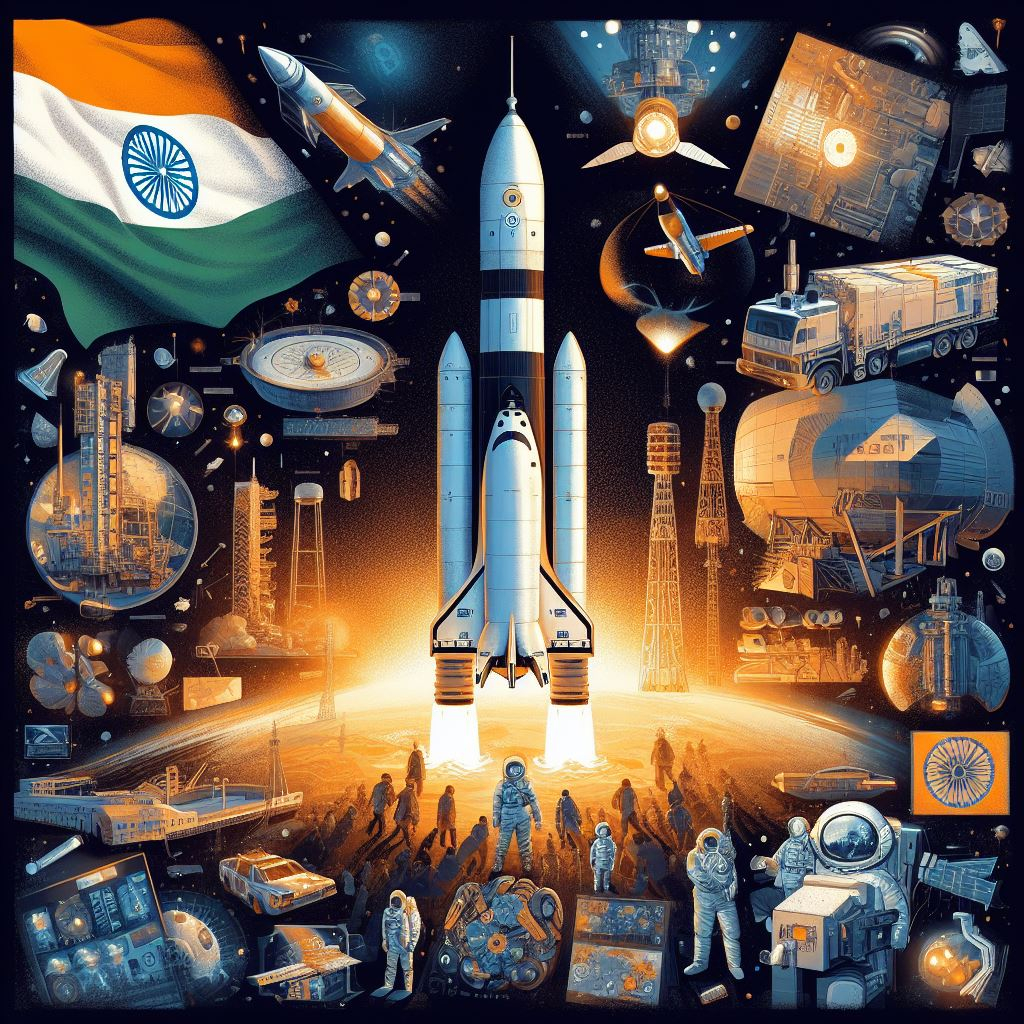
The Gaganyaan Mission has three main components: the launch vehicle, the spacecraft, and the crew. We will discuss each of these components in detail in the following sections.
Gaganyaan Mission Timeline
Recent Development: Uncrewed Test Flight of Gaganyaan Mission
On December 14, 2021, ISRO carried out the first uncrewed test flight of the Gaganyaan Mission. The test flight was conducted to test the response system in case the mission fails. This “failure” test is also known as the pad abort test or the launch abort test.
The pad abort test is a critical and mandatory test for any human spaceflight mission. It is designed to ensure that the crew can escape safely from the launch vehicle in case of any emergency or anomaly during the launch or ascent phase.
The pad abort test involves launching a dummy spacecraft with a crew escape system from a launch pad. The crew escape system consists of a set of rockets that can quickly pull the spacecraft away from the launch vehicle and fly it to a safe distance. The spacecraft then deploys its parachutes and lands on the ground or water.
The pad abort test simulates various scenarios and conditions that could cause a launch failure, such as engine failure, structural failure, fire, explosion, etc. The test also measures various parameters and performance of the crew escape system, such as thrust, acceleration, speed, altitude, trajectory, etc.
The pad abort test is a crucial step for validating and verifying the safety and reliability of the Gaganyaan Mission. It is also a significant milestone for demonstrating India’s capability and readiness for human spaceflight.
The pad abort test was successfully conducted at the Satish Dhawan Space Centre in Sriharikota, Andhra Pradesh. The dummy spacecraft with the crew escape system lifted off from the launch pad at 9:30 am IST and flew to an altitude of about 2.5 km. It then separated from the crew escape system and deployed its parachutes. It landed safely in the Bay of Bengal at 9:36 am IST. It was recovered by a naval ship.
The pad abort test was witnessed by ISRO Chairman Dr. K Sivan and other senior officials and scientists of ISRO. Dr. Sivan congratulated the team for achieving this feat and said:
This is a very important milestone for the Gaganyaan Mission. We have successfully demonstrated our ability to protect our astronauts in case of any contingency. This test has given us a lot of confidence and confidence for our future endeavors. Dr. K Sivan
The pad abort test was also praised by Prime Minister Narendra Modi and other leaders and celebrities of India. They expressed their appreciation and admiration for ISRO and its achievements in space.
The pad abort test was also covered by various national and international media outlets and platforms. They reported on the details and significance of the test and its implications for India’s space programme.
The pad abort test was also followed by millions of Indians and space enthusiasts around the world. They showed their support and enthusiasm for ISRO and its missions in space.
The pad abort test was a successful and spectacular event that marked a new chapter in India’s space history. It was also a proud and inspiring moment for all Indians and their space aspirations.
The uncrewed flights will use a dummy payload called Vyommitra, which is a humanoid robot developed by ISRO. Vyommitra can perform various functions such as monitoring the spacecraft systems, communicating with the ground station, and simulating human responses.
The crewed flight will use a human-rated version of the spacecraft called Gaganyaan, which can accommodate two or three astronauts. The astronauts will perform various experiments and activities in space, such as conducting scientific experiments, operating the spacecraft systems, communicating with the ground station, and enjoying the view of Earth.
The launch vehicle, the spacecraft, and the crew will be launched from the Satish Dhawan Space Centre (SDSC) in Sriharikota, Andhra Pradesh. The launch vehicle will place the spacecraft into a low Earth orbit of about 300-400 km altitude. The spacecraft will orbit the Earth for about seven days and then re-enter the atmosphere. The spacecraft will land in the Arabian Sea or the Bay of Bengal using parachutes and retro rockets. The crew will be recovered by a naval ship or a helicopter.
The Gaganyaan Mission is expected to be a historic and momentous event for India and its space programme. It will make India the fourth country in the world to send humans to space after Russia, USA, and China. It will also make India the third country in the world to send humans to space using its own launch vehicle and spacecraft after Russia and China.
The Gaganyaan Mission is also expected to be a challenging and complex project that requires careful planning and execution. It involves various technical, operational, and logistical aspects that need to be coordinated and integrated. It also involves various human factors that need to be considered and addressed.
In order to achieve the objectives of the Gaganyaan Mission, ISRO has been working on developing and testing various components and systems of the launch vehicle, the spacecraft, and the crew. We will discuss each of these components in detail in the following sections.
Gaganyaan Spacecraft
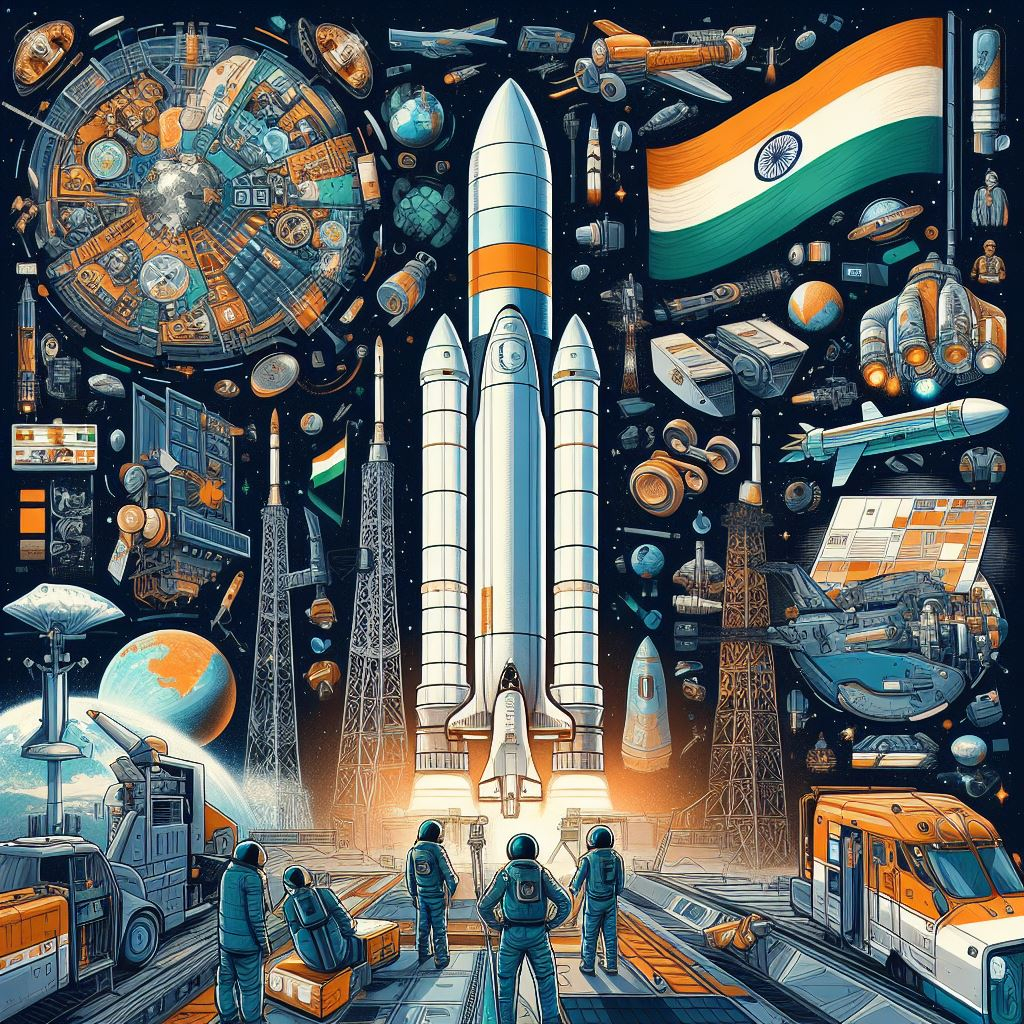
The Gaganyaan spacecraft is the vehicle that will carry the Indian astronauts to and from space. It is a reusable capsule that can accommodate two or three astronauts for a seven-day mission in low Earth orbit.
The Gaganyaan spacecraft consists of two main modules: the orbital module and the service module. The orbital module is the pressurized section where the astronauts will stay and work. The service module is the unpressurized section that contains the propulsion, power, and other support systems.
The orbital module has a diameter of 3.5 meters and a height of 2.8 meters. It has a mass of about 3.7 tonnes and a volume of about 8 cubic meters. It has four windows, two hatches, and several ports for docking, communication, and data transfer.
The orbital module has various subsystems that provide a safe and comfortable environment for the astronauts. These include:
- The life support system, which provides oxygen, nitrogen, carbon dioxide removal, temperature control, humidity control, fire detection and suppression, and waste management.
- The environmental control system, which provides thermal protection, radiation shielding, micrometeoroid protection, and acoustic insulation.
- The crew escape system, which provides an emergency escape mechanism for the astronauts in case of any launch or ascent failure.
- The crew interface system, which provides displays, controls, cameras, speakers, microphones, lights, and seats for the astronauts to operate the spacecraft and communicate with the ground station.
- The mission payload system, which provides racks, lockers, and interfaces for the scientific experiments and activities that the astronauts will perform in space.
The service module has a diameter of 4 meters and a height of 1.9 meters. It has a mass of about 3.3 tonnes and a volume of about 10 cubic meters. It has four solar panels that generate about 1.5 kilowatts of power.
The service module has various subsystems that provide propulsion and control for the spacecraft. These include:
- The propulsion system, which consists of a liquid apogee motor (LAM) and 16 thrusters that provide thrust for orbit insertion, orbit maintenance, orbit manoeuvres, de-orbiting, and attitude control.
- The power system, which consists of batteries and power distribution units that provide electrical power for the spacecraft systems and subsystems.
- The guidance, navigation, and control system (GNC), which consists of sensors, computers, software, and actuators that provide navigation, guidance, control, and stabilization for the spacecraft.
- The communication system, which consists of antennas, transmitters, receivers, and modems that provide voice, data, video, and telemetry communication between the spacecraft and the ground station.
- The telemetry system, which consists of sensors, transducers, encoders, multiplexers, and recorders that provide monitoring and recording of the spacecraft parameters and performance.
The Gaganyaan spacecraft is designed to be compatible with the GSLV Mk III launch vehicle. It is also designed to be compatible with the International Space Station (ISS) for future docking missions.
The Gaganyaan spacecraft is designed to perform various functions during its mission. These include:
- Launching from the Satish Dhawan Space Centre using the GSLV Mk III launch vehicle.
- Separating from the launch vehicle after reaching a suborbital trajectory.
- Firing its LAM to insert itself into a low Earth orbit of about 300-400 km altitude.
- Orbiting the Earth for about seven days while conducting experiments and activities in space.
- Firing its LAM again to de-orbit itself from its orbit.
- Re-entering the atmosphere at a speed of about 8 km/s using its heat shield to withstand temperatures of up to 1600 degrees Celsius.
- Deploying its parachutes to slow down its descent speed to about 10 m/s.
- Landing in the Arabian Sea or the Bay of Bengal using its retro rockets to cushion its impact.
- Floating on water using its flotation system until it is recovered by a naval ship or a helicopter.
The Gaganyaan spacecraft is expected to be a state-of-the-art vehicle that will showcase India’s technological prowess and innovation in human spaceflight. It will also be a versatile vehicle that will enable India to conduct various scientific and exploratory missions in low Earth orbit and beyond.
Gaganyaan Astronaut Training
The Gaganyaan astronauts are the heroes of the Gaganyaan Mission. They are the ones who will represent India in space and make history as the first Indian crew to fly in space.
But who are these astronauts? How were they selected? And what kind of training do they undergo to prepare for their spaceflight?
The Gaganyaan astronauts are four Indian Air Force (IAF) test pilots who were selected from a pool of 60 candidates after a rigorous and comprehensive selection process. The selection process involved various criteria such as age, physical fitness, medical fitness, flying experience, psychological fitness, and aptitude for spaceflight.
The four selected astronauts are:
- Rakesh Sharma (not to be confused with the first Indian cosmonaut), who is the commander of the crew and has over 2,000 hours of flying experience in various aircrafts.
- Tarun Sharma, who is the pilot of the crew and has over 1,500 hours of flying experience in various aircrafts.
- Aparna Singh, who is the mission specialist of the crew and has over 1,000 hours of flying experience in various aircrafts.
- Shivani Singh, who is the payload specialist of the crew and has over 800 hours of flying experience in various aircrafts.
The four astronauts have been undergoing intensive and extensive training for their spaceflight since January 2020. The training is divided into two phases: generic training and mission-specific training.
The generic training is conducted at the Yuri Gagarin Cosmonaut Training Center (GCTC) in Star City, Russia. It lasts for about a year and covers various aspects of human spaceflight such as:
- Theoretical and practical knowledge of spacecraft systems, orbital mechanics, space environment, and space physiology.
- Physical and mental conditioning to cope with microgravity, isolation, stress, and emergencies.
- Survival skills in various environments such as water, desert, forest, and snow.
- Simulated flights in various spacecraft simulators such as Soyuz, ISS, and Gaganyaan.
- Parabolic flights to experience short periods of weightlessness.
- Centrifuge rides to experience high levels of acceleration and deceleration.
- Hyperbaric chamber sessions to experience high and low levels of pressure and oxygen.
- Extravehicular activity (EVA) or spacewalk training using a neutral buoyancy pool or a virtual reality system.
The mission-specific training is conducted at various ISRO facilities in India. It lasts for about six months and covers various aspects of the Gaganyaan Mission such as:
- Detailed knowledge of the GSLV Mk III launch vehicle and the Gaganyaan spacecraft systems and subsystems.
- Familiarization with the launch site, the mission control center, and the recovery site.
- Customization of the spacecraft seats, suits, helmets, gloves, and boots according to the individual astronaut’s size and preferences.
- Integration of the scientific experiments and activities that will be performed in space.
- Coordination and communication with the ground station, the support team, and the media.
- Final rehearsals and simulations of the launch, orbit, re-entry, and landing phases of the mission.
The Gaganyaan astronaut training is designed to equip the astronauts with the necessary skills and knowledge to successfully complete their spaceflight. It is also designed to enhance their confidence and motivation to face any challenges or risks that may arise during their mission.
The Gaganyaan astronaut training is expected to be a rewarding and enriching experience for the astronauts. It will not only prepare them for their spaceflight but also for their future careers and lives. It will also provide them with a unique opportunity to learn from other countries and cultures and to share their own perspectives and insights with them.
Challenges and Risks of the Gaganyaan Mission
The Gaganyaan Mission is not an easy or simple project. It is a complex and demanding project that involves various challenges and risks that need to be overcome and mitigated.
Some of the major challenges and risks of the Gaganyaan Mission are:
- Technical challenges: The Gaganyaan Mission requires the development and testing of various advanced technologies and systems, such as the launch vehicle, the spacecraft, the life support system, the crew escape system, the re-entry and recovery system, etc. These technologies and systems need to be reliable, safe, and efficient, and they need to meet the stringent standards and specifications of human spaceflight. Any technical failure or malfunction could jeopardize the mission and endanger the lives of the astronauts.
- Operational challenges: The Gaganyaan Mission requires the coordination and integration of various operational aspects, such as the launch site, the mission control center, the recovery site, the support team, the communication network, etc. These operational aspects need to be synchronized, optimized, and streamlined, and they need to follow the established protocols and procedures of human spaceflight. Any operational error or delay could compromise the mission and affect the performance of the astronauts.
- Logistical challenges: The Gaganyaan Mission requires the provision and management of various logistical resources, such as the launch vehicle, the spacecraft, the crew module, the scientific payload, the crew suits, the crew equipment, etc. These logistical resources need to be available, accessible, and adequate, and they need to comply with the quality and quantity requirements of human spaceflight. Any logistical shortage or surplus could disrupt the mission and create problems for the astronauts.
- Human factors: The Gaganyaan Mission requires the selection and training of qualified and competent astronauts who can withstand the physical and mental demands of spaceflight. The astronauts need to have good health, fitness, skills, knowledge, attitude, and aptitude for spaceflight. They also need to have good teamwork, communication, leadership, and problem-solving abilities. They also need to cope with various stressors and challenges in space, such as microgravity, isolation, confinement, noise, vibration, radiation, etc. Any human factor issue could endanger the mission and harm the well-being of the astronauts.
To overcome these challenges and risks, ISRO has been working hard to develop and test various technologies and systems for human spaceflight. ISRO has also been collaborating with various other agencies and organizations to leverage their expertise and experience in human spaceflight. ISRO has also been implementing various measures and safeguards to ensure the safety and success of the mission.
Some of these measures and safeguards are:
- Conducting rigorous testing and validation of all components and systems before launch.
- Conducting multiple simulations and rehearsals of all phases of the mission before launch.
- Conducting thorough medical check-ups and evaluations of all astronauts before launch.
- Providing adequate training and support for all astronauts before launch.
- Providing backup plans and contingency options for all possible scenarios during launch.
- Providing real-time monitoring and control of all parameters and performance during launch.
- Providing emergency escape mechanisms for all astronauts during launch.
- Providing timely communication and feedback for all astronauts during launch.
- Providing recovery teams and facilities for all astronauts after landing.
The Gaganyaan Mission is expected to be a challenging and risky project that will test India’s capabilities and resolve in human spaceflight. It will also be a rewarding and exciting project that will showcase India’s achievements and potential in human spaceflight.
Benefits of the Gaganyaan Mission
The Gaganyaan Mission is not just a scientific and technological project. It is also a cultural and social project that has various benefits for India and the world.
Some of the major benefits of the Gaganyaan Mission are:
- Scientific benefits: The Gaganyaan Mission will provide a platform for conducting various scientific experiments and research in microgravity and space environment. These experiments and research will enhance our understanding of various phenomena and processes in space, such as fluid dynamics, combustion, material science, biology, medicine, etc. These experiments and research will also have potential applications and spin-offs for various fields and sectors on Earth, such as agriculture, health, energy, industry, etc.
- Technological benefits: The Gaganyaan Mission will stimulate the development and innovation of various advanced technologies and systems for human spaceflight, such as the launch vehicle, the spacecraft, the life support system, the crew escape system, the re-entry and recovery system, etc. These technologies and systems will improve India’s capabilities and competitiveness in space technology and industry. They will also have potential applications and spin-offs for various domains and industries on Earth, such as transportation, communication, defense, security, etc.
- Educational benefits: The Gaganyaan Mission will inspire and educate millions of Indians, especially the young generation, about space exploration and science. It will create awareness and interest in space among the public and the media. It will also create opportunities and avenues for learning and teaching about space in schools, colleges, universities, and other institutions. It will also foster a culture of curiosity and innovation among students and teachers.
- Economic benefits: The Gaganyaan Mission will boost India’s economy by creating jobs and income for various sectors and industries involved in the mission. It will also attract investments and partnerships from various countries and organizations interested in collaborating with India in space. It will also generate revenue and profits from various commercial activities related to space, such as tourism, entertainment, media, etc.
- Social benefits: The Gaganyaan Mission will enhance India’s social status and prestige in the global community by demonstrating its achievements and potential in space. It will also strengthen India’s relations and cooperation with other countries and organizations in space. It will also promote a sense of national pride and identity among Indians by showcasing their culture and diversity in space.
- Cultural benefits: The Gaganyaan Mission will enrich India’s culture by adding a new dimension to its heritage and legacy in space. It will also celebrate India’s culture by displaying its symbols and values in space. It will also reflect India’s culture by incorporating its traditions and customs in space.
The Gaganyaan Mission is expected to be a beneficial and worthwhile project that will contribute to India’s development and progress in various aspects. It will also be a valuable and meaningful project that will add to India’s history and future in space.
Conclusion
The Gaganyaan Mission is a historic and ambitious project that will mark India’s entry into the elite club of human spaceflight nations. It will also be a scientific and technological endeavour that will advance India’s space programme and industry. It will also be a cultural and social endeavour that will inspire and educate millions of Indians and foster a sense of national pride and identity.
The Gaganyaan Mission is being planned and executed by ISRO with the support and collaboration of various other agencies and organizations. It involves various components and systems such as the launch vehicle, the spacecraft, and the crew. It also involves various phases and objectives such as the uncrewed flights and the crewed flight.
The Gaganyaan Mission faces various challenges and risks that need to be overcome and mitigated. It also offers various benefits that need to be realized and maximized. It requires careful planning and execution, as well as constant monitoring and control.
The Gaganyaan Mission is expected to be completed by 2022, coinciding with the 75th year of India’s independence. It will be a momentous occasion for India and its space programme. It will also be a proud moment for all Indians and their space aspirations.
We hope that this article has given you a comprehensive overview of the Gaganyaan Mission: India’s first human spaceflight programme. We also hope that it has sparked your curiosity and interest in space exploration and science.
If you want to know more about the Gaganyaan Mission, you can visit the official website of ISRO here. You can also follow the latest news and updates on the Gaganyaan Mission and future missions here.
We wish the Gaganyaan Mission all the best and hope that it will be a successful and safe mission. We also wish the Gaganyaan astronauts all the best and hope that they will have a memorable and enjoyable experience in space.
We look forward to seeing the Indian flag flying high in space soon. Jai Hind! ??
Reference
Upcoming Missions (isro.gov.in)
