




Dussehra and Vijayadashami are two names for the same Hindu festival that celebrates the victory of good over evil. It is one of the most important and popular festivals in India, as well as in other countries where Hinduism is practiced. In this article, you will learn about the history, mythology, significance, celebrations, and astrology of this festival. You will also discover some tips and remedies to make the most of this auspicious occasion and achieve success and happiness in your life.
editor@newspatron.com
Dussehra and Vijayadashami festival falls on the tenth day of the bright fortnight (Shukla Paksha) of the Hindu lunar month of Ashwin, which usually corresponds to September or October in the Gregorian calendar.
Dussehra Celebrations
Dussehra is celebrated in different ways across India, depending on the regional traditions and legends. However, the common theme is the triumph of good over evil, symbolized by the burning or effigy of Ravana, the demon king who abducted Sitaji, the wife of Lord Shri Rama, the seventh incarnation of Lord Vishnu. Shri Rama, along with his brother Shri Lakshmana and his devotee Hanumanji, fought a long and epic battle against Ravana and his army of demons in Lanka (modern-day Sri Lanka). Shri Rama finally killed Ravana with his divine arrow on the tenth day of the war, which is celebrated as Dussehra.
In many parts of North India, especially in Uttar Pradesh, Bihar, Madhya Pradesh, Rajasthan, and Delhi, Dussehra is celebrated by staging Ramlila, a dramatic reenactment of the life and deeds of Lord Rama. The Ramlila culminates on the tenth day with the burning of huge effigies of Ravana, his brother Kumbhakarna, and his son Meghnad, accompanied by fireworks and music. The crowds cheer and chant “Jai Shri Ram” (Hail Lord Rama) as they witness the spectacle.
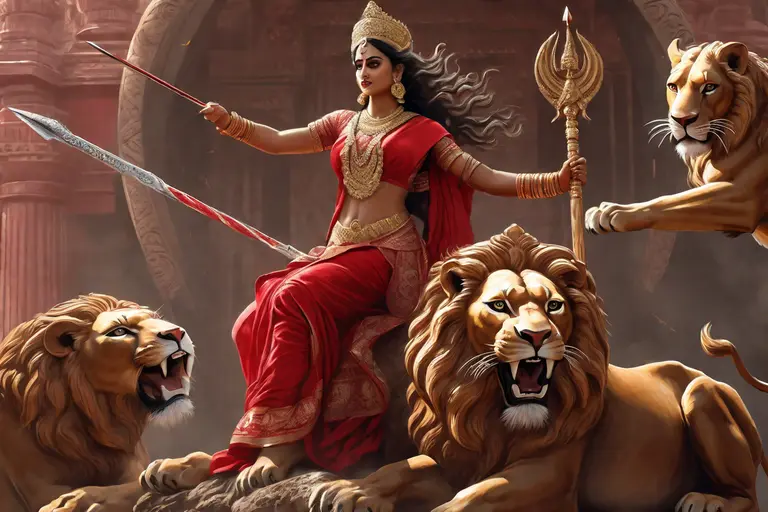
In some parts of South India, especially in Karnataka, Tamil Nadu, Kerala, and Andhra Pradesh, Dussehra is celebrated as Vijayadashami, which means “the day of victory”. It commemorates the victory of Goddess Durga over Mahishasura, a buffalo-demon who terrorized the gods and humans. According to legend, Mahishasura had a boon that he could not be killed by any man or god. Therefore, the gods created Goddess Durga, a fierce form of Shakti (the divine feminine power), who fought with Mahishasura for nine days and nights (Navratri) and finally killed him on the tenth day (Vijayadashami). Vijayadashami is also considered auspicious for initiating children into learning or performing arts, such as music, dance, or martial arts. It is believed that Goddess Saraswati, the goddess of learning and arts, blesses those who start their education or training on this day.
In some parts of West India, especially in Gujarat and Maharashtra, Dussehra is celebrated by worshipping Goddess Durga and her nine forms during Navratri. The festival is marked by colorful dances such as Garba and Dandiya Raas, where people dress up in traditional attire and dance with sticks or swords to the tunes of folk songs. The dances are also a way of honoring Goddess Durga’s victory over Mahishasura.
In some parts of East India, especially in West Bengal, Odisha, Assam, and Tripura, Dussehra is celebrated as Durga Puja, which is the biggest and most grandiose festival in these regions. Durga Puja is a five-day celebration that involves elaborate rituals, decorations, pandals (temporary structures that house the idols of Goddess Durga and her family), cultural programs, food stalls, and fairs. The festival honors Goddess Durga as the mother of the universe who descends to earth to protect her children from evil forces. On the tenth day (Vijayadashami), the idols are immersed in water bodies with much fanfare and emotion.
Dussehra Significance
Dussehra and Vijayadashami
Dussehra is not only a festival of joy and celebration but also a festival of learning and reflection. It teaches us several moral and spiritual lessons that can help us lead a better life. Some of these lessons are:
- The victory of good over evil: Dussehra reminds us that no matter how powerful or cunning evil may seem, it will always be defeated by good in the end. Evil may have temporary success but good will have eternal glory. Therefore, we should always follow the path of righteousness and avoid temptation.
- The importance of duty and devotion: Dussehra inspires us to emulate Lord Rama and Goddess Durga, who performed their duties with utmost dedication and devotion. Lord Shri Rama obeyed his father’s command and went to exile for 14 years, even though he was the rightful heir to the throne. He also rescued his wife Sitaji from Ravana’s clutches, even though he had to face many hardships and dangers. Goddess Durga sacrificed her comfort and happiness to fight for the welfare of the gods and humans. She also protected her children from the evil forces that threatened them. Therefore, we should also do our duties with sincerity and devotion, and serve our family, society, and country with loyalty and love.

- The value of courage and confidence: Dussehra encourages us to be brave and confident in facing the challenges and difficulties that life may throw at us. Lord Shri Rama and Goddess Durga showed immense courage and confidence in confronting their enemies, who were much stronger and more numerous than them. They did not lose hope or faith in themselves or their cause. They also had the support and guidance of their allies and mentors, such as Hanuman, Lakshmana, and the gods. Therefore, we should also have courage and confidence in ourselves and our abilities, and seek the help and advice of our friends, family, and well-wishers when needed.
- The power of faith and prayer: Dussehra also shows us the power of faith and prayer in overcoming obstacles and achieving success. Lord Shri Rama and Goddess Durga had unwavering faith in their respective deities, Lord Vishnu and Goddess Shakti, who bestowed them with divine grace and blessings. They also prayed to them regularly and sincerely, seeking their guidance and protection. Therefore, we should also have faith in our chosen deity or higher power, who can help us in times of trouble and distress. We should also pray to them regularly and sincerely, expressing our gratitude and devotion.
Read more about Lunar Eclipse 2023 Astrology
Recommended Product
Alpino Peanut Butter Chocolate Protein Bar – Gluten Free
🛒 View on Amazon →As an Amazon Associate, we earn from qualifying purchases. Price and availability may vary.
Read about How to Read Durga Saptashati and Get Amazing Benefits in Your Life
Dussehra Astrology
Dussehra also has an astrological significance that is related to the position of the Sun in the zodiac. The Sun is the source of life, energy, light, and warmth in the universe. It is also a symbol of authority, power, leadership, and respect. The Sun represents our soul, our heart, our self-esteem, and our ego.
The Sun changes its sign every month as it moves around the zodiac. However, there are two signs where the Sun is not comfortable or happy: Libra and Capricorn. These are called the debilitated signs of the Sun, where it loses its strength and dignity. Libra is the sign of balance, harmony, justice, partnership, and diplomacy. Capricorn is the sign of discipline, responsibility, ambition, structure, and achievement.
The Sun is debilitated in Libra because it does not like to compromise or share its power with others. It wants to be independent and dominant. It does not like to follow rules or regulations that limit its freedom or creativity. It does not like to be diplomatic or polite when it can be direct or assertive.
The Sun is debilitated in Capricorn because it does not like to work hard or be patient for its goals. It wants to be spontaneous and adventurous. It does not like to be restricted or controlled by authority or hierarchy. It does not like to be practical or realistic when it can be idealistic or optimistic.
The Sun enters Libra around mid-October every year, which coincides with the festival of Dussehra. This is a time when the Sun is at its weakest point in the zodiac. This is also a time when the forces of evil are at their peak, represented by Ravana or Mahishasura. However, this is also a time when the forces of good are victorious over evil, represented by Rama or Durga.
This signifies that even though the Sun may be debilitated in Libra, it can still overcome its challenges and enemies with the help of other planets or deities that support it. For example,
- The Sun is exalted in Aries, which is opposite to Libra in the zodiac. Aries is the sign of courage, action, initiative, and leadership. The Sun is strong and powerful in Aries because it can express its true nature without any hindrance or interference. Therefore, those who have the Sun in Aries in their birth chart are blessed with high self-esteem, authority, power, and respect in their life.
- The Sun is friendly with Jupiter, Mars, Moon, and Ketu (the south node of the Moon). These planets or deities enhance the positive qualities of the Sun such as wisdom, courage, emotion, and spirituality. They also protect the Sun from the negative influences of other planets or deities that may harm it such as Saturn, Venus, Rahu (the north node of the Moon), or Mercury. Therefore, those who have the Sun well-aspected by these planets or deities in their birth chart
Therefore, those who have the Sun well-aspected by these planets or deities in their birth chart are likely to enjoy success, fame, honor, and happiness in their life. They are also likely to overcome their enemies and obstacles with ease and grace. They are also likely to be devoted to their faith and prayer, which can help them in times of need.
On the other hand, those who have the Sun debilitated or afflicted by other planets or deities in their birth chart may face difficulties, challenges, delays, and losses in their life. They may also struggle with low self-esteem, lack of confidence, fear of authority, and disrespect from others. They may also face problems with their health, especially related to the heart, eyes, blood, and bones.
However, astrology also provides some remedies and solutions for those who have a weak or afflicted Sun in their birth chart. Some of these remedies are:
- Offering water to the Sun every morning with some jaggery, honey, wheat, or red flowers in a copper pot. This can help to appease the Sun and gain its favor.
- Chanting the mantras of the Sun such as Om Suryaya Namah, Om Ghrini Suryaya Namah, Om Ghrini Aditya Arya Namah, or any other mantra related to the Sun. This can help to invoke the power and blessings of the Sun.
- Reciting the Aditya Hrudaya Stotra, a hymn dedicated to the Sun that was taught by Sage Agastya to Lord Rama before his final battle with Ravana. This can help to enhance the courage, confidence, and victory of the person.
- Wearing a ruby gemstone or a copper ring on the ring finger of the right hand. This can help to strengthen the Sun and increase its positive effects.
- Donating or serving things related to the Sun such as wheat, copper, gold, red clothes, red flowers, or cow’s milk or ghee. This can help to reduce the negative effects of the Sun and increase its positive effects.
- Respecting and honoring one’s father, elders, teachers, mentors, leaders, and authorities. This can help to please the Sun and gain its respect.
- Seeking the help or partnership of a woman in one’s work or business. This can help to balance the Sun and Venus in one’s chart and improve one’s relations with others.
- Consulting an astrologer or following astrological guidance. This can help to understand one’s chart better and take appropriate measures accordingly.
These are some of the astrological aspects and remedies related to Dussehra and Vijayadashami. By following these tips and suggestions, one can make the most of this auspicious festival and celebrate the triumph of good over evil in one’s life.
I hope you found this article informative and useful. If you have any questions or feedback, please feel free to comment below. I would love to hear from you.
Thank you for reading. Happy Dussehra and Vijayadashami! ?????

Dussehra or Vijayadashami Celebrations
Explore how Dussehra or Vijayadashami is celebrated in different regions all over India
Dussehra is a festival that celebrates the triumph of good over evil in different ways in different parts of India. Here are some of the ways that people celebrate Dussehra in various regions of India:
- In North India, especially in Uttar Pradesh, Bihar, Madhya Pradesh, Rajasthan, and Delhi, people celebrate Dussehra by burning huge effigies of Ravana, the demon king who abducted Sita, the wife of Lord Rama. They also stage Ramlila, a dramatic reenactment of the life and deeds of Lord Rama, who killed Ravana on this day with his divine arrow1.
- In South India, especially in Karnataka, Tamil Nadu, Kerala, and Andhra Pradesh, people celebrate Dussehra as Vijayadashami, which means “the day of victory”. They worship Goddess Durga, who killed Mahishasura, a buffalo-demon who terrorized the gods and humans. They also initiate children into learning or performing arts on this day, as it is considered auspicious for education and culture2.
- In West India, especially in Gujarat and Maharashtra, people celebrate Dussehra by dancing to folk songs with sticks or swords called Garba and Dandiya Raas. They also worship Goddess Durga and her nine forms during Navratri, which precedes Dussehra. They honor her victory over Mahishasura and seek her blessings for prosperity and happiness3.
- In East India, especially in West Bengal, Odisha, Assam, and Tripura, people celebrate Dussehra as Durga Puja, which is the biggest and most grandiose festival in these regions. They set up elaborate pandals (temporary structures) that house the idols of Goddess Durga and her family. They perform rituals, offer prayers, enjoy cultural programs, and feast on delicious food. On the tenth day (Vijayadashami), they immerse the idols in water bodies with much fanfare and emotion4.
These are some of the ways that people celebrate Dussehra in different parts of India. You can learn more about them by clicking on the links provided in the references.
About Aditya Hridaya Stotram
The Aditya Hrudaya Stotra is a sacred hymn dedicated to Lord Surya, the Sun God, who is also known as Aditya, the son of Aditi. The significance of this hymn is that it was taught by Sage Agastya to Lord Rama, the seventh incarnation of Lord Vishnu, on the battlefield of Lanka, when Rama was about to face Ravana, the demon king who had abducted his wife Sita12.
The hymn praises the various attributes and activities of Lord Surya, who is the source of life, light, energy, and wisdom in the universe. The hymn also contains the core prayer to Lord Surya, known as the Aditya Hrudayam, which invokes his grace and blessings. The hymn also describes the glories and benefits of worshipping Lord Surya, who can bestow success, fame, honor, health, and happiness to his devotees12.
The significance of this hymn is that it helped Lord Rama to overcome his fatigue, doubt, and fear, and to gain courage, confidence, and victory over his enemy. By reciting this hymn with devotion and concentration, Rama was able to invoke the power and protection of Lord Surya, who is also his ancestor and mentor. Rama was able to defeat Ravana with his divine arrow and rescue Sita from his captivity12.
Therefore, this hymn is considered one of the most powerful and effective mantras in Hinduism for achieving fame and success in any endeavor. It is also a mantra for overcoming obstacles and difficulties in life. It is believed that by reciting this hymn regularly and sincerely, one can attain the favor and grace of Lord Surya, who can fulfill all the desires and wishes of his devotees12.
