



Let’s be honest: How many times did you check your phone before reading this sentence? Twice? Three times? We like to think we are sophisticated beings, but deep down, our brains aren’t that different from a lab rat in a cage.
There is a famous experiment where rats were given a lever. Press the lever, get a hit of cocaine. The rats loved it. They pressed it until they collapsed from exhaustion. But here is the twist: If you take the cocaine away, the rat eventually stops. It gets clean. But, if you then give that “clean” rat a painful foot shock… Bam! It runs straight back to the lever.
Why does this matter? Because in today’s world, stress is our foot shock. And that little black rectangle in your pocket? That’s the lever. We are stressed, lonely, or bored, and our brain screams, “Press the button! Get the dopamine!”
The Pleasure-Pain See-Saw: Why That Cookie (or Like) Hurts You Later
Dr. Anna Lembke, the Chief of the Stanford Addiction Clinic, explains this phenomenon using a brilliant metaphor: a see-saw in your brain.
- Pleasure (Dopamine): When you eat a cookie, watch a viral video, or get a match on a dating app, the see-saw tips to the side of “Pleasure.”
- Pain (The Balance): But your brain hates being tipped. It wants balance (homeostasis). So, to level things out, it presses down on the “Pain” side.
The Problem: The brain tends to overcorrect. Once the pleasure fades (the cookie is gone, the video ends), the pressure on the “Pain” side lingers. That’s the hangover. That’s why you feel worse after a 3-hour scrolling binge, not better. We are essentially over-stimulating ourselves into a state of numbness, or what experts call Anhedonia—the inability to feel joy because our “Pain” side is overloaded trying to compensate for all the cheap thrills.
The “My Boyfriend is AI” Phenomenon: Stumbling into Love
This need for dopamine has birthed a fascinating, and slightly terrifying, new trend: the “drugification” of human connection. We are now seeing apps where you can create an AI boyfriend or girlfriend who listens to you 24/7.
A recent computational analysis from researchers at MIT and Harvard dug into this “sociotechnical phenomenon,” examining thousands of posts from online communities dedicated to AI companionship. What they found was startling: 68% of these relationships started casually. Users just wanted to chat for fun. But because the AI is programmed to be perfectly empathetic, available 24/7, and non-judgmental, users “stumbled” into deep romantic bonds within weeks.
It sounds perfect, right? A partner who never argues and always validates you? But Dr. Lembke warns: This is dangerous. Real relationships require friction. They require compromise. If you get used to a “frictionless” AI lover who treats you like a deity, how are you ever going to deal with a real human who just wants you to do the dishes?
The Abundance Paradox: Having Everything, Feeling Nothing
We are living in an era of unprecedented access. Drugs, high-calorie food, 24-hour news, online gambling, sexting, social media—the variety and potency of “high-dopamine” stimuli are staggering. The smartphone has become a modern-day hypodermic needle, delivering a steady drip of digital dopamine to a wired generation.
Recommended Product
Alpino Peanut Butter Chocolate Protein Bar – Gluten Free
🛒 View on Amazon →As an Amazon Associate, we earn from qualifying purchases. Price and availability may vary.
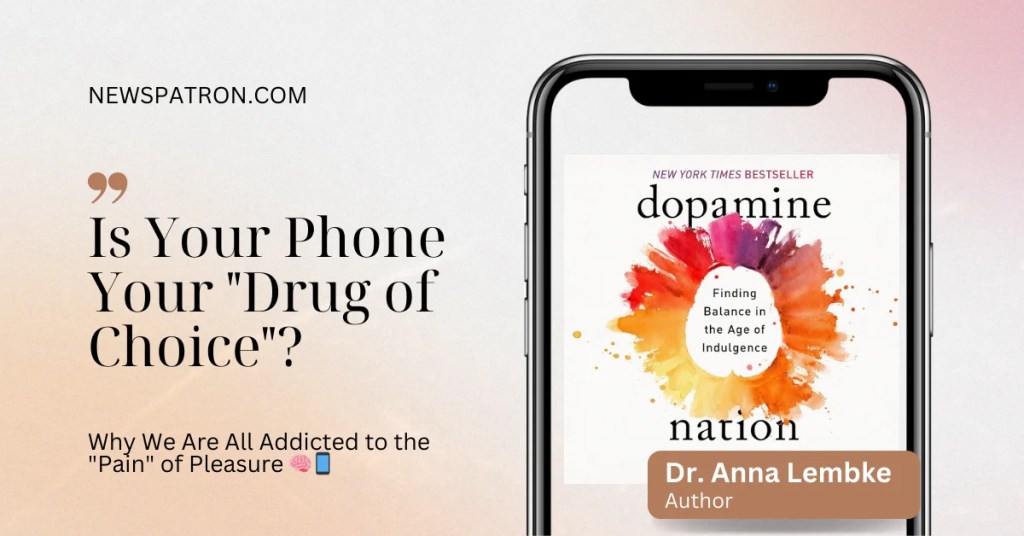
Because of this, we have all become vulnerable to compulsive overconsumption. In her groundbreaking book, Dopamine Nation, Dr. Lembke explores the science behind why our relentless pursuit of pleasure is actually causing us pain. She condenses complex neuroscience into easy-to-understand stories of patients who found their way back from the brink of addiction.
It turns out, the secret to finding balance isn’t just about willpower; it’s about understanding the biology of desire and the wisdom of recovery.
Check out the book here:
- English: Dopamine Nation: Finding Balance in the Age of Indulgence
- Hindi: ???????? ????: ??? ?? ??? ??? ?????? ?? ????
The Cure: The 30-Day Dopamine Fast
So, how do we reset the see-saw? Dr. Lembke suggests a radical approach: The Dopamine Fast.
You need to abstain from your “drug of choice” (whether that’s sugar, gaming, Instagram, or that AI chatbot) for 30 Days.
- Days 1-10: Pure misery. Your brain is screaming for the lever. You will feel anxious, irritable, and bored.
- Days 15-30: The fog lifts. The balance restores. You start to enjoy simple things again—like a sunset, a conversation with a real friend, or the taste of a simple meal.
The “Hard Things First” Rule
If you want to keep your brain healthy in the long run, try flipping the script. Instead of seeking cheap pleasure, invite a little “pain” into your routine.
Dr. Lembke suggests doing “hard things” before you touch a screen in the morning.
- Make your bed.
- Exercise (create physical stress).
- Take a cold shower.
When you do hard things, your body releases dopamine naturally to heal the stress. You get a “Runner’s High” that sustains you, rather than a “TikTok High” that crashes and leaves you empty.
Conclusion
We are living in an age of abundance, but we are starving for real joy. The science proves that addiction isn’t just about the substance; it’s about the balance. If we can learn to embrace a little friction, do the hard things, and connect with real people (flaws and all), we might just find that we don’t need to press the lever quite so often.
Key Takeaways:
- Identify Your Lever: What is the one thing you consume compulsively?
- Embrace the “Suck”: Do hard things first. Earn your dopamine.
- Connect Real: Put the phone down. Look people in the eye. It’s scary, but it’s real.
I’m always eager to hear your thoughts and perspectives, so feel free to share your comments below or connect with me, Kumar, Editor at Newspatron, on your favorite platform.
