


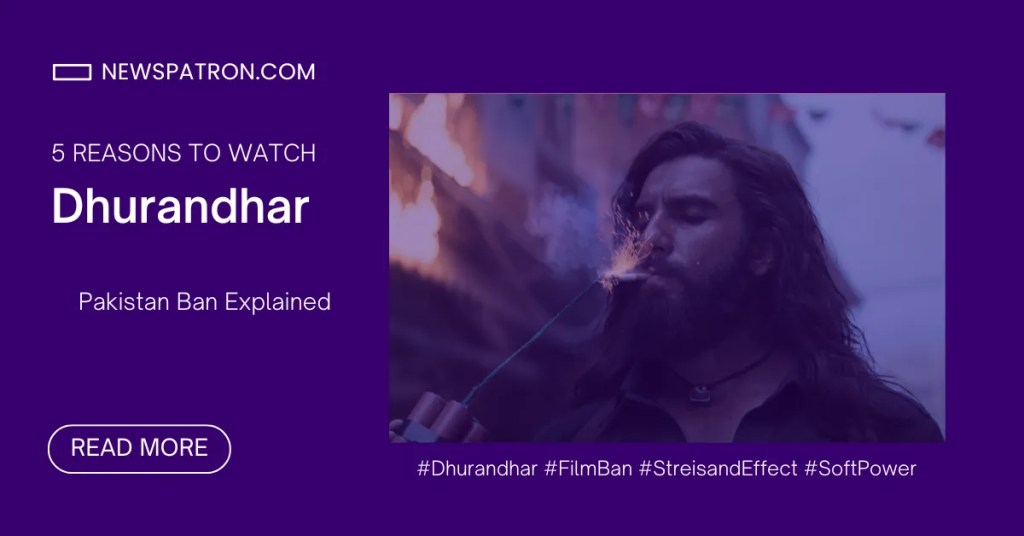

Dhurandhar Pakistan Ban and Its Unexpected Afterlife
Creative Note
When a film is officially blocked yet informally consumed, the story shifts from cinema to consequence. Dhurandhar offers a case study in how bans behave in a digital-first world.
Dhurandhar Pakistan Ban: What Happened After the Screens Went Dark
The Indian spy thriller Dhurandhar was denied an official theatrical release in Pakistan, in line with the country’s ongoing ban on Indian films that has remained in place since 2019. The decision was reportedly linked to the film’s subject matter, which includes terrorism, espionage, and criminal networks portrayed within Pakistan.
Despite the absence of an official release, multiple Indian and international media outlets reported that the film quickly gained underground visibility in Pakistan through illegal downloads, private sharing, and encrypted distribution channels.

Reported Access and Piracy Claims
According to trade estimates cited by outlets such as NDTV, India TV News, and BBC News, Dhurandhar may have crossed approximately two million illegal downloads in Pakistan within its first 12–14 days of release. These figures are estimates and have not been independently audited, but they are consistent with search trend data and digital monitoring reports referenced by multiple publications.
Access methods reportedly included:
* Torrent networks
* Encrypted messaging platforms
* VPN-assisted streaming
* Private peer-to-peer sharing
Public Response and Cultural Engagement
Public reactions within Pakistan appeared mixed. While some viewers criticized the film’s political framing, others engaged with its music, performances, and visual style. Short video clips, dialogue snippets, and soundtrack segments circulated across social media platforms, indicating engagement beyond passive “hate watching.”
Several Pakistani commentators acknowledged the film’s technical execution while disputing its narrative choices, particularly its depiction of Karachi’s Lyari district.
Box Office Performance Elsewhere
Outside Pakistan and certain Gulf countries where the film also faced certification barriers, Dhurandhar performed strongly. Trade data from Sacnilk, Bollywood Hungama, and Times of India indicated that the film crossed ?700 crore worldwide within approximately two weeks of release, supported by strong second-week collections — a pattern typically associated with sustained audience interest.
The Streisand Effect and Film Bans
Media analysts have frequently framed Dhurandhar’s post-ban trajectory as an example of the Streisand Effect — a phenomenon in which attempts to suppress information inadvertently increase public attention. Similar patterns have been observed in earlier cases involving restricted or controversial films across global markets.
Recommended Product
Jockey Women's Hipster Brief – Comfort Fit, Assorted Colors
🛒 View on Amazon →As an Amazon Associate, we earn from qualifying purchases. Price and availability may vary.
Conclusion
The case of Dhurandhar illustrates how film bans function differently in the digital era. While regulatory bodies can block theatres and certification, they cannot fully control curiosity, discussion, or informal access.
Rather than disappearing from public consciousness, the film entered a parallel circulation — unofficial, fragmented, and debate-driven. Whether viewed as cultural penetration or unintended amplification, the outcome highlights the limits of censorship in an interconnected media environment.
This article is based on verified reporting, cited trade data, and attributed public discourse for editorial and archival reference.
Want the deep analysis?
Read the full report on the ban’s fallout.
#quickreads
