




By the NewsPatron Business Desk
The air in Davos is thin, but the conversations are heavy with opportunity. As global leaders gather for the World Economic Forum (WEF) 2026, one Indian state is making noise not just with promises, but with a report card that demands attention.
Devendra Fadnavis, leading the charge for Maharashtra, isn’t just pitching a state; he is pitching a “game-changer.” With a focus on the massive Third Mumbai project and a staggering portfolio of investments, the message is clear: Maharashtra is no longer just competing with other Indian states. It is competing with the world.
The ?14.5 Lakh Crore Breakdown
This year’s visit is distinct. Unlike previous years focused on intent, Devendra Fadnavis Davos 2026 is about execution. On Day 1 alone, the state secured commitments worth a staggering ?14.5 lakh crore, signing 19 strategic MoUs that promise to create over 15 lakh jobs.
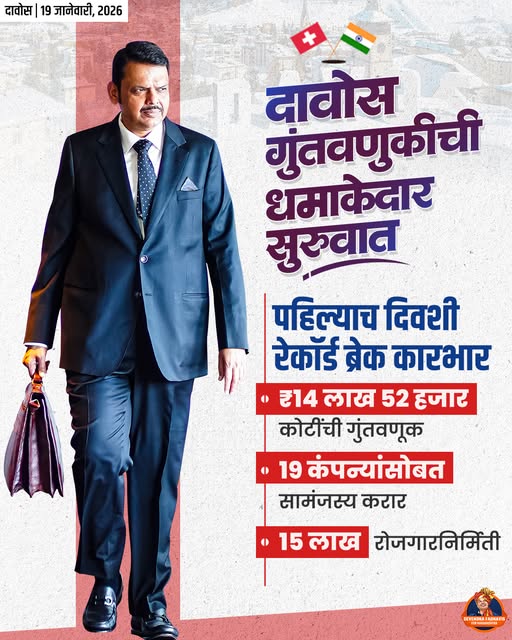
Fadnavis didn’t just talk; he signed. Here is the breakdown of the mega-deals that matter:
- The Data Center Giant: Lodha Group inked a ?1 Lakh Crore (~$12B) deal to develop a 2.5 GW Green Data Center Park in the MMR. This single move targets 1.5 lakh jobs and positions the state as Asia’s digital vault.
- The Logistics Behemoth: SBG Group committed $20 Billion (~?1.67 Lakh Crore) for a massive logistics and supply chain network, projecting 4.5 lakh jobs.
- Urban Infra: Alta Capital & Panchshil Realty signed the largest check of the day—$25 Billion (~?2.09 Lakh Crore) for urban infrastructure projects.
The “Third Mumbai” Blueprint
If there is one phrase you need to remember from this summit, it is “Third Mumbai.”
This is not just a suburb; it is a 675 square kilometer urban agglomeration rising around the new Navi Mumbai International Airport and the Atal Setu (MTHL). Specifically, the Karnala-Sai-Chirner (KSC) New Town, spanning 323 sq km, is being master-planned by CIDCO as the thematic engine of this region.
What makes Third Mumbai unique?
It is being built with “thematic precision.” Instead of random sprawl, the government is developing dedicated zones:
- Edu City: For global university campuses.
- Medi-City: A hub for super-specialty healthcare and biotech.
- Innovation & GCC City: Tailor-made for Global Capability Centers that need high-end talent.
Credibility: The Davos Premium
In India, the gap between an MOU (Memorandum of Understanding) and a real factory on the ground is often the subject of jokes. Fadnavis tackled this head-on with numbers that silence the skeptics.
Recommended Product
Casio Vintage A168WA Digital Grey Unisex Watch
🛒 View on Amazon →As an Amazon Associate, we earn from qualifying purchases. Price and availability may vary.
“In today’s world, credibility is more important than capital. When we make commitments, we deliver on them,” Fadnavis stated.
The data backs him up:
- National Average: MOU realization hovers around 35%.
- Maharashtra Standard: The state delivers a conversion rate of 55-60%.
- Davos Premium: For agreements signed specifically at Davos, the success rate jumps to over 75%.
Geopolitics: The “China Plus One” Winner?
By pitching Maharashtra’s 40% share of India’s recent FDI inflows, the state is effectively positioning itself as the premier “China Plus One” alternative. Whether it’s the ?565 Cr steel deal with BFN Forgings or the $8 Billion Japanese commitment from Sumitomo Realty, the “Trillion Dollar Economy” roadmap is now a timeline, not just a slogan.
Devendra Fadnavis Davos 2026 wasn’t just a diplomatic visit; it was a sales pitch backed by a solid product. With the Third Mumbai project offering scale and a 75% execution rate offering safety, Maharashtra has cemented its status as India’s premier investment destination.
What do you think? Will Third Mumbai solve the congestion of the old city, or is it just another real estate boom? Let us know in the comments below! ?
