


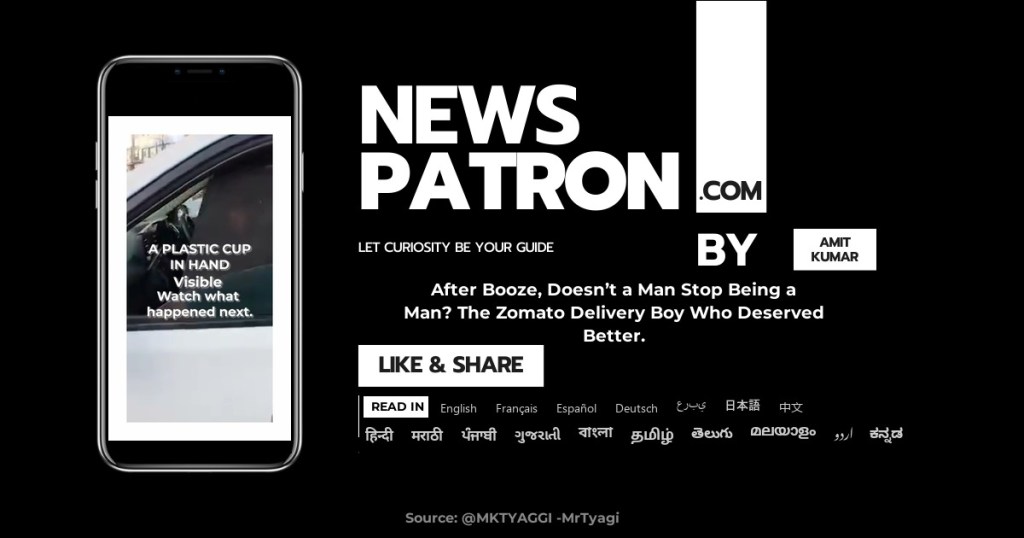

Editorial Note: This article is based on publicly circulated video footage posted on 15 March 2026. The identities of the individuals involved have not been officially confirmed, and neither is named in this report. No FIR or official police statement has been confirmed at time of publication. Newspatron does not endorse or reproduce unverified personal information circulating in public replies. All commentary reflects editorial opinion and civic advocacy. The footage is used for the purpose of public interest journalism.
Subscribe to @newspatron on YouTube — Let Curiosity Be Your Guide.
We published a story not long ago that stayed with people for a long time after they read it. 🧠
An 18th-floor apartment. A pizza that arrived cold. A delivery boy who knocked on the door anyway. And a mother who had just died inside — while her son, instead of calling for help, had called for a pizza. The delivery boy did not have to stay. He stayed. He was, in that moment, the only human presence in a situation that desperately needed one.
And then the Rapido driver in Goa who refused to give up when the map failed his passenger. And Paul Keller, a UPS driver in frozen Iowa, who noticed something was wrong at a house on his route, trusted his instinct, and saved a life.
These are the people who deliver your food. Your medicine. Your parcels.
Now hold all of that in your mind. And then watch what a man in a car in Delhi did to a Zomato delivery boy who arrived to deliver a food order on 15 March 2026.
The man had ordered food. He was already drunk when the delivery arrived. And what the delivery boy got for completing his job was one minute and forty-eight seconds of contempt from someone who should not have been in any state to interact with another human being.
What Actually Happened
Let us be precise about this, because the facts matter. 😠
The customer in the car did not order alcohol through the delivery platform. He ordered food. The delivery partner arrived to complete a standard food delivery — car number verification against the delivery address, a procedure that takes approximately thirty seconds.
The customer was already heavily intoxicated. Not tipsy. Not slightly affected. Visibly, audibly, heavily under the influence of alcohol — inside a car, on a public road in Delhi, with a woman beside him.
What followed was not a dispute over the order. It was not confusion about the delivery address. It was one man, impaired by alcohol, directing sustained contempt at another man who had done nothing except arrive to do his job.
Credit: @mktyaggi
The video is one minute and forty-eight seconds. The delivery partner does not raise his voice. The customer does not stop.
The original poster’s question has been shared over 188,000 times: “After drinking booze, doesn’t a man stop being a man?”
The Question Behind the Question: Is Drinking in a Car on a Public Road Even Legal?
This incident raises something that almost nobody in the outrage thread stopped to ask. 🧠
The man was not drinking at home. He was not in a licensed bar. He was sitting in a car, parked on a public road in Delhi, visibly intoxicated, with what appears to be alcohol present in the vehicle.
So here is the legal question: is drinking inside a parked car on a public road in India prohibited?
The answer depends on how courts and police interpret “public place” — and in most Indian jurisdictions, the answer is effectively yes.
Under the Delhi Excise Act and similar state legislation, consuming alcohol in a public place is prohibited. A car parked on a public road is not a private residence. The road is public. The car is visible from it. Courts have consistently held that a vehicle on a public thoroughfare does not constitute a private space for the purposes of alcohol consumption laws.
More directly: IPC Section 510 specifically addresses misconduct in public by a drunken person. It covers any person who, in a public place, is intoxicated and behaves in a manner that causes nuisance or annoyance to others. The delivery boy arriving to complete a lawful order and being subjected to the conduct visible in this video is precisely the situation Section 510 is designed to address.
Quiet Drunk in a Car vs Aggressive Drunk in a Car: The Legal Difference
This distinction is worth understanding clearly, because the law treats these two scenarios differently. 🔍
Scenario A: A person is sitting in a parked car on a public road, drinking quietly, not interacting with anyone, not causing a disturbance. In most Indian states, this is still technically a violation of public consumption laws — the car is in a public place. In practice, enforcement is inconsistent. Police may or may not act, depending on the area, the time, and whether a complaint is filed.
Scenario B: A person is sitting in a parked car on a public road, heavily intoxicated, and becomes aggressive, abusive, or disruptive toward others — including, say, a delivery boy doing his job. This is a different category of offence entirely. IPC Section 510 applies clearly. IPC Section 294 — obscene acts and language causing annoyance in a public place — also applies. The conduct is no longer passive. It has a victim. It has witnesses. It is on video.
The critical difference is not the drinking. It is the aggression. The moment intoxication in a public space crosses into behaviour that causes annoyance, distress, or harm to another person, the law has a clear handle.
We have covered this ground before, in a different context but the same underlying principle. In Ghatkopar East, groups of men drink openly on the footpath outside a wine shop — next to a bus stop used by women, children, and senior citizens every evening. The footpath is a public space. The presence of people being made uncomfortable converts passive consumption into actionable public nuisance. A parked car on a Delhi road operates under the same logic.

The Entitlement Pattern: Same Week, Different Prop
This incident did not happen in isolation. Same week, same country. 😠
A Thar owner in Wadala, Mumbai beat an auto-rickshaw driver who was already holding his ears in apology. Visible damage to the Thar: zero.
And before Wadala — Nikol, Ahmedabad and Gachibowli, Hyderabad. Elderly men and uniformed constables on car bonnets while drivers kept moving.
The delivery bag, the auto-rickshaw, the police uniform — different props. The calculation is identical every time: I can do this. Nothing will happen to me. Alcohol does not create the entitlement. It removes the filter that was previously containing it.
The Doxxing Problem and Why We Are Not Repeating It
The reply thread attempted to identify and expose the individual — name, address, mobile number. All of it circulated widely.
We are not reproducing any of that here. Not because the man in the video deserves protection from consequence. Because doxxing is not justice. Unverified information spreads as fact. People with similar names or addresses get harassed by mistake. The actual accountability process gets bypassed in favour of a pile-on that produces no durable outcome.
The video is evidence. It is sufficient. Use the video.
The Gig Worker Behind the Delivery Bag
The delivery partner in this video is one of approximately 7.7 to 12 million gig workers in India’s food and quick-commerce sector — projected to reach 23 million by 2030.
41.5% reported experiencing some form of violence at work. 27% met with traffic accidents during work. 60% received no safety training from their platforms. India’s gig economy is expected to contribute ₹2.35 lakh crore to GDP by 2030. The people generating that number arrive at your door with no institutional protection when someone already drunk decides that a delivery verification is the moment for public humiliation.
What Should Actually Happen
One: IPC Section 510 and Section 294 apply. The conduct in the video — a visibly intoxicated person in a public-facing vehicle causing annoyance and distress to a person going about lawful work — meets the threshold of both sections. A complaint can be filed. The video is the evidence.
Two: Delhi Police should treat the car’s location as a public place. The vehicle was on a public road. The customer was visibly and heavily intoxicated. The consumption itself may warrant action under Delhi Excise rules — separate from and in addition to the conduct charge.
Three: Zomato should clarify its policy on abusive customers. Not because alcohol was ordered — it was not. But because this video shows a delivery partner completing a lawful delivery and being subjected to sustained abuse by an intoxicated customer. The platform owes its workers clarity on what they are authorised to do when a customer is in this condition.
Four: the delivery partner should know his options. He has legal remedies available. The video is his evidence. He should not absorb this in silence because he does not know the process exists.
The Close
Paul Keller saved a life in Iowa because he noticed something was wrong. The Rapido driver in Goa found his passenger when the map failed. The delivery boy on the 18th floor stayed when he could have left.
The man in the Delhi car ordered food. A delivery partner arrived to bring it. One version of India treats these workers as the last line of human presence in moments of crisis. Another version treats them as an inconvenience to be absorbed by whoever is drunk enough to feel entitled to unload on them.
A parked car on a public road is still a public road. Being drunk in it is not a private matter when it affects the people around you. And a delivery boy doing his job deserves thirty seconds of basic decency — drunk or sober.
The law is clear on what happened. The only question is whether anyone uses it.
Are you a gig worker who has experienced customer harassment? Tell us in the comments.
A Note on Sources: The primary video footage was publicly posted by @mktyaggi on 15 March 2026 and is used here for public interest journalism. The identities of the individuals are unconfirmed; neither is named. Gig worker statistics sourced from IDinsight/NITI Aayog projections, PAIGAM Delhi NGO survey (2025–2026), and NCAER/Prosus study (2023–24). No doxxing information has been reproduced. Legal analysis reflects editorial interpretation and does not constitute legal advice.
Newspatron — Let Curiosity Be Your Guide.
