


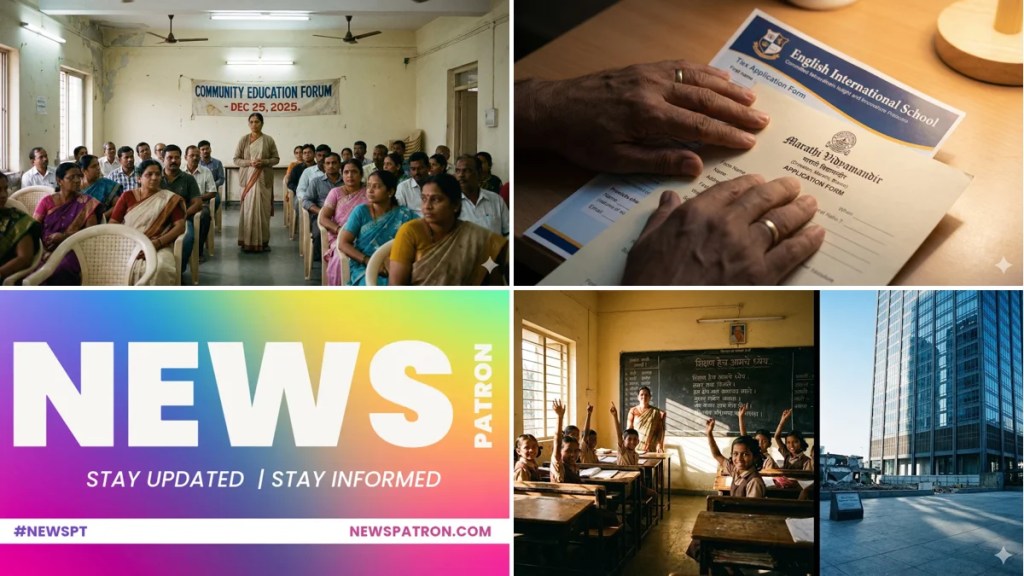

In a time when activism is often loud, reactive, and driven by trends, there exists another kind of resistance—quiet, sustained, and rooted in lived experience. Actress and social activist Chinmayee Sumeet represents precisely this kind of engagement. Her work around Marathi-medium schools is not symbolic, nor is it ideological posturing. It is personal, deliberate, and shaped by decades of observation, parenting, and grassroots involvement.
This conversation is not merely about education policy or linguistic pride. It is about what a society chooses to value, whom it leaves behind, and how neglect becomes normalized—until entire institutions quietly disappear.
Community, Compassion, and the Selective Nature of Activism
Chinmayee begins by reflecting on how social groups—especially those formed by like-minded artists and professionals—often come together for visible humanitarian causes. Distributing blankets to pavement dwellers during winter, organizing food drives during festivals, or supporting charitable campaigns feels necessary and immediate. These actions are important, she acknowledges, but they also reveal a pattern.
When the call is made for something less visible—such as dedicating time to defend Marathi language institutions or attending meetings to save Marathi schools—the response is strikingly muted. The uncomfortable truth, she suggests, is that language activism is frequently dismissed as the domain of “movement people,” something others feel absolved from engaging with.
Growing Up with Social Responsibility
This sense of responsibility did not arrive late in Chinmayee’s life. It was embedded early. Raised in Marathwada, she grew up in a household where public service and social awareness were not theoretical ideas. Her father, an IAS officer with activist roots, and her mother, a psychology professor, shaped an environment where civic duty was unquestioned.
Choosing Marathi Education for Her Children
The most defining decision in Chinmayee’s activism came not on a stage or protest ground, but at home—as a parent. When it came time to choose schools for her children, the pressure to opt for English-medium education was immense. The assumption was universal: English equaled progress; Marathi meant limitation.
Yet Chinmayee saw something others overlooked. Language is not just a medium of instruction; it is the medium of thought. Having studied in Marathi herself, she possessed a vast internal library of stories, poetry, and cultural references. She wanted her children to inherit that same intellectual and emotional richness.
? The Bilingual Advantage
Studies consistently show that children who learn in their mother tongue during primary years develop stronger cognitive skills and deeper conceptual understanding. Transitioning to English later is often easier for them because they have mastered the structure of language itself.
Despite resistance, she enrolled her children in Marathi-medium schools. The results challenged every stereotype. Her children thrived, remained confident, and developed strong linguistic adaptability. Today, they operate successfully in English-dominant professional worlds—without a trace of inferiority.
What Marathi Schools Really Offer
One of the most persistent myths Chinmayee dismantles is that Marathi schools are inferior spaces meant only for underprivileged children. Her lived experience paints a different picture. In Marathi schools, children encounter diversity organically. They learn that society is not homogeneous. They share classrooms with students from varied economic backgrounds, developing empathy not through textbooks but through daily interaction.
Recommended Product
Alpino Peanut Butter Chocolate Protein Bar – Gluten Free
🛒 View on Amazon →As an Amazon Associate, we earn from qualifying purchases. Price and availability may vary.
The Slow Erasure of Marathi Schools
The decline of Marathi schools is not accidental. It is systemic. Municipal schools, once vibrant educational hubs, have been allowed to decay physically while being undermined institutionally. Instead of strengthening Marathi-medium education, authorities rebranded schools under CBSE or ICSE boards, marketed “free English education,” and redirected students away from Marathi classrooms.
Meanwhile, valuable school land in prime urban locations has quietly changed hands. Schools are declared unsafe, demolished, and replaced with residential towers. Chinmayee calls this what it is: institutional theft.
Activism Beyond Protests
Her work with Marathi Abhyas Kendra and other grassroots groups includes parent education, school visits, documentation, and relentless follow-ups with authorities. She recounts how even meeting education ministers can take over a year. Yet when large numbers mobilize, results become possible.
The Real Question: What Kind of Society Do We Want?
At its core, Chinmayee’s argument is not anti-English. It is anti-erasure. She questions a system that prioritizes cosmetic infrastructure over educational quality, market logic over child psychology, and convenience over cultural continuity. True progress, she insists, lies in raising thoughtful citizens—not just employable individuals.
As Chinmayee powerfully states, if future generations ask what we did when our language and institutions were disappearing, we should have an answer. Because when society abandons its foundations, rebuilding them later is far harder than preserving them now.

[…] Want the full story? Read the Deep Dive Interview here. […]