



By the NewsPatron Editorial Desk
#ChanakyaNiti #Vegetarianism #Ethics #FoodEconomics #Philosophy
What is the cheapest food in the world? Is it rice? Wheat? Or is it meat?
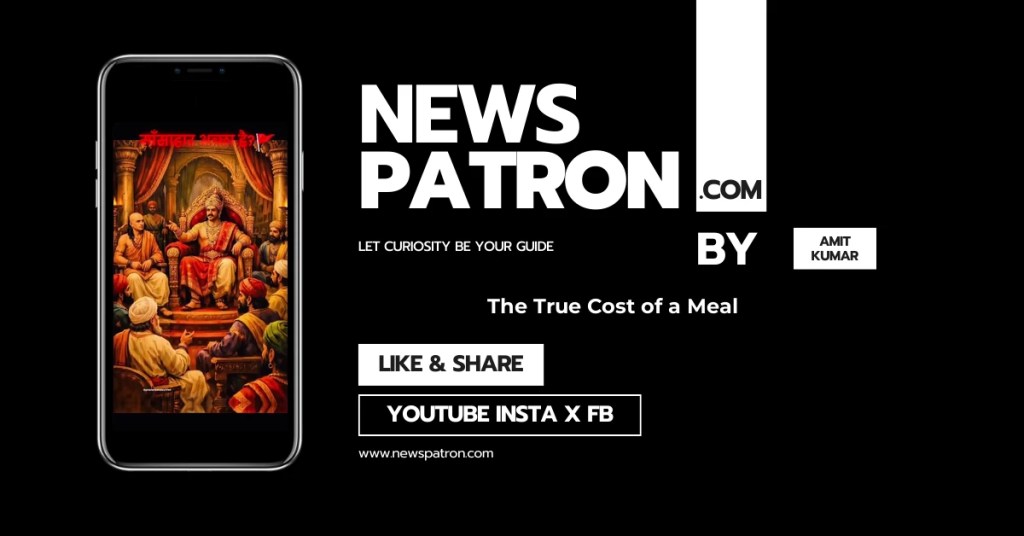
This question was once posed by Emperor Bindusara to his royal assembly. The courtiers, eager to please, argued that meat was the cheapest because it required less labor than growing crops. They saw it as a simple equation: Hunt, kill, eat.
But the wise Prime Minister, Chanakya, remained silent. His answer, delivered the next day, was not a speech but a powerful demonstration that proved a chilling truth: Life is priceless, and therefore, taking it can never be “cheap.”
The Lesson: 2 Crore Coins for 20 Grams of Flesh ??
In this viral retelling of a Mauryan legend, Chanakya visits his courtiers at night, claiming the King needs “human flesh” to survive an illness. He offers vast wealth. The result? Everyone refuses to give their own flesh but is willing to pay millions to save themselves.
The moral is striking: “If you cannot put a price on your own life, how can you call the life of another creature ‘cheap’?”
The Hidden Human Cost: PTSD in the Industry ?
While Chanakya focused on the value of life, modern discussions are uncovering another hidden cost: the human toll. Recent threads on online forums (like psychology and ethics communities) highlight the harrowing reality of slaughterhouse workers.
As Rohan, a sociology researcher, notes: “We talk about cheap chicken, but we ignore the ‘Perpetration-Induced Traumatic Stress’ (PITS) faced by workers who kill thousands of animals a day. The meat is cheap because we don’t factor in their mental health trauma.”
Recommended Product
Casio Enticer Men's Analog Green Dial Watch MTP-VD01D
🛒 View on Amazon →As an Amazon Associate, we earn from qualifying purchases. Price and availability may vary.
The 2026 Paradox: Is Veg the New Luxury? ?
Interestingly, Chanakya’s philosophy faces a strange economic reality in 2026. In cities like Mumbai, inflation has flipped the script. While mass-produced chicken remains artificially cheap, a healthy, diverse vegetarian thali has become a luxury.
Users on sustainability forums argue that while the “moral high ground” of vegetarianism is valid, it is becoming a privilege of the wealthy. The “True Cost” Chanakya spoke of is now being paid by the planet (in water footprint) and the poor (in food security).
Conclusion: The Right to Take Life
Chanakya’s final argument echoes through the ages: “If you cannot give life, do you have the right to take it?”
Whether you eat meat or plants, this story forces us to pause and acknowledge that every meal has a cost—one that goes far beyond the price on the menu.
?? Let’s Connect: I’m Kumar, Editor at Newspatron.
? Updates:
Instagram •
X (Twitter) •
YouTube •
WhatsApp
? Network:
LinkedIn •
Facebook •
FB Group
? Chat:
Telegram •
Insider Group •
Tumblr
