




Your Marks Did Not Lie. The System Did.
This one is for every parent who sat next to their child at 11 PM refreshing the CBSE results portal. And for every student who spent a year in preparation, cleared the toughest national competitive rounds, and then stared at a board scorecard that looked like it belonged to someone else entirely.
What went wrong with the CBSE 2026 results? Why are students who sailed through JEE screening rounds suddenly stuck in the 60s on Chemistry and Physics scripts? And why does fixing it cost thousands of rupees out of your own pocket to audit a mistake that may not even be yours?
This is a detailed ground-level breakdown. We are going section by section, number by number, and allegation by allegation. No press release spin. No institutional comfort. Just the full picture.
For video breakdowns on this and related education stories, visit Newspatron on YouTube @newspatron and check drone coverage and shorts at DroneMitra — https://youtube.com/@dronemitra/
Disclaimer: This investigative analysis is primarily informed by the field observations of a veteran chemistry educator with 25 years of valuation experience, alongside public sentiments expressed across student-teacher discussion forums. Certain operational data points and personal sources have been omitted to maintain confidentiality.
Cracking the Code Behind the CBSE 2026 Result Controversy
Lets talk about something that has completely upended thousands of households this week. If you have been tracking mid-May educational updates, you already know how tense the atmosphere is. Meritorious students who scored well in mock setups and competitive exams are staring at board scores that look like a system glitch.
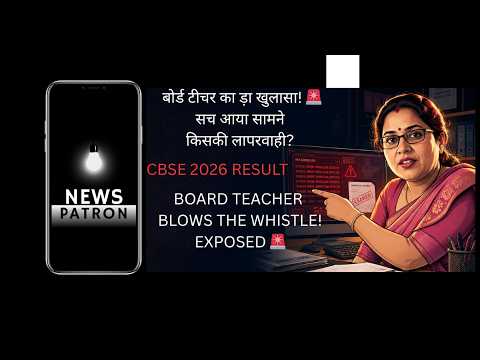
The internet is flooded with dark humor and angry rants. But behind that noise lies a serious crisis. A viral video from veteran chemistry teacher Rakhi Mishra — a professional with 25 years of valuation experience — has blown the lid off what is quickly becoming an institutional showdown. The core issue is the sudden nationwide rollout of digital checking for board answer scripts.
In this investigation, we break down why top science candidates are hitting an unexpected ceiling at 65 marks. We look at the administrative pressure on evaluators, the specific infrastructure gaps, and what the boards own response reveals. This is not a press release. This is the ground reality of the CBSE 2026 result controversy.
Recommended Product
Amazon India – Shop Today's Best Offers
🛒 View on Amazon →As an Amazon Associate, we earn from qualifying purchases. Price and availability may vary.
Inside the CBSE 2026 Result Controversy What the Numbers Show
The results dropped on May 13, and the data tells a story that cannot be quietly set aside. The overall national pass percentage fell by a sharp 3.19 percent, landing at 85.20 percent. That is a significant drop from last years steady 88.39 percent.
Think about that for a moment. This is not a marginal shift. This is one of the sharpest post-pandemic declines on record. So what explains the slide?
The primary catalyst dominating the conversation is the re-introduction of the On Screen Marking mechanism. Under this digital evaluation framework, physical answer sheets are scanned at centralized facilities, cut, masked, and converted into digital uploads. Examiners then log into a remote portal to complete their evaluations on a monitor with no physical pages and no direct visual contact with the original script.
The system was marketed as a precision upgrade. Faster processing, fewer totaling errors, cleaner audit trails. However, ground-level reports point toward serious execution bottlenecks that directly impacted how science answers were graded. The CBSE 2026 result controversy did not come out of nowhere. It was building through April.
Just two days after results went live, the Controller of Examinations released a detailed nine-page framework. This updated guidance introduced an altered grievance redressal roadmap, an unusual move that itself signals the board acknowledges something went sideways.
How the CBSE 2026 Result Controversy Hit Top Performers
The hardest hit group in this entire situation is the classroom high achievers. These are students who consistently maintained 95 percent or above in pre-boards and internal terminal assessments. For them, seeing a final scorecard in the 60 to 70 range is a genuine shock and not an inconvenience.
What makes this pattern particularly hard to ignore is the stark divergence between subjective board grades and competitive national entrance scores. Multiple documented cases show students clearing the 95th percentile in engineering screening rounds while simultaneously scoring unexpectedly low on board Chemistry and Physics scripts.
Under normal conditions, competitive exam accuracy correlates directly with strong theoretical understanding. When a student performs well in a high-difficulty national format but scores poorly on a subjective board script, that is a structural signal and not a personal failure.
The sheer volume of consistent complaints across districts and states suggests a systemic disconnect rather than isolated cases. If left unaddressed, this CBSE board exam marks drop risks altering the academic paths of thousands of deserving science students before they even reach a college gate.
Rakhi Mishra Chemistry Teacher Sounds the Alarm
When an educator with a quarter-century of classroom experience speaks up about an assessment system, the profession listens. On May 16, 2026, a video surfaced on social media platforms that quickly moved from a routine grievance into a major national talking point.
In this testimony, senior chemistry educator Rakhi Mishra shared her professional distress over the Class 12 evaluation outcomes openly and directly. She described the situation as heartbreaking. Students tracking at 95 percent all year, she said, were suddenly landing in the 60 to 70 range with no clear academic explanation.
Mishras critique focused squarely on the rushed rollout of the digital On Screen Marking system. Her argument was straightforward: a lack of comprehensive teacher training combined with a hurried implementation timeline compromised the grading process at its core.
For a subject like Chemistry, where structural diagrams, valency balances, and step-by-step organic equations require precise visual verification, the digital transition allegedly introduced significant room for human error. This board exam teacher testimony resonated immediately because it was specific, professional, and difficult to dismiss.
Widespread Validation of the Board Exam Teacher Testimony
It would be convenient to treat a single video as an isolated grievance. But the digital space quickly demonstrated that Rakhi Mishra was voicing a far wider systemic concern. Within hours, other verified evaluators and subject matter experts came forward to confirm her core points.
Internal feedback from multiple regional evaluation centers revealed that teachers faced immense administrative targets. Examiners reported a standard daily quota requiring them to check between 17 and 18 multi-page answer scripts under pressure to close evaluation loops quickly.
Because of the steep learning curve with the new software interface, many teachers said their initial checking speed crashed to just 4 or 5 booklets a day. That sudden slowdown forced multiple evaluation teams into late-night sessions extending past 2 AM to avoid bureaucratic penalties.
Faced with prolonged screen time, eye strain, and software lags, the conditions for precise evaluation became severely compromised. The accumulating testimony from frontline evaluators strongly reinforces the argument that the digital system introduced unchecked variables that skewed final grades, particularly in detailed, diagram-heavy science subjects.
Evaluators Speak Out on Digital Checking Issues in CBSE 2026
Think about what it takes to evaluate millions of answer scripts under a hard deadline. When the board transitioned entirely to a digital setup this year, examiners expected a more efficient experience. Instead, frontline evaluators describe a process marked by immense administrative friction.
Look at the numbers. Reports from regional evaluation hubs indicate that teachers faced rigid quotas requiring the assessment of 17 to 18 dense booklets per day. For educators adjusting to an unfamiliar computer interface, that target quickly turned a modern initiative into a race against midnight.
Many teachers openly admitted their initial checking speed crashed to just four or five papers daily. Evaluators point toward a steep learning curve combined with significant interface lag. Many valuation teams ended up working until 2 AM simply to avoid bureaucratic penalties.
The central administration maintains that the process remained on schedule. But the sheer volume of frontline complaints cannot be set aside. These reports suggest that evaluator fatigue may have introduced unverifiable irregularities in how complex science responses were graded on screen.
The Technical Reality of On Screen Marking Flaws
To understand what went sideways, we need to look behind the software login screens. The technical foundation of this years digital evaluation setup relied on regional operations decentralized across various localized contracts.
Scanning was handled through individual regional tenders processed via Government e-Marketplace portals. Because execution was fragmented across local service providers in different zones, consistency in file processing became an immediate challenge.
The cracks showed up as early as the mock evaluation pilot phase held between February and March. Examiners across multiple hubs encountered major bottlenecks including delayed security authentication codes, persistent portal timeouts, and sudden system disconnections.
When actual script evaluation began in April, these digital hurdles reportedly intensified. Teachers documented instances where completed marks failed to save properly, or where digital scripts temporarily vanished from the active portal database. These systemic software issues directly impacted evaluation accuracy.
Why Digital Checking Issues Affected Subjective Science Papers
Evaluating Class 12 Chemistry or Physics is not like grading a multiple-choice test. These papers depend entirely on step-wise derivations, balance equations, structural chemical diagrams, and intricate graphs. Nuance is everything.
This is exactly where the digital checking issues created a significant barrier. When physical papers were scanned through high-volume machines at regional centers, resolution quality became inconsistent. Frontline teachers reported encountering blurred or pixelated images on their monitors that made fine details extremely difficult to read.
In Chemistry, a faint minus sign, a decimal point, a structural bond line, or a tiny subscript number can completely change the meaning of an answer. Because the digital interface lacked physical clarity, evaluators had to repeatedly zoom in, causing text lines and punctuation marks to merge on screen.
Under strict daily targets, this visual strain made it incredibly difficult to verify detailed, multi-page responses written close to the margins. As a result, lengthy subjective answers allegedly faced systematic under-valuation simply because the full depth of the script was not fully visible.
Broken Dreams and the NEET Eligibility Crisis
The consequences of this digital evaluation gap stretch far beyond an underwhelming report card. For a science student in India, Class 12 board percentages are a hard administrative gatekeeper for higher education and not just a matter of prestige.
Here is the practical reality. While admissions to premier engineering and medical institutions are primarily driven by competitive ranks in JEE and NEET, national bodies strictly mandate minimum aggregate thresholds in board exams. Missing those thresholds can mean immediate disqualification from national counseling rounds.
We are now seeing a deeply concerning pattern. Students who cleared intense competitive screening percentiles are finding themselves administratively ineligible for seat allocations because their board scores dropped unexpectedly into the 60s. Their year-long preparation is now stuck in limbo.
This unexpected divergence has created severe stress across households. For borderline candidates who spent years in coaching hubs preparing for medical and engineering seats, an allegedly flawed digital marking transition has introduced an artificial barrier.
Solutions to Resolve the CBSE 2026 Result Controversy
Fixing a challenge of this scale requires moving well past administrative denial. While official bodies maintain the digital transition was successful, regaining the trust of parents and students requires transparent, verifiable structural upgrades.
The first step is a comprehensive, independent technology audit of the decentralized scanning mechanisms. Standardized, high-definition scanning protocols across every regional hub would ensure that structural formulas and long-form answers are fully readable before reaching an evaluators monitor.
Additionally, future policy transitions of this scale must be anchored by extensive, long-term pilot programs. Mandatory multi-phased training cycles spanning a full academic year would ensure that technology functions as a tool for accuracy rather than a source of friction.
High Reevaluation Fees Create Major Parental Outrage
The immediate financial path laid out for aggrieved families has transformed a technical grievance into a wave of public outrage. Under the altered 2026 scrutiny guidelines, challenging an unexpected grade is locked behind a multi-tiered fee structure that many parents are openly calling institutional extortion.
To verify whether an answer booklet was scanned correctly, a family must first pay 700 rupees per subject just to obtain a digital copy of the evaluated script. If they spot visible scanning omissions or un-evaluated sections, they must then pay an additional 500 rupees for a marks verification check. Contesting specific errors costs a further 100 rupees for every individual question raised.
This steep financial barrier means thoroughly scrutinizing one flawed science scorecard can easily cost a family thousands of rupees. Public forums are flooded with complaints from parents who argue they are being forced to pay heavy fees to audit administrative mistakes that were not theirs to make.
Widespread demands are growing for the immediate release of scanned answer booklets for free via secure platforms like DigiLocker to ensure total transparency and democratic accountability in the CBSE 2026 result controversy.
Connect with Kumar and the Newspatron Community
This is an escalating story that directly impacts the academic landscape, and your perspective shapes the conversation. Did you or someone in your family experience an unexpected drop in core science papers this session? How is your local institution navigating the new digital validation rules?
Drop your experiences in the comments below. Share this analysis across your networks so that these administrative gaps receive the structural attention they deserve. Stay with Newspatron as we track this policy rollout, and find deeper video breakdowns on YouTube at @newspatron.
You can also connect with Kumar, Editor at Newspatron, across platforms. Quick updates: Instagram, X Twitter, YouTube, and Reddit. Conversations: Facebook. Visual content: Tumblr. Instant updates: WhatsApp Channel. Quick chats: Telegram. Never miss a post: RSS feed subscription. Professional network: LinkedIn.
All links are available on the Newspatron homepage. See you there.
Video Breakdown
News as they are. Not as you like it. — Newspatron
