



? Short on Time? Read the 60-Second Summary
Click here for the Quick Read version.
For nearly three decades, Canada occupied a unique place in the Indian imagination. It was not just another immigration destination—it was marketed as a system: predictable, rules-based, humane, and welcoming. A country where paperwork, patience, and perseverance would eventually yield stability.
That narrative is now under visible strain.
Across social platforms, community forums, private WhatsApp groups, and increasingly in real-world decisions, a subtle shift is underway. Indian immigrants—particularly students and early-career professionals—are no longer asking how to settle in Canada. They are asking whether they should stay at all.
This is not a single policy failure or economic shock. It is a cumulative unraveling—of expectations, of trust, and of the implicit social contract that once defined Canada’s appeal.
The Quiet End of Predictability
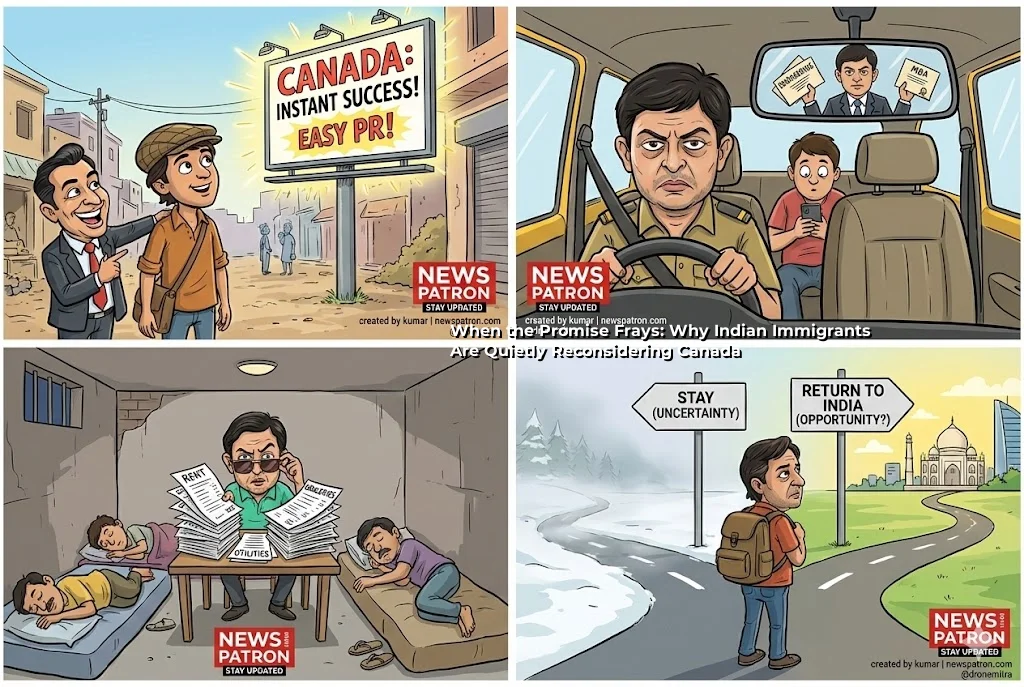
Canada’s immigration system was never easy, but it was legible. Students knew the sequence: education ? work permit ? permanent residency ? citizenship. The clarity of that arc justified extraordinary sacrifices—family savings, land sales, debt.
What changed after 2023 was not just policy, but tempo.
Recommended Product
Top Electronics Bestsellers on Amazon India
🛒 View on Amazon →As an Amazon Associate, we earn from qualifying purchases. Price and availability may vary.
Caps on international student visas tightened sharply. Express Entry scores climbed beyond the reach of many already inside the system. Entire PR pathways quietly stopped issuing draws. Processing timelines stretched, then blurred. For those already in Canada, the sense was not rejection—but displacement mid-journey. Rules appeared to shift after commitments were made, creating a feeling many immigrants describe as being “trapped between legality and expiry.”
Underemployment and the Dignity Question
Perhaps the most emotionally charged shift is not bureaucratic but existential. A recurring theme across immigrant narratives is not poverty—but mismatch. Engineers driving ride-share cars. Healthcare graduates stocking shelves. IT professionals juggling multiple low-wage jobs with no clear path back into their trained fields.
Underemployment has always existed in immigrant societies. What is new is its scale and persistence—combined with shrinking timelines to qualify for permanent residency before work permits expire. This has transformed the immigrant experience from one of delayed gratification to prolonged limbo.
Housing, Cost, and the Collapse of the “Middle Step”
Housing costs have become the most visible pressure point—and the least ideological one. When dual-income households cannot afford mortgages, when students crowd into basement accommodations with eight or ten occupants, and when rents consume disproportionate shares of income, the immigration bargain collapses.
This is where nostalgia enters the conversation—not for India as it was, but for what it has become. India’s uneven growth, long derided in emigration narratives, now appears competitive in opportunity, autonomy, and upward mobility.
A Broader Context: Canada Beyond the Moment
To understand this shift fully, it helps to step back. Canada remains a complex, functioning democracy with deep institutional strengths. Its history as a pluralistic society did not emerge overnight, as explored in How Canada Became a Nation: A Brief History of Canada’s Formation. Its cultural diversity and civic ideals still matter, as outlined in Canada: A Mosaic of Majesty, Diversity, and Progress.
At the same time, bilateral tensions—especially in the wake of the Khalistan controversy—have altered the diplomatic atmosphere between Ottawa and New Delhi. The political undercurrents of this shift are examined in How India-Canada Relations Turned Sour Over Khalistan.
Conclusion: A System at an Inflection Point
Canada has not “failed,” nor has it rejected immigrants wholesale. But the conditions that once made it uniquely attractive—predictability, proportional reward, psychological safety—are under visible stress. The question many are now asking is not whether Canada still offers opportunity—but whether the opportunity still justifies the price.
The Arc of Change: 2015 to 2026
To understand the current crisis, one must look at the timeline of policy shifts that redefined the Canadian immigration landscape.
- 2015–2019 (The “Gold Standard” Phase): Express Entry CRS scores remained relatively stable, and education was widely viewed as a guaranteed pathway to Permanent Residency.
- 2020–2021 (Pandemic Pause & Surge): Canada accelerated PR approvals for those already inside the country to meet targets, while international student inflows rebounded rapidly post-lockdown.
- 2023 (Stress Fractures): Housing affordability escalated into a national political crisis, leading provinces to signal capacity limits for new arrivals.
- Jan 2024 (The Structural Break): The federal government imposed sharp caps on international student visas, and education-linked PR streams began pausing draws.
- 2025 (The PR Bottleneck): CRS scores have crossed psychologically unreachable thresholds for many, prompting increased exit planning among temporary residents.
- Projected 2026 (Retrenchment): Analysts predict a pivot toward exclusively “high-impact” talent (healthcare, trades), making general immigration narrower and more conditional.
The New Reality: Addressing Key Concerns
Selectivity, Not Rejection
Is Canada “anti-immigrant” now? No. The nation still relies on immigration for demographic stability. However, the system has fundamentally moved from volume-driven intake to capacity-constrained filtering. This shift disproportionately affects those already in transitional pathways.
The “Return” Narrative
Is returning to India a failure? Increasingly, returnees are rejecting that framing. Many describe the move as a strategic reset—a way to regain professional identity and long-term stability in an Indian economy that is growing rapidly compared to the West.
Who is Canada Still For?
Does Canada still make sense? Yes, but the target demographic has narrowed. It remains a viable option for those with direct job offers in shortage occupations (like healthcare or construction) or those with high CRS scores who do not need to rely on general education pathways.
? Strategic Comparison: Canada vs. Australia vs. India
| Factor | Canada ?? | Australia ?? | India (Growth Story) ?? |
|---|---|---|---|
| Immigration Policy | Narrowing; High unpredictability | Strict but transparent; Point-based | N/A (Home Base) |
| Housing Cost | Crisis levels (GTA/Vancouver) | High, but larger spacing | Rising, but options exist across tiers |
| Job Market | Saturation in entry-level/IT | Strong in trades/healthcare | Booming in Fintech/Tech/Service |
| Long-Term Stability | High (once PR secured) | High (but slower PR) | High (Social/Cultural safety) |

[…] Click here to read the detailed report. […]