




What You Are About to Watch — And Why This Time May Actually Be Different
Context, names, and what the Borivali Pattern means in 2026
This post is built on a video personally recorded and published by BJP MLA Sanjay Upadhyay of Borivali during an on-ground inspection of Mahavir Nagar and New Link Road, Borivali West. Legal context — on gutkha’s status in Maharashtra, imported cigarette restrictions, and Maharashtra’s new liquor shop NOC rules — is drawn from published state government notifications and peer reporting. The individual named “Atiq” in the MLA’s remarks is identified by the MLA as the gutkha supplier for the shop inspected; his full identity has not been independently confirmed at time of publishing. The inspection was MLA Upadhyay’s 142nd documented public accountability walk under the Borivali Pattern series. That number is not a typo. ?
The Man Who Has Done This 141 Times Before Just Did It Again — And This Time He Found Everything
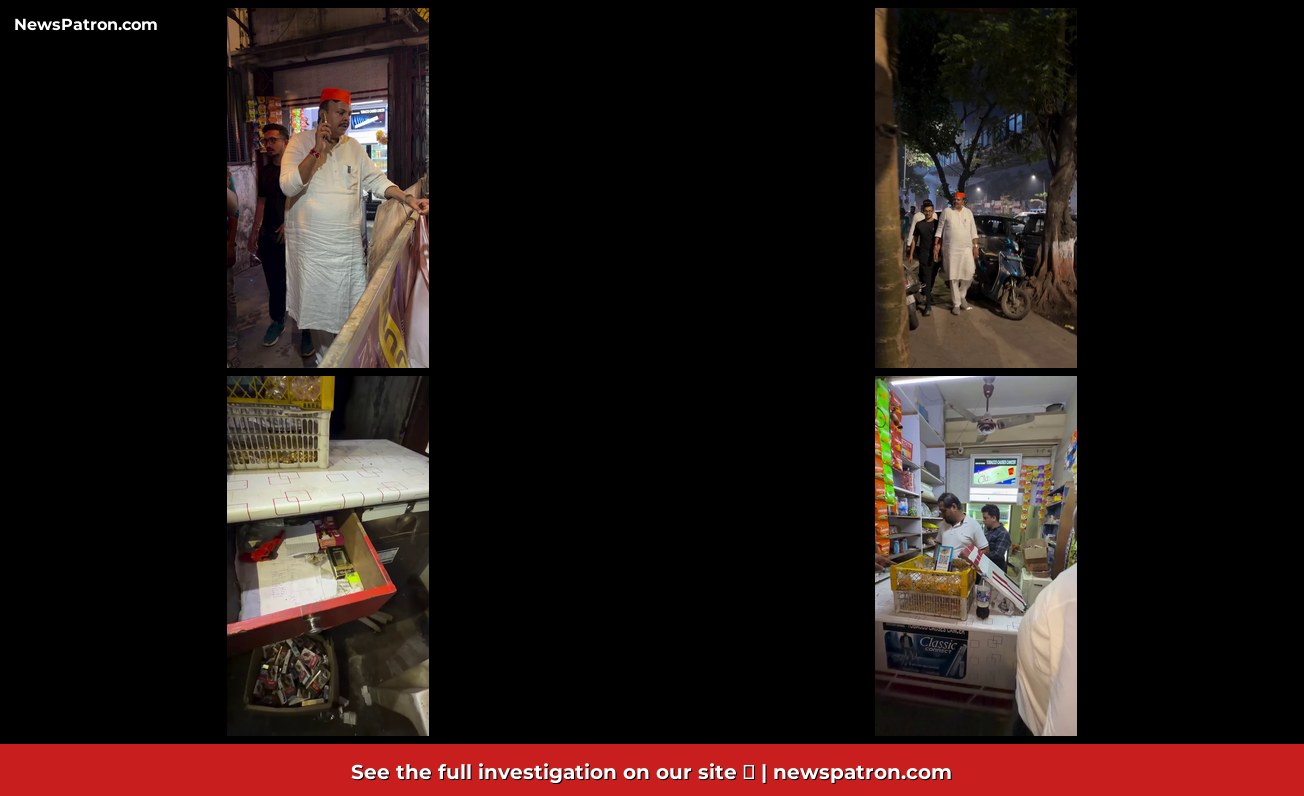
Sanjay Upadhyay, BJP MLA, Borivali, walked into a paan shop on New Link Road on 23 February 2026 — in the middle of the afternoon — and found the following, all in one establishment:
- Open liquor bottles and glasses on the counter
- Customers drinking upstairs on a daily basis
- Gutkha packets, banned in Maharashtra under the Food Safety and Standards Act
- Imported cigarettes, banned from retail sale without authorised import licensing
- Paper pipe products labelled as “hookah flavour” that the MLA immediately identified as marijuana delivery devices
- Bills linking the gutkha supply to a specific individual named Atiq
He recorded all of it on camera. He confronted the shopkeeper on camera. He demanded the excise department be called on camera. And then he said: “I want that same Atiq in jail. Give his number. I want Atiq inside — no excuses.”
This is not the first time Sanjay Upadhyay has walked into a street in Borivali and found this. It is, based on his own public documentation, the 142nd time he has done a public accountability walk of this type in Borivali alone.
It is the first time, in any of those 142 walks, that he found open marijuana alongside open alcohol alongside banned gutkha alongside illegal imported cigarettes — all in one shop, all available at three in the afternoon, all within easy reach of any teenager or child walking past on their way home from school.
What the Inspection Revealed on Camera
The interaction captured inside the shop highlighted a massive gap between legal regulations and ground reality. When confronted about the open bottles and glasses, the shopkeeper casually dismissed them as a setup meant “for sitting.” Banned gutkha packets were aggressively defended as mere “hookah flavour,” met with complete silence when the state-wide ban was pointed out. Most brazenly, paper pipes clearly designed for marijuana were passed off as “beedis.”
The discovery of supply bills naming a specific distributor, Atiq, prompted immediate and unambiguous demands from the MLA for police custody and a formal excise department intervention. The “Borivali Pattern” — his public hawker and encroachment crackdown that has become one of the most talked-about local governance initiatives in Mumbai’s western suburbs — is now being extended to the open bar and nasha trade with the same zero-tolerance approach.
Who Is Sanjay Upadhyay — And Why the Borivali Pattern Is Not Political Branding
The context of why this video carries more weight than a standard politician’s inspection walk requires understanding what the Borivali Pattern actually is and what it has cost the MLA personally.
Sanjay Upadhyay won the Borivali assembly seat in 2024. From his first weeks in the role, he began a systematic campaign against illegal hawkers and encroachments on Borivali’s footpaths, station approaches, and public spaces — not by filing complaints or issuing press releases, but by walking the streets personally, camera in hand, in publicly numbered series starting from Part 1.
Recommended Product
Amazon India – Shop Today's Best Offers
🛒 View on Amazon →As an Amazon Associate, we earn from qualifying purchases. Price and availability may vary.
The crackdown worked well enough that the hawkers pushed back. In December 2025, MLA Upadhyay spoke publicly about receiving threats after the crackdown. He was offered money to stop. He did not stop. He spoke on record: “How many times will they bounce back? One day or the other they will have to give up.”
In April 2025, he went further — calling a meeting with BMC officials and demanding that materials seized from illegal hawkers be destroyed rather than returned after fines are paid, specifically to break the cycle of hawkers returning to the same spots within hours of removal. He defended it plainly: “BMC takes action, but within hours of action, the hawkers are back at the same spot. Unless this practice is not stopped, the circus will go on.”
In July 2025, hawkers were physically removed from Borivali West railway station under his watch. On 20 February 2026 — just three days before the nasha inspection walk — BMC demolished 25 illegal structures and 35 unauthorised stalls in the Mahavir Nagar area of Borivali West and Kandivali West.
The man in that video is not performing for an election. He won it. He is doing Part 142 of a documented series because he has decided that Borivali will look different when he is finished with it. The question is whether the excise department, the police, and the supplier chain behind Atiq agree to cooperate with that vision.
What the Law Says — And How Far the Reality Is From It
Gutkha has been banned in Maharashtra under the Food Safety and Standards (Prohibition and Restrictions on Sales) Order since 2012. The ban covers manufacture, storage, distribution, and sale. What the MLA found in that shop was not a grey area. It was a shelf of banned products, openly stocked, with supply bills showing a named supplier.
Marijuana (ganja) is a controlled substance under the Narcotic Drugs and Psychotropic Substances (NDPS) Act. Possession for commercial purposes carries a minimum sentence of 10 years. Labelling it as “hookah flavour” does not change what it is.
Imported cigarettes without authorised import licensing and proper duty-paid clearance are illegal to retail under Customs Act provisions and the Cigarettes and Other Tobacco Products Act. The shopkeeper’s acknowledgement — “This one came imported. This one.” — is not a defence. It is a confession.
Open drinking on shop premises without a valid excise permit is an offence under the Maharashtra Prohibition Act and the Bombay Prohibition Act. The customer upstairs drinking “every day” is not a grey area. The establishment either has a permit or it does not. If it has one, the permit should be reviewed. If it does not, the fine and closure procedure is clear.
In December 2025, Maharashtra Deputy CM Ajit Pawar announced that new liquor shops in housing societies now require a No Objection Certificate from the society, and that 75% of votes in a ward can force the closure of an existing shop. The policy direction at state level is tightening. The street reality in Mahavir Nagar on 23 February 2026 was the opposite.
What Residents Are Saying — And They Are Not Wrong
Two responses from Borivali residents circulating alongside the video deserve to be read as the civic temperature they represent:
The first: “Hard-working taxpayers pay for infrastructure, and illegal encroachers take it over like it’s their private property. A skywalk is for pedestrians, not for a permanent illegal market. If the system doesn’t have the guts to clear the path for its citizens, the system is failing us. Bulldoze the illegal or stop taking our taxes.”
The second: “This is all over Mumbai, not just limited to Borivali. Should ban the sale of plastic glasses — as they consume the liquor in those plastic glasses available at Rs. 3 or 5.”
The plastic glass observation is sharper than it looks. The Rs. 3 disposable glass is the infrastructure of the open bar — cheap enough to be untraceable, disposable enough that no establishment needs a licence for a consumption-on-premises model. Banning the retail sale of single-use plastic glasses at liquor access points — or requiring any business selling alcohol to be a licensed premises — is a specific, actionable policy suggestion that emerges directly from ground reality.
These are not angry social media comments. They are citizen policy briefs from people who walk those streets every day.
What Has to Actually Happen Now
The MLA has done his part — he walked in, found it, showed it, named it, and demanded action on camera. What follows belongs to other institutions.
- The excise department must visit the establishment on New Link Road with the video as documented evidence and initiate licence proceedings — or confirm that no licence exists and proceed accordingly.
- The police must register Atiq, the named gutkha supplier, based on the bills recovered on camera by the MLA. The supplier is the logistics chain. Arresting the shopkeeper alone restocks the shelf within a week.
- The NDPS team must test and formally classify the “hookah flavour” products found. If they are confirmed marijuana delivery devices, the NDPS Act provisions apply — not just excise law.
- BMC must include open-premises drinking establishments in its ongoing verification cycle. The Mahavir Nagar demolition drive of 20 February covered 60 illegal structures. The nasha supply chain found three days later in the same neighbourhood suggests the civic clean-up and the narcotics clean-up are not yet coordinated.
- Maharashtra’s housing society NOC rule — announced in December 2025 — should be actively communicated to Borivali resident associations so that they know they have a formal instrument to block new liquor retail establishments in their localities.
The Borivali Pattern — What It Needs to Become
The Borivali Pattern began as a hawker-free drive. It proved a point: that a single elected representative with a camera, a documented series, and an unwillingness to accept money or threats can visibly move the needle on street encroachment in Mumbai.
What Part 142 shows is that the pattern needs to expand. Clean footpaths matter. Clean streets also means streets where a daughter walking home from college at 7 PM does not pass men in various states of intoxication outside an unlicensed open bar, where the paan shop on the corner is not also the local gutkha counter and ganja distributor, and where the next generation of Borivali’s residents grows up with something better than the options on that shelf.
The MLA said it himself: “These people are working to ruin the younger generation.”
He is right. And the Borivali Pattern, in its nasha phase, is the right answer. Whether it delivers depends on the excise department, the police, and a supplier named Atiq.
From NewsPatron — Kumar Wants to Hear From You
Are you a Borivali resident who has seen this open bar culture in your area? Do you know of other spots in western suburbs where gutkha, ganja, and open drinking operate in plain sight? This story is not finished with one inspection walk.
Kumar, Editor at NewsPatron, is on every platform:
- ? Daily updates and breaking civic stories: Follow on Instagram, X (Twitter), YouTube, and Reddit
- ? Community conversations: Like the NewsPatron Facebook page — Mumbai civic accountability posts travel furthest there
- ? Instant alerts: Subscribe to the NewsPatron WhatsApp Channel — your number stays private, always
- ?? Direct tips: Find Kumar on Telegram
- ? Professional civic network: Connect on LinkedIn
All links at newspatron.com. And when you need to remember why all of this is worth fighting for — DroneMitra on YouTube, where Mumbai and India look exactly the way they should: youtube.com/@dronemitra and youtube.com/@dronemitra/shorts. ?

[…] https://newspatron.com/borivali-pattern-paan-shop-raid-sanjay-upadhyay-mumbai/ […]