


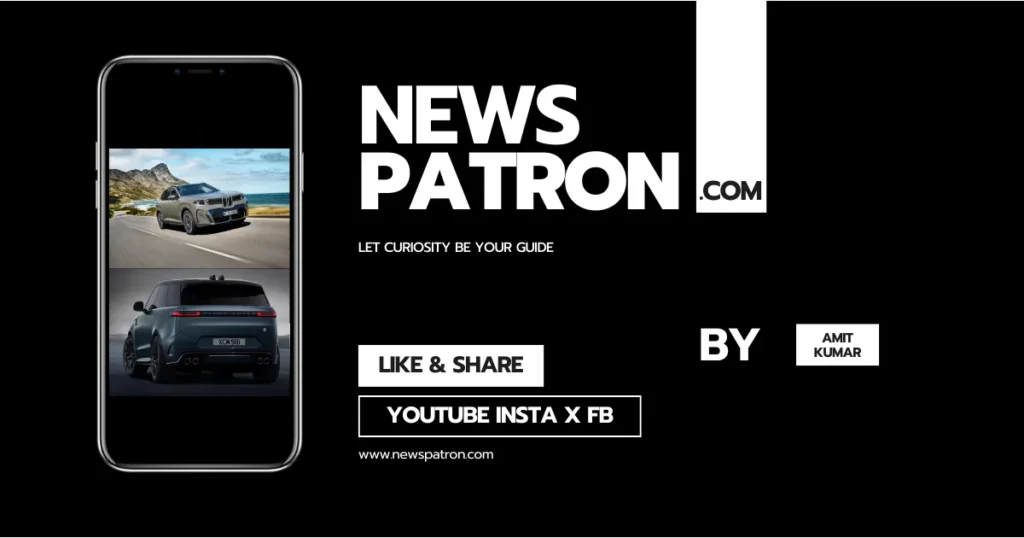

Watch on YouTube: This Shorts video | Auto playlist
Editorial Preface
The BMW X5 vs Range Rover Sport debate is one of the most important luxury SUV decisions for Indian buyers right now. On paper, both are premium, powerful, and expensive. In real life, though, they represent two very different ways of spending serious money. One leans toward logic, balance, and easier ownership. The other leans toward prestige, road presence, and a stronger emotional pull.
In this Newspatron feature, we look at what really matters once the showroom lights stop impressing you. We compare price, Indian road comfort, powertrain choices, fuel efficiency, service reality, long-term costs, and daily usability. If you are trying to decide whether to buy with your head or your heart, this article is designed to make that choice easier. You can also explore more sharp auto comparisons on Newspatron after this piece.
BMW X5 vs Range Rover Sport in India
If you walk into a premium showroom in Delhi, Mumbai, or Bengaluru with a budget near the top end of the luxury SUV market, this is the question that will come up quickly: BMW X5 vs Range Rover Sport. Both look like serious machines. Both promise comfort, performance, and status. Yet they appeal to very different kinds of buyers.
The BMW X5 usually speaks to the buyer who wants a luxury SUV that feels modern, capable, and easier to justify on practical grounds. The Range Rover Sport speaks to the buyer who wants the cabin mood, the road presence, and the satisfaction that comes with owning a badge that still turns heads before the engine even starts.
That is what makes this comparison worth doing properly. This is not just about specifications. It is about what these two SUVs feel like on Indian roads, how they fit Indian ownership patterns, and where the money actually goes after the purchase.
BMW X5 vs Range Rover Sport price in India
Price is where this comparison gets serious very fast. The gap between these two SUVs is not a token premium. In India, it is the kind of difference that shapes your buying decision, your financing burden, your insurance bill, and often your long-term ownership comfort.
A well-equipped BMW X5 typically sits in the lower band of this contest. Depending on variant and city, it usually lands in a noticeably more accessible bracket than the Range Rover Sport. The Range Rover Sport starts higher and climbs faster once you begin looking at desirable trims and options. That means the real on-road difference can feel larger than the brochure difference.
Recommended Product
Top Electronics Bestsellers on Amazon India
🛒 View on Amazon →As an Amazon Associate, we earn from qualifying purchases. Price and availability may vary.
Why does that matter so much in India? Because buyers here do not just pay ex-showroom price. They pay GST, compensation cess, registration, road tax, insurance, and city-specific charges. The final figure can shift the SUV from strong luxury buy to major lifestyle statement. That is exactly why the BMW X5 often enters the conversation as the rational luxury option, while the Range Rover Sport enters as the emotional one.
BMW X5 vs Range Rover Sport driving feel on Indian roads
Indian roads reveal character quickly. A luxury SUV is not tested only on smooth expressways. It is tested on patchy tarmac, rough urban edges, tall speed breakers, broken rural links, and monsoon damage that appears overnight. In those conditions, these two SUVs begin to show very different personalities.
The BMW X5 tends to feel sharper and more driver-focused. The steering usually feels more precise, the chassis feels more settled when you press on, and the entire package makes more sense for buyers who enjoy driving themselves. That matters in India because a large share of luxury SUV owners still spend plenty of time behind the wheel, especially on highway runs and weekend drives.
The Range Rover Sport takes a different route. Its appeal comes from calmness, isolation, and a richer sense of comfort over poor surfaces. It feels more relaxed when the road gets ugly. That makes it especially attractive for buyers who are often chauffeur-driven or who place rear-seat comfort and bad-road composure above driver involvement.
So which one is better? It depends on what you value more. If you want a luxury SUV that feels alive and controlled, the X5 has the edge. If you want the car to iron out broken roads and make every journey feel softer, the Range Rover Sport has the stronger case.
BMW X5 vs Range Rover Sport powertrain options
Powertrain flexibility is one of the BMW X5 strongest advantages in India. The X5 has historically made more sense for a broader range of owners because it offers versions that suit different use cases, especially buyers who value a diesel option for long distances and lower running stress. That alone gives it a practical edge.
The Range Rover Sport still offers strong engines and plenty of performance credibility, but the buying logic is different. Once you step into that lineup, the price jumps are sharper and the ownership equation becomes heavier. The appeal remains strong, but it is less about flexibility and more about whether you are comfortable paying a premium for the full experience.
This is where Indian usage matters. A buyer doing airport runs, city traffic, and occasional highway journeys has different needs from someone doing heavy intercity travel every month. The X5 usually covers more of those use cases with less compromise, which is why it often looks like the easier recommendation on paper.
Real world fuel efficiency
Fuel efficiency may sound secondary in this segment, but it matters once annual running starts to climb. Even buyers in this class notice the difference over time, especially when one SUV clearly stretches each tank better than the other.
- BMW X5 xDrive40i petrol: 9 to 11 kmpl on the highway, 6 to 8 kmpl in the city.
- BMW X5 xDrive30d diesel: 13 to 15 kmpl on the highway, 10 to 12 kmpl in the city.
- Range Rover Sport P400: 8 to 10 kmpl on the highway, 6 to 7.5 kmpl in the city.
The diesel X5 is clearly the standout for buyers who cover long distances regularly. Even the petrol X5 usually remains more favorable than the Range Rover Sport for owners who care about annual fuel spend.
BMW X5 vs Range Rover Sport reliability and service reality
This is often the section that quietly decides the winner for Indian buyers. Many people fall in love with a luxury SUV during the first drive. The real question starts later: what happens after one year, after three years, and after the warranty fades into memory?
The BMW X5 generally carries the more reassuring ownership image. Buyers tend to view it as easier to service, easier to support, and less stressful to live with over time. A wider service footprint and better parts comfort also strengthen that impression in India.
The Range Rover Sport is not without appeal here. In fact, its desirability often survives even when buyers openly acknowledge the ownership risk. That is part of the badge power. Yet the practical side remains clear: if long-term predictability matters to you, the X5 usually feels like the safer place to put your money.
Maintenance and long term costs
Long-term ownership costs are where the gap can become hard to ignore.
- BMW X5 standard maintenance is usually in the ?45,000 to ?70,000 per year range.
- Range Rover Sport can rise to ?80,000 to ?1.5 lakh or more per year depending on usage, parts, and repairs.
- Air suspension risk changes the picture further. BMW repairs are usually easier to absorb. Range Rover Sport air suspension repairs can run into ?3 lakh to ?6 lakh per incident.
That means the difference is not only about the purchase price. It is about how much uncertainty you are willing to carry once the vehicle ages.
Warranty reality in India
Warranty support also matters in this segment because repair costs are rarely small. Land Rover typically offers a 3 year or 1,00,000 km warranty in India, with extended options available at added cost. BMW generally offers 4 years or 1,00,000 km, and the ownership picture is usually seen as more predictable.
For many Indian buyers, that extra confidence matters as much as the feature list. A luxury SUV is easier to enjoy when you are not constantly budgeting for the next unpleasant surprise.
Key differences between BMW X5 and Range Rover Sport in India
At this point in the comparison, the broad pattern becomes clear. The table below works as a quick decision guide for readers who want the argument in one view before moving to luxury feel, practicality, and final verdict.
| Aspect | BMW X5 xDrive40i or 30d | Range Rover Sport P400 | Winner in India |
|---|---|---|---|
| On road price approx | 1.45 to ?1.75 Cr | 1.85 to 2.25 Cr | BMW X5 better value |
| Driving feel | Sharper, more engaging, driver-focused | Softer, more comfortable, wafting ride | Tie depends on preference |
| Highway fuel efficiency | 9 to 11 kmpl petrol, 13 to 15 kmpl diesel | 8 to 10 kmpl | BMW X5 |
| City fuel efficiency | 6 to 8 kmpl petrol, 10 to 12 kmpl diesel | 6 to 7.5 kmpl | BMW X5 |
| Reliability | Stronger track record, fewer issues | More electronics and suspension concerns | BMW X5 |
| Annual maintenance | 45k to 70k standard, higher for air suspension | 80k to 1.5 lakh plus | BMW X5 |
| Service network | Wider, faster parts availability | More limited, longer waits | BMW X5 |
| Insurance first year | 1.8 to 2.4 lakh | 2.6 to 3.5 lakh | BMW X5 |
| Road presence and status | Strong but sporty | Superior prestige and road presence | Range Rover Sport |
| Ride over bad roads | Good | Excellent with air suspension advantage | Range Rover Sport |
| Rear seat comfort | Very good | Excellent for chauffeur use | Range Rover Sport |
| Long term ownership cost | Lower | Significantly higher | BMW X5 |
| Best for | Self-driven buyers, value, efficiency | Status, comfort, emotional appeal | Depends on buyer |
If you want the shortest possible takeaway, it is this: choose the BMW X5 for value, lower running costs, reliability, and driving enjoyment. Choose the Range Rover Sport for prestige, ride comfort, and status.
Luxury features and road presence
Now we come to the part that keeps the Range Rover Sport firmly in the fight. Luxury is not just a spreadsheet exercise. It is also about how a vehicle makes you feel when you step in, shut the door, and settle into the cabin.
The BMW X5 usually feels more modern and more technical. Its interior presentation, interface logic, and overall layout often appeal to buyers who like clean functionality and a sharper sense of control. It feels premium, but also disciplined.
The Range Rover Sport moves in a different direction. It tends to feel richer, softer, and more occasion-driven. The materials, seating atmosphere, and visual presence work together to create a more dramatic luxury statement. That is why many buyers still want it even after admitting that the X5 is the sensible option.
BMW X5 vs Range Rover Sport practicality for daily Indian use
Daily practicality matters more than many buyers admit at first. Luxury does not cancel traffic, poor parking, bad roads, family luggage, or repeated airport runs. A vehicle that feels great on day one can become tiring if it does not suit your routine.
The BMW X5 usually wins the practical argument because it balances comfort, usability, and ease of ownership so well. It feels better suited to buyers who want one premium SUV to do everything with minimum drama. Self-driven owners often end up appreciating this more over time than they expected.
The Range Rover Sport still holds important advantages. It feels more special, its ride over poor roads can be better, and its rear-seat comfort can suit chauffeur-driven families more convincingly. If those priorities sit above outright practicality, then the decision starts shifting again.
So think about your real use case. Do you drive yourself often? Do you cover a lot of distance? Do you care more about quiet confidence or visible prestige? Those answers matter more than marketing lines ever will.
Performance trims and aspirational appeal
Some buyers will naturally look beyond the mainstream versions of both SUVs. Performance trims and more expensive variants add excitement, stronger acceleration, and a bigger emotional payoff. They also add another layer of cost.
That can make sense if your buying brief genuinely includes performance as a top priority. Still, for most Indian buyers, the flagship story is more about aspiration than daily usefulness. A more powerful trim may look fantastic in the spec sheet, but the standard logic of running costs, comfort, and ownership stress does not disappear.
In other words, the aspirational versions are interesting, but they do not change the main conclusion of this comparison. They simply make the stakes higher.
BMW X5 vs Range Rover Sport final verdict
After looking at price, driving feel, fuel use, ownership reality, maintenance risk, luxury appeal, and practicality, the answer is fairly clear for most Indian buyers. The BMW X5 is the more rational and more complete buy.
It gives you stronger value, more flexible powertrain logic, lower running stress, better efficiency in key variants, and a more reassuring ownership story. That makes it the SUV most people can recommend with a straight face once the excitement of badge talk fades.
The Range Rover Sport still wins in areas that matter deeply to a certain buyer. It has stronger road presence, a richer emotional feel, more soft-edge luxury, and a greater sense of occasion. If you are buying with your heart and you are comfortable with the higher long-term burden, it will still feel special in a way the BMW sometimes does not.
So here is the cleanest possible conclusion. Choose the BMW X5 if you want the smarter luxury SUV for India. Choose the Range Rover Sport if you want the more emotional one and you fully accept the cost of that choice.
Closing note
That is the real shape of the BMW X5 vs Range Rover Sport decision in India. One SUV makes more sense. The other makes a stronger impression. Neither is random. The better one depends on what kind of owner you really are.
If you have driven either of these SUVs on Indian roads, share what stood out most to you. Was it comfort, badge value, fuel cost, ownership confidence, or something else entirely? You can also follow Newspatron for more practical car comparisons that cut through brochure talk and get to the point.
Source channel reference used in workflow: DroneMitra channel dashboard.
