



Introduction
The newly built Alluri Sitarama Raju International Airport at Bhogapuram is, by any visual measure, a genuine architectural milestone for Andhra Pradesh. GMR Group’s greenfield terminal near Visakhapatnam arrives with sweeping glass facades, generous passenger halls, and the kind of scale usually reserved for national capital hubs.
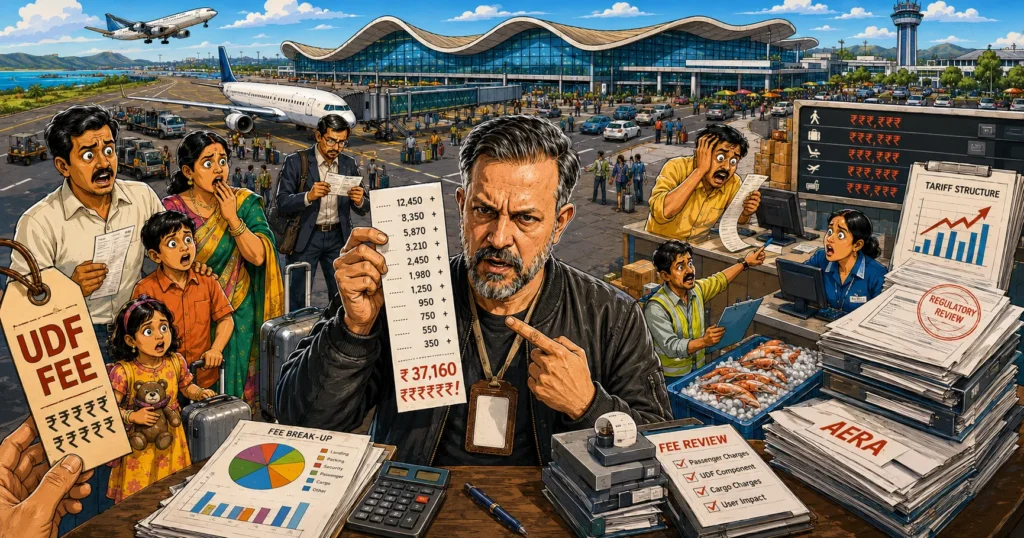
That grandeur makes the next part harder to swallow. The Airports Economic Regulatory Authority (AERA) has approved an ad-hoc User Development Fee (UDF) structure for Bhogapuram’s July 2026 launch window that places it above several established and upcoming tier-1 airports in India. The core question this raises is simple: why are Vizag travelers being asked to pay premium metro-level fees at a mid-tier regional market.
The User Development Fee Cost Reality
UDF is the direct charge airports levy on passengers to fund terminal operations and infrastructure recovery, and it is usually baked into the ticket price rather than paid separately at the counter. Bhogapuram’s approved outbound UDF rates come in higher than Navi Mumbai, Noida’s Jewar airport, and even Delhi and Mumbai on the domestic side.
| Airport | Domestic Departure Fee | International Departure Fee |
|---|---|---|
| Bhogapuram (Vizag) | ₹ 835 | ₹ 1,255 |
| Navi Mumbai | ₹ 620 | ₹ 270 |
| Noida (Jewar) | ₹ 490 | ₹ 210 |
| Mumbai (BOM) | ₹ 175 | ₹ 75 |
| Delhi (DEL) | ₹ 129 | ₹ 650 |
The Inbound Fee Double-Whammy
Most Indian metro airports, including Hyderabad and Delhi, do not charge arriving passengers an additional UDF component, since the fee structure is generally designed around outbound departures. Bhogapuram breaks that pattern.
- Arriving domestic passengers at Bhogapuram will pay ₹ 355.
- Arriving international passengers will pay ₹ 545.
- This effectively doubles the passenger-side fee exposure on a round trip, since both the outbound and inbound legs carry a charge.
For a round-trip domestic traveler, that means UDF exposure of roughly ₹ 1,190 combined, compared to a near-negligible arrival-side cost at most comparable airports.
Why Is Bhogapuram Significantly More Expensive?
Four structural economic pillars explain why a mid-tier regional airport has landed on tariffs closer to a metro hub than a typical secondary city.
Greenfield capital recovery
Bhogapuram was built entirely from raw land by GMR Group, with no existing runway, terminal shell, or utility backbone to build upon. CapEx, or capital expenditure, refers to the upfront money spent on constructing physical infrastructure, and AERA’s regulatory framework legally permits high early ad-hoc tariffs specifically to help recover that staggering initial construction cost.
The sole gateway monopoly
Delhi and Mumbai each have secondary airports nearby that create competitive pricing pressure on tariffs. Vizag does not have that check. Civilian operations at the city’s existing naval airbase will fully shut down once Bhogapuram opens, meaning the new airport absorbs 100 percent of regional traffic with zero local competition to keep fees in check.
Low initial passenger volumes
Mature metro airports spread their fixed operational costs across tens of millions of annual passengers, which keeps the per-passenger fee relatively small. Bhogapuram starts with an initial capacity cap of just 6 million passengers per annum, which means the same fixed cost base gets divided across a much smaller crowd, inflating the per-passenger financial slice.
Recommended Product
Alpino Peanut Butter Chocolate Protein Bar – Gluten Free
🛒 View on Amazon →As an Amazon Associate, we earn from qualifying purchases. Price and availability may vary.
Lack of initial non-aeronautical revenue
Established airports lean heavily on non-aeronautical income such as duty-free retail, hotels, lounges, and premium F&B concessions to offset passenger fees. Greenfield airports like Bhogapuram take years to mature those commercial ecosystems, so in the early phase, the airport has little choice but to rely directly on aeronautical fees like UDF just to stay financially solvent.
Airline and Air Freight Infrastructure Charges
Passengers are not the only ones absorbing Bhogapuram’s early-stage cost recovery. Airlines and cargo shippers face their own back-billed structural charges.
Aircraft landing fees
Landing fees are typically calculated against an aircraft’s Maximum Take-Off Weight (MTOW), which is the heaviest weight at which a plane is certified to safely take off. AERA has set Bhogapuram’s domestic landing rate at ₹ 1,400 per Metric Tonne (MT) of MTOW, and the international landing rate at ₹ 1,975 per MT.
Commercial cargo handling charges
While aircraft landing fees are billed per Metric Tonne, cargo handling charges from Terminal Service Providers (TSP) are billed per kilogram of goods processed.
- Domestic cargo freight: baseline TSP charges average ₹ 0.80 to ₹ 1.20 per kg, roughly equivalent to ₹ 800 to ₹ 1,200 per MT.
- International export cargo, general category: starts at ₹ 1.15 per kg, roughly ₹ 1,150 per MT.
- Specialized perishable and pharma cargo: scales past ₹ 3.50 to ₹ 5.00 per kg, roughly ₹ 3,500 to ₹ 5,000-plus per MT, due to the temperature-controlled logistics routing these categories require.
Cargo Processing Tariff Comparison Hub
Bhogapuram’s cargo pricing sits above both Chennai and Hyderabad across general and cold-chain categories, reflecting the same early-stage cost recovery logic seen on the passenger side.
| Cargo Type & Hub | Baseline Processing Fee (per kg) | Fee Equivalent (per Metric Tonne) | Key Operational / Infrastructure Reality |
|---|---|---|---|
| General Domestic Cargo | |||
| Chennai (MAA) | ₹ 0.75 – ₹ 0.90 | ₹ 750 – ₹ 900 | High-volume, fully amortized state-run/AAICLAS terminal assets. |
| Hyderabad (HYD) | ₹ 0.85 – ₹ 1.05 | ₹ 850 – ₹ 1,050 | Privatised multi-terminal scale via the newly built GMR Cargo Terminal 2. |
| Bhogapuram (Vizag) | ₹ 1.10 – ₹ 1.35 | ₹ 1,100 – ₹ 1,350 | Ad-hoc recovery rates applied to a brand-new, early-stage facility. |
| Perishable / Cold-Chain Cargo | |||
| Chennai (MAA) | ₹ 2.20 – ₹ 3.10 | ₹ 2,200 – ₹ 3,100 | Deep-rooted marine and agricultural export channels with legacy plants. |
| Hyderabad (HYD) | ₹ 2.80 – ₹ 3.80 | ₹ 2,800 – ₹ 3,800 | Major global pharmaceutical hub equipped with dedicated GDP-certified zones. |
| Bhogapuram (Vizag) | ₹ 3.90 – ₹ 5.20 | ₹ 3,900 – ₹ 5,200 | Premium pricing to recover tech setups for sea/aqua product processing. |
Three pain points for shippers
- The scale disadvantage: lower cargo volumes at launch mean fixed handling infrastructure costs get spread across far fewer shipments than at Chennai or Hyderabad.
- Premium tech integration costs: Vizag’s coastal aqua-trade demands blast freezers and cold-chain setups, and those specialized systems are priced into cargo fees from day one rather than being absorbed by existing scale.
- Belly cargo dependency: without a dedicated freighter fleet network yet, Bhogapuram’s cargo capacity leans on belly space inside passenger aircraft, which is inherently less predictable and less cost-efficient than purpose-built freighter routes.
Conclusion
Bhogapuram’s architectural achievement is real, and it marks a genuine milestone for Andhra Pradesh’s aviation ambitions. But the tariff structure approved for its July 2026 launch is a clear reminder that privatized greenfield infrastructure comes with a steep early-stage price tag, one that lands squarely on passengers, airlines, and cargo shippers before the airport’s economics mature.
For more context on how India’s aviation infrastructure is being stress-tested in real time, read our coverage of how the Iran-Israel war turned Mumbai airport into a global waiting room, and our deep dive into India’s aviation safety record.
We also recently covered a striking safety incident abroad in our piece on the Boeing 777 low pass in Texas that raised safety alarms, paired with our YouTube short breakdown of the moment.
Want More Aviation Deep-Dives?
Want to catch more high-flying, visually stunning infrastructure breakdowns? Check out our dedicated Aviation Playlist on Newspatron to watch the absolute GOAT aviation videos and analysis online today!
