


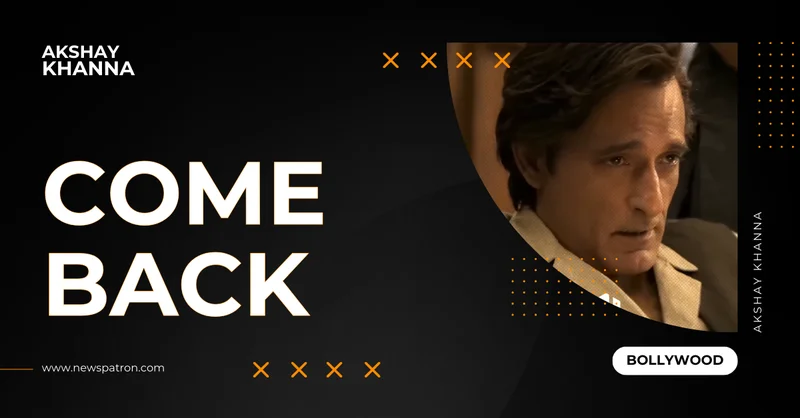

When silence speaks louder than stardom
The Akshaye Khanna Bollywood comeback did not arrive with viral interviews, loud promotions, or manufactured controversies. It arrived quietly—through performances that stayed with audiences long after the film ended. In an era dominated by Bollywood PR culture, constant visibility, and staged relevance, this return feels unusual. And that is precisely why it matters.
For years, Hindi cinema rewarded image over acting. Airports became photo studios. Social media turned into a résumé. Relevance was often measured in clicks rather than craft. In such a system, actors who avoided noise were treated as risks. Yet today, Akshaye Khanna’s cult following shows that restraint, when backed by skill, can still command attention.
This is not just a story about one actor finding his way back. It is a story about an industry adjusting to a more demanding audience—one that now values performance-driven cinema over spectacle.
Before we move ahead, a quick note for curious readers. Do explore DroneMitra – “Your Sky is Digital with a Drone as a Friend” for stunning drone shots, and Newspatron – “Let Curiosity Be Your Guide”, where stories are driven by questions, not noise.
Akshaye Khanna Bollywood comeback and the illusion of fame
For a long time, Bollywood functioned on a simple belief: if you are visible, you are valuable. This belief shaped an entire ecosystem. Paid PR, staged paparazzi appearances, and even fake controversies became standard tools of survival. Many actors without recent work were still seen everywhere, because visibility itself was treated as proof of relevance.
This system favored image over acting because it was easier to sell. A familiar face on a poster felt safer than a risky script. Marketing often came before merit, and perception mattered more than performance. Over time, this created a gap between what audiences were told to value and what they actually connected with.
Akshaye Khanna never fully fit into this visibility-first model. Even with early access and industry connections, he avoided constant appearances and resisted building a loud public persona. More importantly, he did not match the Bollywood hero template of his time. His presence was understated. His performances relied on inner tension rather than surface energy. In an image-driven industry, that made him difficult to package.
He avoided overbuilt physiques, did not reinvent himself for spectacle, and showed little interest in selling a fantasy version of himself. That decision quietly pushed him out of the spotlight. Roles narrowed. Visibility dropped. And in an industry where absence is often mistaken for irrelevance, silence came at a cost.
Yet the illusion of fame has limits. When visibility becomes routine, it loses meaning. As audiences gained more choice, performances built on honesty rather than hype began to stand out. The Akshaye Khanna Bollywood comeback did not happen because he changed. It happened because the illusion around stardom began to crack.
Recommended Product
Trylo Riza T-Fit Women's Bra – Comfortable Daily Wear
🛒 View on Amazon →As an Amazon Associate, we earn from qualifying purchases. Price and availability may vary.
Akshaye Khanna career analysis beyond privilege and comparison
A common question follows naturally: if Akshaye Khanna struggled under these conditions, how did actors like Ranbir Kapoor succeed with similar restraint and lean physicality?
The answer lies less in personal traits and more in timing and system alignment. Akshaye Khanna entered mainstream cinema in the late 1990s, when hero images were rigid and masculinity had narrow definitions. Deviating from that mold carried real consequences. Ranbir Kapoor arrived later, when vulnerability had commercial value and urban audiences had grown more influential.
There was also a difference in how both engaged with the system. Ranbir Kapoor allowed careful narrative framing. Even during quieter phases, the industry continued to speak for him. Akshaye Khanna chose near-total withdrawal from narrative construction. He did not trade access for attention or visibility for comfort. In Bollywood, that choice matters.
The Akshaye Khanna Bollywood comeback feels delayed because the industry was not ready to reward restraint when he first offered it. His talent did not disappear. The system simply lacked patience.
In that sense, Akshaye Khanna did not lose time.
The industry did.
The cost of silence in Bollywood PR culture
Silence in Bollywood is rarely neutral. It is often interpreted as arrogance or disinterest. Akshaye Khanna avoided award shows, elite parties, and constant interviews. He did not treat media presence as career maintenance, nor did he rely on controversy for relevance.
This protected his personal space but reduced his professional visibility. Casting conversations in Bollywood often depend on presence rather than auditions. Relationships are reinforced at events, not just on sets. When an actor stops appearing in those spaces, their name slowly fades from informal discussions.
At the time, there were no alternative paths to rediscovery. No social media bypass. No audience-driven correction. If you were not visible, you were forgotten. Akshaye Khanna did not disappear because of failure. He faded because he refused to compete in a system built on noise.
Ironically, that silence preserved his work. When audiences returned to his performances years later, they felt fresh rather than familiar. That difference would matter when the system changed.
How OTT and covid changed Bollywood forever
The real shift did not begin with actors. It began with audiences. As internet access widened and global content became easily available, viewers started comparing rather than accepting. This change accelerated after covid. Confined to their homes, audiences explored Korean dramas, British crime series, European thrillers, and tightly written American shows.
What united much of this content was control. Strong writing. Believable characters. Performances that trusted the audience. When viewers returned to Hindi cinema, the contrast became clear. Loudness began to feel dated. Weak writing stood exposed.
This shift rewired expectations. Star power alone could no longer guarantee engagement. Performance-driven cinema gained value. Actors who could disappear into characters rather than dominate them found renewed relevance.
This is where the Akshaye Khanna Bollywood comeback becomes inevitable rather than surprising. The ecosystem that once sidelined him had changed. Not because it became kinder, but because it became more accountable.
Akshaye Khanna Bollywood comeback after Dhurandhar
When Dhurandhar released, the conversation focused on Akshaye Khanna’s performance rather than promotion. His presence was controlled, unsettling, and believable. The character felt lived-in, not performed.
This was not an isolated moment. Roles in Section 375, Drishyam 2, and Chhava followed the same pattern. Whether playing a lawyer, an investigator, or a historical figure, he earned attention without demanding it. Directors trusted him to serve the script. Producers valued the credibility he brought to projects.
The Akshaye Khanna cult following did not emerge from campaigns. It grew from consistency. He appears rarely, but when he does, the discussion follows. That reliability is rare in an industry built on spikes and crashes.
Performance driven cinema and the space left behind
Comparisons with Irrfan Khan must be handled carefully. This is not about replacement. It is about a vacuum. Irrfan Khan occupied a rare space in Indian cinema—trusted across genres, scales, and audiences. When he passed away, that space remained empty.
What defines that space is trust. Directors trust such actors to serve the story. Audiences trust them to elevate flawed material. Producers trust the credibility they bring. These qualities cannot be manufactured. They are built over time.
Akshaye Khanna now occupies a similar space. He is not cast to sell spectacle. He is cast to hold scenes together. As performance-driven cinema regains importance, such actors become essential rather than optional.
What the Akshaye Khanna Bollywood comeback means for Indian cinema
The Akshaye Khanna Bollywood comeback is not a personal victory story. It is a signal. It suggests that Indian cinema is slowly moving toward credibility-based decision-making. Image still matters, but it cannot carry weak writing forever.
Audiences today expect agency. They want believable characters, controlled performances, and stories that respect intelligence. OTT platforms did not kill stars. They raised the baseline.
Akshaye Khanna’s journey shows that credibility compounds quietly. It does not spike like hype. It builds until the moment arrives when the system needs it again.
A curious moment from Dhurandhar has sparked quiet amusement among Bollywood watchers.
Ranveer Singh reportedly underwent an intense physical transformation for the role — months of training, a carefully built physique, and long hair grown specifically to inhabit the character. The effort was unmistakable, visible, and very much in line with his reputation for total immersion.
Then Akshaye Khanna appeared.
With no visible transformation and nothing more than a composed screen presence (yes, even a simple wig), Akshaye managed to command attention purely through restraint and performance. No buildup, no spectacle — just control, timing, and experience doing the heavy lifting.
The contrast is what makes it fascinating, not unfair. Ranveer represents preparation that shows on the surface; Akshaye represents craft that works quietly underneath. One is kinetic and expressive, the other calm and surgical — and both coexist within the same film.
If anything, Dhurandhar benefits from this balance. Ranveer brings momentum and intensity, while Akshaye adds weight and authority. The irony that one actor trained relentlessly while the other walked away with much of the conversation is less a slight — and more a reminder of how unpredictable cinema can be.
Sometimes transformation shouts.
Sometimes gravitas whispers.
And audiences notice both.
Conclusion
Akshaye Khanna did not change to fit the industry.
The industry changed to catch up with him.
Noise can create attention.
Only craft sustains it.
Connect with me
If this analysis resonated with you—or challenged you—I’d like to hear your thoughts. Conversations around cinema become meaningful when readers question and engage.
You can connect with Kumar, Editor at Newspatron, on Instagram, Twitter, YouTube, Reddit, Facebook, Tumblr, Telegram, LinkedIn, RSS, and the official WhatsApp Channel. Only authentic profiles are used on Facebook, and WhatsApp remains privacy-first. All links are available on the Newspatron homepage.
For visual storytelling, explore DroneMitra – “Your Sky is Digital with a Drone as a Friend”, featuring drone shots that add perspective to stories.
