




Check out DroneMitra (your sky is digital, with a drone as a friend!) and Newspatron (let curiosity be your guide!) on YouTube for some fantastic drone shots and more insightful content.
Close your eyes for a moment.
It is a Sunday morning. You have bathed, worn clean clothes, finished your chores, and you are now walking — quickly, almost jogging — to the one house in your neighborhood that owns a television set. A mat is already spread on the floor. Children in the front. Elders behind. Women in the corner. Someone is peering in through the window.
The electricity cuts out.
Everyone holds their breath.
Someone scrambles to the rooftop to rotate the antenna. Voices float up from below: “A little to the right… now left… yes! Stop there!”
And then — Lord Rama’s face appears on the screen.
Hands fold automatically. Eyes fill up. Nobody needs to be told to be quiet.
That was not just a Sunday. That was a feeling. A shared one. And it belonged to all of us. ?
Recommended Product
Amazon Renewed — Best Deals of the Day
🛒 View on Amazon →As an Amazon Associate, we earn from qualifying purchases. Price and availability may vary.
When Life Was Driven by Feelings, Not Followers
The 1980s in India was not a time of abundance. Money was limited. Choices were fewer. Comfort, by today’s standards, was basic at best.
And yet — walk through the video that has been making rounds recently, and something catches in your throat. Not because things were perfect. But because something about that era felt whole.
“At that time, people had less money, but so much contentment that peace was always visible on their faces.”
That line lands differently when you are sitting in a house full of gadgets, watching multiple screens, and still somehow feeling like something is missing. ?
The mornings in that era needed no alarm. The rooster did the job. So did the sound of a mother sweeping the courtyard, the hand pump’s rhythmic pull, and the slow, patient heat of a stove. The day began with purpose — not with a phone shoved into your face before your eyes had even adjusted to the light.
Watch: The Video That Made an Entire Generation Stop Scrolling
Disclaimer: This video was shared publicly online and is used here under fair use for commentary and cultural appreciation. Newspatron does not claim ownership of this material. Original credit belongs to its creator.
The Takhti, the Ink, and the Peacock Feather: School Was an Event
Going to school in the 1980s was not a commute. It was a ritual. ?
The takhti — a wooden writing board — was washed clean every morning and left to dry in the sun. Then a pen dipped in ink, letters written with care, mistakes erased with a finger and rewritten. A peacock feather tucked inside the book for luck, for knowledge, for the quiet belief that learning was sacred.
Today we might smile at the peacock feather. But consider this: the children who grew up with that feather in their books also grew up understanding that education was not a transaction. It was a gift — paid for, often dearly, by parents who gave up their own wants so their children could sit in that classroom.
That is not superstition. That is faith. And there is a difference.
Lunchboxes were packed by hand. Every morning, without complaint, without asking for appreciation. The effort was invisible because it was constant — and constant love tends to go unnoticed until it is gone.
(Read the full story in our previous blog about How Community Spaces Shaped Indian Identity — and What We Lost When They Became Transactional)
The Red Powder, the Lifebuoy Bar, and the Two-Rupee Haircut
Let us be honest — the bathroom routine of the 1980s had a certain personality. ?
Lifebuoy soap. Its scent spread through the entire house when it hit warm water. And Dabur Lal Dant Manjan — that bold red powder that stained your lips and brush but left behind a freshness that, if you grew up with it, you still remember. Toothpaste was for special occasions. The red powder was for real life.
And then there was the salon. No air conditioning. No revolving chairs. A large wall mirror, a ceiling fan that worked on its own schedule, and the steady khat-khat of scissors. A white cloth around the neck. Hair trimmed, powder dusted on, a light pat — like an honor.
For two rupees, a child walked out feeling like a movie star.
The salon was not just a haircut. It was the village newspaper. Every piece of neighborhood news passed through that chair. Births, marriages, disputes, celebrations — all discussed while someone got a trim.
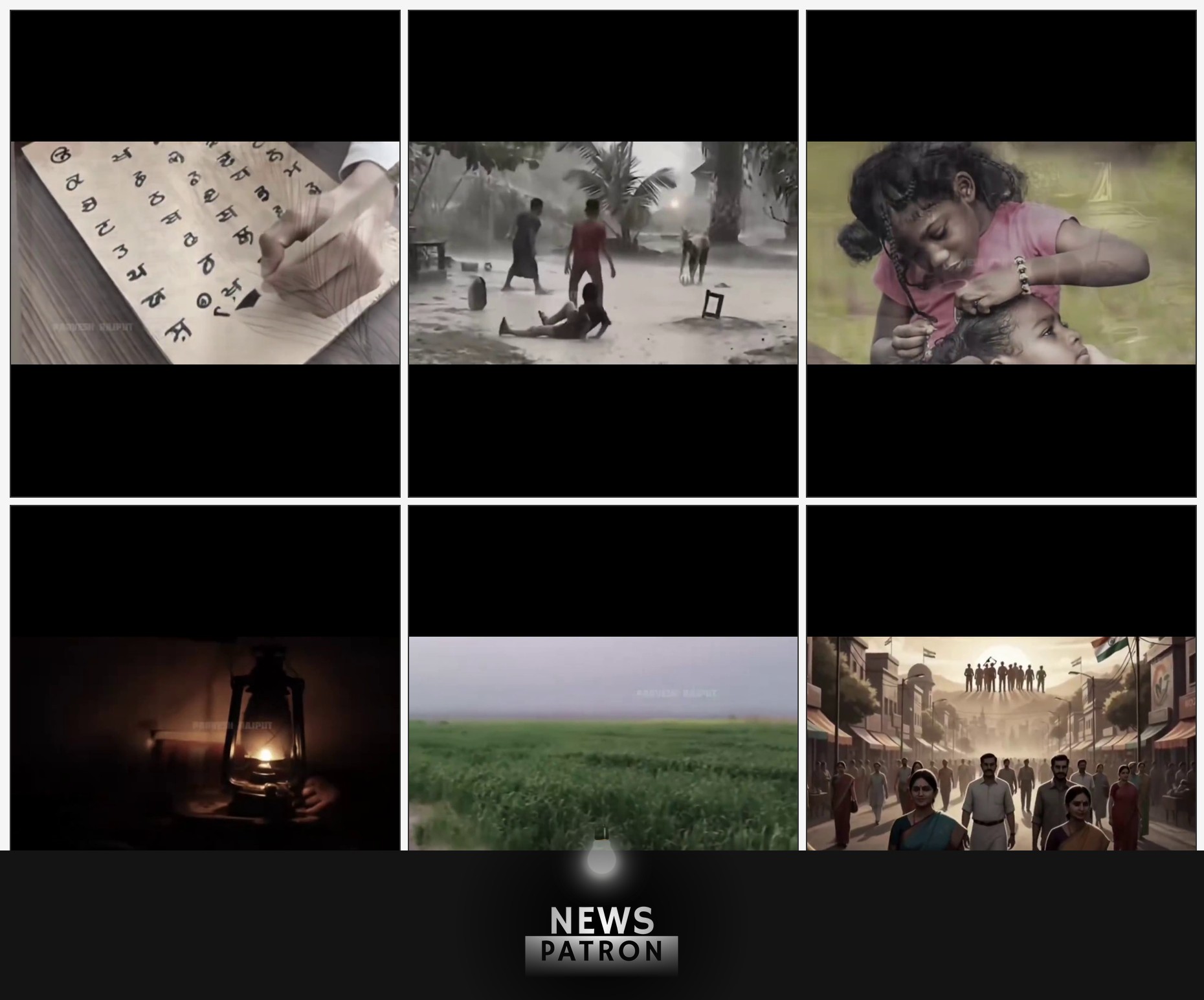
Marbles, Mud Circles, and Mangoes That Tasted Like Freedom
As soon as school ended, the bags were thrown into the nearest corner — and the real work began. ?
Marbles. Gilli-Danda. Kabaddi. Hide-and-seek. Jump rope. These were not “activities” — they were the architecture of childhood. Friendships were built in those mud circles, tested in those Kabaddi matches, and sealed over afternoon games that nobody wanted to stop.
Toys were expensive. So children built their own — cars from wood and old slippers, spinning tops from cold drink caps. A pinwheel bought at the fair might last two days before it broke. But those two days? The happiness from those two days is, as the narration puts it simply, still intact.
And the mangoes. Guavas. Pears. Not bought at a store for inflated prices, but climbed for — in the village orchard, with friends standing below and fruit coming down from above. Eaten with salt, right there, dust on your hands and joy on your face.
No expensive fruit today can match that taste. Not because the fruit was better. Because the company was everything.
Sunday and Ramayan: The Whole Neighborhood Sat Together
Here is something worth pausing on — because it tells you everything about what has changed.
Not every house had a television. After fifty or sixty homes, perhaps one family owned a black-and-white set. And on Sunday morning, the entire neighborhood came to them. Bathed. Dressed in clean clothes. Arrived early. Sat on mats. Children in front, elders behind, someone peering through the window because there was no more room inside.
When the power cut — and it often did — someone would run to the rooftop to fix the antenna while the crowd below issued directions. And when the picture returned, and Lord Rama appeared on that grainy screen, hands folded on their own. Many people’s eyes filled with tears.
It was not just a serial. It was faith. And it was collective.
After the episode ended, nobody rushed home. They stood outside and talked about it. Children went home and made wooden bows. Someone became Rama. Someone became Lakshman. Someone, delightedly, became Ravana. The whole neighborhood lived the story together.
Today, we have hundreds of channels. Crystal-clear picture. Surround sound. And we watch alone — each in our own room, each on our own screen.
“The TV was black and white, but life was colorful. Today the TV is colorful — but the voice of relationships has dimmed.”
What This Video Made People Remember
When this video circulated recently, something happened in the comments that is worth noting. People did not just watch it. They responded with memories of their own.
One person noted, warmly and with a trace of irony, that today relatives call ahead to announce they are coming — and even then you are not sure if they will actually show up. In the 1980s, relatives simply arrived. Unannounced. And the joy of that surprise visit was different — a different level of happiness entirely, because the relationship was the point, not the scheduling.
Another person captured it precisely: “This video shakes the heart. The struggles of our parents remind us that every comfort and education we received came from their sacrifice. They set aside their own desires to fulfill our dreams — and we owe them more than we give.”
“Work was hard then. But respect was for people — not just for money.”
The 1990s: When India Started to Change — But the Heart Had Not Yet Left
The 1980s gave way to the 1990s — and with them came the beginning of a shift. Not a rupture, but a gentle loosening.
India’s 1991 economic liberalisation cracked open a new world. Cable television arrived. Doordarshan’s monopoly ended. Suddenly, Shaktimaan and Chandrakanta and dubbed cartoons were competing with Ramayan reruns. MTV brought Michael Jackson into Indian living rooms. Uncle Chipps. Maggi. Rasna. Dairy Milk as a luxury.
But here is what did not change — not yet. ?
The street still belonged to children. Gully cricket with a tennis ball and chalk-marked stumps. Carrom boards on rainy afternoons. The hand pump, in smaller towns, was still the morning routine. Mothers still packed lunches by hand. Fathers still took the bus.
The takhti became a notebook. The ink pen became a ballpoint. The peacock feather faded from the books — but the intention behind it, the sense that learning was sacred, that effort mattered — that was still there. In most homes. For a while longer.
The seeds of change had been planted. But the roots of the 1980s were still deep.
And for many who grew up in those two decades — the 80s child who became a 90s teenager — the defining memory is not of what was lacking. It is of what was enough. Of friends who lived on the same street. Of food that tasted of effort and love. Of parents who never once asked you to acknowledge what they sacrificed — because they considered it their duty, not a transaction.
That is the part that gets you. ?
(Read the full story in our previous blog about The Great Indian Unhygienic Kulfi Factory — where the street food of our childhood summers turns out to carry a story nobody wanted to tell)
What These Decades Ask of Us Now
The narration in this video does not just reminisce. It presses gently — and then a little harder.
It asks a question that is uncomfortable for the generation that grew up in that era and now lives in air-conditioned apartments, tapping on smartphones, occasionally too busy to return a call.
Those parents — who stood at hand pumps before sunrise, who ate less so their children could eat more, who repaired slippers instead of discarding them, who sat on a mat on someone else’s floor just to share a Sunday with their family — where are they now?
Some of them are in homes — not their own. Some of them wait for calls that come less frequently than they used to. Some of them have learned, quietly and without complaint, that the children they gave everything to now have very full lives.
And they understand. They always understand.
That does not make it easier to sit with.
Understanding how parents give is not just nostalgia. It is a reckoning. And this video, in its gentle, unhurried way, offers us that reckoning without accusation.
Take it. ?
A Time That Lives On in Those Who Were There
The 1980s was not just a decade. It was a way of being.
It was simplicity that did not feel like deprivation. It was community that did not need to be organised. It was belonging that arrived naturally — in the clinking of marbles in a pocket, in the scent of Lifebuoy on a Sunday morning, in the sound of an antenna being turned on a rooftop while twenty people held their breath below.
For those who lived it, it has never fully left. It lives in a particular smell, a particular sound, a particular quality of afternoon light on a mud courtyard.
And for those who did not — it is a window into what India was built on. Not policy. Not technology. Not infrastructure.
People who showed up for each other. Every day. Without being asked.
That is worth remembering. And worth carrying forward. ?
Which memory hit you hardest — the 80s or the 90s?
Was it the Ramayan Sunday? The marble games? The first time you saw cable TV? Drop your memory in the comments. We genuinely want to read it.
Newspatron — Let Curiosity Be Your Guide. Check out DroneMitra (your sky is digital, with a drone as a friend!) and Newspatron on YouTube for drone shots and more insightful content.
