


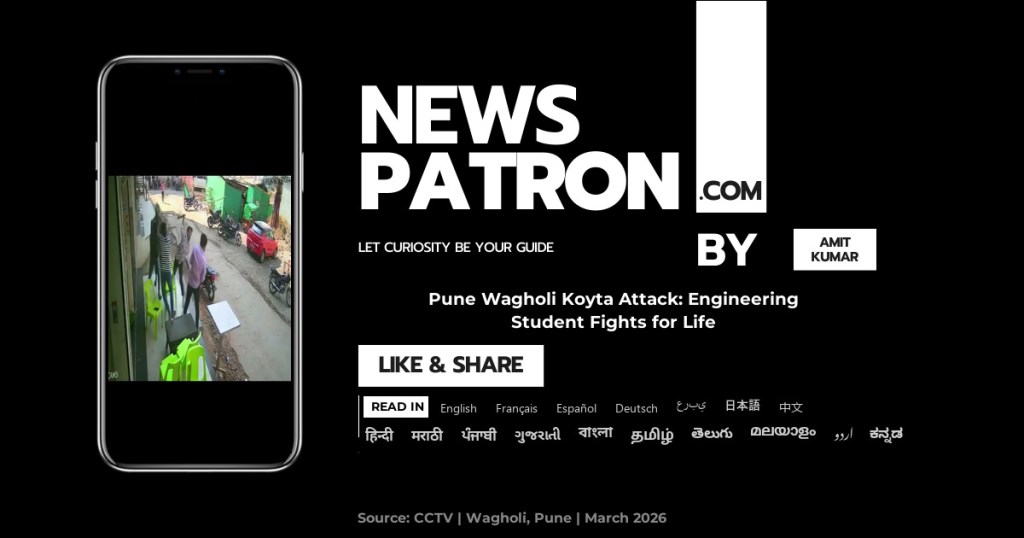

Editorial Note: This article is based on CCTV footage of an incident
outside G H Raisoni College of Engineering and Management, Wagholi, Pune, on 16 March 2026.
The victim has been identified in police and media reports as Nagesh Jagtap.
Three accused — Mangesh Sangale, Rohan Gawali, and a minor — have been arrested.
All legal analysis reflects editorial interpretation and does not constitute legal advice.
The footage is used for the purpose of public interest journalism.
Subscribe to Newspatron on YouTube — Let Curiosity Be Your Guide.
On an ordinary March afternoon in Wagholi, outside a college gate, a group of engineering
students did something completely routine.
They stepped out for tea.
No protest. No clash. No drunken brawl. Just a tea break at a small roadside hotel
opposite their campus.
Minutes later, one of them was on the ground, bleeding, with a koyta stuck in his head.
This is not a scene from a crime web series. This is what actually happened outside
G H Raisoni College of Engineering and Management in Wagholi, Pune, on 16 March 2026.
And the CCTV has captured almost every second of it.
The Attack Outside Raisoni College
According to police reports and local crime desks, the sequence is brutally simple.
- The victim, Nagesh Jagtap, is an engineering student.
- On 16 March 2026, at a roadside tea stall near the main gate of G H Raisoni College,
Wagholi, he was sitting with a friend, having tea. - Three youths arrived: Mangesh Sangale, Rohan Gawali,
and a minor associate. - There was an old dispute between them and Nagesh. Previous words,
previous abuse, previous ego.
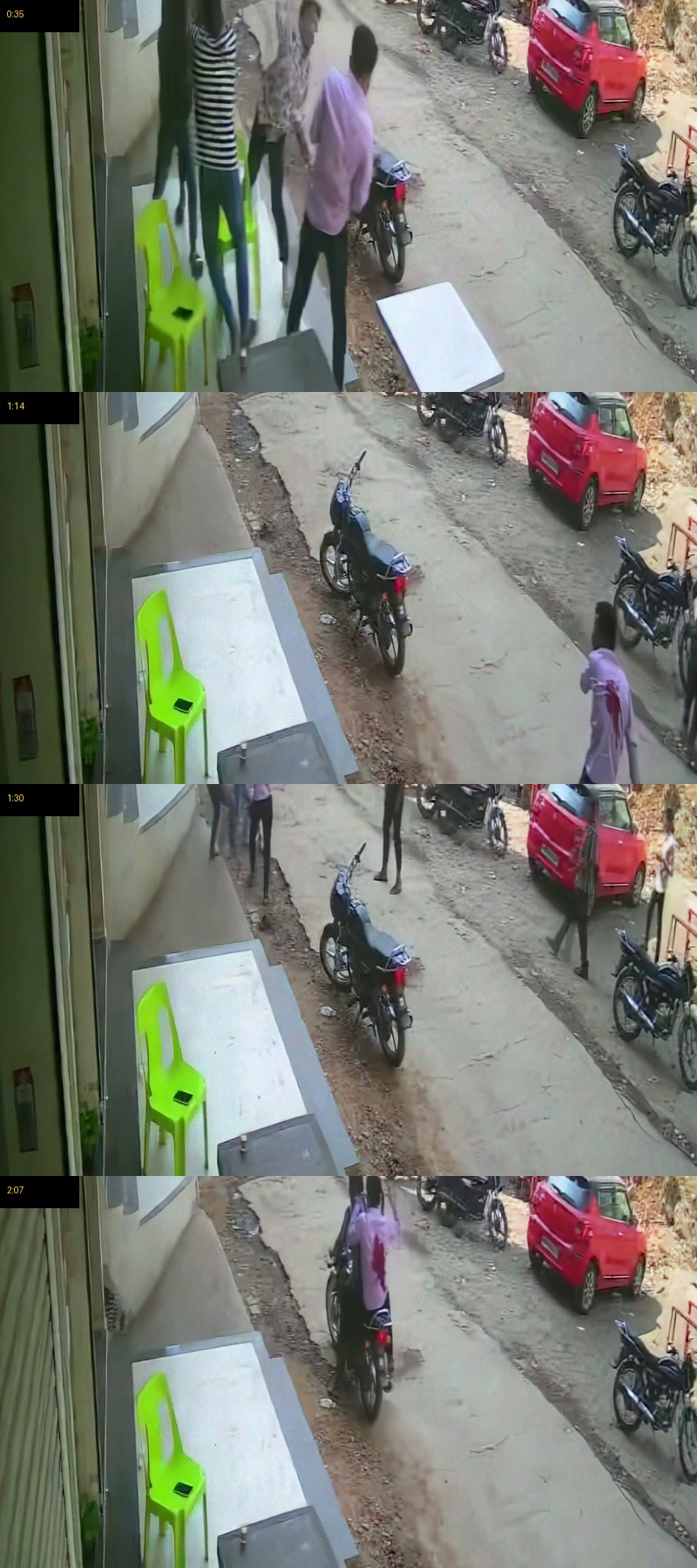
The CCTV shows the accused approaching the stall area, a brief verbal confrontation,
and then — within seconds — one of them producing a koyta. The attack is sudden and ferocious.
Multiple blows. A friend who tried to intervene was also hurt.
Police say the assault was so severe that the koyta became lodged in Nagesh’s
head during the attack. He suffered serious injuries to his head, back, and other
parts of his body and was rushed to hospital in critical condition. As of the latest updates,
he is alive and under treatment.
Police have arrested all three accused, booked under relevant sections of the
Bharatiya Nyaya Sanhita and the Arms Act. The investigation into the “old dispute” motive
is ongoing.
Wagholi, Pune — CCTV footage of koyta attack outside G H Raisoni College of Engineering and Management, 16 March 2026. Victim: Nagesh Jagtap. Three accused arrested. Published by Newspatron for public interest journalism.
Wagholi Is Not an Isolated Incident
If this was one freak incident, it would still be horrific. But it is not one freak incident.
The koyta has appeared again and again in Pune’s suburban crime blotter over the last two years —
especially around colleges.
- Kothrud, February 2026: A Class 12 student was attacked outside
Mamasaheb Mohol College with a koyta shortly after his exam. The motive: an old dispute over a
girl dating back to Class 10. All three suspects were minors. - Junnar, March 2026: A female student was attacked with a koyta after
rejecting a marriage proposal. A personal grievance that should have ended with distance,
not blood. - Pimpri–Chinchwad and BJS College corridor: Multiple reports over
2024–2025 of youth gangs moving with machetes and koytas — attacking rivals, vandalising
vehicles, staking territorial claims outside coaching hubs and campuses. - Earlier Wagholi and Hadapsar cases: School van drivers, shopkeepers,
and students targeted in similar daylight assaults over petty feuds and bruised egos.
Different victims. Different neighbourhoods. Different immediate triggers.
Same geography: Pune’s expanding suburbs.
Same setting: outside educational institutions.
Same weapon: the koyta.
This is not a random tool of choice. It is a signature.
The Weapon and What It Really Signals
In rural Maharashtra, a koyta has a legitimate role — agriculture, cutting brush,
working in fields. But a koyta near a college gate in Wagholi is not an agricultural implement.
It is an announcement.
You do not “happen to be” carrying a koyta on an urban tea break outside an engineering
college. You bring it to the scene. You conceal it until the moment you want to use it.
That decision tells us at least three things:
- Intent: This is not a spontaneous scuffle. You have come prepared
to seriously injure someone. - Comfort: You believe you can travel with that weapon, reach a college
road, and not get intercepted by anyone — not by local patrols, not by campus security. - Expectation of consequence: You expect, at worst, a short chase, some
local “settlement,” and maybe a few months of legal trouble. You do not expect your life
prospects to end the moment you swing that blade.
When a weapon is used near a college gate, it is not just an attack on one student.
It is a public test of what the system will tolerate in front of an entire generation.
If the response is weak — slow arrests, soft charges, easy bail — the message is simple:
bring your grudges to the gate. Nothing permanent will happen to you.
The Old Dispute Gap Where Intervention Should Live
One line appears again and again in all these cases: “The attack happened over an
old dispute.”
The koyta is the final scene. The “old dispute” is the opening scene. Between those two
scenes is a long gap — days, weeks, sometimes years. That time is where
intervention should live.
What could have filled that gap?
- A formal complaint in college, investigated properly, not “sorted” verbally.
- Parents being informed that their child is being threatened — or is threatening others.
- Local police calling both sides in for counselling and documented warning.
- Colleges maintaining an incident register for serious disputes and sharing
it with the local police station when escalation patterns appear.
In reality, most “old disputes” are treated as petty drama: “Students fight sometimes,
they’ll grow out of it.” So nothing goes on record. No one gets a formal warning. And then
one day, that old dispute shows up outside a college gate holding a koyta.
What the Law Already Provides
The law is not silent on this. An attack like the one in Wagholi crosses the threshold
from “simple assault” into attempt to murder.
Under the Bharatiya Nyaya Sanhita, the equivalent of Section 307 can be invoked when
the accused commits an act with intention or knowledge that it is likely to cause death.
The nature of the weapon, the body part targeted, and the severity of the blow all matter.
Here, the facts are stark: a sharp heavy weapon, repeated blows, direct strikes to the head,
and the weapon lodging in the skull. This is not a shove or a single impulsive hit.
Police have already registered offences under multiple BNS sections and the Arms Act
and arrested all three accused. The way forward should include:
- Strong charges: Attempt to murder, not diluted to lesser offences
in negotiation. - Opposition to bail at the earliest stages for the main adult accused.
- For the minor: Juvenile Justice proceedings, with full recognition of the seriousness
of the act — not counselling and release.
For the victim’s family — particularly where legal knowledge and awareness of rights
is present — the expectations should be clear: access to the FIR copy and all charge sheet
filings, the right to be heard at every bail hearing, and the right to demand that the full
history of the “old dispute” is investigated, including any previous threats that were
ignored or dismissed.
College Safety: Beyond a CCTV at the Gate
G H Raisoni College is not unique. Many engineering and degree colleges in Pune’s outer
ring — Wagholi, Hinjewadi, Tathawade, Pimpri, Junnar — share a similar layout: a main gate
opening directly onto a busy road, a cluster of stalls outside, students congregating at all
hours, and minimal controlled buffer between “campus” and “public road.”
A single CCTV camera at the gate, pointing outward, is not campus safety.
It is post-incident documentation.
Actual safety infrastructure looks like this:
- A defined safety perimeter extending to the road stretch where students
predictably gather — monitored and patrolled during peak times. - Formal coordination between colleges and local police stations: shared
incident logs, escalation protocols, and a named liaison officer. - On-site security trained to de-escalate and report, not just guard
the fee counter. - Zero-tolerance policies for weapons, stalking, and repeated harassment —
written, visible, and actually enforced.
Students live in the no-man’s land between the campus gate and the public road every day.
The moral perimeter of a campus cannot end at the gate arch when every parent in Pune knows
that the danger lives just beyond it.
Nagesh Was Having Tea. That Is the Whole Story.
Strip away the legal sections, the jargon, the crime briefs, the headlines —
and what are you left with? A student. Having tea.
That is the entirety of what he was doing when his morning turned into a fight
for his life.
Somewhere in the days before 16 March, an old dispute began. It simmered.
Perhaps words were exchanged. Perhaps threats were made. Perhaps adults — teachers,
parents, local police — got a hint of it. Perhaps they did not.
Somewhere between that first moment and this CCTV clip, there were multiple
opportunities for intervention. At the first fight. At the first threat. At the first
sign that one side was not letting it go. At the point where someone decided to pick up
a koyta and put it in a vehicle headed towards a college.
None of those opportunities were used.
So the responsibility for what happened outside that Wagholi tea stall does not end
with three names in a police press note. It extends to the systems — educational, familial,
legal, and civic — that allowed the koyta to reach the gate before any serious consequence
reached the people who chose to carry it.
The CCTV shows the last 70 seconds of that story.
The real work now is to make sure there is no next one.
Are you a student, parent, or educator in Pune? Do you think colleges are doing
enough on safety near their gates? Tell us in the comments.
